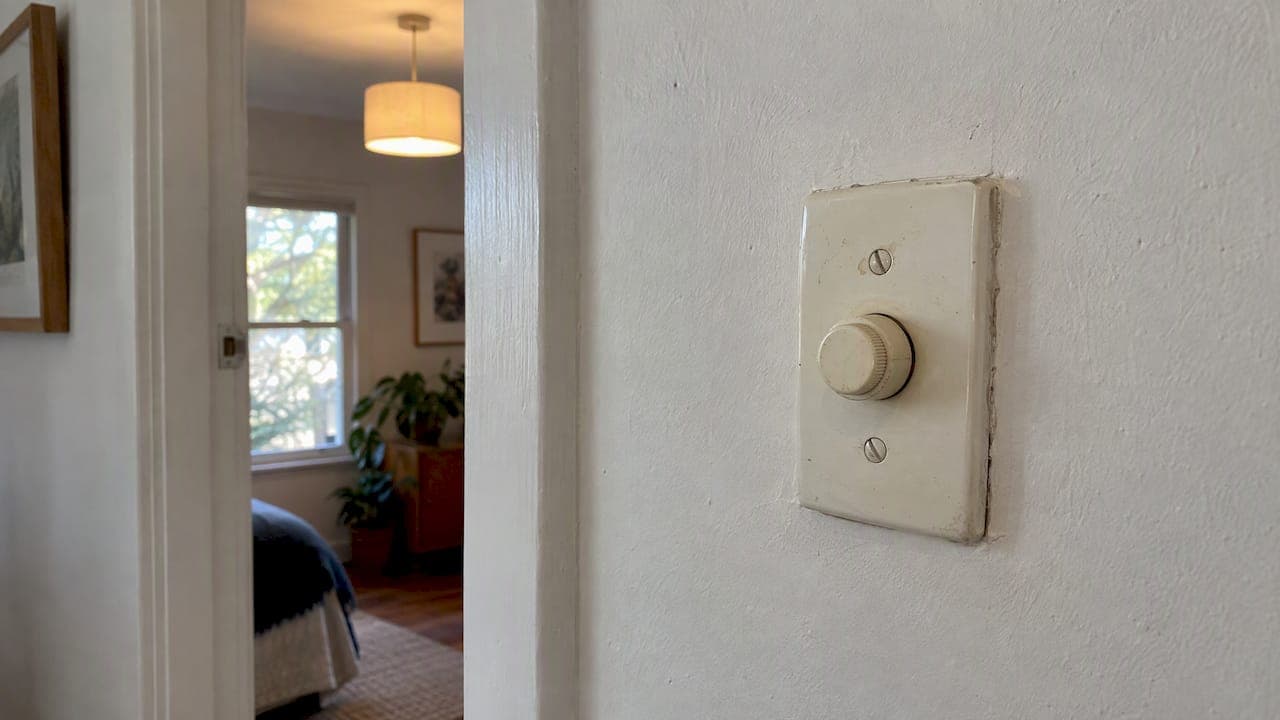
A light switch that buzzes is telling you something. Sometimes it is a harmless hum from a dimmer that doesn't suit your LED globes. Sometimes it is electrical arcing inside the switch, which is a fire risk. You can't tell which by ear alone, and in Victoria the fix is not a DIY job: replacing or repairing a switch is fixed electrical work that must be done by a licensed electrician.
This guide helps you sort the likely causes, spot the signs that mean "switch it off now", and decide what to do next, whether you own a home, run a business or manage an aged care, retirement or disability care site.
TL;DR
- A steady, faint hum from a dimmer is often a load mismatch, usually LED globes on an older dimmer. A crackle, pop or irregular buzz points to arcing at a loose or worn contact.
- Heat, a burning smell, a discoloured plate or a sound that changes or gets louder means: turn the circuit off at the switchboard and call a licensed electrician.
- Swapping globes or tightening screws can hide the problem without fixing it. A switch with arc damage inside stays a risk.
- In Victoria, replacing a switch is licensed work. Ask for a Certificate of Electrical Safety when it's done.
- For care facilities, one buzzing switch is a good reason to look at the wider electrical system, not just the one fitting.
Table of Contents
- Why a light switch buzzes
- Hum, buzz or crackle: what the sound tells you
- What to do right now
- Is it a dimmer problem? A quick sanity check
- Why bulb swaps and tightened screws aren't a fix
- Why it's a licensed job in Victoria
- Older wiring and why age matters
- For aged care, retirement village and disability care managers
- Our perspective: treat the buzz as a symptom
- Need a buzzing switch checked?
- Preventing it from coming back
- FAQ
- Sources
Why a light switch buzzes
Inside every switch, metal contacts close to complete the circuit. A buzz comes from one of three things.
1. Arcing at a poor connection. When a terminal screw is loose, or the contacts have worn, current can jump a tiny gap instead of flowing through solid metal. A switch that begins to buzz audibly often means current is arcing between the metal contacts, which also causes crackling. The same thing can happen when you flick a switch: an arc across the contacts can produce a crackle and sometimes a small blue flash. A brief spark at the moment of switching can be normal for some switches. A continuous buzz or crackle is not.
2. Dimmer and load mismatch. Older "leading-edge" (TRIAC) dimmers were designed for incandescent and halogen lamps. Most have a minimum load, often 40 to 60 W, that a single low-wattage LED doesn't meet. The dimmer can't hold a stable load, so it hums and the light may flicker.
3. Overload. A switch rated for a lower load than the fittings it controls will run hot and complain. This is more common after a renovation where extra downlights were added to an existing circuit.

Hum, buzz or crackle: what the sound tells you
Sound is a clue, not a diagnosis. Use this table to judge how urgent things are.
| What you notice | Likely cause | How urgent |
|---|---|---|
| Faint, steady hum only when dimmed, lights otherwise fine | LED on an older leading-edge dimmer | Book a check soon; not an emergency |
| Hum plus flickering at low settings | Load below the dimmer's minimum, or non-dimmable globes | Book a check soon |
| Crackling, popping or an intermittent buzz | Arcing at a loose terminal or worn contacts | Stop using the switch; call an electrician promptly |
| Buzz with a warm plate, burning smell or brown marks | Overheating, active arcing | Turn off at the switchboard now; call urgently |
| Buzz that is getting louder or changing | Deteriorating connection | Treat as urgent |
| Buzzing in several switches or circuits | Wider wiring, switchboard or supply issue | Full electrical inspection |
The dangerous habit is getting used to it. A sound you have lived with for months is still a sound the switch shouldn't make.
What to do right now
- Stop using the switch if it crackles, pops, feels warm or smells. Leave the light in whichever state is safest.
- Turn the circuit off at the switchboard if there's any heat, smell, discolouration or sparking. If you can't tell which breaker feeds it, switch off the main.
- Don't open the switch plate. Even with the switch off, a wiring fault can leave a live conductor behind the plate. Faulty or degraded household wiring can expose you to shock from switches and appliances, and a switch that has been wired to break the neutral instead of the active leaves the circuit live when "off".
- Note what you observe: which switch, when it buzzes (on, off, dimmed), whether the light flickers, whether the sound has changed. This speeds up the diagnosis.
- Call a licensed electrician. If the switch is hot or smells, say so when you call, so it's treated as urgent.
One point on a common question: yes, you can be shocked from a circuit with the switch off if there is a fault, such as damaged wiring or incorrect wiring. That's the reason an "off" switch isn't proof of safety, and why checking a switch is a job for a licensed professional with the right test equipment.
Is it a dimmer problem? A quick sanity check
You can make some safe observations without touching anything behind the plate.
- Does it only buzz on a dimmer, and only when dimmed? That points to a compatibility issue.
- Did the buzz start after you swapped to LED globes? Another sign of a load mismatch.
- Are all the globes in that circuit labelled dimmable? Many LEDs are not. A non-dimmable LED on a dimmer will often buzz or flicker.
- Does a standard on/off switch buzz? Dimmer theory doesn't apply. Suspect a connection or a fault.
If it is a mismatch, the usual remedy is a trailing-edge dimmer, sometimes labelled for CFL/LED use, paired with globes explicitly rated as dimmable. The dimmer and the globes need to suit each other, not just one of them. If you're choosing replacement globes, this guide to diagnosing LED flicker symptom by symptom can help you narrow down whether the bulb or the dimmer is the culprit before the electrician arrives.
A caution here: the dimmer is itself part of the fixed wiring. Choosing a compatible model is something you can discuss with your electrician, but fitting it is not a DIY task.
Why bulb swaps and tightened screws aren't a fix
It's tempting to swap the globe, and sometimes the buzz does go away. The trouble is what you can't see. If the original problem was an incompatible dimmer, a new globe might quieten it. But if the switch has already suffered arc damage to its contacts, it stays a hazard even when silent.
Tightening a terminal screw looks like the obvious cure for a loose connection. It is also work on live-capable wiring, and it won't repair a contact that has already pitted or burned. Electricians generally prefer to replace a suspect switch outright, because a new switch is cheap compared with a fire.
Why it's a licensed job in Victoria
This isn't just red tape. Energy Safe Victoria is blunt on the subject: doing your own electrical work may look easy, but you could kill or injure yourself or your family, or start a fire. Replacing a switch counts as fixed electrical work, so it needs a licensed electrician.
Two practical consequences:
- Insurance. Unlicensed electrical work can create problems if you ever need to claim after a fire or injury.
- Paperwork. Ask for a Certificate of Electrical Safety after the work, and keep it with your property records. It shows the work was done and tested to the required standard.
This applies to landlords and property managers too. If you manage a rental or a care site, don't ask a handyman or maintenance staff member to fix a buzzing switch.
Older wiring and why age matters
Wiring doesn't last forever. The insulation on household wiring degrades over time and can leave bare wires exposed. In older homes, buzzing switches are often an early sign of that ageing: brittle insulation, loose terminals that have worked free over decades of use, and switches that have simply worn out.
If your home or building is several decades old and has the original switches and switchboard, a buzzing switch is a good prompt to have the whole installation looked at. Our guides on why switchboard audits matter for Victorian properties and the benefits of regular electrical inspections explain what a check covers. If your safety switch trips as well, read why electrical safety switches trip, and for a general routine, see our electrical safety checklist for homeowners.
For aged care, retirement village and disability care managers
In a care environment, a buzzing switch is more than a nuisance. Residents may be less able to notice a smell, react to heat or move away quickly, and the consequences of an electrical fire are far higher. The right approach is to treat the switch as a trigger:
- Isolate and report. Make it clear to staff that a buzzing, hot or crackling switch is reported straight away, not logged for the next maintenance round.
- Don't rely on site staff for the repair. Use a qualified electrical contractor.
- Look wider. Ask the electrician to check the circuit, nearby switches and the switchboard. Lighting faults are often the first visible sign of a larger issue.
- Confirm protection. Check that residual current device (RCD) protection is in place and tested. Our article on why RCD testing is required in Victoria covers this.
- Keep a record. Keep the Certificate of Electrical Safety and any test results with your compliance documents.
For more depth, see our guides to the electrical safety audit for care facilities, electrical safety standards for disability care homes, retirement village electrical duties in Victoria and upgrading an ageing electrical system in a care facility.
Our perspective: treat the buzz as a symptom
We work across plumbing, electrical and heating and cooling for homes, businesses and care sites on the Mornington Peninsula, and a buzzing switch is one of the calls where the first question is never "which switch?" but "what else is going on?"
Here's how we look at it.
Don't normalise it. The most common mistake we see described across the trade is living with a sound. A switch that hums faintly on a dimmer may be a design quirk, but you only know that after someone has checked. Anything that changes, intensifies or comes with warmth deserves attention the same day.
Fix the cause, not just the sound. If a dimmer and LED globes don't match, we'd rather solve the match properly than leave you swapping globes until one is quiet. If the switch shows signs of arcing, we'd replace it rather than patch it.

In care settings, think system. For facility managers, one switch is rarely the whole story. We'd rather use the visit to check the circuit and its protection than come back in three months for the next fitting. Having one team that covers electrical, plumbing and heating and cooling means one point of contact and less coordination for you, and our emergency call-out is available around the clock if a switch becomes urgent.
Keep it licensed and documented. The work should be done by a licensed electrician, tested, and recorded.
— Mike
Need a buzzing switch checked?
If you're on the Mornington Peninsula or in the surrounding Melbourne suburbs, our electrical team can inspect and repair or replace a buzzing switch, check the circuit, and advise on compatible dimmers. We also offer scheduled maintenance and compliance checks for homes, businesses, aged care, retirement villages and disability care homes. If the switch is hot, smells or sparks, switch the circuit off first and use our emergency call-out. We don't publish set prices, so describe the problem and we'll talk you through the next step.
Preventing it from coming back
- Match dimmers to the load: check the minimum and maximum wattage on the dimmer and the dimmable rating on each globe.
- Don't add extra fittings to a circuit without checking its capacity and the switch rating.
- Replace worn, loose or discoloured switches early.
- Have wiring in older properties inspected periodically.
- For businesses and care sites, put switches and lighting circuits into a scheduled maintenance plan with a qualified contractor.
FAQ
Why does my light switch buzz when I turn it on?
The usual causes are a loose or worn contact that arcs as it closes, or a dimmer that doesn't suit the LED globes it controls. A brief click is often normal. A buzz that continues, crackles or gets louder isn't, and should be checked by a licensed electrician.
Can I still get shocked if the light switch is off?
Yes, if there is a fault. Damaged wiring, a short circuit or a switch wired on the neutral instead of the active conductor can leave parts live when the switch is off. Don't open the plate to find out; isolate the circuit at the switchboard and call a licensed electrician.
Why does my dimmer buzz and my lights flicker?
Most often it's a load mismatch. Older dimmers need a minimum load that low-wattage LEDs don't provide, and not all LEDs are dimmable. A trailing-edge, LED-rated dimmer with dimmable globes usually resolves it, fitted by a licensed electrician.
Is a buzzing switch a fire risk?
It can be. A steady faint hum from a dimmer is often harmless, but crackling, popping, heat or a burning smell suggest arcing, which can start a fire. Turn off the circuit and get it checked promptly.
Can I replace a light switch myself in Victoria?
No. Replacing a switch is fixed electrical work, so it must be done by a licensed electrician, and you should receive a Certificate of Electrical Safety afterwards.
Sources
- Electrical DDIY: Don't do it yourself, Energy Safe Victoria
- Test. Reset. Protect., Energy Safe Victoria
- Sparking Light Switch?, Mance Electrical
- How to Diagnose a Buzzing Dimmer Switch, The Spruce
- How to fix a dimmer switch buzzing, Checkatrade