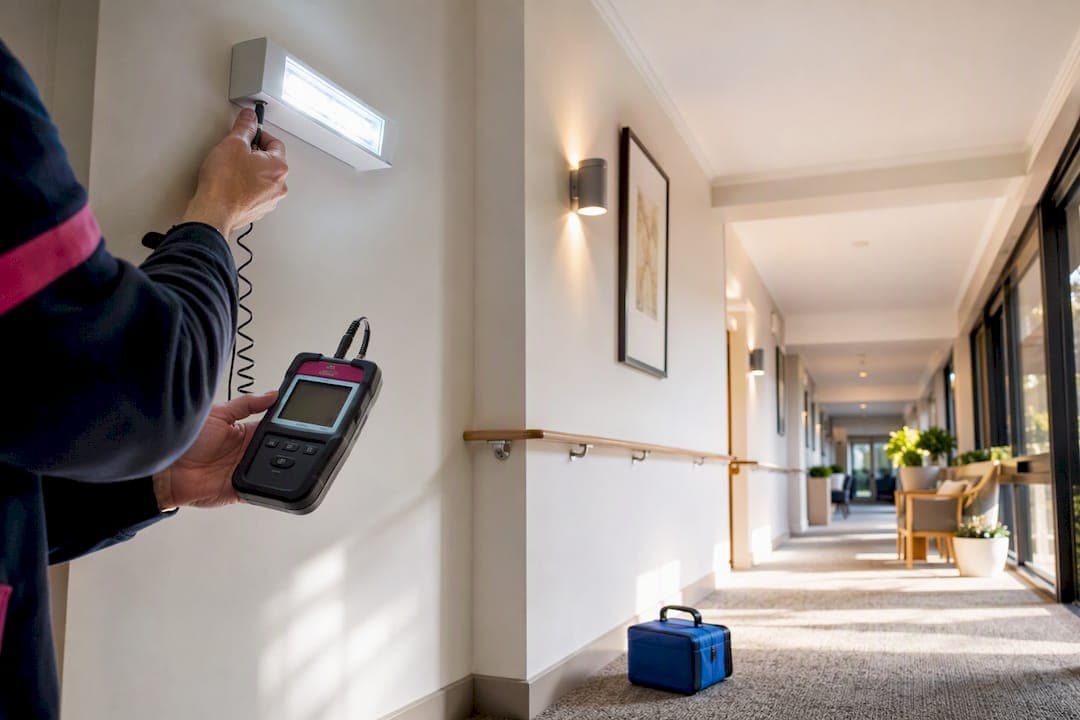
Operators must hold annual AS/NZS 3019 electrical safety checks, maintain emergency and evacuation plans, and keep audit-ready records under the 1 May 2026 reforms. If your village is not already on an annual inspection schedule, contact Consumer Affairs Victoria and Energy Safe Victoria for guidance, then book a licensed electrician to carry out the check. A local compliance visit can be arranged and documentation provided as required by operators.
TL;DR:
- Annual electrical safety checks require licensed electricians to inspect switchboards, RCDs, wiring, and appliances, with specific testing and documentation outlined by Energy Safe Victoria.
- From May 2026, operators must also re-register villages, develop emergency plans, run evacuation exercises, and maintain capital funds for major electrical assets, with strict recordkeeping required.
- Most non-compliance issues involve outdated RCDs, RCBO restrictions, or unverified battery and solar additions; upgrades should be scheduled proactively following safety checks.
- Regular audits demand comprehensive documentation, including signed reports, defect logs, and inspection records, stored in accessible digital folders for quick review.
- Combining electrical inspections with emergency planning enhances safety, ensuring emergency systems function correctly and defects are addressed before emergencies occur.
Table of Contents
- At-a-glance compliance checklist for retirement village electrical duties
- Legal and regulatory obligations after the 1 May 2026 retirement village reforms
- What an electrical safety check must cover under AS/NZS 3019
- Technical rules that commonly fail in retirement villages: RCDs, RCBOs, solar and batteries
- Scheduling, recordkeeping and audit-ready documentation
- How inspections feed into emergency and evacuation planning
- Capital maintenance planning and funding for electrical works
- Practical preparation for an audit or compliance review
- Practical implementation: what a compliant electrical service visit looks like
- Why proactive compliance protects residents and reduces disputes
- How Dualflow Services can help with your village's electrical compliance
- Sources
- FAQ
At-a-glance compliance checklist for retirement village electrical duties
Before working through the detail, use this as a triage list to assign tasks and confirm nothing is overdue.
- Annual AS/NZS 3019 safety check, covering switchboards, RCDs, wiring and fixed appliances, carried out by a licensed electrician.
- RCD testing, using the test button and timed trip testing, recorded against each device on the switchboard.
- Smoke alarm testing, checked against the manufacturer's schedule and village fire safety plan.
- Emergency lighting checks, confirming duration and illumination levels along evacuation routes.
- Documented evacuation exercise, run at least annually and linked to the emergency plan.
Responsibility sits with different people depending on the task:
- A Registered Electrical Contractor or Licensed Electrical Inspector carries out the AS/NZS 3019 safety check and signs the report.
- A licensed electrician completes RCD testing and switchboard work, including any rectifications identified.
- The facility or compliance manager coordinates the evacuation exercise and liaises with the local fire authority where needed.
- The operator holds overall responsibility for scheduling, funding and recordkeeping across all of the above.
Keep five categories of documents on file at all times: the signed safety check form, the certificate of periodic assessment, a rectification log showing defects and their close-out dates, evacuation exercise records, and the relevant entries in the capital maintenance plan. Auditors and residents' committees will ask for these in that order, so store them where they can be produced within minutes rather than days. A maintenance checklist for retirement village facilities is a useful companion for tracking non-electrical items alongside these.
Legal and regulatory obligations after the 1 May 2026 retirement village reforms
The Retirement Villages Amendment Bill passed the Victorian Parliament and gave Consumer Affairs Victoria expanded powers over how villages are registered, reported on and inspected. From 1 May 2026, operators face a distinct set of duties that go beyond simply keeping the wiring safe.
Consumer Affairs Victoria's reforms page sets out the core requirements operators must now meet:
- Re-notify and register village details through myCAV, Consumer Affairs Victoria's online portal.
- Prepare and maintain a written emergency and evacuation plan specific to the village.
- Carry out annual safety inspections covering the building's key systems, including electrical.
- Run annual evacuation exercises and keep records showing who took part and what was learned.
- Establish and maintain a capital maintenance plan and fund for major assets, including electrical infrastructure.
- Submit annual reporting to Consumer Affairs Victoria confirming these obligations have been met.
A mandatory Code of Practice is also being developed under the amended Act, which will likely tighten reporting expectations further once finalised. Operators who treat the current requirements as a floor rather than a ceiling will be better placed when that code lands.
The practical dividing line between operator and resident responsibility usually follows the capital versus lifestyle distinction. Wiring, switchboards, common-area lighting, emergency systems and shared solar or battery infrastructure are capital items and sit squarely with the operator. Personal appliances, fixtures a resident has installed inside their own unit, and any modifications made without the operator's sign-off are typically the resident's concern, though village rules and lease terms can vary this. Where there is ambiguity, document the position in writing before a dispute arises rather than after.
Consumer Affairs Victoria's role is both educational and enforcement-focused. The regulator can request evidence of annual inspections, emergency plans and capital maintenance funding, and operators who cannot produce it face the same scrutiny as those who have ignored the requirements altogether. When a review does happen, the strongest position is a simple one: a folder (digital or physical) containing the current safety check report, the emergency plan, the most recent evacuation exercise record and the capital maintenance plan, all dated and cross-referenced. An operator's checklist published by Consumer Affairs Victoria lays out these immediate steps in sequence, and is worth working through line by line rather than treating as background reading. For a broader view of why these rules exist, why Victoria's electrical safety regulations matter covers the reasoning behind the inspection and RCD requirements more generally.
What an electrical safety check must cover under AS/NZS 3019
An AS/NZS 3019 safety check is not a quick look at the switchboard. Energy Safe Victoria's electrical safety check template sets out both visual inspection items and testing items, and a compliant report needs to record findings against each.
| Item category | Visual inspection | Testing required |
|---|---|---|
| Switchboards | Condition, labelling, enclosure integrity | RCD trip time and test button function |
| Socket outlets | Damage, correct polarity markings | Polarity and earth continuity where accessible |
| Wiring | Visible insulation condition, connections | Insulation resistance where accessible |
| Solar and battery systems | Isolator condition, signage, cabling | RCD compatibility and inverter protection settings |
| Water heaters | Element and thermostat housing condition | Earth continuity and RCD protection |
| Pool equipment | Pump and filtration wiring condition | Equipotential bonding and RCD protection |
| Vehicle chargers | Cable and connector condition | RCD type verification per AS/NZS 4777.1 |
| Lighting | Fitting condition, emergency lighting signage | Emergency lighting duration test |
The completed check produces a Certificate of Periodic Assessment, sometimes referred to by operators as a Form 1. It needs to record the electrician's licence number, the date of inspection, a description of any defects found, and the date the next inspection is due. Energy Safe Victoria's FAQ on electrical safety inspections and testing clarifies that inspections are generally visual with limited testing rather than exhaustive dismantling of every circuit, so scope limitations are expected and should be recorded rather than hidden.
If an electrician cannot access a switchboard behind furniture, or a resident declines entry to a unit on the scheduled date, that limitation goes on the safety check form as a noted exclusion with a plan to revisit it. A safety check that silently skips inaccessible areas is a weaker document than one that names the gap and schedules its resolution. For a plain-language primer on how these checks work in practice, see what an electrical safety inspection in Victoria involves.
Technical rules that commonly fail in retirement villages: RCDs, RCBOs, solar and batteries
Most non-compliance findings in retirement villages come down to a handful of recurring issues, and they are almost always fixable once identified.
- Type AC RCDs are no longer appropriate for new installations or replacements where the switchboard interacts with inverter or battery systems, according to Energy Safe Victoria guidance. Type A, B or F devices are the preferred replacement, chosen according to the load type they protect.
- Older Type AC devices already in service in circuits with no inverter or battery interaction can often remain until they need replacing, but every safety check should confirm they are still appropriate for what they now protect, since additions to the switchboard change that calculation.
- Compact RCBOs remain restricted, with the prohibition on non-compliant units extended to 30 June 2030 under ESV guidance. Any switchboard upgrade should confirm the specific RCBO model is on the compliant list before it goes in.
- Battery energy storage systems change the risk profile of an existing switchboard. Energy Safe Victoria's neighbourhood battery safety guideline points to AS/NZS 5139, AS/NZS 4777.1 and AS/NZS 3000 as the standards governing earthing, protection and installation, and recommends verification by qualified personnel whenever a battery system is added to an existing board.
Pro Tip: Whenever a village adds solar, a battery or an EV charger, treat it as a trigger for an unscheduled RCD verification rather than waiting for the next annual check.
Legacy switchboards are the most common source of hidden risk; careful planning around EV charging for care homes can help future-proof infrastructure and manage upgrades effectively. A board installed a decade ago may have been fully compliant at the time, but the addition of a battery system or an EV charger without a matching review of RCD types is exactly the gap regulators look for. For more detail on how testing itself works, why electrical RCD testing is required in Victoria walks through test methods and recording practice.
Scheduling, recordkeeping and audit-ready documentation
A compliance program that relies on memory rather than a schedule will eventually miss something. The fix is a simple annual cycle with clear ownership.
- Lock in the annual AS/NZS 3019 safety check date at the start of the compliance year and set a reminder 60 days ahead to confirm the booking.
- Align the evacuation exercise with the safety check, running it within a few weeks of the inspection so findings can feed directly into the emergency plan update.
- Store every report in a single digital folder structured by year and system type, with file names that include the date and the contractor's licence number.
- Log corrective actions separately from the original report, noting the defect, the date raised, the contractor assigned and the date of completion with photographic evidence.
- Review the full folder quarterly, not just before an audit, so gaps are caught while there is still time to fix them.
Retention practice matters as much as collection. Keep at least the current year and the prior two years of safety check reports, rectification logs and evacuation records readily accessible, with older records archived rather than deleted. Every safety report, at minimum, needs to show the inspecting electrician's licence number, the inspection date, the next inspection due date, a list of items checked, and any defects with their rectification status. A folder missing any of these fields is not audit-ready, no matter how complete it looks.
How inspections feed into emergency and evacuation planning
Electrical findings and emergency planning are not separate exercises under the 2026 reforms, they are meant to inform each other directly.
- Switchboards and emergency lighting circuits need to be confirmed working before an evacuation exercise, since a failed emergency light along an evacuation route undermines the whole plan.
- Smoke alarm test results should be cross-checked against the emergency plan's assumptions about detection and response times.
- Solar and battery systems that feed backup power to common areas need to be verified as functional before they are relied on in an emergency scenario.
- Any defect found during a safety check that affects an evacuation route, alarm circuit or emergency lighting should trigger an update to the written emergency plan, not just a rectification ticket.
Documenting an evacuation exercise properly means recording the date, who participated, how long it took, any issues encountered, and how those issues were addressed. Where an inspection has flagged an electrical defect relevant to the exercise, note that link explicitly in the exercise record so a reviewer can see the two processes were coordinated rather than run in isolation. Stakeholders worth involving include the compliance officer, the contracted electrician, a resident representative and, where the village has arrangements with local emergency services, a liaison from that side. Regulators reviewing evacuation records after the fact expect to see evidence of participation, not just a statement that an exercise occurred. Emergency lighting cadence is covered in more detail in emergency lighting testing requirements, and smoke alarm obligations in annual smoke alarm tests mandatory in Victoria.
Capital maintenance planning and funding for electrical works
Consumer Affairs Victoria's guidance on the capital maintenance plan and fund puts the funding responsibility for major electrical assets, switchboards, common-area wiring, shared solar systems, squarely on the operator rather than individual residents. Getting this distinction right at the planning stage avoids disputes later.
- Capital items include the main switchboard, common-area circuits, emergency lighting infrastructure and any shared solar or battery system.
- Resident-owned fixtures, such as appliances or modifications a resident has installed within their own unit, generally sit outside the capital fund.
- Sequencing upgrades works best when tied to the annual safety check findings, so a switchboard flagged for RCBO non-compliance moves into next year's capital plan rather than being deferred indefinitely.
Pro Tip: Stage switchboard upgrades so essential circuits stay protected throughout the works, and notify residents ahead of any planned outage rather than after.
When procuring the work, three things are worth insisting on: staged delivery so the whole village is never without power at once, written confirmation that replacement components (particularly RCDs and RCBOs) meet current compliance requirements, and a clear scope document listing what the contractor will and will not touch. Build in milestones tied to compliance dates, such as completing switchboard remediation ahead of the next scheduled safety check, so the capital plan and the inspection cycle reinforce each other. Practical staging advice is covered in upgrading ageing electrical infrastructure in care facilities.

Practical preparation for an audit or compliance review
With 30 to 90 days' notice of a review, or simply as a standing discipline, work through this in order.
- Days 1 to 30: commission or confirm the annual AS/NZS 3019 safety check, and pull together every certificate and rectification record from the past year.
- Days 30 to 60: confirm all flagged defects have been closed out, with photographic evidence and sign-off dates attached to each.
- Days 60 to 90: update the written emergency and evacuation plan to reflect any changes, and schedule or run the annual evacuation exercise if it is not already recent.
Triage any outstanding defects by safety risk rather than working through them in the order they were found. A failed RCD on a shared laundry circuit is a higher priority than a cosmetic switchboard labelling issue, and a temporary control, isolating a faulty circuit rather than leaving it live, should be applied immediately while the permanent fix is scheduled. When writing to contractors, be specific about the standard you expect the work to meet and the documentation you need back. When writing to residents about upcoming works, keep the message short: what will happen, when, and how long any disruption will last.
Practical implementation: what a compliant electrical service visit looks like
A typical compliance visit for a retirement village should follow a defined scope rather than an ad hoc walk-through. A typical compliance visit generally includes an AS/NZS 3019 safety check across switchboards and common-area circuits, RCD testing against each protective device, a switchboard audit checking for prohibited or non-compliant components, and a check of smoke alarms and emergency lighting against the village's testing schedule. The visit ends with a written report that states the next inspection due date, so the operator's calendar updates itself.
Whichever contractor a village uses, managers should insist on the same deliverables every time: a signed report carrying the electrician's licence number, photographs of any defects found, recorded test results for every RCD checked, and a rectification log showing what remains outstanding and by when it will be closed. A report missing any of these leaves gaps that surface at the worst possible time, during a regulator review or after an incident. For background on why switchboard audits specifically matter, see why electrical switchboard audits matter.
Why proactive compliance protects residents and reduces disputes
Treating the annual safety check as a paperwork obligation misses the point. A well-run inspection cycle is a governance tool: it gives an operator a defensible record when a resident questions the state of the wiring, and it catches small defects, a tired RCD, a switchboard nearing capacity, before they become an incident. The villages that handle audits calmly are almost never the ones with the newest wiring. They are the ones with the most complete paper trail.
I'd encourage any manager reading this to stop viewing the emergency plan and the safety check as two separate compliance boxes. Run them together, document them together, and the annual cycle starts working for you rather than against you.
— Mike
How Dualflow Services can help with your village's electrical compliance
Getting the annual AS/NZS 3019 check, switchboard audit, RCD testing and emergency lighting servicing done by one contractor means less coordination for facility managers already juggling plumbing, heating and resident concerns. Scheduled electrical safety checks, switchboard upgrades, emergency lighting and smoke alarm servicing, capital works coordination and 24/7 emergency call-outs are provided, allowing a retirement village's electrical, plumbing and heating compliance to run through a single point of contact rather than three separate trades relationships.
If your village needs an AS/NZS 3019 safety check booked, or you would like to see a sample compliance report before committing, get in touch through the Dualflow Services website to arrange a site visit or set up an annual maintenance plan.
Sources
- Retirement village reforms - Consumer Affairs Victoria
- Electrical Safety Check – Report (ESV‑RTR–ESC 01.1) — Energy Safe Victoria
- Residual current device (RCD) requirements for alternative supplies — Energy Safe Victoria
FAQ
What are the changes to retirement village regulations in Victoria in 2026?
From 1 May 2026, operators must re-notify through myCAV, maintain a written emergency and evacuation plan, run annual safety inspections and evacuation exercises, and establish a capital maintenance plan and fund. A mandatory Code of Practice is also being developed under the Amendment Bill.
What are the changes to the Retirement Villages Act in Victoria?
The Retirement Villages Amendment Bill gives Consumer Affairs Victoria expanded oversight powers, including new registration and annual reporting obligations for operators. It also sets the foundation for a mandatory code of practice covering maintenance and emergency planning.
Who can carry out an AS/NZS 3019 electrical safety check?
A Registered Electrical Contractor or Licensed Electrical Inspector must carry out the check and sign the resulting certificate. The report needs to record the electrician's licence number, the inspection date and the next inspection due date, in line with Energy Safe Victoria's template.
What are the hidden costs associated with retirement villages?
Beyond ingoing and ongoing fees, villages can carry capital maintenance costs for shared assets like switchboards, common-area wiring and solar systems, which Consumer Affairs Victoria's capital maintenance guidance requires operators to plan and fund. Prospective residents should ask specifically how electrical upgrades are budgeted within that fund before signing.
How is a retirement village treated by Centrelink?
Centrelink's treatment of a retirement village depends on the specific contract type and entry payment structure, which varies between villages and is assessed on an individual basis. This falls outside electrical compliance and is best confirmed directly with Services Australia or a financial adviser familiar with the resident's contract.