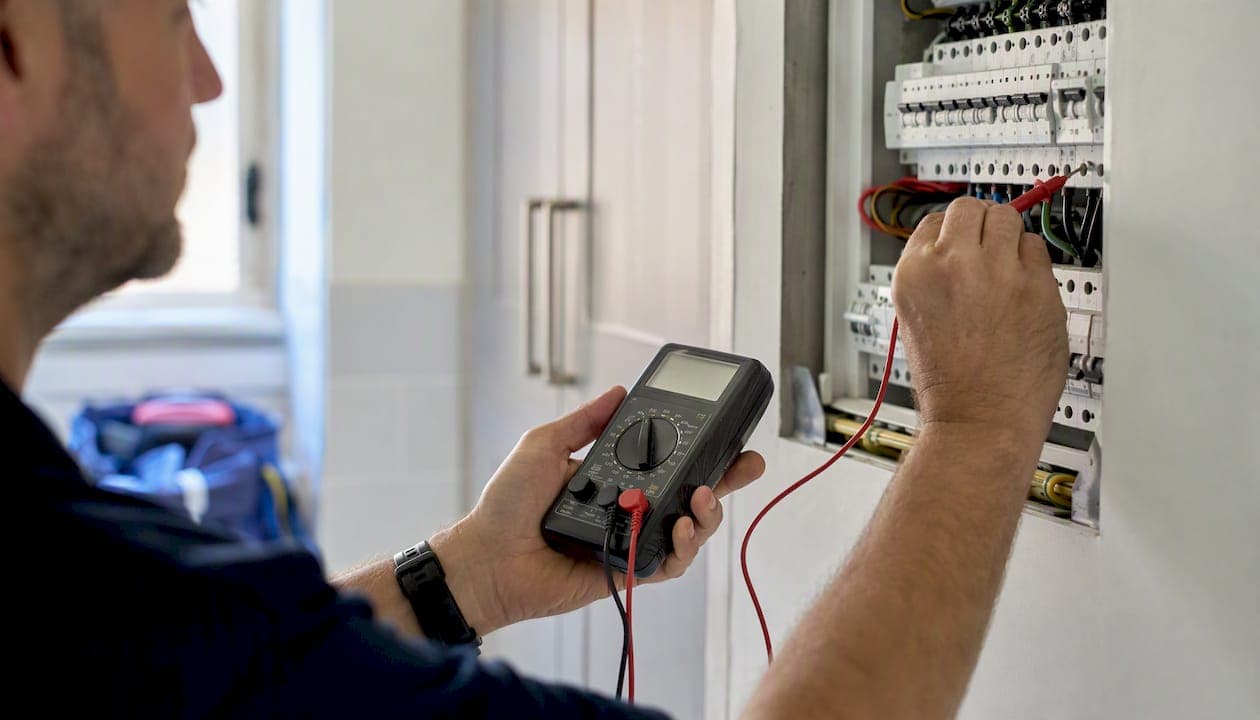
Victoria's electrical safety regulations exist to prevent electrocution, electrical fires, and property damage by setting enforceable standards for how electrical work is done, inspected, and certified. Without them, there would be no consistent way to verify that wiring in a rental property, a café kitchen, or an aged care facility is actually safe. The rules give regulators real teeth, and they give property owners, landlords, and employers a clear framework to follow.
Three things the regulations do in practice:
- Reduce risk by mandating safety standards through the Electricity Safety (General) Regulations 2019 and the AS/NZS 3000 Wiring Rules, so electrical installations meet a minimum safe standard.
- Make compliance verifiable through inspections, testing, and certificates of electrical safety that create an auditable record of work done.
- Enable enforcement by giving Energy Safe Victoria (ESV) statutory powers to investigate incidents, issue directions, and prosecute non-compliance under the Electricity Safety Act 1998.
The named entities that govern all of this: Energy Safe Victoria (ESV), the Electricity Safety Act 1998, the Electricity Safety (General) Regulations 2019, WorkSafe Victoria, and AS/NZS 3000 (Wiring Rules).
Key takeaways
Victoria's electrical safety regulations protect lives and property by setting enforceable standards for installation, inspection, and certification, with ESV and WorkSafe holding real powers to investigate and prosecute non-compliance.
| Point | Details |
|---|---|
| Regulations have legal force | The Electricity Safety Act 1998 and 2019 Regulations create enforceable duties, not just guidelines. |
| Landlords must act | Rental minimum standards require safe electrical systems; inspections at tenancy changes are the practical way to verify this. |
| Employers face ongoing duties | WorkSafe expects continuous risk control, not a single certificate, so scheduled checks are part of the obligation. |
| Certificates require real tests | A Certificate of Electrical Safety or Inspection must be backed by test logs; ESV can request those records during an investigation. |
| Dualflowservices covers the Peninsula | Inspections, RCD testing, switchboard audits, and emergency repairs are available across the Mornington Peninsula and surrounding Melbourne suburbs. |
Table of Contents
- Why do Victoria's electrical safety regulations exist?
- Who has duties under Victoria's electrical safety rules?
- What happens when electrical safety rules are ignored?
- What does an electrical safety inspection cover in Victoria?
- When are inspections required, and who enforces them?
- Practical steps to meet Victoria's electrical safety rules
- What do inspections and repairs typically cost in Victoria?
- What to do if you find an electrical hazard
- How Dualflowservices approaches electrical safety in Victoria
- Dualflowservices electrical safety services for the Mornington Peninsula
- Sources
Why do Victoria's electrical safety regulations exist?
The statutory foundation is the Electricity Safety Act 1998, which establishes ESV's objectives and functions: determining minimum safety standards, monitoring and enforcing compliance, and investigating electrical incidents. Sitting beneath it, the Electricity Safety (General) Regulations 2019 translate those objectives into specific, measurable obligations covering wiring methods, testing requirements, and inspection and certificate rules.
The Regulatory Impact Statement for the 2019 Regulations concluded that mandating safety standards, including adopting the Wiring Rules, improves safety outcomes and is justified because even small improvements can prevent serious harm. That is not a throwaway policy line. Electricity is inherently hazardous, and the consequences of a single wiring fault can be catastrophic.
Energy Safe Victoria is the independent technical regulator. Its functions under the Act include setting standards, conducting inspections, approving electrical workers and inspectors, and investigating incidents. ESV is not simply an advisory body. It can issue enforcement notices, direct remedial work, and refer matters for prosecution.
WorkSafe Victoria holds a parallel role for workplaces. Where ESV governs the installation and network side, WorkSafe's electrical safety guidance requires employers to assess and control electrical hazards so far as is reasonably practicable. The two regulators cover different but overlapping ground, and a business owner may be accountable to both.
AS/NZS 3000 (the Wiring Rules) is the technical standard referenced by the regulations. When a licensed electrician installs or modifies wiring in Victoria, compliance with AS/NZS 3000 is not optional. It is the benchmark against which work is assessed and certified.
Statistic callout: ESV's 2023 safety performance report on Victorian electricity networks documents network incident causes, bushfire mitigation measures, and the regulator's monitoring role, illustrating how electrical safety regulation directly protects property and communities across Victoria.
Who has duties under Victoria's electrical safety rules?
Responsibility is not uniform. Where you sit in the chain — owner, landlord, employer, or licensed worker — determines what you must do.
Landlords and property owners
Victorian rental minimum standards require landlords to maintain safe electrical systems. Inspections and maintenance are not optional for rental properties.
- Maintain all electrical installations in a safe and working condition throughout the tenancy.
- Arrange inspections when required, particularly at tenancy changes or following a reported fault.
- Keep records of inspections and certificates of electrical safety.
- Treat regular electrical inspections as part of routine property management, not a one-off task.
Employers and businesses
WorkSafe Victoria frames employer duties as risk-based rather than certificate-based. A single inspection does not discharge the obligation if equipment changes or the workplace layout shifts.
- Conduct a risk assessment covering all electrical equipment and installations.
- Eliminate or reduce electrical hazards so far as is reasonably practicable.
- Maintain safe systems of work, including regular checks and test-and-tag programmes for portable appliances.
- Provide appropriate training and, where required, install residual current devices (RCDs).
Licensed electrical workers and responsible entities
- Hold a current licence issued or recognised in Victoria before performing prescribed electrical work.
- Test work to AS/NZS 3000 standards before energising.
- Issue a Certificate of Electrical Safety for prescribed work and retain a copy.
- Notify ESV of completion of certain prescribed work within required timeframes.
Shared responsibilities arise when a building owner is not the occupier, or when a tenancy changes mid-lease. In those situations, both parties may hold concurrent duties, and the safest approach is a clear written agreement about who arranges inspections and who retains the certificates.
What happens when electrical safety rules are ignored?
The physical consequences come first. Faulty wiring, overloaded circuits, and unprotected installations cause electric shock, arcing faults, and electrical fires. These are not theoretical risks. Electrical faults are a documented cause of residential and commercial fires in Victoria, and the harm can extend from property loss to serious injury or death.
Enforcement outcomes under ESV's powers include:
- Formal directions to carry out remedial work.
- Infringement notices and fines.
- Prohibition on using unsafe installations.
- Prosecution for serious or repeated breaches of the Electricity Safety Act 1998.
ESV's safety performance reporting shows that network incidents and bushfire mitigation are a material part of the regulator's ongoing work. For property owners near bushfire-prone areas on the Mornington Peninsula and outer Melbourne, this is not abstract. Electrical network faults are a recognised ignition source, and ESV actively monitors and enforces bushfire mitigation obligations on network operators.
Insurance and civil liability are the downstream risks that catch people off guard. An insurer can refuse or reduce a claim if non-compliant electrical work contributed to a fire or damage event. A landlord whose tenant suffers injury from a known electrical fault faces civil liability exposure that a current certificate of inspection would have helped address. Reputational harm for a business found to have ignored workplace electrical duties is harder to quantify but no less real.
What does an electrical safety inspection cover in Victoria?
A thorough inspection is not a visual walk-through. Licensed electrical workers and inspectors perform specific tests and checks, and the scope varies depending on whether the work is a new installation, a periodic check, or a post-incident assessment.
Typical checks in a standard residential or commercial inspection:
- RCD testing: verifying that residual current devices trip within safe limits. See why RCD testing is required in Victoria for the technical detail.
- Switchboard and earthing inspection: checking for overloaded circuits, deteriorated components, and adequate earthing. A switchboard audit often reveals ageing fuse wire, undersized breakers, or missing RCDs.
- Fixed wiring tests: insulation resistance and continuity testing of fixed wiring circuits.
- Socket and outlet condition: checking for damage, loose connections, and correct polarity.
- Test-and-tag: required for portable appliances in workplaces, construction sites, and certain care settings. See why test-and-tag is required in Victoria.
- Visible wiring condition: identifying exposed, damaged, or non-compliant wiring runs.
Who can inspect and certify?
| Role | What they can do | Certificate issued |
|---|---|---|
| Licensed electrical worker (installer) | Perform and test prescribed electrical work | Certificate of Electrical Safety |
| Licensed electrical inspector | Independently inspect work done by others; must be physically present | Certificate of Inspection |
| Specialist (high-voltage, solar/battery) | Specific scopes requiring additional endorsements | Scope-specific certificates |
ESV guidance is explicit: a licensed electrical inspector must be physically present for certain inspections and must carry out specified tests before signing a certificate of inspection. A signed form without the underlying tests is not compliance. It is paper compliance, and ESV has the power to investigate and request the test records behind any certificate.
Common exclusions from a standard inspection include battery storage systems, high-voltage switchgear, and embedded network infrastructure. These require additional endorsements or specialist contractors.
When are inspections required, and who enforces them?
Inspections are not always discretionary. Several trigger points make them mandatory or strongly advisable.
- After prescribed electrical work: a Certificate of Electrical Safety must be issued, and certain work requires notification to ESV within a set timeframe under the Electricity Safety (General) Regulations 2019.
- At tenancy start or change: landlords must meet rental minimum standards before a new tenancy begins. An inspection at tenancy turnover is the practical way to verify compliance.
- Following an electrical incident: ESV or WorkSafe may direct an inspection as part of an incident investigation. Having existing records speeds this process considerably.
- As part of workplace risk management: WorkSafe expects employers to maintain ongoing risk controls, not just respond to incidents. Scheduled inspections are part of that system.
- For aged care and disability care facilities: these settings carry heightened duty of care obligations, and electrical safety standards for disability care homes reflect that.
Who enforces what: ESV handles electrical installations, networks, and licensed worker compliance. WorkSafe handles workplace electrical duties under occupational health and safety law. Local councils have a limited role in certain building and planning contexts. For most residents, landlords, and businesses, ESV and WorkSafe are the relevant authorities.
Practical steps to meet Victoria's electrical safety rules
Compliance is not complicated, but it does require deliberate action rather than good intentions.
- Identify your scope. Are you a landlord, an employer, or a homeowner? Your duties differ, and so does the inspection type you need.
- Book a licensed electrical worker. Check their licence on the ESV register before engaging them. A licence number is not optional information.
- Request the right tests. For a rental property, ask for RCD testing, switchboard condition, and fixed wiring checks. For a workplace, add test-and-tag for portable appliances.
- Obtain and retain certificates. A Certificate of Electrical Safety or Certificate of Inspection is your evidence of compliance. File it with the property or asset records.
- Schedule recurring checks. Electrical safety is not a one-time event. Set a calendar reminder for the next inspection before the current one is complete.
- Act on findings promptly. A report that identifies a fault and sits in a drawer is not compliance. Remedial work should be completed and re-certified.
Questions to ask your electrician or inspector
Before engaging anyone, ask: Is your licence current and endorsed for this work type? What specific tests will you perform, and will you provide the test logs? What certificate will you issue, and when? Are you covered by professional indemnity insurance?
Pro Tip: Ask for the actual test logs, not just the signed certificate. ESV's inspection regime review found that independent audits and detailed records are the markers of genuine compliance. If a contractor cannot produce test logs, the certificate is worth very little in an investigation.
Record-keeping for landlords and businesses
Keep certificates, test logs, and maintenance records for the life of the installation, or at minimum for the duration of your ownership or tenancy. ESV can investigate incidents and request records, and accessible maintenance history speeds that process. A folder per property, updated after each inspection, is the minimum viable system.
For landlords and small businesses on the Mornington Peninsula and across greater Melbourne, scheduling inspections in autumn or spring avoids the summer peak demand on licensed electricians and gives time to complete remedial work before the next tenancy or audit cycle.
What do inspections and repairs typically cost in Victoria?
Setting realistic expectations matters. Costs vary based on property size, switchboard condition, access, and whether specialist work (solar, battery storage) is involved.
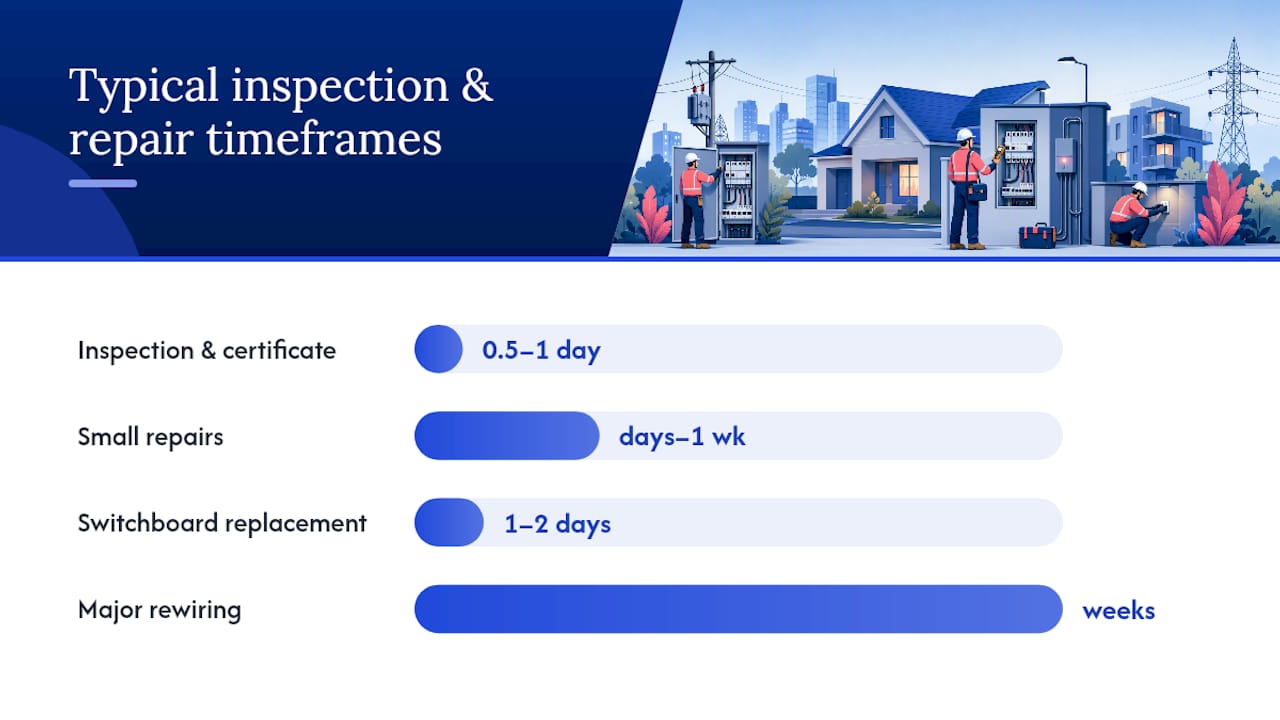
Typical timeframes:
- Standard residential inspection and certificate: half a day to a full day on site.
- Small repairs (replacing an RCD, fixing a faulty outlet): days to a week, depending on parts availability.
- Switchboard replacement or upgrade: typically one to two days of work, with lead time for parts.
- Major rewiring: weeks, depending on scope and access.
Cost factors to consider:
- Age and condition of the switchboard (older fuse-wire boards cost more to audit and often need upgrading).
- Presence of solar or battery systems (requires additional endorsements and testing time).
- Access to wiring (concealed wiring in older homes takes longer to test).
- Number of circuits and RCDs to test.
- Whether remedial work is needed immediately or can be scheduled.
Regulatory timing reference:
| Regulatory document | Revision cycle | Relevance |
|---|---|---|
| Electricity Safety Management Schemes (ESMS) | 5-year revision cycle | Network operators; affects infrastructure maintenance planning |
| Bushfire Mitigation Plans (BMP) | 5-year revision cycle | Network operators in bushfire-prone areas |
| Electricity Safety (General) Regulations 2019 | Reviewed periodically by government | Affects testing and certificate requirements for all duty holders |
These cycles matter for property owners near network infrastructure. When ESV reviews network operator plans, it can trigger changes to vegetation clearance and asset maintenance requirements that affect properties in bushfire-prone zones.
What to do if you find an electrical hazard
Speed and sequence matter here.
- Isolate the power at the switchboard if it is safe to do so without touching damaged equipment or entering a flooded area.
- Evacuate if there is smoke, burning smell, or visible fire. Call 000 immediately for fire or imminent danger.
- Do not re-energise the affected circuit until a licensed electrician has assessed and cleared it.
- Contact a licensed electrician for urgent assessment and repair. For emergency call-outs, a local provider covering the Mornington Peninsula can respond faster than a metropolitan contractor.
- Notify ESV if the incident involves a serious electrical accident, a fatality, or a network fault. ESV's incident reporting obligations are set out under the Electricity Safety Act 1998.
- Notify WorkSafe if the incident occurred in a workplace and resulted in injury or a dangerous incident.
- Document everything. Take photos of the hazard before any work begins. Record the time you discovered it, who attended, and what actions were taken. This record supports insurance claims and any regulatory follow-up.
A common mistake is to have the repair done quickly and move on without documentation. ESV can investigate incidents retrospectively, and a gap in the record is harder to explain than a well-documented response.
How Dualflowservices approaches electrical safety in Victoria
Across the Mornington Peninsula, the most common issues we see are ageing switchboards still running fuse wire, ad-hoc solar installations added without a proper Certificate of Electrical Safety, and rental properties where the last documented inspection predates the current tenancy by several years. None of these are unusual, and none are automatically dangerous, but all of them carry risk that a proper inspection makes visible and manageable.
A typical scenario: a landlord preparing a property for a new tenant books an inspection and discovers two RCDs that fail the trip-time test and a switchboard with no earthing conductor on one circuit. The fix is straightforward, the certificate is issued after remediation, and the landlord has documentation that protects them if anything goes wrong during the tenancy. Without the inspection, that risk sits hidden.
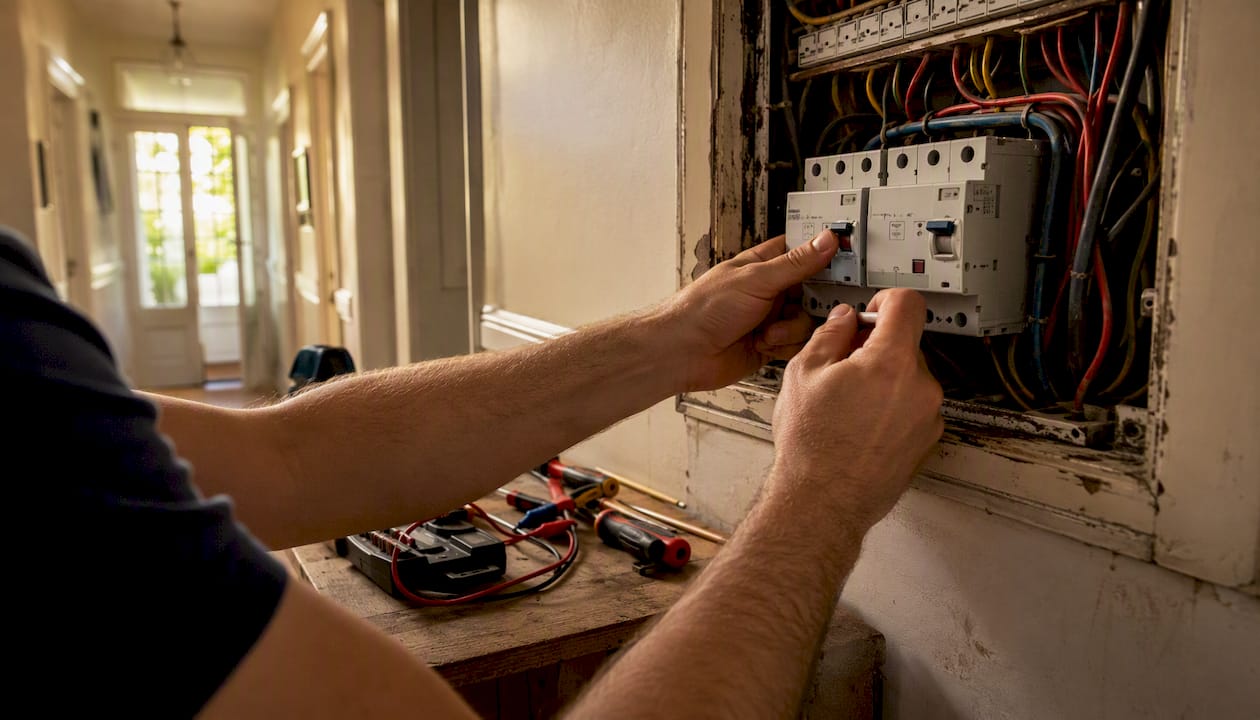
The recommendation is simple: use licensed electrical workers, request the test logs alongside the certificate, and keep both on file. That combination is what separates genuine compliance from a signed form in a drawer.
Dualflowservices electrical safety services for the Mornington Peninsula

Dualflowservices provides scheduled electrical inspections, switchboard audits, RCD testing, and certificates of electrical safety for homeowners, landlords, businesses, aged care facilities, and disability care homes across the Mornington Peninsula and surrounding Melbourne suburbs. When an inspection uncovers a fault, the same team handles the repair and re-certification, so there is no gap between finding a problem and fixing it.
For landlords managing tenancy turnover, the process is straightforward: book an inspection, receive a written report and certificate, and have any remedial work completed before the new tenancy begins. For businesses, scheduled maintenance visits keep workplace electrical risk controls current without disrupting operations.
Emergency call-outs are available when a hazard cannot wait. Whether it is a tripped RCD that will not reset, a burning smell from a switchboard, or a fault discovered during a property handover, the team is available across the Peninsula and greater Melbourne.
To book an inspection or request a quote, visit Dualflowservices and submit an enquiry. A licensed electrician will follow up to confirm scope, timing, and cost before any work begins.
Sources
The following official sources underpin this article. Each is worth bookmarking if you need to verify legal text or regulator guidance directly.
- Electricity safety general regulations | Energy Safe Victoria
- Regulatory Impact Statement Electricity Safety (General) Regulations 2019 | Victorian Government
- Electricity Safety Act 1998 | AustLII
- Electrical safety | WorkSafe Victoria
- Minimum standards for rental properties | Consumer Affairs Victoria
This article is general information, not a substitute for advice from a qualified lawyer. Consult a qualified legal professional about your own circumstances before acting on anything here.