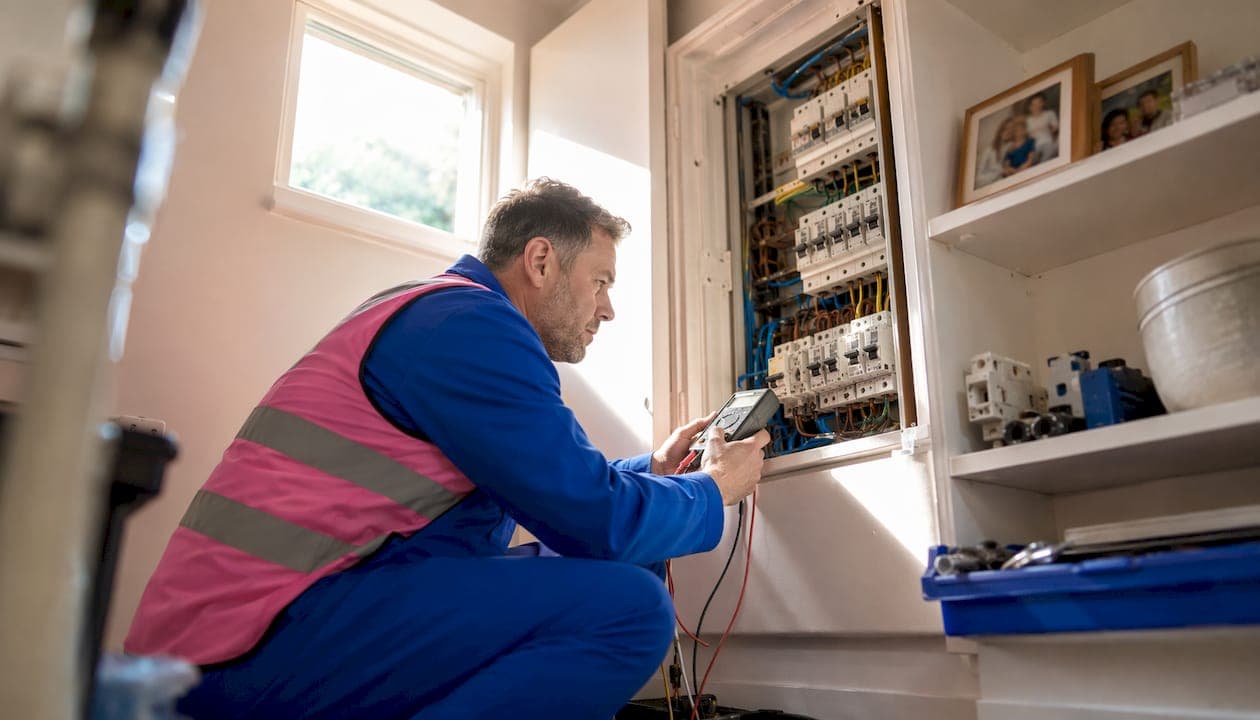
Switchboard audits matter because they catch fire and shock risks before they cause harm, give insurers and regulators the documented evidence they need, and turn raw test data into a prioritised maintenance plan you can actually budget from. For Victorian homeowners and business owners, skipping this step is not a minor oversight. It is a gap that can void an insurance claim, attract Energy Safe Victoria scrutiny, or leave a fault quietly building toward a fire.
Three reasons to act now:
- Safety: Audits identify overloaded circuits, loose terminations, missing RCDs, and other faults that cause electrical fires and electric shock.
- Compliance and insurance: Documented audit reports referencing AS/NZS 61439 and AS/NZS 3000 give insurers and regulators the evidence they ask for, especially after an incident.
- Asset management: Condition-scored findings let you plan capital works and avoid surprise switchboard replacements.
Table of Contents
- Why electrical switchboard audits matter: what the tests actually cover
- How audits make a measurable difference to safety, compliance, and budgets
- What Australian standards and Energy Safe Victoria mean for your audit
- Who should do the audit and how often to schedule one in Victoria
- What an audit report looks like and how to use it
- How to prepare for an audit and what to ask on the day
- What affects audit cost and how long audits take
- Dualflowservices: licensed switchboard audits on the Mornington Peninsula
- Key takeaways
- A practical perspective on switchboard maintenance
- Useful sources and further reading
Why electrical switchboard audits matter: what the tests actually cover
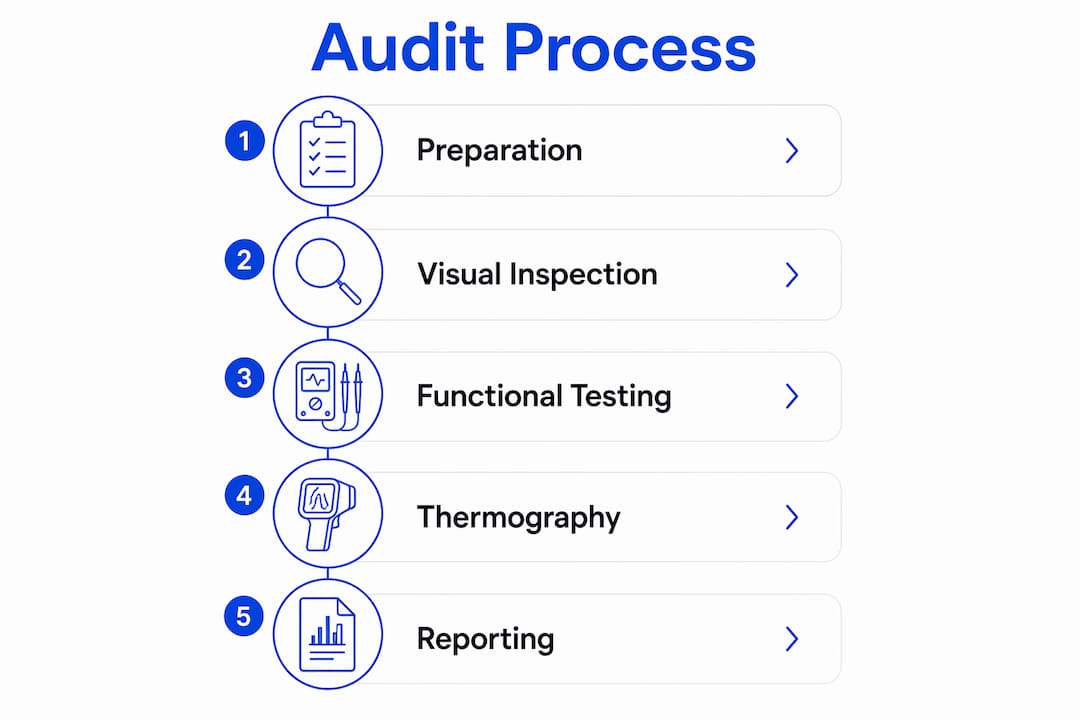
An audit combines visual inspection, functional testing, and a thermographic survey to confirm your switchboard is performing safely, not just looking intact. Industry guidance is clear that routine audits identify faults leading to outages, fires, and safety risks that a quick visual check will never surface.
Typical checks include:
- Visual inspection: clearances, enclosure condition, IP ratings at cable entries, labelling accuracy, and signs of corrosion or moisture ingress.
- RCD/safety switch testing: trip-time verification against required thresholds, not just the push-button test.
- Circuit breaker checks: operation under load, discrimination settings, and identification of obsolete or recalled components.
- Thermographic survey: infrared imaging to locate hotspots caused by loose terminations or overloaded circuits before they ignite.
- Protection settings verification: confirming breaker ratings match the circuits they protect.
- Earthing and bonding tests: continuity checks to confirm fault-current paths are intact.
- Insulation resistance testing: detecting degraded insulation that raises shock risk.
- Ventilation and access: confirming the board breathes correctly and is accessible for emergency isolation.
- Documentation review: checking single-line diagrams and switchboard schedules are current and accurate.
Common safety issues found in audits include overloaded circuits, loose terminations causing hotspots, missing or faulty RCDs, poor labelling, inadequate clearances, and asbestos in older boards.
Pro Tip: A component can look perfectly fine and still fail under load. Thermography catches the heat signature of a loose termination long before the connection fails or ignites. Visual inspection alone gives you a false sense of security — you need both.
How audits make a measurable difference to safety, compliance, and budgets
Audits reduce immediate safety risks and convert test evidence into priority actions that save money and protect people. A structured electrical safety audit maps measured results against Australian standards to produce a practical maintenance roadmap, not just a list of problems.
Audit findings translate directly into outcomes:
- Hotspot repairs reduce fire risk at the source.
- Correct protection settings cut nuisance trips and prevent wider outages.
- Current documentation speeds fault diagnosis and emergency response.
- Condition scoring lets strata committees and facility managers justify levies and target capital works with ranked, budget-ready recommendations.
A documented audit report is one of the most effective tools a property owner has when an insurer asks for proof of active electrical maintenance. Insurers increasingly request RCD testing records and current switchboard schedules when assessing claims for electrical fires or failure. Without them, a claim can be weakened or denied.
For commercial and strata settings, electrical health auditing pairs condition checks with functional testing to give facilities a reliable picture of what will likely fail next — and how to budget for it. That is the difference between reactive spending and planned capital works.
What Australian standards and Energy Safe Victoria mean for your audit

Auditors measure findings against two primary standards: AS/NZS 3000 (the wiring rules governing installation) and AS/NZS 61439 (switchboard verification). In Victoria, Energy Safe Victoria is the state regulator responsible for enforcement and guidance on electrical safety obligations.
AS/NZS 61439 changed switchboard compliance by separating design verification from assembly verification, creating a documented chain of accountability that asset owners can request to prove a board meets safety requirements. That checklist-style verification is what makes an audit report credible for insurers and regulators, not just useful internally.
A compliant audit report typically contains:
| Standard / Regulator | What it covers | Evidence the auditor provides |
|---|---|---|
| AS/NZS 3000 | Wiring rules: installation, protection, earthing | Inspection findings referenced to wiring rules clauses |
| AS/NZS 61439 | Switchboard design and assembly verification | Verification checklist, test results, compliance declaration |
| Energy Safe Victoria | Victorian enforcement, licensing, and safety obligations | Licence details, compliance notes, corrective action items |
A report that references all three gives you something you can hand to an insurer, a building surveyor, or a facilities manager with confidence.
Who should do the audit and how often to schedule one in Victoria
Audits must be performed by a licensed electrician or accredited electrical inspector who documents their credentials, testing methodology, and instruments used, just like the best electrician contractors in Auckland ensure top-quality safety and compliance standards. Before you book, ask:
- Can you provide your electrical licence number?
- Do you have specific switchboard testing and thermographic imaging experience?
- Can I see a sample report before we proceed?
- Who signs off on any remedial work identified?
- Do you carry calibrated test instruments and thermal imaging equipment?
For frequency, the Operations and Maintenance Manual for switchboards recommends inspection within 12 months of commissioning and at regular intervals thereafter. Some providers recommend annual audits as routine practice for identifying weaknesses. Triggers that demand an inspection regardless of schedule:
- After major alterations, fit-outs, or new circuit additions.
- Change of occupancy or tenancy.
- Following an electrical fault, outage, or tripped breaker that could not be explained.
- High-risk environments: commercial kitchens, aged care facilities, industrial sites.
- Smoke, burning smell, visible damage, or frequent unexplained trips — these demand immediate inspection, not a scheduled one.
What an audit report looks like and how to use it
The report is the product. It converts test data into a prioritised maintenance roadmap with urgency ratings and cost guidance so you know exactly what to fix first and what can wait.
A thorough report contains:
- Executive summary with overall risk classification.
- Thermographic images showing hotspot locations and temperatures.
- Instrument readings: RCD trip times, insulation resistance values, earth continuity results.
- Recommended corrective actions ranked by urgency and estimated cost band.
- Updated single-line diagrams and switchboard schedules where gaps were found.
- Compliance notes referencing AS/NZS 3000 and AS/NZS 61439.
A good audit report ranks findings by risk and urgency so owners can budget logically. Here is how that looks in practice:
- Urgent: Loose termination on main incomer causing hotspot at 68°C. Repair within 48 hours.
- Routine: Three circuits with no RCD protection. Upgrade within 90 days.
- Future capital: Switchboard approaching end of service life. Budget for replacement in 2–3 years.
Once you have the report, get quotes for urgent items immediately, document completed work for your insurer, and schedule follow-up testing to confirm remediation was effective.
How to prepare for an audit and what to ask on the day
Preparation cuts site time and keeps costs down. Clear access to the switchboard, a list of known faults or trips, and any documentation from recent renovations will make the auditor's job faster and your report more accurate.
Pre-audit checklist:
- Clear the area around the switchboard (minimum 1 metre clearance).
- Note any recent installations, circuit additions, or renovations.
- Gather existing single-line diagrams and switchboard schedules if you have them.
- Confirm isolation windows with tenants or staff if circuits need to be de-energised.
- List any recurring trips, burning smells, or flickering that you have noticed.
Questions to ask the auditor on the day:
- Which specific tests will you perform today?
- Which Australian standards are you testing against?
- How will thermographic imaging be conducted with live circuits?
- How will you protect live equipment during testing?
- What is the process if you find an urgent fault mid-audit?
- How and when will the report be delivered?
Pro Tip: Never attempt to clean debris, nests, or dust from inside a switchboard yourself. Live exposed components are present even when the main switch is off. A licensed electrician with appropriate PPE handles internal cleaning safely.
What affects audit cost and how long audits take
Cost and time depend on site size, number of switchboards, access complexity, and the tests required.
Key factors:
- Number and physical size of switchboards on site.
- Whether circuits need to be de-energised and tenants notified.
- After-hours or captive testing requirements.
- Whether documentation needs to be created from scratch.
- Remedial works discovered during the audit (quoted separately).
Rough time estimates: a small residential board takes 1–2 hours; a medium commercial site runs half a day; large or complex sites require a full day or staged visits. Ask for a fixed-price scope for the audit itself, then request separate cost bands for any remediation. Bundling them together makes it hard to compare quotes or prioritise spend.
Dualflowservices: licensed switchboard audits on the Mornington Peninsula
Dualflowservices provides licensed electrical switchboard audits for homes, businesses, strata properties, aged care, and disability care facilities across the Mornington Peninsula. Every audit delivers a written report with thermographic images, instrument readings, and prioritised recommendations you can hand straight to your insurer or facilities manager.
The team, led by Mike, carries calibrated test instruments and thermal imaging equipment, coordinates with strata managers and tenants on isolation windows, and offers emergency call-out when an audit uncovers something that cannot wait. Documentation is formatted for compliance and insurance purposes, referencing AS/NZS 61439 and AS/NZS 3000 throughout.
Request a quote or book an inspection directly through the Dualflowservices website. Contact details and service information are on the landing page.
Key takeaways
Switchboard audits reduce fire and shock risk, protect your insurance position, and give you a prioritised maintenance plan that prevents expensive surprises.
| Point | Details |
|---|---|
| Safety comes first | Audits identify loose terminations, missing RCDs, and overloaded circuits before they cause fires or electric shock. |
| Insurance depends on records | Insurers request RCD test logs and current switchboard schedules when assessing electrical fire claims. |
| Standards give reports credibility | Reports referencing AS/NZS 61439 and AS/NZS 3000 are accepted by regulators, insurers, and building surveyors. |
| Triggers matter as much as schedules | Book immediately after faults, fit-outs, or change of occupancy, not just on a calendar cycle. |
| Dualflowservices covers the Peninsula | Licensed audits with thermographic imaging, written reports, and emergency call-out across the Mornington Peninsula. |
A practical perspective on switchboard maintenance
The biggest mistake property owners make is treating a switchboard like a set-and-forget appliance. It is not. It is an active system under constant stress from fluctuating loads, moisture, vibration, and ageing components, and its condition changes faster than any calendar schedule can track.
What actually works is evidence-driven maintenance: keep a simple log of every trip, every unexplained flicker, and every circuit change. That log, combined with a proper audit report, tells you far more than a 12-month interval ever will. Prioritise heat issues and loose terminations above everything else because those are the failure modes that move from "finding" to "fire" fastest.
The other habit worth building is keeping your audit report in the same folder as your insurance policy. When a claim happens, the insurer's first question is whether you maintained the system. A dated, signed report from a licensed electrician is the clearest answer you can give. Properties that cannot produce that document are at a disadvantage before the conversation even starts.
Useful sources and further reading
Verify auditor claims against primary standards and Energy Safe Victoria guidance. These are the authoritative sources to check:
- AS/NZS 61439 overview: Explains how the standard separates design and assembly verification and what it means for asset owners.
- Electrical safety audits for strata and commercial buildings: Practical guide to what a structured audit delivers and how it supports insurance and compliance.
- The importance of electrical auditing: Covers code compliance, insurance, and energy efficiency benefits of regular auditing.
- Switchboard safety compliance checklist: Industry checklist covering common faults and RCD testing obligations.
- Energy Safe Victoria: The Victorian regulator for electrical safety. Check here for current licensing requirements and enforcement guidance.
- RCD testing requirements in Victoria: Explains testing frequency and how to maintain RCD logs for insurance evidence.
- Dualflowservices: Local contact for licensed switchboard audits on the Mornington Peninsula.
Keep your audit reports with your insurance records and your building risk register. They are evidence, not paperwork.