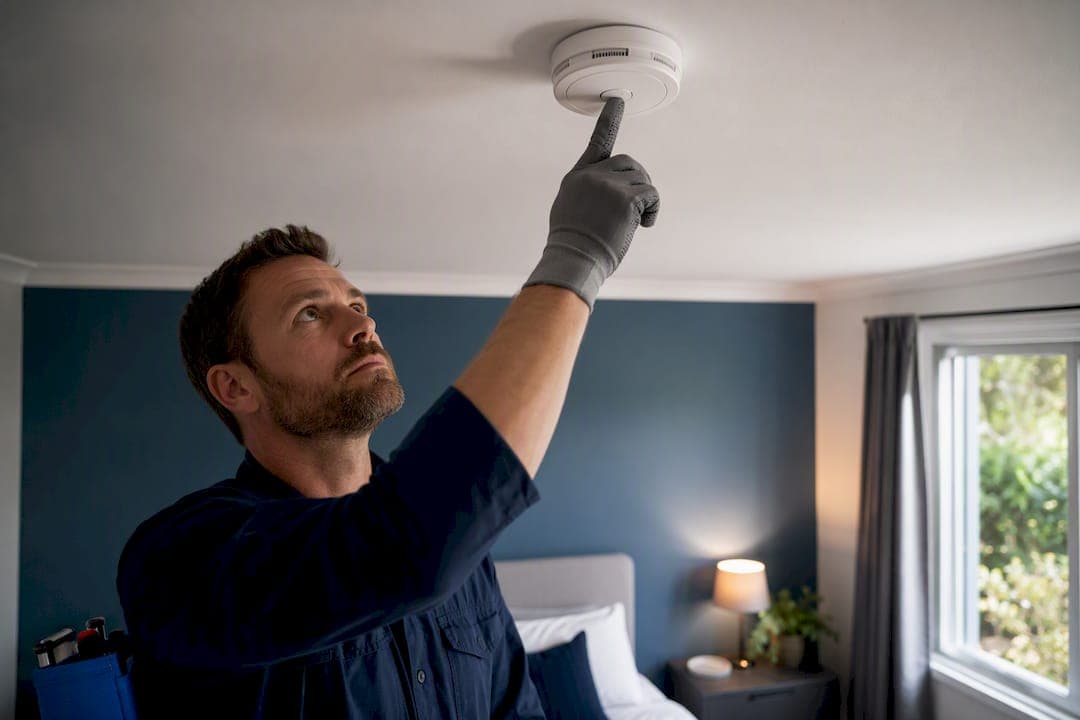
Rental providers in Victoria must ensure every smoke alarm is correctly installed, working, and tested at least once every 12 months, with mains-powered repairs handled only by a licensed electrician. Renters should press the test button monthly and report any fault straight away. Every alarm must meet Australian Standard AS 3786 and get replaced once it hits 10 years old, regardless of who owns the property.
TL;DR:
- Rental providers are legally required to conduct annual smoke alarm testing and keep proof of compliance, with repairs on mains-powered alarms performed only by licensed electricians.
- Renters must test alarms monthly and report any faults in writing, while avoiding tampering with hard-wired units to maintain safety standards.
- Owners must replace alarms older than 10 years, using certified interconnected alarms in homes built after 2014, and check the manufacture date to ensure compliance.
- Proper testing involves a full annual function check by a qualified tradesperson, along with regular battery replacements or upgrades to sealed 10-year lithium units.
- Combining compliance checks into one professional service can ensure alarms meet standards, the wiring is safe, and all documentation is available for dispute or audit.
Table of Contents
- Compliance checklist: what rental providers, renters and homeowners must do
- What Victorian law actually requires
- How to test and maintain your smoke alarms properly
- Where alarms must go and which standard they must meet
- Who's allowed to test and repair hard-wired alarms
- What written information rental providers must give renters
- Urgent repairs, renter rights and the penalties for getting it wrong
- A tradesperson's read on where to spend first
- Book a compliant smoke alarm and electrical check with Dualflowservices
- Sources
- FAQ
Compliance checklist: what rental providers, renters and homeowners must do
Your obligations depend on whether you own, rent, or manage the property, so here's the breakdown by role.
If you're a rental provider:
- Arrange annual testing in line with the manufacturer's instructions and keep proof it happened.
- Give renters written information on alarm locations and how to test them.
- Fix a reported fault immediately, since a non-working alarm counts as an urgent repair.
If you're a renter:
- Test each alarm monthly using the button, and never remove the battery to stop a false alarm.
- Report any fault or dead battery to the rental provider in writing so there's a record.
- Leave hard-wired units alone. Tampering with them can void the safety compliance and put you at risk.
If you're a homeowner:
- Check the manufacture date stamped on the back of each unit and replace anything older than 10 years.
- Consider upgrading to interconnected 10-year lithium alarms, especially in a multi-storey home.
What Victorian law actually requires
The Residential Tenancies Regulations 2021, schedule 3 sets out the smoke alarm safety duties that sit underneath the Residential Tenancies Act. It requires rental providers to ensure every smoke alarm is installed, working, and tested at least once every 12 months, and it specifies that any work on a mains-powered alarm must be carried out by a suitably qualified person, not the rental provider or a handyman.
From 25 November 2025, this annual testing duty became a hard compliance line rather than a best-practice suggestion. Consumer Affairs Victoria's guidance confirms rental providers must also supply renters with written information about how the alarms operate and what the renter is and isn't allowed to do with them.
Separately, the Victorian Building Authority administers building regulations that apply to every residential building regardless of tenure. These set the technical standard (AS 3786), the mains-power requirement for newer homes, and the 10-year expiry rule. Non-compliance can trigger infringement notices, and in a rental dispute, a poorly maintained or missing alarm becomes a serious liability if there's ever a fire investigation or a VCAT hearing.
How to test and maintain your smoke alarms properly
Testing isn't complicated, but the timing and the record-keeping matter more than most people realise.
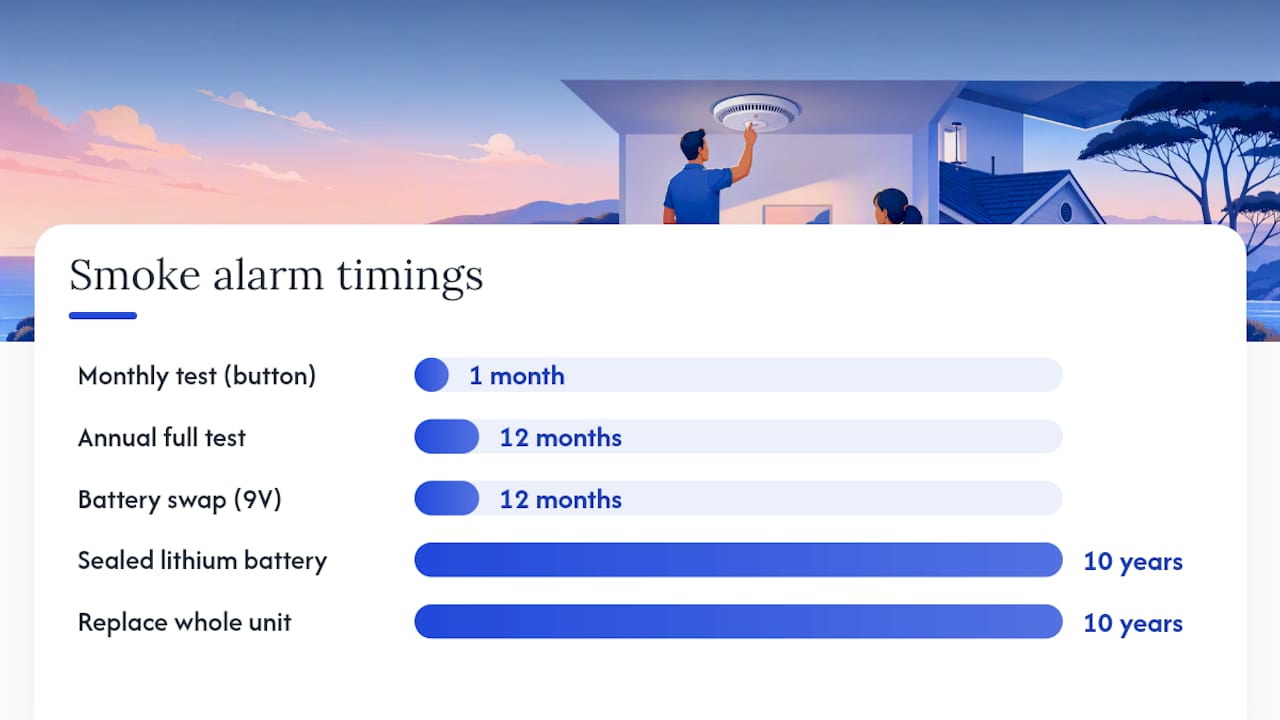
- Monthly: press and hold the test button until the alarm sounds its alert tone. If nothing happens or the sound is weak, treat it as a fault, not a "check it later" job.
- Annually: the rental provider (or a hired tradesperson) runs a full functional test in line with the manufacturer's instructions, not just the button press. This is the check that satisfies the 12-month legal requirement.
- Battery care: swap 9V batteries every 12 months, or install sealed 10-year lithium units that remove the annual battery hassle entirely.
- End of life: replace the whole unit at 10 years from the manufacture date, printed on the back of the alarm. No amount of testing keeps an expired sensor accurate.
Keep a simple dated log of every test, every battery change, and every unit replaced like the detailed steps in the SA Rent Ready Checklist With Photo Evidence. If a dispute ever lands at VCAT, that log is your evidence the annual duty was met.
Pro Tip: Photograph the manufacture date on each alarm the day you move in or take over a property. That single photo settles most "is it too old" arguments before they start.
Where alarms must go and which standard they must meet
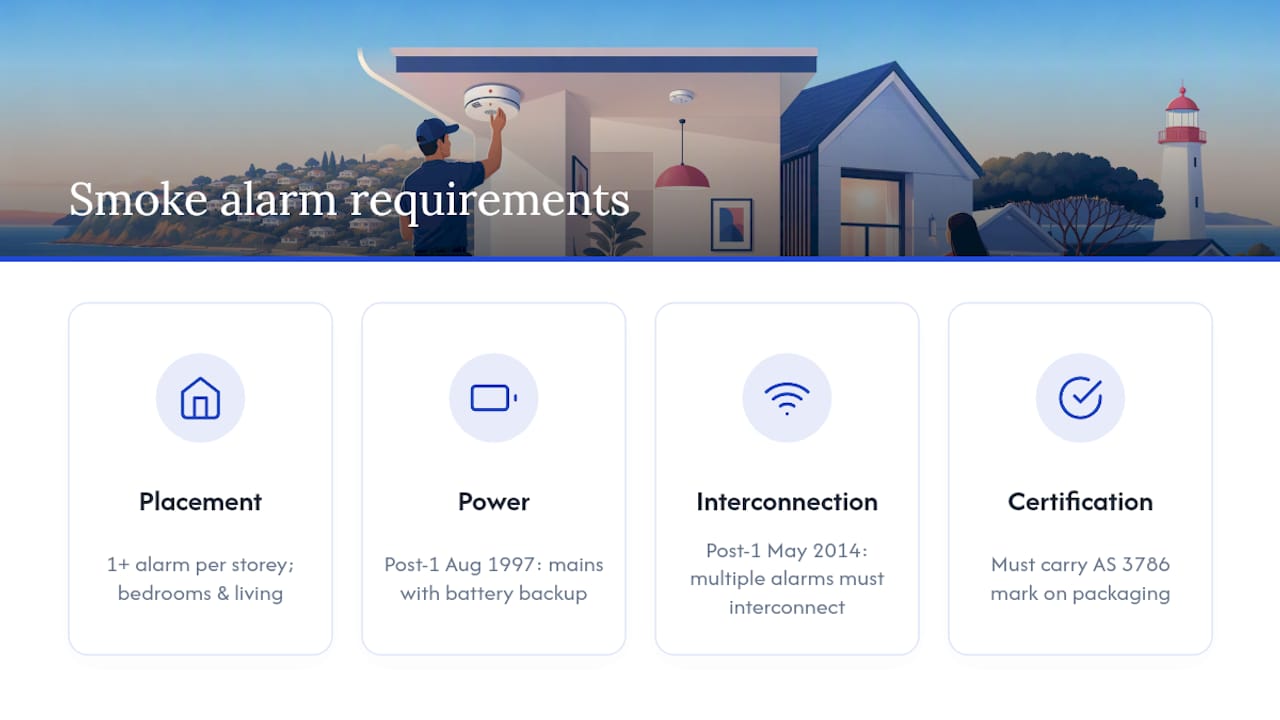
Every storey of a Victorian home needs at least one working smoke alarm, installed on or near the ceiling where smoke naturally collects first. Fire Rescue Victoria recommends going further than the bare minimum: fit one inside every bedroom and in main living areas, because an alarm sitting in the hallway often can't be heard through a closed bedroom door.
Build date determines the power source you're legally required to use. Homes built after 1 August 1997 must have mains-powered alarms with battery backup, confirmed by the Victorian Building Authority. Older homes can still run on battery-only alarms, though upgrading is worth serious consideration given how much cheaper 10-year lithium units have become.
Anything built or substantially renovated after 1 May 2014 needs interconnected alarms whenever more than one is installed, meaning every alarm triggers together. Whatever you install, confirm it carries AS 3786 certification on the packaging. An alarm without that mark isn't compliant, no matter how new it looks.
Who's allowed to test and repair hard-wired alarms
Mains-powered alarms are electrical fittings, not household gadgets, and the law treats them that way. Repair or replacement of a 240V hard-wired unit must be done by a suitably qualified person, typically a licensed electrician, a rule confirmed by the Victorian Building Authority. Renters can and should do the monthly button test and swap a battery where the unit design allows it, but opening up a hard-wired alarm or rewiring anything is off limits.
Before booking anyone for the annual check, ask for their electrical licence number and confirm they'll issue a written report. A proper visit checks the RCD protection feeding the circuit as well as the alarm itself, since both sit on the same safety chain.
What written information rental providers must give renters
Rental providers owe renters more than just a working alarm. Schedule 3 requires clear written instructions covering how each alarm operates, how to run the monthly test, and what the renter must not do (removing batteries, painting over sensors, disconnecting units).
A decent move-in pack should include:
- The location and manufacture date of every alarm in the property.
- Step-by-step test instructions matching the actual model installed.
- A written statement of the renter's obligation not to tamper with any unit.
If none of this arrives, Consumer Affairs Victoria advises renters to request it in writing and keep a copy of that request, since it strengthens any later dispute.
Urgent repairs, renter rights and the penalties for getting it wrong
A dead or faulty smoke alarm is classed as an urgent repair under Victorian tenancy law, so the rental provider has to act immediately once notified, not wait for the next routine visit.
If the rental provider can't be reached, renters may authorise urgent repairs themselves, up to $2,500, and recover that cost. Rental providers who ignore reported faults or skip the annual test face infringement notices and potential VCAT orders, on top of the far bigger risk: a fire that a working alarm would have caught earlier.
A tradesperson's read on where to spend first
If money's tight, spend it on the alarms protecting sleeping areas first, and replace anything nudging the 10-year mark before it becomes an emergency callout. In older weatherboard homes where running new cabling means pulling up flooring, wireless-interconnected 10-year lithium alarms are a genuinely practical fix. They give you the interconnection benefit without the disruption of a full rewire. We've seen the same logic play out in other regulated safety checks, like the carbon monoxide heater testing process, where a modest upfront job avoids a much bigger one down the track.
— Mike
Book a compliant smoke alarm and electrical check with Dualflowservices
Some providers offer combined visits covering multiple compliance checks in one appointment. One visit covers your smoke alarm testing, the electrical circuit behind it, and any other repairs due, instead of booking an electrician one week and a maintenance contractor the next.
A typical visit includes a full inspection of every alarm against AS 3786, a written checklist documenting locations and manufacture dates, and straightforward recommendations, whether that's a battery swap, an upgrade to 10-year lithium units, or hard-wired repairs handled by our licensed electricians. Rental providers get the paperwork they need to prove the annual duty was met; homeowners get peace of mind their alarms will actually work when it matters. For property managers juggling multiple compliance certificates, it's worth pairing this with your existing gas compliance records so everything sits in one file. Book a scheduled maintenance visit or an emergency call-out through Dualflowservices and get your smoke alarms, wiring, and compliance paperwork sorted in a single appointment.
Sources
- Smoke alarms and fire safety
- RESIDENTIAL TENANCIES REGULATIONS 2021 - SCHEDULE 3
- Smoke alarms | Victorian Building Authority
- Frv
FAQ
What are the legal requirements for smoke alarms in Victoria?
Rental providers must ensure alarms are correctly installed, working, and tested at least once every 12 months, as set out in schedule 3 of the Residential Tenancies Regulations 2021. Alarms must also meet AS 3786 and be replaced at 10 years old.
What is the Australian standard for testing smoke alarms?
Alarms sold and installed in Victoria must comply with AS 3786, the standard covering sensitivity, construction, and reliability for household smoke alarms. It's confirmed by the Victorian Building Authority as the benchmark every unit needs to meet, whether battery or mains-powered.
How often do smoke alarms need to be checked in Victoria?
Residents should press the test button monthly, while rental providers must arrange a full functional test at least once every 12 months under Consumer Affairs Victoria's guidance. Homeowners without a tenancy still need to replace units at the 10-year mark regardless of test results.
Can an electrician test smoke alarms?
Yes, and for hard-wired mains-powered units, an electrician is legally required to carry out any repair or replacement work. A licensed electrician can also test battery-only alarms as part of a broader property compliance check, giving you one written report covering everything.