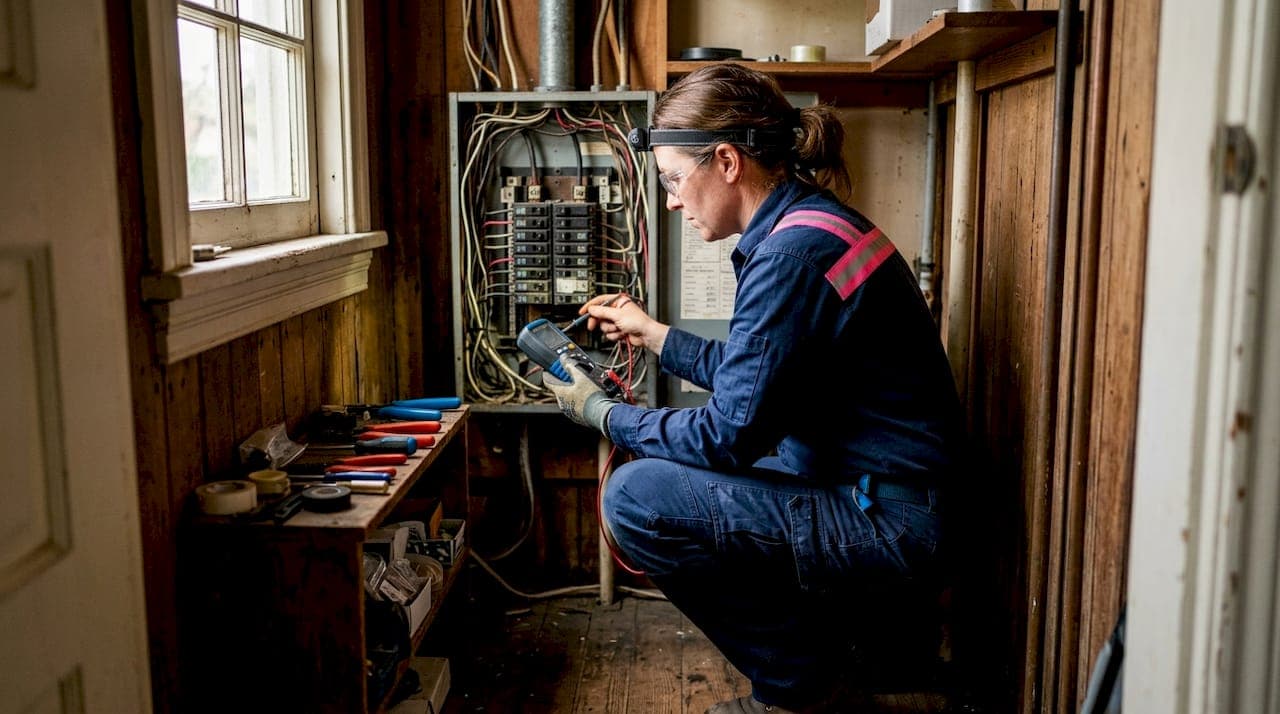
An electrical safety inspection is a professional, systematic assessment of a property's electrical installation to identify hazards, verify safe operation, and confirm compliance with Victorian safety standards. Every home and business owner in Victoria should understand what these inspections involve, because faulty wiring and overloads can cause fires and electric shock before any visible warning signs appear. The process covers switchboards, wiring, safety switches, outlets, and fixed appliances, and it concludes with a written report detailing findings and required actions. Energy Safe Victoria and the Electricity Safety Act 1998 set the legal framework that governs every inspection carried out in the state.
What is an electrical safety inspection and what does it involve?
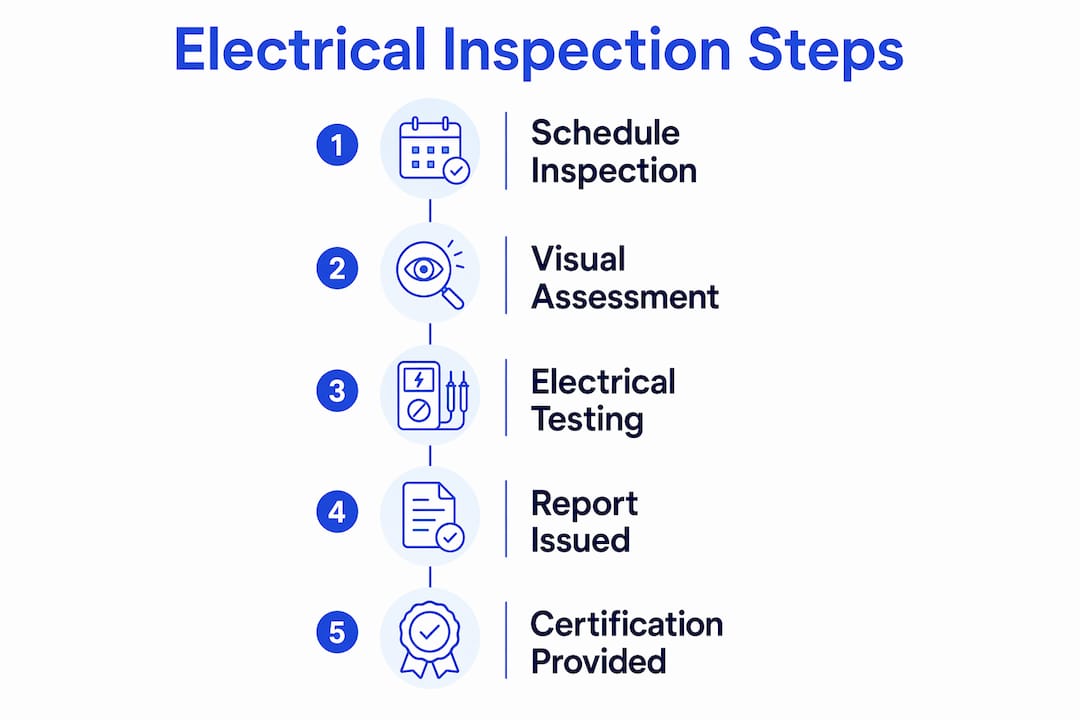
An electrical safety inspection is a two-part process: a visual check followed by electrical testing using calibrated instruments. The systematic assessment covers switchboards, safety switches, wiring insulation, earthing, outlets, and fixed appliances. A written report with findings and recommendations is issued at the end.
The inspection follows a clear sequence. Understanding each step helps you know what to expect on the day.
- Visual inspection. The electrician examines all accessible wiring, switchboards, power points, light fittings, and fixed appliances for physical damage, incorrect installation, or signs of overheating.
- Electrical testing. The electrician uses calibrated test equipment to run procedures including RCD (residual current device) trip-time tests, insulation resistance tests, and earth continuity checks as outlined in AS/NZS 3760.
- Hazard identification. Any faults, non-compliant installations, or potential risks are recorded. Australia's 240-volt supply increases the severity of electrical faults, so identifying hazards early is critical.
- Written report. The electrician produces a report listing every finding, classifying outcomes, and recommending corrective actions.
Residential inspections typically take 1–2 hours depending on the size and complexity of the property. A larger commercial premises with multiple circuits and portable equipment will take longer.
Pro Tip: Ask your electrician to walk you through the report before they leave. A brief verbal summary of the key findings helps you prioritise any follow-up work without needing to decode technical language on your own.

What are the legal requirements for electrical inspections in Victoria?
Victoria's regulatory framework for electrical safety is among the most clearly defined in Australia. The Electricity Safety Act 1998 and its associated regulations set out who must inspect, what must be tested, and what documentation must follow.
The most important document in this framework is the Certificate of Electrical Safety. Electricians in Victoria must issue a Certificate of Electrical Safety for all prescribed electrical installation work within 30 days of completing that work. This certificate is a legal document that holds the electrician accountable for the safety of the work performed.
Key obligations under Victorian law include:
- Prescribed work requires certification. Any installation, alteration, or repair that falls under the prescribed work category must be accompanied by a Certificate of Electrical Safety, regardless of whether a separate inspection was conducted.
- Electricians must test before certifying. Compliance evidence requires the electrician to test the installation before issuing the certificate. Verbal assurances do not satisfy this requirement.
- Failure to comply is a criminal offence. Non-compliance with certification obligations can result in disciplinary action and criminal prosecution under Victorian law.
- Energy Safe Victoria enforces compliance. Energy Safe Victoria is the state's electrical safety regulator. It receives lodged certificates and has the authority to investigate and prosecute breaches.
"Certificate of Electrical Safety is not just about safety fixes but also legal accountability; obtaining and keeping certification is crucial for owners in Victoria." — Energy Safe Victoria
One area that confuses many property owners is the difference between prescribed and non-prescribed work. Prescribed work covers most installation and alteration tasks carried out by a licensed electrician. Non-prescribed work includes minor tasks that do not require a licensed electrician. Knowing which category applies to your situation determines what documentation you should expect to receive.
For businesses, AS/NZS 3760:2022 adds a further layer of obligation. It requires ongoing inspection and testing of in-service electrical equipment, with documented intervals, competent personnel, and tagging of tested equipment. This applies to portable appliances in workplaces and is separate from the certification process for fixed installations.
How do you read an electrical inspection report?
An inspection report is the formal record of everything the electrician found. Understanding its structure helps you act on the findings without delay.
Reports commonly classify results using outcome categories. Standard classifications include outcomes such as "safe/satisfactory" and "unsatisfactory/potentially dangerous," though exact terminology varies between electricians and inspection types.
| Classification | Meaning | Recommended action |
|---|---|---|
| Safe / Satisfactory | No faults found; installation meets current standards | Retain report; schedule next inspection |
| Minor defect noted | Small issue present but not immediately dangerous | Arrange repair within a reasonable timeframe |
| Unsatisfactory | Fault present that requires attention | Book remedial work promptly |
| Potentially dangerous | Immediate risk to safety identified | Do not use affected circuits; arrange urgent repair |
The report also distinguishes between inspection-only outcomes and inspection-plus-testing outcomes. Visual inspection alone can miss hazards that only show up under electrical measurement. A report that includes both visual and test results gives you a more complete picture of your installation's condition.
Documentation matters beyond the day of the inspection. For insurance claims, tenancy disputes, or compliance audits, certified written documentation lodged with Energy Safe Victoria according to required timelines is the only evidence that counts. Verbal assurances from a previous electrician carry no legal weight.
Pro Tip: Store your inspection reports and certificates in a dedicated folder, either physical or digital. If you sell, lease, or insure the property, you will need these documents quickly and in order.
What are the benefits of regular electrical safety checks?
Regular electrical safety checks deliver practical benefits that go well beyond ticking a compliance box. AS/NZS 3760:2022 identifies three core outcomes: reduced risk of shock and fire, support for legal compliance, and improved performance and reliability of electrical equipment.
The benefits for home and business owners in Victoria include:
- Fire and shock prevention. Faulty wiring, deteriorated insulation, and overloaded circuits are leading causes of electrical fires. Regular inspections catch these faults before they become emergencies.
- Legal compliance. Staying current with inspection and certification requirements protects you from fines, prosecution, and liability under the Electricity Safety Act 1998.
- Insurance validity. Many insurers require evidence of compliant electrical installations. An up-to-date inspection report supports your policy and strengthens any claim.
- Equipment longevity. Identifying minor faults early prevents the kind of electrical stress that shortens the life of appliances, switchboards, and wiring systems.
- Peace of mind. Knowing your property has been assessed by a licensed electrician and found compliant removes uncertainty for you, your tenants, your staff, and your visitors.
For aged care facilities, retirement villages, and disability care homes, the stakes are even higher. Occupants in these settings are more vulnerable to the consequences of electrical faults, making regular inspections a duty of care, not just a regulatory requirement.
How do you prepare for an electrical inspection and what comes next?
Preparation makes the inspection faster and the report more useful. A few straightforward steps before the electrician arrives will help the process run smoothly.
- Clear access to switchboards and power points. Move furniture, boxes, or stored items away from electrical panels, meter boxes, and wall outlets so the electrician can reach them without delay.
- List any known concerns. If you have noticed flickering lights, tripping circuits, warm power points, or unusual smells near appliances, write these down and share them at the start of the inspection.
- Confirm the scope in advance. Clarify with your electrician whether the inspection covers fixed installations only, portable appliances, or both. This avoids misunderstandings about what documentation you will receive.
- Ask about the applicable standard. For businesses, ask whether the inspection will be conducted under AS/NZS 3760 and whether equipment tagging is included.
- Arrange follow-up work promptly. Once you receive the report, prioritise any items classified as unsatisfactory or potentially dangerous. Do not defer urgent remedial work.
- Schedule the next inspection. Residential properties benefit from an inspection every few years. Commercial and industrial premises with portable equipment under AS/NZS 3760 have defined intervals that your electrician can advise on.
After the inspection, keep your Certificate of Electrical Safety and the written report together. If the work was prescribed, confirm that the certificate has been lodged with Energy Safe Victoria within the required 30-day window.
Key takeaways
An electrical safety inspection is the most reliable way to confirm that a Victorian property's electrical installation is safe, compliant, and properly documented.
| Point | Details |
|---|---|
| Definition and scope | An inspection covers visual checks, electrical testing, and a written report on the full installation. |
| Legal obligation | Victorian electricians must issue a Certificate of Electrical Safety for prescribed work within 30 days. |
| Report interpretation | Classifications range from satisfactory to potentially dangerous; act on unsatisfactory findings without delay. |
| Ongoing compliance | Businesses must follow AS/NZS 3760 intervals for in-service equipment testing and documentation. |
| Documentation value | Certified written records are required for insurance, tenancy, and compliance purposes in Victoria. |
What I've learned from years of electrical inspections on the Mornington Peninsula
The most common mistake I see property owners make is assuming that because nothing has gone wrong, everything must be fine. Electrical faults are not always visible. A switchboard that looks perfectly normal can have deteriorated insulation or an RCD that fails to trip within the safe time limit. You would never know without testing.
The second mistake is confusing a Certificate of Electrical Safety with a routine periodic inspection. They are not the same thing. A certificate covers prescribed installation work. A periodic inspection is a separate programme that checks the ongoing condition of the whole installation. Both matter, and both serve different purposes.
What I tell every home and business owner I work with is this: treat an electrical inspection the way you treat a car service. You do not wait for the engine to fail before you check the oil. The cost of a regular inspection is a fraction of the cost of an electrical fire, a failed insurance claim, or a prosecution under the Electricity Safety Act 1998.
On the Mornington Peninsula, we see a mix of older homes with ageing wiring and newer builds where installation shortcuts occasionally slip through. Neither is immune to faults. The only way to know your property's true condition is to have a licensed electrician assess it properly, with instruments, not just a visual once-over.
— Mike
Electrical safety inspections with Dualflowservices
Dualflowservices provides licensed electrical inspections and certification services for home and business owners across the Mornington Peninsula and greater Victoria.

Our electricians carry out full visual and electrical testing, produce written reports, and handle the Certificate of Electrical Safety paperwork required under Victorian law. We work with residential properties, commercial premises, aged care facilities, retirement villages, and disability care homes. Whether you need a scheduled inspection, a compliance check before a property sale, or urgent follow-up after a fault is identified, book an inspection with Dualflowservices and get a clear, documented picture of your property's electrical condition.
FAQ
What is an electrical safety inspection?
An electrical safety inspection is a professional assessment of a property's electrical installation, covering visual checks, electrical testing, and a written report. It identifies hazards such as faulty wiring, overloaded circuits, and non-compliant installations.
How often should I get an electrical inspection in Victoria?
Residential properties benefit from an inspection every few years, while commercial premises with in-service equipment under AS/NZS 3760 have defined testing intervals. Your licensed electrician can advise on the right frequency for your property type.
Do I need a Certificate of Electrical Safety in Victoria?
Victorian electricians must issue a Certificate of Electrical Safety for all prescribed electrical installation work within 30 days. This certificate is a legal document and must be lodged with Energy Safe Victoria.
What is the difference between an inspection and a Certificate of Electrical Safety?
A Certificate of Electrical Safety covers prescribed installation work completed by a licensed electrician. A periodic inspection is a separate programme that assesses the ongoing condition of an existing installation and is not automatically linked to new work.
Can I use an inspection report for insurance or tenancy purposes?
Yes. Certified written documentation lodged with Energy Safe Victoria is the accepted form of compliance evidence for insurance, tenancy, and legal purposes in Victoria. Verbal assurances from an electrician are not sufficient.