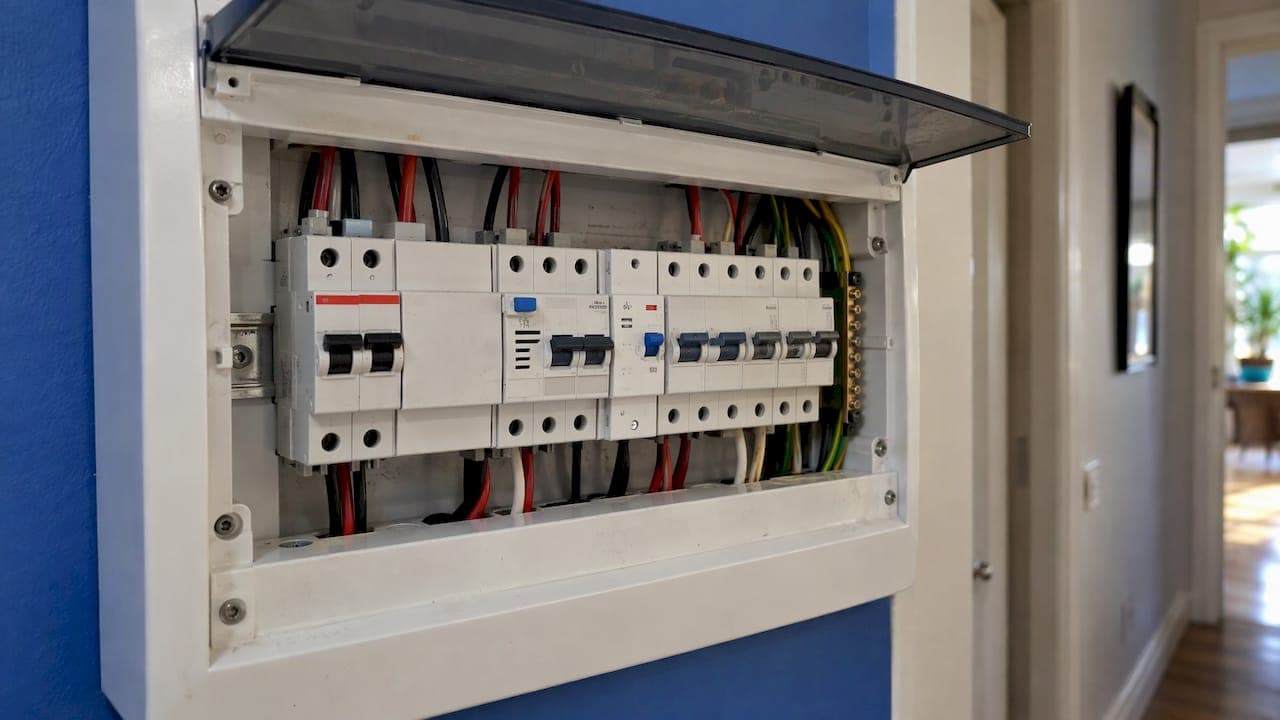
An arc fault detection device (AFDD) is a protective device in your switchboard that listens for the electrical signature of a dangerous arc in a circuit's wiring and cuts the power before the arc can start a fire. Standard circuit breakers and RCDs (safety switches) don't do that job. In Australia, AFDDs are covered by the Wiring Rules and are generally recommended for higher-risk situations rather than required on every circuit. This guide explains how they work, where they earn their place, and what to ask your electrician.
TL;DR
- An arc fault is a damaging spark across a break or fault in wiring. It can smoulder inside walls and ceilings where nobody sees it.
- Circuit breakers and RCDs protect against overload, short circuit and earth leakage. An AFDD adds protection against arcing in cables and connections.
- Australia's Wiring Rules (AS/NZS 3000:2018) cover AFDDs, and their performance is set by AS/NZS 62606. Use is recommended for higher-risk premises, not mandated everywhere.
- They suit sleeping accommodation, ageing wiring, and buildings with flammable materials or valuable contents, which includes aged care and disability homes.
- A licensed electrician must select, install and test them. Plan for a manual test every six months.
Table of Contents
- What an arc fault is and how it starts a fire
- How an arc fault detection device works
- AFDD, RCD, circuit breaker and arc-flash detector: what's different
- What Australian rules say about AFDDs
- Where arc fault protection makes the most sense
- Selecting and installing an AFDD
- Testing, maintenance and repeated tripping
- How AFDDs fit with the rest of your electrical safety
- A practical way to decide
- Talk to a licensed electrician on the Peninsula
- FAQ
- Sources
What an arc fault is and how it starts a fire
An arc is a current jumping across a gap in a conductor, a bit like a continuous tiny lightning bolt. The temperature at the point of the arc is far higher than the wire around it can tolerate. Broken wires, loose connections, crushed cables and worn insulation can all create hidden arc faults that can turn into flames in seconds if nothing interrupts them.
Electricians usually talk about two types:
- Series arcing happens along a single conductor, for example at a loose terminal or a partly broken wire. The load keeps running, so a normal breaker sees nothing unusual. Series arcing can heat surrounding insulation until it smokes or ignites.
- Parallel arcing happens between two conductors, or between a conductor and earth, such as when a nail or a rodent damages a cable. The current can be erratic, and a conventional breaker may not trip fast enough, or at all, on an intermittent arc.
The common thread is that the fault is intermittent and local. A cable can be arcing inside a wall cavity while every light in the house works and the switchboard looks fine. That's why arc faults are a worry in older homes, in roof spaces with rodent activity, and wherever furniture has been pushed hard against a plug or a cord has been pinched.
How an arc fault detection device works
An AFDD continuously monitors the current waveform on the circuit it protects. According to the US Consumer Product Safety Commission, arc fault technology uses electronics to tell normal arcing from dangerous arcing, then analyses the event and trips to de-energise the circuit when it identifies a hazardous arc. (In North America the equivalent device is called an AFCI.)
The hard part is discrimination. A vacuum cleaner motor, a drill or a light dimmer all produce small arcs in normal operation. Research presented at the IEEE Electrical Safety Workshop notes that the algorithm has to work correctly regardless of connected loads, separating harmful arcing from the patterns everyday appliances produce. Good devices do this so reliably that you shouldn't notice them until they trip.
In practice, when an AFDD trips it isolates only the affected final sub-circuit. The rest of the house stays powered, and the tripped circuit tells your electrician where to start looking.

AFDD, RCD, circuit breaker and arc-flash detector: what's different
These terms get mixed up constantly, so here they are side by side.
| Device | What it protects against | Where it sits |
|---|---|---|
| Circuit breaker | Overload and short circuit | Switchboard, per circuit |
| RCD (safety switch) | Earth leakage that can electrocute a person | Switchboard, per circuit or group of circuits |
| RCBO | Combines breaker and RCD in one unit | Switchboard, per circuit |
| AFDD | Dangerous arcing in cables and connections on final sub-circuits | Switchboard, start of the protected circuit |
| Arc-flash detector | Internal arcing faults inside large switchgear | Industrial and commercial switchgear |
A BEAMA guide from the UK explains that overcurrent and residual-current protection have cut electrical fire risk, but cannot detect electric arcs in cables and connections. An AFDD fills that gap by detecting the arc and disconnecting the circuit.
One important distinction for Australian readers: the Wiring Rules make clear that AFDDs protect final sub-circuit wiring and should not be confused with arc-flash detectors used in switchgear to guard against fire and explosion from internal arcing faults. If you manage a commercial site with large switchgear, those are two separate conversations.
An AFDD also doesn't replace your RCDs. They do different jobs. If you want a refresher on why safety switches matter and why they get tested, see our guide to why electrical RCD testing is required in Victoria. It's also worth knowing that Energy Safe Victoria states that Type AC RCDs must not be installed in Australia from 1 May 2023, with Type A, B and F the options going forward. If your switchboard is older, it's a good moment to check what's in it.
What Australian rules say about AFDDs
The short version is that AFDDs are recognised, standardised and recommended in the right places, but they are not blanket-mandated.
- AS/NZS 3000:2018, the Wiring Rules, is the main installation standard. It has been amended since, with amendments in 2020, 2021 and 2023 listed on the Standards Australia store.
- Clause 2.9 of the 2018 edition covers AFDDs and refers users to Appendix O for installation information.
- AS/NZS 62606 defines the performance requirements for the devices. Standards Australia's listing for the standard describes AFDD use as generally recommended for high-risk applications rather than mandated for every circuit, with practitioners following Appendix O for installation.
The international product standard, IEC 62606, treats AFDDs as devices intended for operation by uninstructed persons, which is why they are built to be "fit and forget" apart from periodic testing.
Because rules and amendments change, treat this as a guide and confirm the current position with your licensed electrician or Energy Safe Victoria before you make decisions on a specific building. Your electrician will also tell you whether a particular installation, such as a new build or a large renovation, has requirements beyond the Wiring Rules.
Where arc fault protection makes the most sense
Appendix O of the Wiring Rules suggests AFDDs should be considered for:
- premises with sleeping accommodation
- buildings constructed of, or storing, flammable materials
- places storing valuable items
- installations with ageing or deteriorating wiring, or a risk of conductor damage
Lay those over the properties we work in on the Mornington Peninsula and the match is strong.
Homes
Any home is sleeping accommodation. Older homes on the Peninsula, including weatherboard houses and holiday properties that sit quiet for months, can have wiring that has aged in roof spaces and under floors. A circuit feeding bedrooms or a living area with soft furnishings is a sensible candidate for an AFDD during a switchboard upgrade. Garden studios and cabins built with timber also deserve thought. A good cabin electrical installation guide shows why wiring in a timber building is not the place to cut corners, and arc protection on that outbuilding's circuit is a conversation worth having with your electrician.
Aged care, retirement villages and disability homes
These are sleeping accommodation, often with residents who can't evacuate quickly. They are also places with a lot of plug-in equipment: adjustable beds, mobility chargers, lifting equipment, medical devices. Cords get run over, pinched and pulled. Residents' rooms, and the circuits feeding them, are where arc protection can add a layer of defence on top of the existing safety switches and smoke alarms.

Facility managers already juggle compliance. Our guides on electrical compliance for retirement village operators and the SDA electrical checklist for disability homes cover the wider obligations, and arc fault protection can be planned into the same works.
Businesses
Shops, offices, cafes and warehouses that store stock, paper, fabric or packaging have the combustible load that Appendix O flags. Valuable stock or equipment adds to the case. For commercial sites with large switchgear, ask your electrician about arc-flash risk separately.
Selecting and installing an AFDD
Installation is licensed electrical work. It isn't a DIY upgrade, and a mistake at the switchboard can create the very hazard you are trying to prevent. Here's how a sound job goes.
- Inspection first. Your electrician checks the switchboard, existing protective devices, circuit loading and the condition of wiring. An AFDD does not repair a loose connection. It detects it. Faults found during inspection get fixed first.
- Choosing circuits. Usually bedrooms, living areas and any circuit supplying spaces with sleeping occupants or combustible contents come first. You don't have to protect every circuit at once.
- Choosing the device. Some units combine arc detection with overcurrent protection, and some combine it with RCD functions too. Your electrician matches the device to the circuit and board.
- Correct position. Appendix O says AFDDs should be installed after the main switch and at the start of the final sub-circuit they protect. If the device doesn't have integral overcurrent protection, it must sit downstream of a suitably rated overcurrent device.
- Testing and certification. The electrician tests the installation and provides the required paperwork. Our explainer on the electrical compliance certificate shows what you should receive and keep.
- Labelling. The switchboard should be clearly labelled so the next person knows what each device protects. See our switchboard labelling guide for Victoria.
Testing, maintenance and repeated tripping
AFDDs don't need servicing in the way a hot water unit does. They do need testing. Appendix O recommends manual testing every six months, using the test button on the device. Put it in your calendar alongside your safety switch test, and for a business or care facility, record it in your maintenance log.
If an AFDD trips:
- Note which circuit it protects and what was running.
- Unplug the appliances on that circuit and reset once.
- If it holds, reintroduce the appliances one at a time. A device that trips every time one particular appliance is plugged in points to that appliance or its cord.
- If it trips again with nothing connected, or keeps tripping at random, leave it off and call a licensed electrician. Repeated tripping means the device is seeing something real in the wiring or connections, and holding the switch on is not a fix.
As with any protective device, repeat trips are information, not a nuisance to be silenced. Our guide to why electrical safety switches trip walks through the same logic for RCDs, and much of it applies here.
Signs of a possible arc fault that warrant a call to an electrician straight away, whether or not you have an AFDD: a burning or fishy smell near outlets or the switchboard, discoloured or warm faceplates, flickering lights that aren't a bulb issue, crackling or buzzing sounds from walls, or breakers that trip with no clear cause. If you see smoke or flames, call 000.
How AFDDs fit with the rest of your electrical safety
Arc fault detection is one layer. It sits beside smoke alarms, safety switches, sound wiring and regular inspection, and works best when the others are in order.
- Smoke alarms warn you when a fire has started. AFDDs aim to stop the ignition source earlier. Victorian rules on alarm testing are in our guide to annual smoke alarm tests in Victoria.
- Inspections find the loose terminals, degraded insulation and overloaded circuits that cause arcs. See the benefits of regular electrical inspections for Victorian properties.
- Testing and tagging keeps cords and portable equipment in safe condition, which matters in workplaces and care settings. Read why electrical tagging and testing is required in Victoria.
A practical way to decide
If you are weighing up whether to add arc fault protection, work through these questions with your electrician:
- Does anyone sleep on this circuit, particularly people with limited mobility?
- How old is the wiring, and has it been inspected recently?
- Is there a history of rodent damage, water ingress, DIY alterations or overloaded power boards?
- Does the building hold combustible materials or high-value contents?
- Are you already upgrading the switchboard, renovating or adding circuits? That's the cheapest moment to add devices.
If you answer yes to two or more, put arc fault protection on the quote. If you are a facility manager, raise it as part of your next scheduled maintenance visit so it gets documented with the rest of your compliance records.
Perspective
When we walk through care facilities and older Peninsula homes, the same pattern shows up: the obvious protection is in place, and the hidden risk is the wiring nobody has looked at in years. Smoke alarms tell you there's a fire. Safety switches protect people from shock. Neither is designed to catch a slowly failing connection behind a wall.
That's why we like arc fault detection as part of a planned upgrade rather than as a standalone gadget. It works best when the switchboard has been inspected, the loose terminals have been fixed, the labelling is clear and the device is tested on a schedule.
Because we cover electrical, plumbing and heating and cooling under one roof, we can fold this into the maintenance visits that facility managers and homeowners already book, and be on call 24/7 if something trips at 2am. One team, one set of records, fewer moving parts for you to coordinate.
Mike
Talk to a licensed electrician on the Peninsula
If you'd like to know whether arc fault protection suits your home, business, aged care facility, retirement village or disability home, our electricians can inspect your switchboard, explain your options and quote the work. We also handle scheduled maintenance, compliance checks and emergency call-outs, so you aren't chasing separate trades. See our electrical services or get in touch through our home page.

If a circuit is tripping repeatedly or you smell burning near a switchboard or outlet, don't wait for a scheduled visit. Switch off what you can safely, and call us for an emergency call-out.
FAQ
Are arc fault detection devices compulsory in Victoria?
Not on every circuit. The Wiring Rules cover AFDDs and Appendix O guides their installation, and use is generally recommended for higher-risk situations such as sleeping accommodation and ageing wiring. Rules are amended over time, so ask your electrician to confirm what applies to your property.
Can an AFDD replace my safety switch?
No. RCDs protect people from electric shock caused by earth leakage, while AFDDs target dangerous arcing in wiring. Some devices combine both functions in one unit, but they are separate protections and you need the RCD protection too.
Can I fit an AFDD myself?
No. Work in the switchboard is licensed electrical work in Victoria, and it has to be tested and certified. Your electrician will choose the device, install it at the start of the final sub-circuit and provide your paperwork.
How often should I test an AFDD?
Appendix O of the Wiring Rules recommends manual testing every six months. Press the test button as the manufacturer directs. If the device doesn't trip, call an electrician.
Why does my arc fault device keep tripping?
It may be detecting a real fault, such as a loose connection, damaged cable or faulty appliance. Unplug everything on the circuit, reset once and reconnect items one by one. If it still trips, leave it off and call a licensed electrician.
Sources
- AFCI fire technology, US Consumer Product Safety Commission
- Demystification of arc-fault circuit-interrupters, IEEE Electrical Safety Workshop 2023
- Wiring Rules 2018: Part 2, Appendix O, Electrical Connection
- BEAMA guide to Arc Fault Detection Devices
- Energy Safe Victoria, RCD requirements
- AS/NZS 3000:2018, Standards Australia Store
- AS/NZS 62606:2022 Amd 1:2026 preview, Standards Australia
- IEC 62606 preview
- Arc Fault Detection, Schneider Electric Australia
- Arc fault circuit interrupter with arc signature detection, USPTO
- Cabin electrical installation guide