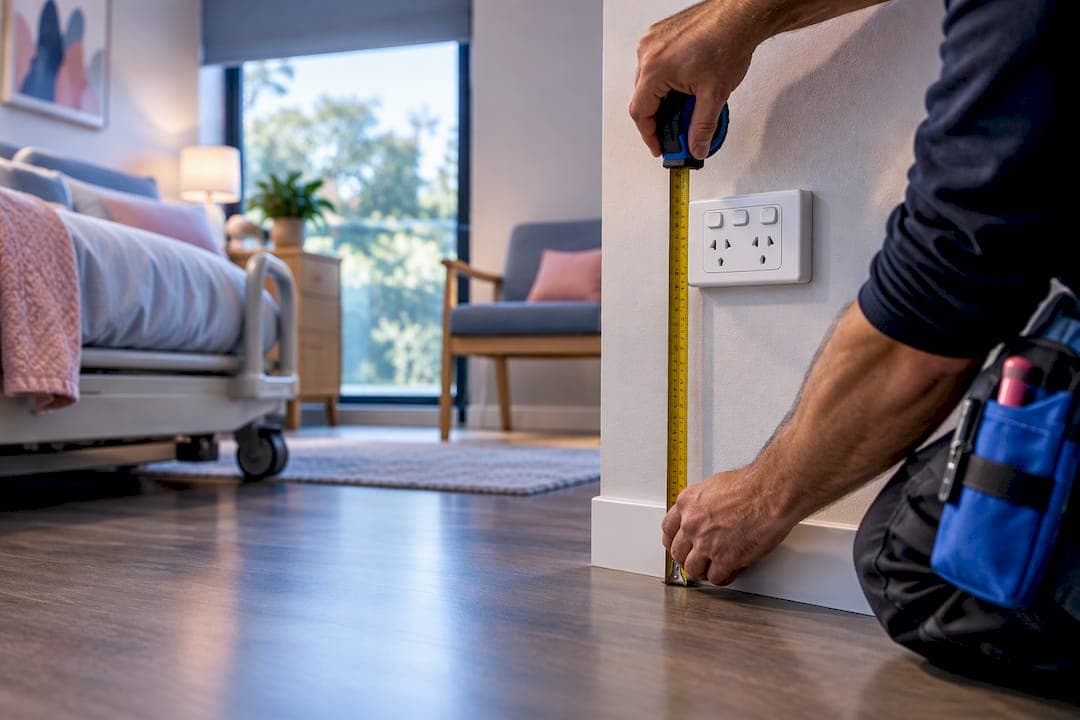
SDA electrical works must meet the NDIS SDA Design Standard and Australian wiring rules (AS/NZS 3000); design-stage and as-built certification is mandatory for enrolment, and NDIS-funded electrical work is usually confined to the immediate area supported by clinical evidence. RCD testing, certificates of electrical safety and state regulator sign-off round out the chain.
TL;DR:
- Electrical certification for SDA dwellings requires both design-stage and as-built approval, with mandatory independent assessor involvement before enrolment.
- Funded electrical work must be directly related to the participant's immediate area, with clinical evidence supporting scope and specific component details to avoid delays.
- Room classification as a patient area triggers extra inspection and commissioning under AS/NZS 3003, with sign-off by an M-class inspector required before live testing.
- Backup power systems, including batteries and inverters, must meet AS/NZS 5139 and 4777 standards, with correct RCD compatibility and post-installation testing within 30 days.
- Ongoing compliance relies on scheduled periodic verification, detailed documentation, and coordinated certification to prevent common gaps that delay SDA enrolment.
Table of Contents
- Who sets the rules: standards, codes and regulators to know
- SDA certification and enrolment: electrical items that trigger mandatory certification
- What electrical work the NDIS will (and generally will not) fund
- Patient areas, medical equipment and heightened testing: when AS/NZS 3003 and M-class inspection apply
- Backup power, batteries and inverters in SDA: safety and compatibility considerations
- Practical compliance checklist and next steps for facility managers
- What on-site work in disability homes actually teaches you
- How DualFlow Services supports SDA electrical compliance
- Sources
- FAQ
Who sets the rules: standards, codes and regulators to know
Electrical compliance for Specialist Disability Accommodation sits at the intersection of disability policy and trade regulation, and providers need both lenses at once. The NDIS SDA Design Standard sets the four design categories, Improved Liveability, Fully Accessible, Robust, and High Physical Support, each carrying its own electrical expectations, from GPO height and location through to emergency power provisions for the most complex builds.
Underneath that sits the trade framework. AS/NZS 3000, the Wiring Rules, governs how any Australian electrical installation is designed, installed and tested, and it's the baseline every SDA property must satisfy before anyone talks about disability-specific features. AS/NZS 3019 takes over once a dwelling is occupied, setting out how existing installations are periodically verified to confirm they're still safe years after handover. Where a space functions as a patient area or houses medical equipment, AS/NZS 3003 introduces stricter commissioning steps, and any battery storage or solar-plus-battery setup brings AS/NZS 5139 and AS/NZS 4777 into play.
State and territory regulators enforce the practical side of all this. In Victoria, Energy Safe Victoria administers the certificate of electrical safety (COES) process and publishes guidance on RCD and RCBO testing that licensed electricians must follow.
- NDIS/NDIA: owns the SDA Design Standard and enrolment rules.
- AS/NZS 3000: the foundation wiring standard for every installation.
- AS/NZS 3019: periodic verification of existing installations.
- AS/NZS 3003 and AS/NZS 5139/4777: patient areas and battery/solar systems respectively.
- State regulators (example: Energy Safe Victoria): COES issuance and enforcement.
SDA certification and enrolment: electrical items that trigger mandatory certification
Every newly built or newly refurbished SDA dwelling needs both design-stage and as-built certification signed by an independent, accredited SDA assessor before it can be enrolled with the NDIS. The assessor has to be independent of the builder and developer, and electrical evidence is one of the areas most likely to hold up an application when it's missing or incomplete.
The electrical elements assessors check most often include:
- Emergency power provisions for High Physical Support dwellings, including backup GPOs and, where life-safety equipment is present, medical-grade supply.
- GPO counts and placement, checked against reach ranges and the needs flagged for each design category.
- Ceiling hoist power points, confirmed as fitted and functional rather than just roughed in.
- Assistive technology cabling and communications infrastructure, including data points that support monitoring or emergency call systems.
Assessors lodge certification through the NDIS provider process, and providers must be registered with the NDIS Quality and Safeguards Commission before an application can proceed. Missing electrical evidence, an unsigned COES, or an as-built layout that doesn't match what was actually installed, are common reasons enrolment stalls. Assessors typically want an as-built electrical drawing, the signed COES, and a commissioning checklist confirming RCD and RCBO tests were carried out and recorded.
What electrical work the NDIS will (and generally will not) fund
NDIS home modification funding has a clear boundary, and it catches a lot of providers off guard. Electrical works funded through a participant's plan must be confined to, and directly related to, the immediate room or area being modified, and they need clinical evidence tying the work back to the participant's actual needs, not a general home upgrade wish list. Extending wiring back to the main switchboard and fitting an RCD can be funded when it's genuinely necessary to support that immediate-area work, but a full switchboard upgrade is generally excluded.
In practice, that means:
- Additional GPOs installed specifically for medical equipment in a bedroom or bathroom are commonly funded.
- GPOs added for ceiling hoist motors, tied to an occupational therapy report, are commonly funded.
- Relocating light switches or GPOs to accessible heights for a participant with limited reach is commonly funded.
- RCDs required by the Wiring Rules as part of that immediate-area work are commonly funded.
- Whole-house rewires, main switchboard replacements unrelated to the immediate work, and general electrical upgrades with no direct link to the participant's needs are commonly excluded.
Pro Tip: Attach the occupational therapist's report, a fixed-scope quote from a licensed electrician, and a floor plan marking exactly which room the work sits in, before submitting a modification request. Vague scopes get queried, and queries cost weeks.
The clearer the paper trail between the clinical need and the specific electrical item, the smoother the approval tends to be. A quote that lists "electrical upgrade, various" invites a request for more information, while one that lists "two additional double GPOs at 900mm height in bedroom 2, for hoist and monitoring equipment" rarely does.
Patient areas, medical equipment and heightened testing: when AS/NZS 3003 and M-class inspection apply
Not every room in an SDA dwelling is treated equally under the wiring rules. A space becomes a patient area when it's used, or intended to be used, for the examination, treatment or monitoring of a person using medical electrical equipment, and that classification changes what's required before and after energisation. Work in a patient area must comply with AS/NZS 3000 before the power goes on, then meet AS/NZS 3003 commissioning requirements once it's live.

Standard residential testing checks insulation resistance, polarity and RCD operation. Patient area commissioning goes further, verifying equipotential earthing between exposed metal parts, checking touch and step voltages, and confirming the installation won't introduce leakage currents that could interfere with sensitive medical equipment.
Prescribed electrical work in a patient area also needs sign-off from an M-class Licensed Electrical Inspector, with a prescribed COES issued as evidence.
- Confirm early whether a room qualifies as a patient area, since it changes the trade scope and the inspection pathway.
- Commission under AS/NZS 3003 once the installation is energised, not just AS/NZS 3000 beforehand.
- Engage an M-class LEI for prescribed work and retain the prescribed COES.
- Keep equipotential earthing test records and the full commissioning checklist on file, not just the certificate.
Backup power, batteries and inverters in SDA: safety and compatibility considerations
High Physical Support dwellings carry their own emergency power obligations under the SDA Design Standard, which requires a solution catering for a minimum outage period and, where life-safety equipment is present, medical-grade emergency power rather than a basic backup circuit.
Any battery storage or inverter system added to support that backup needs to meet AS/NZS 5139 for battery installations and AS/NZS 4777.1 for grid connection, and the RCD type fitted has to suit the inverter's waveform. Getting that wrong is one of the more common on-site hazards, since an RCD selected for a standard sinusoidal supply can fail to trip correctly against an inverter's output.
- Confirm the RCD type is compatible with the inverter before commissioning, not after.
- Have the licensed electrical worker functionally test RCDs and RCBOs and record results on the COES.
- Check how a new battery or backup circuit interacts with any existing solar system already on the switchboard.
- Verify switchboard protection covers the added load rather than assuming spare capacity exists.
Energy Safe Victoria guidance allows some flexibility for testing new installations not yet connected, provided the RCD and RCBO functional test happens within 30 days of connection and is recorded on the COES. Skipping that follow-up test is a compliance gap that shows up at audit.
Practical compliance checklist and next steps for facility managers
Getting SDA electrical compliance right is mostly about sequencing. Do things in the wrong order and you end up paying twice, once for the install and again to fix documentation gaps an assessor flags months later.
- At design stage, engage an accredited, independent SDA assessor early and give them the full electrical layout, the emergency power plan for High Physical Support areas, and details of any assistive-technology cabling, before construction locks the layout in.
- Before as-built certification, confirm the licensed electrical worker has completed AS/NZS 3000 testing, run RCD and RCBO functional tests, and that a COES has been issued and filed alongside the as-built drawings.
- After enrolment, schedule AS/NZS 3019 periodic verification on a recurring basis, maintain a maintenance log, and keep commissioning evidence ready for future audits or resident changes.
Pro Tip: Build a single compliance folder per dwelling, as-built electrical drawing, COES, RCD test records, commissioning checklist, so an assessor or auditor can review the full history in one sitting instead of chasing paperwork across contractors.
A local trades provider works with SDA providers and facility managers across the Mornington Peninsula on documentation gaps, RCD and RCBO testing, COES facilitation and emergency call-outs when something fails between scheduled checks. Our internal guide to electrical safety standards for disability care homes walks through the same certification chain in more detail, and our piece on what an electrical compliance certificate covers is a useful companion when a COES query comes up mid-project.
What on-site work in disability homes actually teaches you
The gaps that hold up SDA enrolment are rarely dramatic. It's a missing COES, an RCD test that was done but never recorded, or a switchboard fault an electrician finds mid-job that blows out the original scope. Coordinating an SDA assessor, a licensed electrician and a provider across three different schedules is its own challenge, and the projects that go smoothly are the ones where documentation and accredited inspection get locked in from the first site visit, not chased afterwards.
— Mike
How DualFlow Services supports SDA electrical compliance
Compliance work for disability homes rarely fits neatly into one trade call, which is why having plumbing, electrical and heating and cooling under one provider matters when a switchboard fault or an RCD failure needs sorting fast. A provider works with facility managers, aged care operators and disability care homes in the region on electrical compliance audits, COES facilitation, RCD and RCBO testing, and coordination around backup power installations, alongside scheduled maintenance to keep those systems compliant between formal reviews.
- Electrical compliance audits and COES facilitation for existing SDA dwellings.
- RCD and RCBO functional testing and recorded verification.
- Coordination for backup power and battery system additions.
- Scheduled maintenance and 24/7 emergency call-out when something fails outside business hours.
If you're managing an SDA property and need a compliance review or a quote for upcoming electrical work, get in touch through our main services page to arrange a site visit and a scope.
Sources
- Specialist disability accommodation (SDA) design standards | NDIS
- RCDs and RCBOs testing requirements – Energy Safe Victoria guidance (Dec 2021)
FAQ
What are the Australian standards for electrical safety?
Electrical installations across Australia are governed primarily by AS/NZS 3000, the Wiring Rules, with AS/NZS 3019 covering periodic verification of existing installations and AS/NZS 3003 applying to patient areas. Battery and solar installations add AS/NZS 5139 and AS/NZS 4777 into the mix, and state regulators like Energy Safe Victoria enforce testing and certification obligations on top of these standards.
What is the main disability legislation in Australia?
The National Disability Insurance Scheme, administered by the NDIA, is the primary framework shaping disability support and housing in Australia, and its SDA Design Standard sets the accessibility and safety requirements Specialist Disability Accommodation must meet. Enrolment under this framework requires accredited assessor certification at design stage and as-built.
Does the NDIS pay for a full switchboard upgrade?
Generally, no. NDIS-funded electrical work is meant to be confined to the immediate room or area being modified and tied to clinical evidence, so a full switchboard upgrade unrelated to that specific need is usually excluded, even though extending wiring and fitting an RCD for the immediate-area work can be funded.
When does a room count as a patient area requiring extra testing?
A room becomes a patient area when it's used for examining, treating or monitoring someone with medical electrical equipment, which triggers AS/NZS 3003 commissioning after energisation and may require inspection by an M-class Licensed Electrical Inspector. This is on top of standard AS/NZS 3000 compliance before the power is connected.
How often does electrical work in an SDA home need to be reverified?
Existing SDA electrical installations should undergo periodic verification under AS/NZS 3019 on a recurring schedule, rather than being checked only once at handover. Providers are expected to keep verification records and maintenance logs current for the life of the dwelling's enrolment.