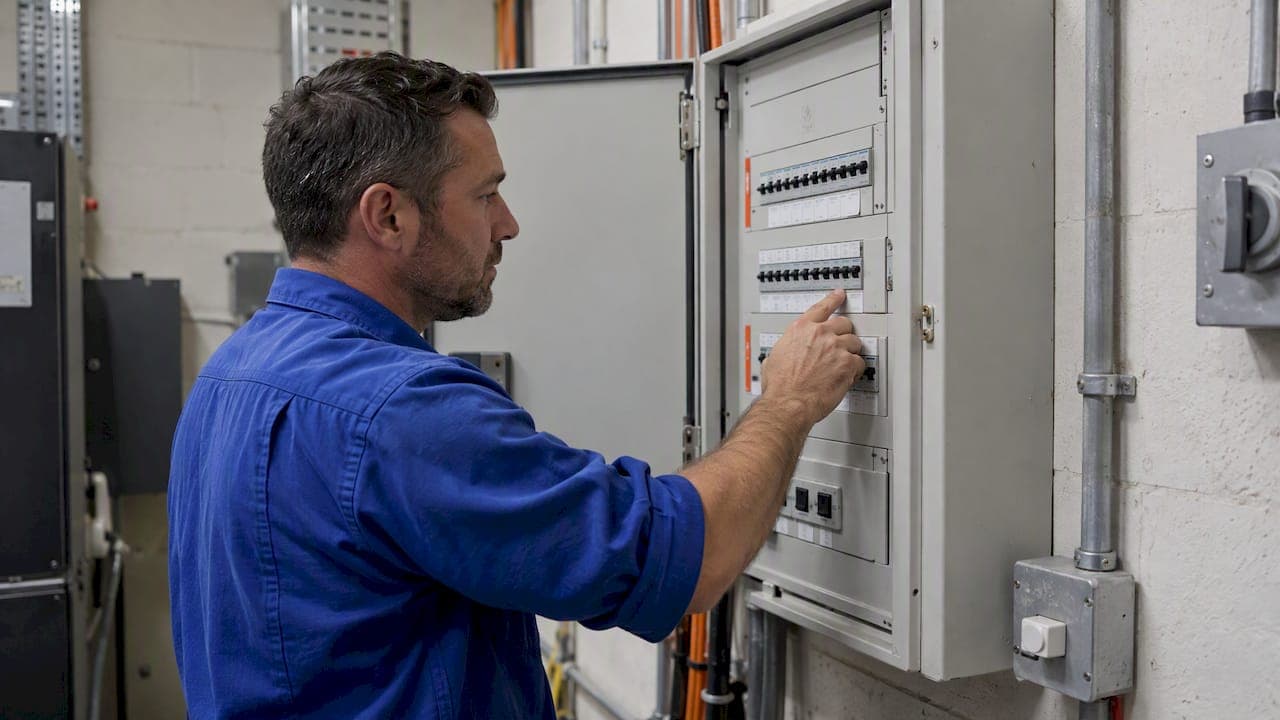
A compliant switchboard lets anyone, including a firefighter or a stranger in the dark, find the main switch and know what every circuit breaker controls. In Australia that comes from AS/NZS 3000 (the Wiring Rules), plus Victorian regulations that add specific warning labels for multiple supplies, solar and battery systems, and safety services. This guide covers what must be on your board, what inspectors flag, and what facility managers in aged care and retirement living need to check.
TL;DR
- The main switch must be marked and easy to tell apart from other switchgear. Every circuit breaker and RCBO must be identifiable and linked to the equipment or area it protects.
- Victoria adds mandatory warnings. Multiple points of supply need a zone diagram and a "not all wiring controlled from this main" warning. Solar and battery premises need a generation warning and isolator locations.
- A numbered list is not enough. Labels must be descriptive, durable and logical.
- Older boards in aged care and other workplaces may contain asbestos. Test for it before any labelling or upgrade work starts.
- Labelling is part of the safety system, not paperwork. Have a licensed electrician audit it.
Table of Contents
- Why labelling is a safety control, not a formality
- What AS/NZS 3000 expects on a switchboard
- Victorian warning labels you may need
- Asbestos on older switchboards: test before you label
- What this means for aged care, retirement villages and disability homes
- A quick self-check you can do in ten minutes
- Our perspective
- Getting your switchboard labelled correctly
- FAQ
- Sources
Why labelling is a safety control, not a formality
When a circuit trips, a tradie is called out, or a fire crew arrives, the first thing anyone does is look at the switchboard. If they cannot tell which breaker feeds what, they either guess or shut down more than they need to. In the worst case they leave a hazard live.
Energy Safe Victoria (ESV) treats this seriously. Its published list of electrical installation defects is a reminder that inspectors check installations against the Wiring Rules, and that unidentified circuits are a recurring finding. ESV's own technical note on common defects says the failure to label circuit breakers and RCBOs so they relate to specific equipment is repeatedly identified at switchboards, citing AS/NZS 3000:2018 Clause 2.10.5.2.
That last point catches many owners out. A single label on the door, or a faded pencil list, usually does not meet the standard.
What AS/NZS 3000 expects on a switchboard
AS/NZS 3000 is the national wiring standard, and Victorian electrical work is assessed against it. The headline labelling expectations are below. The clause numbers are the ones cited in the sources we used. Your electrician works from the full standard, which you must buy from Standards Australia.
The main switch
The supply to every installation must be controlled at the main switchboard by a main switch, or switches, that control the whole installation (Clause 2.3.3.2). That guidance comes from NSW, but it explains the Wiring Rules, which apply nationally. It also flags a common mix-up: a service protective device (the service fuse or similar) is not the same as a main switch, and mislabelling one as the other can lead to a wrong or partial shutdown in an emergency.
In practice that means:
- The main switch is clearly marked as the main switch.
- It stands out from the other switchgear, by grouping, colour or position, so it can be found and operated quickly.
- Nothing else on the board is labelled "main" by mistake.
If your board has a separate hot water main switch, as many homes do, it should be identified too. WorkSafe Victoria notes that electric hot water may have its own main switch that also needs to be turned off when isolating.
Circuit breakers, RCBOs and safety switches
Each circuit protective device should show what it protects. The ESV defect note ties this to the relationship between the device and the equipment or section it serves. Good labels are descriptive and logical:
| Weak label | Better label |
|---|---|
| 1, 2, 3, 4 | Kitchen power, Kitchen oven, Laundry power, Hot water |
| Lights | Lights, ground floor / Lights, upstairs |
| Spare (but wired) | Garage power and door opener |
| Aircon | Split system, living room |
If you have RCDs (safety switches), the label should also show which circuits sit behind each one. That helps when one trips repeatedly. Our guide to why safety switches trip shows how a clear board makes fault-finding faster, and RCD testing in Victoria explains the testing side.
Durability and legibility
Labels must last as long as the installation. Handwriting in biro on masking tape, stickers that curl in a hot meter box, and labels that fade in coastal sun are the usual culprits. Use engraved traffolyte, durable printed labels, or UV-stable laminated vinyl for outdoor enclosures. This is a workmanship point rather than a clause: the principle is that the information still has to be readable years later.
Clearance and access
A label no one can reach is no use. Industry commentary on the latest edition of the Wiring Rules notes a 1 m clearance in front of switchboards may be expected in new work; check this with your electrician for your specific board, because it depends on the installation type and date. Either way, if shelves, stored goods or a freezer block the door, emergency access is compromised.
Victorian warning labels you may need
Victoria adds its own requirements in the Electricity Safety (General) Regulations. ESV summarises these in its regulations toolkit page.
Multiple points of supply
A property with more than one point of supply (common with granny flats, dual occupancies, or sheds fed from a second connection) must display a zone diagram on the main switchboard. The board must also carry a permanent warning that not all wiring in the premises is controlled from that main switch.

Solar, battery and other generation
Where a premises has a consumer electricity generation system, the main switchboard must be clearly and permanently marked with a warning that the premises contains an electricity generation system. It must also show the location of all isolation switches for it. The requirement appears in the Victorian regulations consultation draft, so confirm the wording against the current regulations with your electrician before you order labels. This matters for firefighters, who need to know the roof array and batteries can still be live after the grid is off.
Safety services: "do not turn off in a fire"
Where a building has safety services such as emergency lighting, fire systems or essential life support equipment on the board, the relevant switches need rigid, upper-case, contrasting labelling to say they must not be turned off in a fire. Per ESV's guidance, mistaking a service protective device for the main switch is a frequent audit finding. Treat these labels as part of your emergency plan, not an afterthought.
Temporary isolation and "do not turn on" signs
During maintenance, isolation devices should be identifiable and accessible. If an isolation device cannot be locked, a sign must warn that work is under way and the power must not be turned on. WorkSafe says that after the main switch is locked off, a sign should be placed at the board warning against re-energising. Tags alone are weak: WorkSafe's guidance states a tag is not in itself an effective isolation device and a lock should be preferred. For a plain-English primer on this kind of precaution, see this electrical safety at home and work checklist. Note it is an Irish publication, so follow Australian and Victorian rules for the actual requirements.
Asbestos on older switchboards: test before you label
Older Victorian buildings, especially legacy aged care and workplace sites, can have switchboards with asbestos-containing backing boards or components. WorkSafe's compliance code says that once asbestos is identified, its presence and location must be clearly indicated and the asbestos register kept current.
For you, the practical rule is simple. If the board is old, ask for an asbestos check before any upgrade or relabelling. Drilling, cutting or even removing old labels may disturb material. If asbestos is found, the board gets a warning label for contractors and the register is updated. Do not do this work yourself.
What this means for aged care, retirement villages and disability homes
Facility managers carry a heavier load. Boards are larger, circuits serve critical equipment, and the people who respond to an outage may be agency staff, emergency services or a new contractor at 2 am.
The Aged Care Quality and Safety Commission's emergency and disaster management standard requires providers to plan for risks to the health, safety and wellbeing of residents and workers. Clear identification of isolation points and emergency power sources is a practical part of that planning. It means responders can operate critical infrastructure without delay.
A sensible facility checklist:
- Main switch and each sub-board identified, with the board's location recorded in your emergency plan.
- Circuits mapped to areas and critical equipment: nurse call, lifts, medication fridges, emergency lighting, oxygen concentrators, hot water.
- Safety service switches labelled as not to be turned off in a fire.
- Generator or battery changeover points labelled, with the isolation sequence shown.
- Solar and battery warnings and isolator locations displayed at the main board.
- Asbestos status known for every older board.
- Labels checked after every change, including after additions, refits and upgrades.
We cover the bigger picture in our article on residential aged care switchboard upgrades, and the outage side in power outage checks for homeowners and facility managers.
A quick self-check you can do in ten minutes
You are not doing electrical work by looking. Do not open covers or touch wiring. Stand at the board and ask:
- Can I reach it without moving anything, and is the door fully openable?
- Can I point to the main switch within seconds?
- Does every breaker have a legible label that names a room, appliance or function?
- Are there blank or "spare" breakers that actually feed something?
- Are there handwritten changes, peeling stickers, or labels from a previous owner or tenant that no longer match?
- If I have solar or a battery, is there a warning and an isolator location shown?
- Does the property have a second supply (granny flat, shed, second meter) and a zone diagram?
If you answer "no" or "not sure" to any of these, book a licensed electrician. A qualified person can trace the circuits and relabel them correctly. Guessing from the breaker you think you flicked last time is how labels end up wrong.
Our perspective
We see switchboards across the Mornington Peninsula from beachside holiday homes to care facilities, and the most common problem is not a missing label but a wrong one. A previous electrician added a circuit, a tenant swapped an appliance, and the board kept the old story. Wrong labels are worse than none, because people trust them.

When we audit a board, we trace circuits rather than reading the existing legend. We label to describe function, make sure the main switch and any safety services are unmistakable, and flag solar, battery and second-supply warnings. In older buildings, we raise asbestos before anyone picks up a tool.
For facility managers, our advice is to treat labelling as a standing item in your maintenance schedule, not a one-off job. It costs little compared with a delayed emergency response, and it is one of the easiest things an auditor can see. Pair it with a regular electrical safety inspection and a switchboard audit and you will catch most issues before they matter.
— Mike
Getting your switchboard labelled correctly
DualFlow Services provides electrical services for homes, businesses, aged care, retirement villages and disability care homes across the Mornington Peninsula and surrounding Melbourne suburbs. That includes compliance checks, scheduled maintenance and 24/7 emergency call-outs. Because we also cover plumbing and heating and cooling, one team can handle the hot water and HVAC circuits on your board too. Prices are quoted per job, so contact us to book.
Our wider background on Victorian rules is in why Victoria's electrical safety regulations matter and benefits of regular electrical inspections.
FAQ
Can I label my own switchboard?
You can add a clearer legend for your own reference, but circuit identification that forms part of compliant electrical work should be done by a licensed electrician. They can confirm what each breaker actually feeds and use durable labels that match the standard. Never open covers or trace wiring yourself.
What must be on a main switchboard in Victoria?
At minimum, a clearly identified main switch and labelled circuit protective devices. Depending on the property, you may also need a zone diagram and a warning for multiple supplies, a generation system warning with isolator locations, and safety service labels. Ask your electrician which apply to your site.
Are handwritten labels acceptable?
Only if they are legible, permanent and accurate, which handwritten tape rarely is. Faded or peeling labels fail the intent of the standard, which is for information to remain readable throughout the life of the installation. Replace them with engraved or durable printed labels.
Do I need to relabel after installing solar or a battery?
Yes. Victorian rules call for a permanent warning at the main switchboard that the premises contains a generation system, along with the location of its isolation switches. Your installer should provide this, so check it is on the board before you sign off.
Sources
- Electrical installation defects, Energy Safe Victoria
- EIS 007 common electrical defects, Energy Safe Victoria
- Location and identification of the Main Switch, NSW Government
- Preventing electric shocks when working in ceiling spaces, WorkSafe Victoria
- Electricity safety general regulations, Energy Safe Victoria
- Part 1 Preliminary, proposed Electricity Safety (General) Regulations consultation draft
- Energy Safe Victoria
- Preventing electric shocks to electricians, WorkSafe Victoria
- Lock out and tagging of plant, WorkSafe Victoria
- Managing asbestos in workplaces, WorkSafe Victoria
- Emergency and disaster management, Aged Care Quality and Safety Commission