Check the switchboard first: if a safety switch (RCD) or circuit breaker has tripped, unplug everything on that circuit and try one reset. If it holds, restore devices in stages to find the culprit. If it trips again with nothing plugged in, or won't reset at all, stop and call a licensed electrician. Any burning smell, smoke, hot switchboard or shock means the same thing, immediately: this is an emergency call‑out, not a DIY job.
TL;DR:
- If the safety switch trips with nothing plugged in, the fault likely lies in the wiring, switchboard, or RCD itself, requiring an electrician's inspection.
- Signs such as burning smell, smoke, hot switches, or shocks demand immediate professional response and can indicate dangerous faults needing urgent fixes.
- Reconnecting devices gradually after a trip helps identify faulty appliances, but if the circuit trips again without load, the issue probably resides in internal wiring or equipment.
- Power should be restored gradually, starting with the main breaker, then circuits individually, while avoiding stress on high-load appliances to prevent damage.
- Always contact a licensed electrician for repairs, especially if the RCD fails tests or if you observe damage, as DIY fixes can be unsafe and may lead to house fires or electric shocks.
Table of Contents
- Stepwise checks you can do safely at the switchboard
- Signs you should stop testing and call an emergency electrician
- How to safely switch power back on and verify circuits
- Quick actions for facility managers and business owners
- How to identify and safely inspect your switchboard and safety switches
- How to isolate circuits and test for nuisance tripping
- Is the outage limited to your property or wider than that?
- Checking your main electrical meter and confirming supply
- Using a non‑contact voltage tester without touching live parts
- When to check with your electricity provider directly
- Ruling out blown fuses and downed power lines on your property
- Staying safe during a blackout while you wait
- What an electrician will do next (and why leaving it off matters)
- Get an electrician to your property fast when DIY checks run out
- Sources
- FAQ
Stepwise checks you can do safely at the switchboard
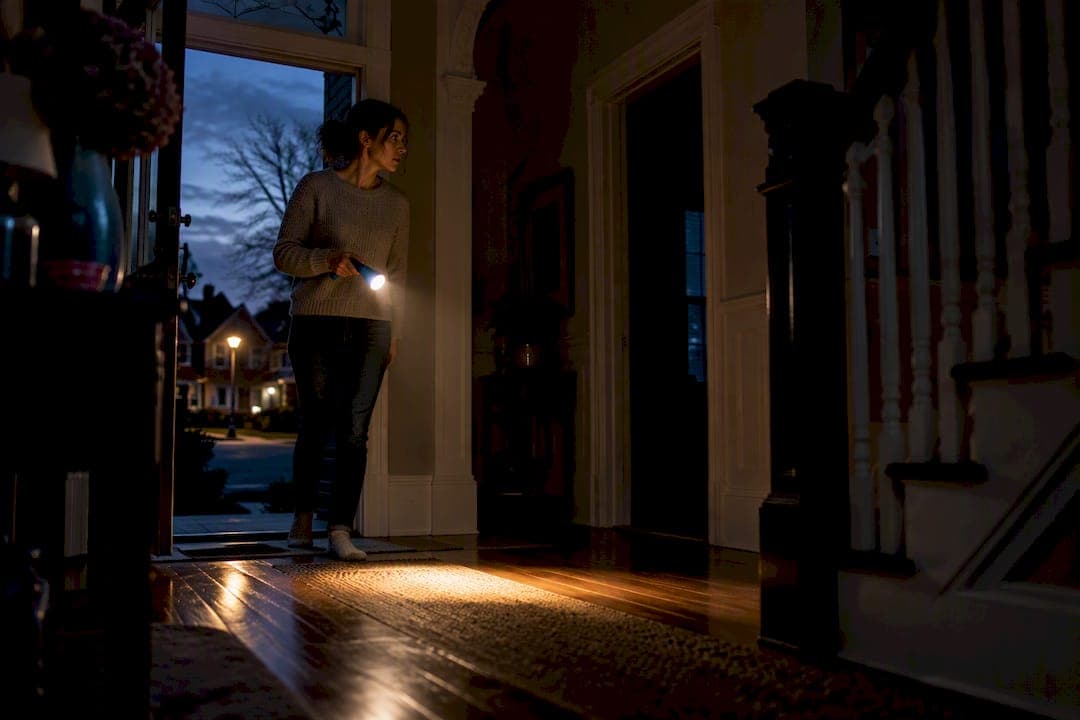
Before touching anything, tell the household or staff what's happening, especially if someone relies on medical equipment or is in the dark. Grab a torch rather than a phone light. You want both hands free and good visibility on the switchboard, not a dim glow and guesswork.
- Unplug everything on the affected circuit. Lamps, appliances, powerboards, the lot. A tripped switch is often just one faulty appliance dragging the whole circuit down with it.
- Reset the relevant RCD or circuit breaker. Flick it firmly to the "on" position. If you're not sure which switch controls which room, check the labels on the switchboard door, they're usually there for exactly this moment.
- If it holds, reconnect devices gradually. Plug items back in one at a time, or in small batches, waiting a minute between each. When the switch trips again, you've found your faulty appliance.
- If it trips again with nothing plugged in, leave it off. That points to a fault in the fixed wiring, the switchboard, or the RCD itself, not an appliance, and forcing a reset only masks a genuine circuit, switchboard or device fault.
- Stop there. Don't open the switchboard cover, poke at terminals, or try a second or third reset "just to be sure." That's a licensed electrician's job from this point.
This is where most people either sort the problem themselves in ten minutes, or realise pretty quickly that they need to book help.
Pro Tip: Write down which circuit tripped and how many times it happened before you called. That single detail lets an electrician bring the right test gear on the first visit instead of guessing.
Signs you should stop testing and call an emergency electrician
Some symptoms mean you shouldn't keep troubleshooting at all, regardless of how confident you feel with a torch and a switchboard diagram.
- A burning smell, visible smoke, or scorch marks and discolouration around power points or the switchboard.
- The switchboard or an outlet feels warm or hot to touch.
- Buzzing, crackling, or arcing sounds coming from the board or a fitting.
- The safety switch won't reset even after every circuit breaker is switched off.
- Anyone feels a shock or a persistent tingle from a tap, appliance, or switch, which the Electrical Safety Office treats as serious enough to warrant contacting your distributor and a licensed electrician immediately.
- The safety switch keeps tripping after rain or a storm, which usually means moisture has found its way into wiring or fittings.
One figure worth knowing: safety switches are meant to be tested every three months using the "T" or "Test" button, and a switch that fails that test isn't protecting anyone, it needs replacing, not monitoring.
None of these signs are "wait and see" situations. They're the difference between a $200 callout and a house fire.
How to safely switch power back on and verify circuits
Power coming back on is when a lot of secondary damage actually happens, because people flick everything on at once and stress the system that's just recovered.
Switch the main breaker on first, then bring circuits back one at a time, pausing between each rather than flipping the whole board in one go. This staged approach, along with switching off or unplugging appliances before restoring power, is standard advice after any outage.
- Leave high‑load appliances like the fridge, freezer, or air conditioner switched off at the wall for two to three minutes before turning them back on, to avoid stressing the compressor.
- Test every RCD with its built‑in test button once circuits are live again.
- Treat a failed RCD test as a call‑an‑electrician result, not a "check again later" result.
- If you have solar panels, isolate the system through the inverter's safe isolation procedure before doing anything at the switchboard, don't assume the grid outage means the solar side is dead too.
Quick actions for facility managers and business owners
A power outage in a business, aged care home, or retirement village carries different stakes than a house losing the porch light. Vulnerable residents, medical fridges, and compliance obligations all raise the bar on how you respond.
- Log the incident: time it happened, which circuits were affected, and exactly what you observed (smell, noise, how many resets attempted).
- Notify your on‑site safety officer or manager before doing anything else.
- Isolate non‑essential loads and protect vulnerable residents first, then arrange backup power if the outage is likely to run long.
- If the RCD fails to reset or anyone reports a shock, keep that circuit isolated and book an emergency call‑out rather than attempting a second test.
- Hand the attending electrician your incident log, including test results and timing, so the visit is diagnosis, not discovery.
- After any repair, request the Certificate of Electrical Safety for your compliance records, particularly if you operate under aged care or disability service obligations.
Pro Tip: If a safety switch trips at roughly the same time every night, ask whether you're on a controlled‑load hot water circuit. That timing pattern is one of the fastest ways an electrician narrows down the cause before they've even opened the switchboard.
How to identify and safely inspect your switchboard and safety switches
Most switchboards sit in a garage, hallway cupboard, or meter box outside, and they're usually labelled, even if the labels are decades old and half‑illegible. Open the board cover (the cover only, never the panel behind it) and you'll typically see a main switch, a bank of circuit breakers, and one or more RCDs, sometimes combined as an RCBO that does both jobs in one device.
RCDs are usually the switches with a small "T" or "Test" button on the front, distinct from the plain toggle breakers either side. If your board is old enough to have no RCD at all, that's worth flagging to an electrician regardless of the current outage, since modern safety switch requirements exist precisely because older boards without them offer no protection against electric shock.
Look, don't touch, beyond the switches themselves. Scorch marks, a melted look around any breaker, or a switch that's physically stuck halfway are all reasons to call an electrician rather than force anything. A healthy board should look clean, with switches sitting cleanly in either the "on" or "off" position, not jammed in between.
If your board has no labels, or the labelling clearly doesn't match your circuits anymore, that's a job for a scheduled switchboard audit rather than something to sort out mid‑outage.
How to isolate circuits and test for nuisance tripping
Isolating a circuit means switching off the individual breaker or RCD for that section of the house, not the main switch, and definitely not opening the board to disconnect wiring by hand. That distinction matters because everything past the switch faces is live, and none of it is a homeowner task.
A genuine nuisance trip usually shows a pattern: it happens when a specific appliance runs, or during storms, or always on the same circuit. Isolate that one circuit, leave everything else running, and see whether the rest of the property behaves normally. If it does, you've confirmed the fault sits on that single circuit rather than in the switchboard or main supply.
To test properly, switch the suspect RCD off, then back on with nothing plugged into that circuit. If it trips immediately with no load at all, the fault is almost certainly in the fixed wiring or the switchboard itself, not an appliance, and that's your signal to stop testing.
Never use a screwdriver, knife, or any other tool to probe inside the switchboard, and never remove a breaker or RCD from its mounting to "check the wiring." That's live work, full stop, and it's exactly the kind of DIY step that turns a $250 callout into a hospital visit. Isolation testing is about switching things off and on in a logical sequence, observing what happens, and reporting that sequence to a qualified professional.
Is the outage limited to your property or wider than that?
The fastest way to separate an internal fault from a network problem is to check whether your neighbours still have power. Step outside, look at streetlights, and check whether other houses on your street have lights on. If everyone around you is dark too, this isn't a switchboard issue at all. It's a supply outage, and no amount of resetting your own board will fix it.

If your neighbours have power and you don't, the fault is almost certainly inside your own property, which shifts the whole troubleshooting approach toward the switchboard checks covered earlier rather than waiting on network repairs.
Business owners and facility managers should factor in a middle scenario too: sometimes only part of a building loses power while an adjoining property or a different tenancy on the same site stays lit. That pattern usually points to a fault on your specific supply connection or metering, rather than the wider street network, and it's worth checking with neighbouring tenants or building management before assuming it's your internal wiring alone.
A partial power outage in a house, where one room or one power point stops working while the rest of the house is fine, is a strong sign the fault sits on a single circuit rather than the whole switchboard. That's a good result, in a sense: it narrows the job for whoever ends up looking at it, whether that's you doing the isolation checks above or an electrician doing something more involved.
Checking your main electrical meter and confirming supply
The meter box is usually separate from the switchboard, sometimes mounted outside on an exterior wall, and it's where the utility's supply physically enters your property before reaching your switchboard.
Have a look at the meter's display. A digital meter that's completely blank, with no lights, numbers, or activity at all, tells you something different to a meter that's clearly running and displaying normally. If the meter's alive and reading but your house has no power, that strengthens the case for an internal fault. If the meter itself looks dead, that leans toward a supply issue upstream of your property.

Don't open the meter box beyond looking through the window or lifting an unlocked inspection cover. The meter and the supply cable feeding it belong to the network distributor, not you, and tampering with either is both dangerous and, in most cases, not something you're legally permitted to do.
If you can see obvious physical damage near the meter, a cracked box, a chewed cable, evidence of an animal or vehicle strike, treat that as a job for the distributor or an electrician straight away rather than something to fix yourself. Photograph it if it's safe to do so from a distance, since that photo speeds up whoever attends next, whether that's a network technician or a tradesperson booked to look at your side of the connection.
Using a non‑contact voltage tester without touching live parts
A non‑contact voltage tester (sometimes called a voltage sniffer) is genuinely one of the few pieces of test gear a careful homeowner can use safely, because it works without any physical contact with wiring or terminals. You hold the tip near a cable, outlet, or switch, and it beeps or lights up if voltage is present, nothing more.
Use it to check whether a power point is actually dead before you assume a circuit is safe, or to confirm a switch has genuinely killed power to a fixture before someone works near it. Run the tip close to the front of an outlet or along a visible cable run, and treat any beep or light as "this is live, leave it alone."
What it won't do is diagnose a fault, measure how much current is leaking, or tell you anything about the condition of insulation inside a wall. That's the job of proper test instruments like insulation resistance testers and clamp meters, which sit firmly in licensed electrician territory. A non‑contact tester is a safety check before you go near something, not a diagnostic tool, and it's not a substitute for surge protection either, since surge protectors and safety switches do different jobs entirely and neither replaces the other.
If you don't own one, they're inexpensive and worth keeping in a kitchen drawer. If you do own one and it shows voltage somewhere you expected none, that's information for the electrician, not a cue to keep investigating yourself.
When to check with your electricity provider directly
Once you've confirmed the outage isn't limited to your property, checking your neighbours' power is a good first filter, the next move is contacting your electricity distributor rather than your energy retailer. These are usually two different organisations: the retailer sends your bill, the distributor owns the poles, wires, and infrastructure that actually deliver power to your street.
Most distributors run outage information lines and online outage maps that show known faults, planned works, and estimated restoration times for affected areas. If a storm has taken down infrastructure nearby, this is usually the fastest way to find out whether crews are already on site and roughly how long you're looking at.
Business owners managing time‑sensitive operations, refrigeration, medical equipment, aged care residents, should treat this check as a priority step, not an afterthought, because it tells you whether you're planning around minutes or hours. If restoration is expected soon, that changes decisions around backup power, evacuating perishables, or standing down non‑essential staff.
Keep your distributor's outage line saved in your phone before you need it. Fishing for a number during a blackout, on a phone that's losing charge, is a bad time to discover you don't have it.
Ruling out blown fuses and downed power lines on your property
Older properties sometimes still run fuse wire rather than modern circuit breakers, and a genuinely blown fuse looks different to a tripped switch, you'll usually see a scorched or broken wire inside the fuse holder rather than a switch that's simply flicked to "off." If your board still uses fuse wire, that's worth mentioning to an electrician regardless of the current fault, since fuse boards are well past their practical use, and replacing a blown fuse yourself means handling exposed wiring, which isn't a safe DIY task.
Downed power lines are a different order of problem entirely. If you see a fallen line anywhere on your property, on the ground, tangled in a fence, draped over a tree, treat it as live regardless of how it looks or whether the street seems to have power. Keep everyone, including pets, well back, don't attempt to move it with anything, and report it to your electricity distributor immediately rather than your usual electrician.
The same caution applies to anything touching a downed line, a car, a trampoline, a garden shed. Assume it's electrified until a professional confirms otherwise, and don't approach it to "just check." This is one of the very few genuinely universal rules in home electrical safety: downed lines are always someone else's job to make safe first.
Staying safe during a blackout while you wait
However long the outage runs, a few habits keep a blackout from becoming a second, separate problem.
Use torches or battery lanterns rather than candles wherever possible, open flames and a dark, unfamiliar house are a bad combination, especially with kids or elderly residents moving around. Keep phones charged where you can, and know where your torch actually lives before you need it in the dark.
If you're using a portable generator, run it outdoors only, well away from windows and doors, never in a garage even with the door open. Generator exhaust contains carbon monoxide, and enclosed or semi‑enclosed spaces let it build up fast enough to be genuinely deadly. Never connect a generator directly into your switchboard or house wiring without a properly installed transfer switch, backfeeding power into your home's circuits can electrocute utility workers repairing the very fault you're waiting out.
Facilities running medical equipment, oxygen concentrators, refrigerated medication, dialysis gear, should have a documented backup power plan before an outage happens, not during one. If you don't have that plan yet, treat this outage as the reminder to build it.
What an electrician will do next (and why leaving it off matters)
Once you've handed a fault over, the electrician's process looks quite different from the checks you've just run, and understanding that gap is useful, because it explains why "just try resetting it again" isn't actually helpful advice at that point.
They'll typically run an insulation resistance test, measuring resistance in megohms across each circuit, to find wiring that's degraded or picking up moisture. They'll isolate and test board sections individually, and often run a clamp leakage test to measure exactly how much current is escaping where it shouldn't. These produce hard numbers, not guesses, insulation resistance and clamp leakage readings are the standard way electricians separate a genuine nuisance trip from a developing insulation failure.
From there, the fix is usually one of a few things: replacing a faulty appliance you'd missed, repairing or rewiring a damaged cable section, replacing a failed RCD, or in older properties, recommending a full switchboard upgrade.
When you book the visit, give the dispatcher the details you gathered earlier: which circuit trips, whether the RCD failed its test button, whether anyone noticed a burning smell, and how many times you attempted a reset. That single call, backed by good notes, is usually what separates a fifteen‑minute diagnosis from an hour of the electrician retracing steps you'd already ruled out.
Get an electrician to your property fast when DIY checks run out
Emergency electrician call‑outs are available 24/7 across the Mornington Peninsula and surrounding Melbourne suburbs, covering exactly the point where this checklist ends and a licensed trade needs to take over. Beyond emergencies, scheduled RCD testing and full switchboard audits are also handled, so a fault like this doesn't have to become a recurring guessing game every few months.

When you call, the details you've already gathered speed things up: which circuit tripped, whether the safety switch failed its test button, whether you noticed any burning smell or heat at the board, and how many resets you attempted before stopping. That's the same information an attending electrician needs anyway, so handing it over at booking means less time diagnosing on site and more time fixing the actual problem.
For homes, businesses, aged care facilities, retirement villages, and disability care homes, that one‑stop coverage across plumbing, electrical, and heating and cooling work means one call gets a tradesperson out, rather than juggling separate contractors for different trades on the same visit. If your switchboard has failed a check today, book a call‑out through the Dualflowservices site now rather than waiting to see if the fault fixes itself.
FAQ
What's the first thing to check during a power outage?
Check your switchboard for a tripped safety switch (RCD) or circuit breaker, then check whether neighbouring properties still have power. If your neighbours are lit up and you're not, the fault is almost certainly inside your own wiring rather than a network issue.
Why do my lights flicker before or during an outage?
Flickering usually points to a loose connection, an overloaded circuit, or voltage fluctuation on the network, and dull or flickering lights can also signal a surge that a standard surge protector won't fully guard against. Persistent flickering across multiple rooms is worth mentioning when you book an electrician, since it can indicate a fault upstream of individual circuits.
My circuit breaker is on but I still have no power. What does that mean?
This usually means the fault sits with an RCD rather than the breaker itself, or that the affected circuit has a separate isolation point that's still switched off. Check each RCD on the board individually and confirm the meter is actually reading supply before assuming the whole property has lost power.
How often should I test my home's safety switch?
Safety switches should be tested every three months using the built‑in "T" or "Test" button, and any switch that fails to trip on that test needs replacing by a licensed electrician rather than continued reliance.
When should I call an emergency electrician instead of troubleshooting further?
Call immediately if you smell burning, see smoke or scorch marks, feel a shock from any appliance or tap, or if the safety switch won't reset even with every circuit breaker switched off. Emergency electrical call‑outs are available across the Mornington Peninsula for exactly these situations, alongside scheduled RCD testing and switchboard work.