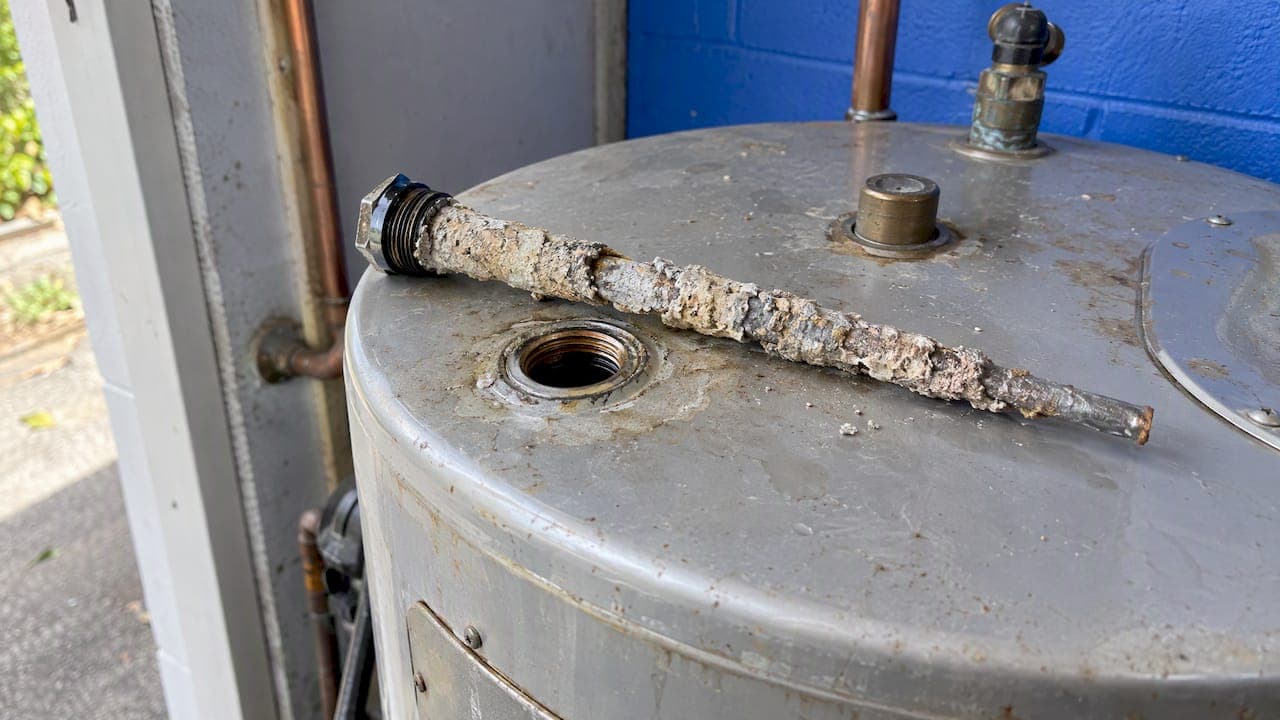
A hot water anode is a sacrificial rod inside your storage tank. It corrodes so the steel tank doesn't. Most Australian manufacturers say to have it inspected at around the five-year mark, and sooner if your water is softened, bore or tank supplied. Replace it on time and you protect the tank. Leave it until it's gone and the tank itself starts to rust.
This guide explains how the anode works, which systems have one, how to tell when it's worn, what the manufacturers' schedules say and what to expect from a replacement. We're a plumbing, electrical and heating and cooling team on the Mornington Peninsula, so we've written it for Victorian homes, businesses and care facilities.
TL;DR
- The anode is a sacrificial metal rod that corrodes in place of your tank, which helps the cylinder last longer.
- Manufacturer schedules in Australia typically call for inspection or replacement at about five years. Shorter intervals apply for softened, bore or tank water.
- Your warranty may depend on it. Some tank warranties require a documented anode replacement by an authorised agent.
- The correct anode material depends on your water's total dissolved solids (TDS), so a generic rod from a hardware shelf isn't always the right one.
- Anode work involves stored hot water, pressure and sometimes 240 V wiring, so it belongs with a qualified tradesperson.
Table of Contents
- What a hot water anode does
- Which hot water systems have an anode
- Anode types and why your water matters
- How often to replace a hot water anode
- Warranty: why the schedule matters
- Signs your anode is worn out
- What replacement involves
- What affects the cost
- Anode or new tank?
- Anodes in aged care, retirement villages and commercial sites
- Our perspective
- Book an anode check with DualFlow
- FAQ
- Sources
What a hot water anode does
The steel tank holding your hot water is lined with glass-like enamel, but no lining is perfect. Tiny gaps expose bare steel to hot, mineral-laden water, and that's where rust starts. The anode is there to give the water something else to attack.
Rinnai Australia describes it simply: the anode rod slowly corrodes while protecting the cylinder, which helps the water heater last longer. A. O. Smith explains the mechanism as cathodic protection: the anode and the steel form a low-resistance circuit, and because the two metals differ in electrical potential, the anode gives up its material first.
That's why the rod is called sacrificial. Its whole job is to be used up. When it's gone, the protection stops, and the tank becomes the next thing to corrode.
Which hot water systems have an anode
Anodes belong to storage systems, meaning anything with a tank of hot water held ready for use. That includes electric storage tanks, gas storage tanks and many heat pump units. Rinnai notes that its electric storage tanks have sacrificial anodes, and that anode replacement is part of gas-storage servicing.
Continuous flow (instantaneous) gas units don't hold a tank of water, so they have nothing for an anode to protect. If you're not sure what you have, the compliance plate on the unit or the model number will tell you whether it's a storage system. Swift and similar brand questions come down to the same check: look up your exact model's manual.
Solar systems with a storage tank also rely on one. Our guide to solar hot water servicing covers the other checks that go with it.
Anode types and why your water matters
Anodes are usually a metal rod, commonly magnesium or aluminium based, with a steel core. Which one suits your tank depends on how mineral-rich your water is, measured as TDS in milligrams per litre.
Rinnai's guidance is that its factory-fitted anode is magnesium based, and that an aluminium-based anode is required when TDS exceeds 600 mg/L. Its installation guide for storage tanks says the same: magnesium suits TDS up to 600 mg/L, and aluminium alloy is required above it.
Rheem publishes a finer scale in its plumbers' handbook, with anode colour matched to TDS:
| Water TDS (mg/L) | Rheem anode colour |
|---|---|
| 0 to 40 | Green |
| 40 to 150 | Green or black |
| 150 to 400 | Black |
| 400 to 600 | Black or blue |
| 600 to 2500 | Blue |
According to the same Rheem plumbers' handbook, above 2500 mg/L there is no cylinder warranty under that guidance. Those colours are Rheem's own coding, so don't assume another brand's rod follows the same scheme.
The practical point: the right anode is a match between your tank model and your local water. Our plumbers check both before fitting.
How often to replace a hot water anode
There's no single number that fits every tank, but the manufacturers are consistent about the ballpark.
- Rinnai recommends that an authorised person inspect the anode at least every five years.
- Rheem says to replace the anode at the five-year service. If it isn't replaced then, the plumbers' handbook says to replace it no later than 8 to 10 years, depending on the model.
- Softened, desalinated or alternating supplies are harder on anodes. Rheem's handbook says to replace within five years of installation and every five years after that.
- Newer Rheem heat pump guidance is stricter again. Its 2025 owner's guide requires inspection, and replacement if there is any depletion, at the five-year major service. For softened, variable, tank-water or bore and public supplies it sets inspection within five years of installation and within three years after that. For other supplies it sets a maximum of ten years after installation.
The Australian Government's YourHome guide also lists checking and replacing corroded sacrificial anodes in hot water tanks as part of regular home maintenance.
So the honest answer to "how long does an anode last?" is: often somewhere between three and ten years, shaped by your water, your tank and the manufacturer's schedule. Your manual beats any rule of thumb, ours included.
A quick way to plan it
- Find your tank's install date on the compliance plate.
- Look up your model's manual for the anode interval.
- If you're on a bore, tank, softened or otherwise variable supply, assume the shorter interval.
- Book the inspection for the year before it falls due, not the year after.
Warranty: why the schedule matters
Anode servicing isn't only good practice. On some tanks it's a condition of cover. Bosch Australia's conditional 10-year tank warranty, for example, requires an authorised service agent to replace the sacrificial anode in the fifth year and keep the service receipt.
That's one brand's terms, but it shows why you shouldn't treat the anode as an optional extra. If your tank carries an extended warranty, read the maintenance clause and keep every invoice. A missing receipt can be the difference between a covered tank and a bill for a new one.
Signs your anode is worn out
You can't see the anode without opening the tank, so the signs are mostly indirect. Watch for:
- Rusty or discoloured hot water, especially first thing in the morning.
- A metallic taste or smell from the hot tap only.
- Rumbling, popping or noisy heating from sediment building in the tank.
- A tank approaching or past the manufacturer's five-year mark with no service record.
These symptoms can have other causes, such as old pipework or element scale, so they're a reason to get it checked rather than a diagnosis.
When the anode is inspected directly, one published rule of thumb from an A. O. Smith service manual says replacement is indicated if most of the rod is thinner than 3/8 inch or about a third of the support wire shows. That's a US-brand figure for its own tanks, so a plumber should judge your rod against your manufacturer's specification.
If your hot water has stopped altogether, start with our no hot water troubleshooting guide. If you can see water around the base of the tank, read what to do first when a hot water system is leaking and shut off the supply.
What replacement involves
An anode replacement is quick for a tradesperson, but it isn't a casual job. The steps run roughly like this:
- Isolate the power or gas supply and shut off the cold water inlet.
- Relieve pressure and drain enough water to access the anode, handling stored hot water safely.
- Remove the old anode and check its condition, which tells you how your water is treating the tank.
- Fit the correct anode for the tank model and local TDS, and reinstate the seal.
- Refill, bleed air, restore power or gas, and confirm the system heats and doesn't leak.
That sequence matches how a published anode replacement method statement describes the job, and it calls for a licensed plumber.
The warnings from manufacturers are blunt. Rheem states that anode changes must be done by a qualified person. Its guide also notes that opening electrical access covers exposes 220 to 240 V wiring, and that the heater must never run without its safety devices fitted and working.
There's a second reason to book a trade rather than attempt it yourself: a seized anode can be very tight, and a stripped fitting can turn a small job into a tank replacement. Because the tank is also holding water well above safe tap temperature, scalding is a real risk. Our guide to preventing hot water scalds explains why, and tempering valves are worth checking at the same visit.

What affects the cost
We don't publish fixed prices for anode work, because the job changes with the tank. The factors that move a quote are:
- Anode type. A standard magnesium or aluminium rod costs far less than a powered anode.
- Tank access. A tank in a tight roof space or cupboard with little headroom above the anode takes longer than one in an open garage.
- Condition of the fitting. A seized or corroded anode port adds time and risk.
- Bundling. Replacing the anode during a scheduled service usually makes more sense than a separate call-out.
- Call-out timing. Planned work during business hours costs less to arrange than an after-hours emergency.
The part itself is usually a small share of the total. Most of the cost is the plumber's time, draining and refilling the tank, and testing afterwards. For a firm number, ask for a written quote that names the anode type and says whether it's supplied and fitted.
Anode or new tank?
Replacing an anode only helps if the tank is still sound. If the anode has been gone for years and the tank is already leaking from the shell, a new anode won't fix it. A fresh rod can't repair rust that has already eaten through steel.
Signs the whole system may be nearing the end, such as leaks, repeated element failures or a tank well past 10 years, are worth weighing against the cost of replacement. Strong Heating and Cooling has a useful list of signs you need a new water heater that helps frame that decision.
Our approach is to inspect first. If the tank is healthy, a new anode is the cheapest way to buy it more years. If it isn't, we'll say so plainly and quote the replacement.
Anodes in aged care, retirement villages and commercial sites
For facilities with large storage systems, an anode is more than a household chore. Hot water failure affects residents' daily care, and water temperature management is tied to health and safety obligations. Anode checks fit naturally into a scheduled maintenance plan alongside temperature testing, tempering valve checks and Legionella controls.
If you manage a facility, our guides on plumbing compliance in aged care in Victoria and Legionella prevention systems show how these checks fit together. For food businesses, our restaurant hot water temperature checklist covers the compliance side.
Our perspective
We see the same pattern on the Peninsula again and again. A tank fails at year eight or nine, the owner says it never gave any trouble, and when we open it up the anode was spent years earlier. The tank was fine for a long time, and then it wasn't.
The anode is the cheapest part of a hot water system and the one most often forgotten. That's why we build it into scheduled maintenance rather than waiting for a call-out. One visit can cover the anode, the tempering valve, the pressure relief valve and a check of the electrical supply to the unit.
Because we are plumbing, electrical and heating and cooling under one roof, we don't need to hand you between trades when a job crosses over. A heat pump or electric tank anode check often touches wiring as well as water, and we can handle both. For care facilities and retirement villages, we also offer 24/7 emergency availability, so a hot water failure isn't left waiting until Monday.
Our advice: know your install date, know your manufacturer's interval, and book the check before it's due.
Mike
Book an anode check with DualFlow
If your tank is approaching five years, or you don't know how old it is, we can inspect the anode, confirm the right type for your water and replace it as part of a scheduled service. We work with homeowners, businesses, aged care facilities, retirement villages and disability care homes across the Mornington Peninsula and surrounding Melbourne suburbs.

See our plumbing services or contact DualFlow Services to book a visit or arrange emergency call-out.
FAQ
What is the purpose of an anode in a hot water heater?
It protects the tank from rust by corroding in its place. The anode is made of a more reactive metal than the steel, so the water attacks it first. When it's used up, the tank becomes the target.
How much does it cost to replace an anode rod?
The price depends on the anode type, how easy the tank is to reach and whether the job is done with a service. The rod is usually the smaller part of the bill, with labour and testing making up most of it. Ask for a written quote that says what's included.
Do all hot water systems have an anode?
No. Storage tank systems do, including electric, gas storage and many heat pump units. Continuous flow units don't hold a tank of water, so they have no anode. Check your model's manual to be sure.
Can I replace a hot water anode myself?
We'd advise against it. Manufacturers such as Rheem state that anode changes must be done by a qualified person, and the job involves stored hot water, pressure and sometimes mains-voltage wiring. A warranty may also require a documented service by an authorised agent.
How do I know which anode my tank needs?
It depends on the tank model and your water's TDS. Magnesium rods suit lower-TDS water, while aluminium alloy is required above 600 mg/L for some brands. A plumber can check your model and local water before fitting.
Sources
- Frequently Asked Questions - Hot Water, Rinnai Australia
- Safety Features in Tank Water Heaters, A. O. Smith
- Hotflo electric hot water service installation guide
- Plumbers' Handbook 2017, Rheem Australia
- Owner's Guide and Installation Instructions, Rheem heat pump 2025
- Repairs and maintenance, YourHome
- 10 Year Tank Warranty, Bosch Australia
- Anode rod inspection, A. O. Smith service manual
- Hot Water Anode Replacement SWMS