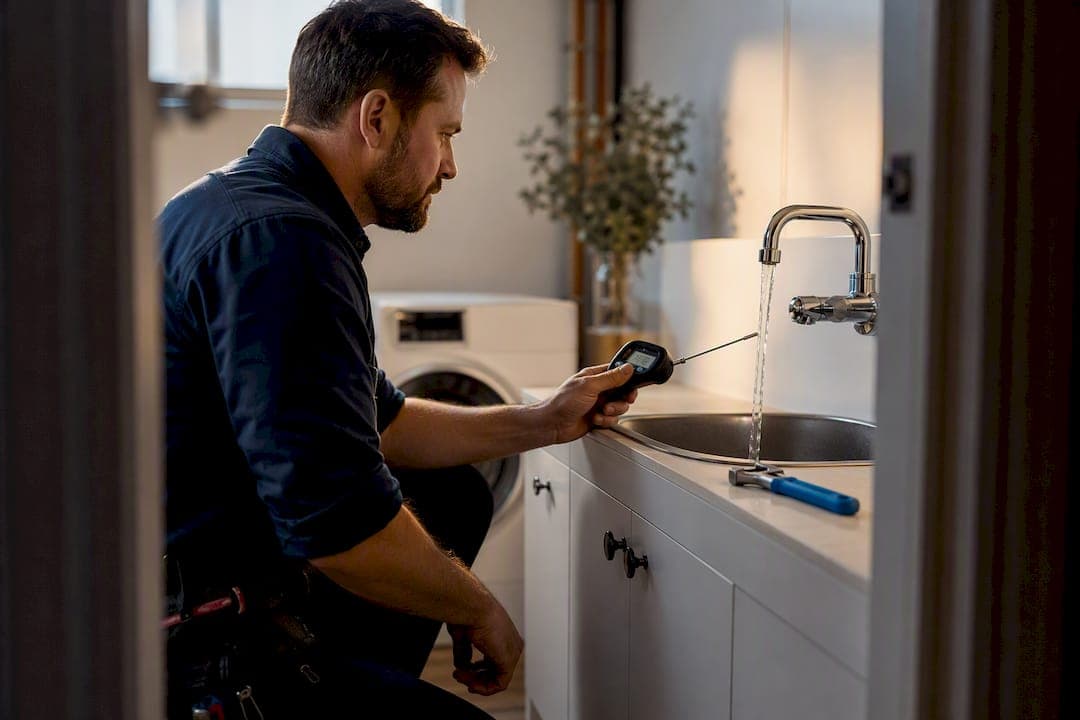
Check one thing first: is it a single tap or the whole house? From there, check the breaker, the gas pilot or supply, and any sign of leaking water. If you smell gas or see water pooling near the unit, stop everything and get out. Most no hot water faults are fixed with these checks alone; the rest need a licensed tradesperson.
TL;DR:
- Most no hot water faults are resolved by resetting the breaker or ECO switch, but repeated trips indicate underlying electrical or heating issues needing professional attention.
- Gas smell, water pooling, sparks, or scorch marks are emergency signs requiring immediate evacuation and a licensed tradesperson, not DIY troubleshooting.
- Identifying the system type through visual cues prevents wasted time and safety risks, as electric, gas storage, continuous-flow, and heat pump units look distinctly different.
- Faults affecting only one tap are usually local issues like blocked aerators or closed valves, while whole-house failures point to system or supply problems.
- Call a licenced technician immediately if safety hazards are present or after unsuccessful resets to avoid delayed repairs and potential dangers.
Table of Contents
- Safety checks to do before any troubleshooting
- How to tell what type of hot water system you have
- Quick checks for each type of hot water system
- Why does one tap have no hot water but others do?
- When should you call a licensed tradesperson?
- What maintenance prevents sudden hot water failure?
- What do technicians actually check first on-site?
- What the checklist gets right, and where most advice falls short
- How Dualflowservices handles a no hot water call-out
- Where this guidance comes from
- Sources
- FAQ
Safety checks to do before any troubleshooting
Before you touch a single switch, rule out the scenarios that turn a plumbing job into an emergency.
A gas smell, a hissing sound near the unit, standing water on the floor, or visible sparking from wiring are not troubleshooting problems. They're stop-and-call situations.
- Gas smell: evacuate the area immediately and call the 24-hour gas emergency number from outside, on a mobile phone. Don't flick any light switches or power points on your way out. Gas appliances must only be assessed by a licensed gasfitter, so this isn't a DIY moment even if you're handy.
- Visible leaking or pooling water: isolate the cold-water inlet valve and switch off power at the breaker. Don't attempt to operate the heater until a professional has looked at it.
- Sparks or a burning smell near the unit: switch off power at the breaker and leave it off.
- Hissing or scorch marks: these point to a gas fault. Leave the unit alone and arrange an inspection.
Beyond those red flags, a safe visual and audible check just means standing back and using your senses: listen for a faint hiss, look for discolouration or scorch marks around the burner housing, and check whether nearby gas appliances (stove, heater) are also affected.
Pro Tip: If you're unsure whether a smell is gas or something else entirely, treat it as gas. The cost of being wrong the cautious way is zero. The cost of being wrong the other way is not.
How to tell what type of hot water system you have
The checks that fix your problem depend entirely on what's sitting in your laundry, garage, or side yard. Guessing the system type wastes time and, with gas units, risks safety.
Look for these visual cues:
- Electric storage tank: a large insulated cylinder, usually indoors or in a garage, with no gas line running to it.
- Gas storage tank: similar cylinder shape but with a gas line and a pilot light or electronic ignition window at the base.
- Continuous-flow (instantaneous) gas unit: a slim wall-mounted box, often outdoors, with a digital display or status LEDs.
- Heat pump: looks like a small air-conditioning unit sitting on top of or beside a tank, with a fan and a controller panel.
Some continuous-flow units run on both gas and electricity. If yours has a digital display, you need to check the power supply and the gas supply before you can call the fault gas-only or electrical-only.
The data plate, usually a sticker on the side or front of the unit, lists the model number, relighting instructions, and often an error code legend. Photograph it before you start; it saves a second trip outside once you're mid-diagnosis.
Quick checks for each type of hot water system
Work through these in order. Stop and call a professional the moment you hit a step marked as a pro-level task.
Electric tank:
- Find your switchboard and locate the double-pole breaker for the hot water circuit.
- Switch it fully off, wait ten seconds, then switch it fully on. Some breakers sit mid-travel after tripping. Push firmly to reset the internal latch properly rather than just nudging it.
- Check the isolating switch near the unit itself, usually a small wall switch, and confirm it's on.
- If the breaker holds, wait a reasonable period for the tank to reheat before testing a tap again.
- If there's a reset button on the ECO (energy cut-out) or high-limit switch, press it once. If it trips again straight away, or trips again within a few days, that's a pro-level job. A tripped ECO that resets repeatedly usually points to a grounded element or loose wiring, not a simple glitch.
Gas storage:
- Confirm gas is actually flowing. Check another gas appliance (stovetop) to rule out a supply issue.
- Follow the relighting instructions on the unit's own label exactly. Every model differs slightly.
- Attempt a proper relight no more than two or three times. If the pilot won't hold after that, the thermocouple or gas control valve is likely at fault, and repeated attempts just release unburned gas.
Continuous-flow gas:
- Run a hot tap and listen for the unit's ignition to fire.
- Check whether it's battery-powered ignition and swap the batteries if the display is dim or blank.
- Note any error code on the display before doing anything else.
- If the manual says a reset is safe for that code, do it once. If the same code returns, stop there.
Heat pump or solar-boosted:
- Check power at the breaker and at the unit's isolating switch.
- Check the controller panel for a fault light or code.
- Allow extra recovery time. Heat pumps reheat water more slowly than gas or straight electric, sometimes several hours after a power interruption, so don't judge the fix a failure too early.
Working through checks in this order, by fuel type, resolves the majority of no hot water faults without needing a service call at all.
Pro Tip: Set a timer when you reset an electric tank or wait on a heat pump. Testing the tap every five minutes doesn't speed anything up, and it makes a working fix look like a failure.
Why does one tap have no hot water but others do?
The pattern of what's affected tells you almost as much as the unit itself. If only one fixture has no hot water and the cold still runs fine there, the fault is local, not at the heater.
If it's a single fixture:
- Shut off the other hot taps in the house and test the affected one alone, in case of a supply-pressure issue.
- Check whether the tap has its own isolating valve that's been partially closed.
- Pull the aerator off the tap and check for blockage or a stuck cartridge, especially in older mixer taps.
If it's the whole house: the fault sits with the appliance or its supply, not any individual tap. Go back to the breaker, ECO, pilot, or gas supply chain for your system type.
If water runs hot for a minute then turns cold: this is a classic sign of a broken dip tube inside an electric tank, which lets cold inlet water mix straight into the hot outlet instead of sinking to the bottom for heating. Isolate the cold inlet briefly and check for plastic flecks in the water; that's the tube breaking down.
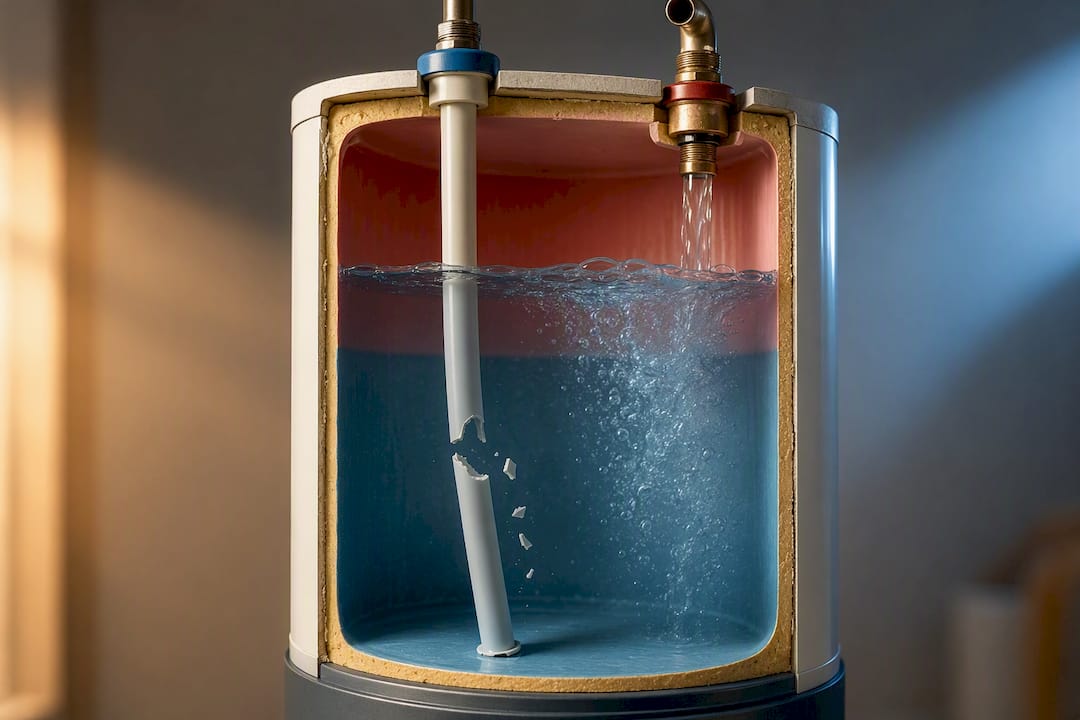
If water is lukewarm or comes and goes: suspect a mixing valve, a thermostatic valve stuck partway, or a partially failed heating element that's only heating half the tank. Uneven pressure elsewhere in the house is sometimes mistaken for a heater fault when it's actually a separate plumbing issue.
When should you call a licensed tradesperson?
Some symptoms mean stop, full stop, regardless of how confident you feel with a screwdriver.
Call immediately if you notice any of these:
- A gas smell, at any point, however faint.
- A pilot that won't stay lit after two or three correct relight attempts.
- Visible leaking, pooling water, or a tank that feels warm on the outside where it shouldn't.
- A breaker that keeps tripping after a proper reset.
- A burning smell or scorch marks anywhere near the unit.
Before the tradesperson arrives, jot down what you've already checked; it saves diagnostic time on-site. Have the model number and any error code ready, note which taps are affected, and check whether other gas appliances in the house have also lost supply. If the display showed a fault code, photograph the LED or code panel rather than trying to describe it from memory.
Pro Tip: Have your address, the unit's model number, and a one-line summary ("no hot water anywhere, breaker won't hold") ready before you call. It cuts the phone call from ten minutes to two.
What maintenance prevents sudden hot water failure?
Most sudden failures aren't sudden at all; they're the end point of something that's been building for months.
- Flush the tank annually. Sediment settles at the bottom of storage tanks and insulates the element from the water it's meant to be heating, which shortens element life and can trigger overheating faults. Regular flushing is the single cheapest thing you can do to avoid a breakdown.
- Check the pressure relief valve for slow drips every few months. A tank that's actively leaking rather than just dripping from the valve usually means replacement, not repair.
- Service gas ignition systems and heat pumps on the schedule the manufacturer sets, typically annually, and have the anode rod in storage tanks checked every few years since a spent anode accelerates internal corrosion.
- Watch scale buildup if your water is hard. Scale coats elements and heat exchangers, forcing them to work harder and fail sooner. This shows up as longer heating times before it shows up as no hot water at all.
- If your unit is past ten to twelve years old and needs frequent repairs, it's often more cost-effective to replace it than keep patching it, and government rebate programs can offset the cost of an upgrade.
What do technicians actually check first on-site?
A technician who's seen hundreds of these calls doesn't guess. They run a short, specific sequence before touching anything.
First: confirm whether it's a supply fault (no gas, no power) or an appliance fault, because that decides everything else that follows. Second: read and photograph any status LEDs or error labels on the unit itself, since misreading a code wastes real time. Third: run a hot-tap thermometer test to measure exactly how far off the target temperature the water actually is, rather than relying on "it feels lukewarm."
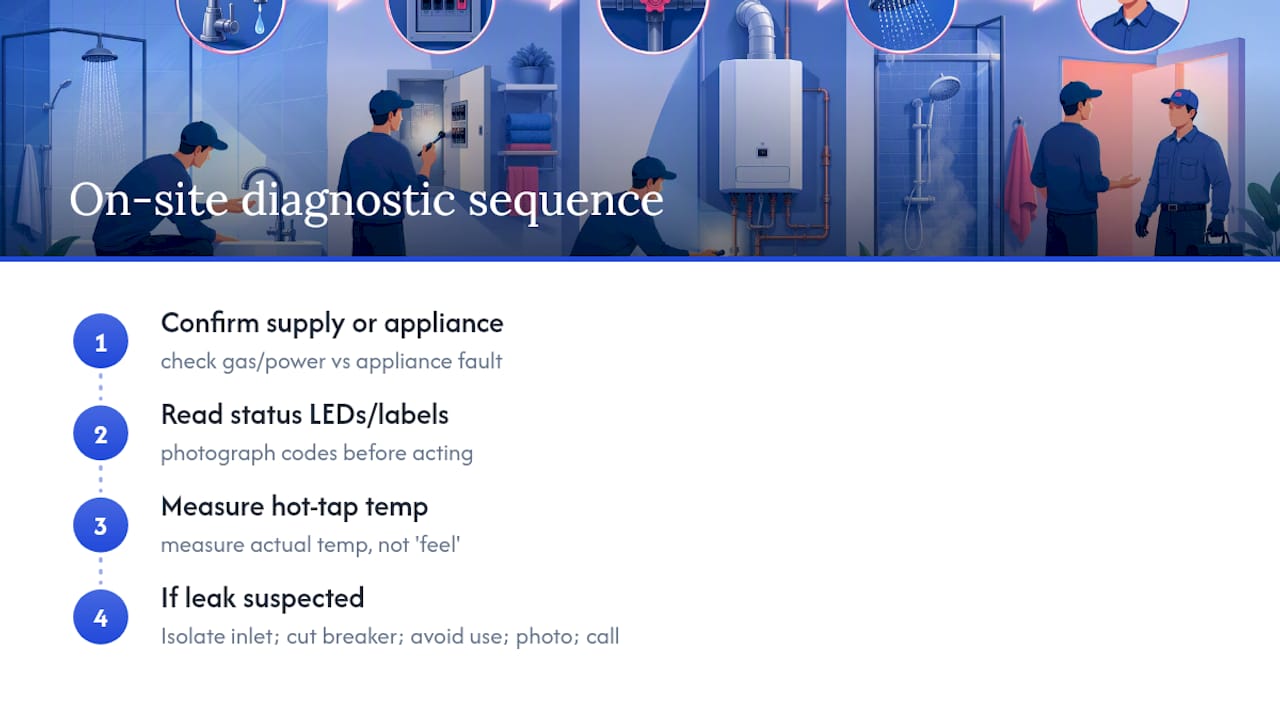
For suspected leaks, the same five safety steps apply every time: isolate the cold inlet, cut power at the breaker, avoid operating the unit, photograph the leak location, and call before it gets worse.
Same-day attendance makes sense for active leaks, gas smells, or a total loss of hot water in a house with vulnerable occupants. A unit that's simply ageing or losing efficiency gradually is a scheduled maintenance job, not an emergency one.
What the checklist gets right, and where most advice falls short
Most troubleshooting guides treat every no hot water fault as equally DIY-friendly. It isn't. The breaker reset, the pilot relight, the tap isolation test: these are genuinely safe for a homeowner to do, and doing them first saves a wasted call-out fee more often than not.
Where the conventional advice falls short is in what happens after the first reset fails. Plenty of guides tell you to "just try resetting it again" without explaining that a safety device tripping repeatedly is the appliance telling you something specific is wrong underneath. An ECO switch or a thermocouple doesn't fail for no reason. Forcing a second or third reset on a fault that's already declared itself doesn't fix anything; it just delays the professional diagnosis while the underlying issue (a grounded element, a failing thermocouple) sits there unresolved.
The single biggest thing homeowners should prioritise first isn't the technical check, it's the triage question: one tap or the whole house? That one distinction, answered honestly before you touch a breaker or a pilot light, points you toward the right chain of checks in under a minute and stops you wasting twenty on the wrong one.
— Mike
How Dualflowservices handles a no hot water call-out
Some homeowners prefer to have a licensed tradesperson take over rather than keep guessing at a fault that involves gas or live electrics. Some service providers only look at plumbing issues, but others cover plumbing, gas, and electrical checks in one visit, so a fault that turns out to be wiring rather than the heater itself doesn't mean booking a second tradesperson and waiting again.
A typical no hot water call-out can include diagnostics to determine whether the fault is supply-side or appliance-side, licensed gas handling for anything involving a pilot, thermocouple, or gas control valve, and electrical testing where a breaker keeps tripping or an ECO switch won't hold. When booking a service, having your address, the unit's model number, symptoms (such as one tap or the whole house affected, any error code shown), and notes of checks already performed can help speed up the visit and improve chances of a same-day fix rather than a return trip. Book a hot water call-out and get a licensed technician looking at the actual cause, not just the symptom.
Where this guidance comes from
- Gas hot water troubleshooting guide: official gas emergency and licensed-gasfitter rules.
- Electrical safety guidance: breaker-reset safety and electrical fault handling.
- No hot water? Gas and electric diagnosis steps: the fuel-type diagnostic chain referenced throughout.
- Water heater no hot water troubleshooting guide: expected diagnosis timeframes and recovery waits.
Sources
- Gas hot water troubleshooting guide
- No hot water? Gas and electric diagnosis steps
- Electrical safety guidance — consumers
- Water heater no hot water (complete troubleshooting guide)
FAQ
What's the first thing to check when there's no hot water?
Check whether it's one tap or the whole house first, then move to the breaker (electric) or gas supply and pilot (gas). This single distinction points you to the right diagnostic chain in under a minute.
What's the most common cause of no hot water?
For electric storage tanks, a tripped breaker or ECO switch is the most common cause. For gas systems, a pilot light that's gone out or a supply interruption tops the list.
Why does my hot water not work but the cold water does?
This means the fault sits with the heater or its power/gas supply, not the plumbing, since cold water bypasses the heater entirely. Work through the breaker, ECO, or pilot checks for your system type.
Why have I got no hot water all of a sudden?
Sudden loss usually traces back to a tripped breaker, a blown pilot light, or a safety switch that's activated for a reason, such as a failing element or thermocouple. If a reset doesn't hold, that's a sign the underlying cause needs a licensed tradesperson rather than a second reset.
When should I stop troubleshooting and call someone?
Stop immediately for any gas smell, a pilot that won't hold after two or three proper attempts, visible leaking, or a breaker that keeps tripping after a correct reset. Dualflowservices can attend for exactly these scenarios with licensed gas and electrical diagnostics in one visit.