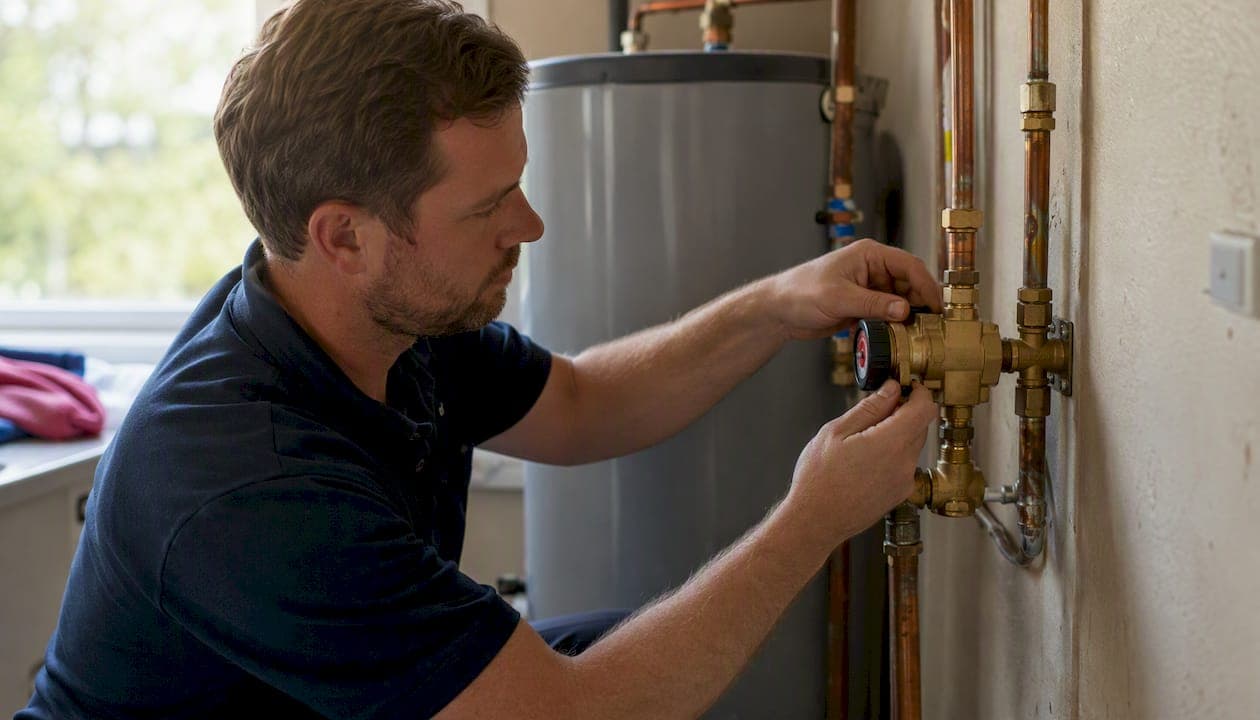
In Australia, hot water must be stored at a minimum of 60°C to suppress Legionella bacteria, yet delivered to bathroom and kitchen fixtures at no more than 50°C. That gap between storage and delivery is where scalding injuries happen, and closing it reliably is the core of hot water temperature scalding prevention. The most dependable way to close it is a tempering valve or thermostatic mixing valve (TMV) fitted by a licensed plumber, not a thermostat dial adjustment.
The two numbers that matter most: store at ≥60°C, deliver at ≤50°C. A tempering or thermostatic mixing valve is the only reliable way to achieve both at once, as confirmed by the PHAA position paper on hot tap water temperature and scalds.
If you are not sure whether your taps are running at a safe temperature, take these steps now:
- Test a tap with a calibrated thermometer after letting it run for 30 seconds.
- Run cold water first before placing any hand or body under hot water.
- Supervise children and older adults near any hot water source.
- Call a licensed plumber if any tap reads above 50°C at the outlet.
Key takeaways
Storing hot water at ≥60°C and delivering it at ≤50°C via a correctly installed tempering valve or TMV is the single most effective measure for preventing scalding injuries at home.
| Point | Details |
|---|---|
| Two core temperatures | Store at ≥60°C to control Legionella; deliver at ≤50°C at all personal hygiene fixtures. |
| TMVs beat thermostat dials | Thermostat settings are unreliable due to thermal stratification; downstream valves are the only accurate control. |
| Test every fixture | Use a calibrated thermometer after 30 seconds of flow; temperatures vary by outlet and pipe run. |
| High-risk residents need more | Children under 5, adults over 65, and people with impairment need point-of-use TMVs, not just a master valve. |
| Dualflowservices | Licensed on-site testing, tempering valve and TMV installation, and compliance documentation across the Mornington Peninsula. |
Table of Contents
- How temperature determines the speed and severity of a burn
- What Australian guidance requires from property owners
- Tempering valves and TMVs: which device does what
- How to test tap temperatures and keep them safe over time
- Everyday habits that reduce scald risk at home
- First aid for scalds: what to do in the first 20 minutes
- Why engineering controls beat education every time
- Dualflowservices can test, install, and certify your hot water safety
- Sources
How temperature determines the speed and severity of a burn
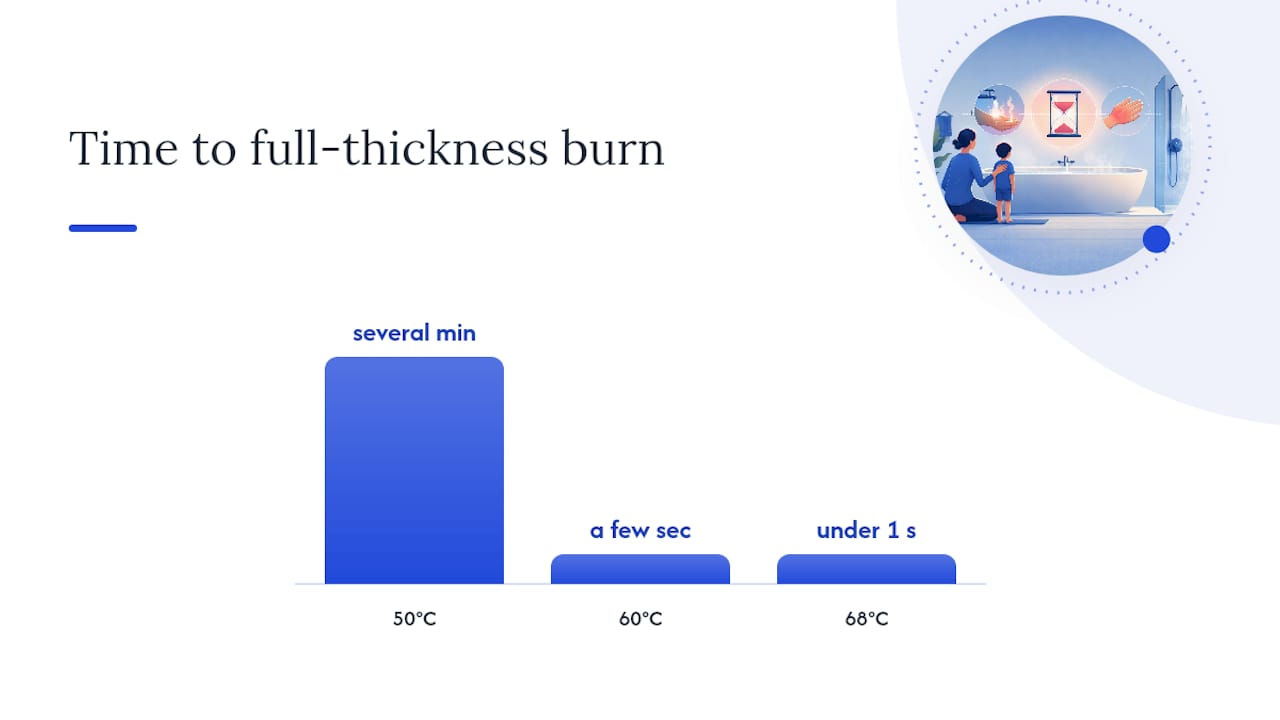
The relationship between water temperature and burn severity is not linear — it is steep. A small rise in temperature can cut the time to a serious burn from minutes to fractions of a second. Clinical research on time-to-burn data shows that at 68°C, full-thickness scalding can occur in under one second. At 60°C, serious burns develop within a few seconds. At 50°C, the exposure time needed to cause a full-thickness burn is substantially longer, giving a person enough time to react and pull away.
| Temperature | Approximate time to full-thickness burn |
|---|---|
| 50°C | Several minutes (time to react) |
| 50°C | Approximately 30 seconds |
| 60°C | A few seconds |
| 68°C | Under 1 second |
Children and older adults face a compounded risk. Children's skin is thinner, so the same temperature causes deeper burns faster. Older adults often have reduced pain sensitivity and slower reflexes, meaning they may not react before serious damage occurs. The same water temperature that gives a healthy adult time to pull away can cause a full-thickness burn in a young child before they can move.
Pro Tip: Test the temperature at multiple outlets, not just the kitchen tap. Temperatures vary by fixture and pipe run length. A bathroom at the far end of a long pipe run can deliver hotter water than a tap close to the cylinder, particularly after the system has been idle.
What Australian guidance requires from property owners
The PHAA position paper sets out the public health position clearly: hot water must be stored at ≥60°C to control Legionella, and delivered to personal hygiene fixtures at a maximum of 50°C using tempering or mixing valves. This is not just a recommendation — it reflects the requirements embedded in Australian plumbing guidance and building standards for new construction and major renovations.
Building guidance consistent with G12 acceptable solutions specifies:
- Maximum delivery temperature of 50°C at personal hygiene fixtures (showers, baths, basins).
- Lower delivery limits of 45°C for highest-risk institutional settings such as aged care facilities and hospitals.
- Acceptable delivery control devices include TMVs, tempering valves, and temperature-limiting water heaters (TLWH).
- Storage at ≥60°C is required to inhibit Legionella growth throughout the system.
For existing homes, the obligation to retrofit depends on jurisdiction and the nature of any renovation work. New builds and significant plumbing upgrades in Victoria must comply with current standards. Even where retrofitting is not legally compelled for an existing home, the Aged Care Quality and Safety Commission is explicit that aged care and disability settings must have engineering controls in place and regularly verified — there is no discretion there.
Compliance checks for any property should be carried out by a licensed plumber who can measure actual delivery temperatures with calibrated instruments, inspect valve condition, and issue documentation. A visual inspection of the thermostat dial is not sufficient.
Tempering valves and TMVs: which device does what
The thermostat dial on a storage water heater is not a reliable final control for delivery temperature. ASSE research on water heater scald hazards explains why: thermal stratification inside the tank means the water at the outlet can be significantly hotter than the thermostat setting suggests, particularly after periods of low draw. The dial tells you the target storage temperature, not what arrives at the tap.
The devices that actually control delivery temperature are:
- Master tempering valve at the cylinder: blends cold water into the hot supply at the storage unit, limiting the temperature throughout the distribution system. Suitable for achieving the 50°C maximum at most fixtures in a standard home.
- Point-of-use TMVs at individual fixtures: installed at the shower or basin, these react rapidly to pressure and temperature fluctuations and include a shut-off feature if the cold supply fails. They provide the tightest control and are the preferred solution for high-risk users.
- Temperature-limiting water heaters (TLWH): units with integrated delivery temperature control; acceptable under building guidance but less flexible than downstream valves.
- Thermostatically controlled taps: useful for specific fixtures but do not protect the whole distribution system.
TMVs have a safety advantage that tempering valves do not: they shut off flow if the cold supply fails, preventing a sudden surge of scalding hot water. For bathrooms used by children, older adults, or people with sensory impairment, that shut-off function is worth the additional cost.
Pro Tip: For a standard home, a master tempering valve at the storage cylinder is a cost-effective baseline. For bathrooms used by high-risk residents, add point-of-use TMVs set to 45–50°C. The PHAA position paper describes this layered approach as best-practice design.
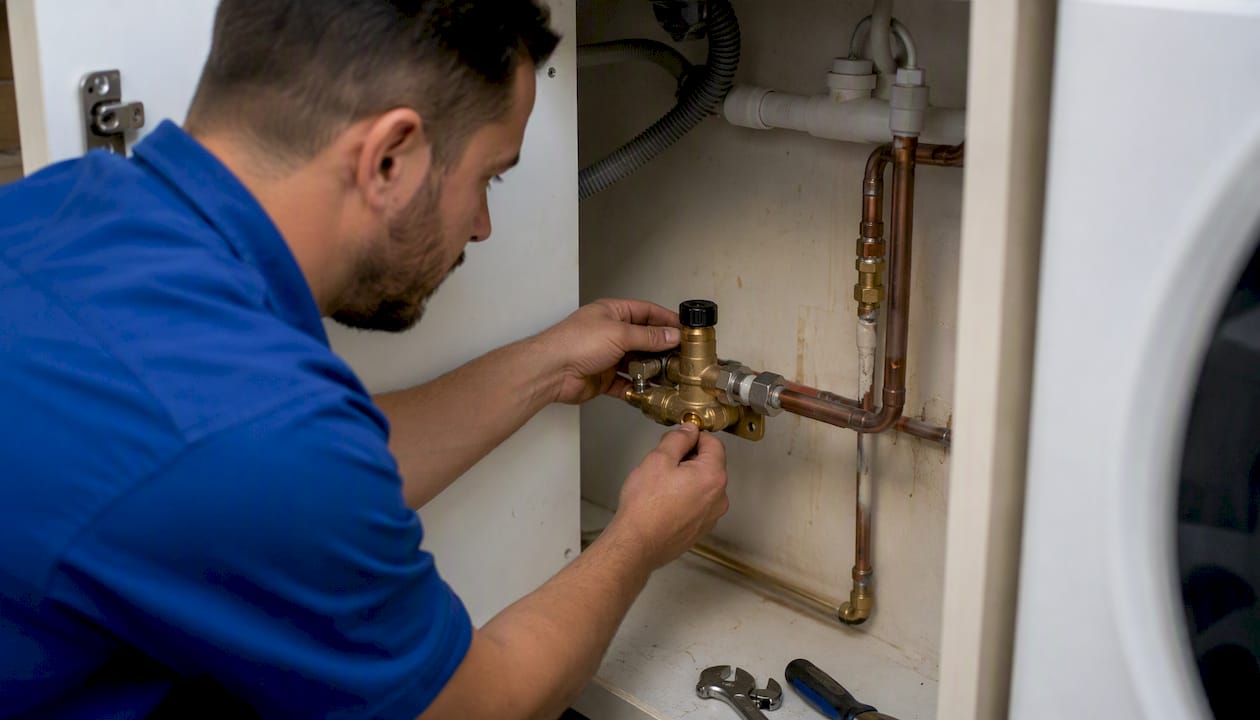
Pro Tip: For disability-compliant hot water systems, point-of-use TMVs at every bathroom fixture used by the resident are the standard, not an optional upgrade. A licensed plumber can assess which fixtures need individual valves and which are adequately protected by the master valve.
How to test tap temperatures and keep them safe over time
Testing tap temperature is straightforward, but doing it correctly matters. A reading taken from a tap that has only run for five seconds will not reflect the true delivery temperature from the hot water system.
What you need:
- A calibrated digital thermometer (a cooking thermometer with a probe works well).
- A clean container to collect water.
- A notebook or phone to record results by fixture and date.
Testing steps:
- Run the hot tap for at least 30 seconds to flush the pipe and draw water from the cylinder.
- Fill the container and immediately insert the thermometer probe.
- Record the temperature, the fixture location, and the time of day.
- Repeat at every personal hygiene fixture in the home: shower, bath, basin, and laundry tub.
- Compare each reading against the 50°C maximum. Any reading above 50°C requires a licensed plumber.
- Retest after any plumbing work, valve replacement, or thermostat adjustment.
For routine maintenance, preventative plumbing maintenance schedules recommend annual professional inspections for residential systems and more frequent checks (every six months) for aged care and disability settings. A professional inspection covers calibrated temperature measurement at all outlets, valve condition assessment, flushing of the system to clear sediment, and documentation of results. Mixing valves have a finite service life and typically require recalibration or replacement every few years depending on water quality and usage.
Regular hot water system flushing is also part of maintaining safe delivery temperatures — sediment build-up can affect valve performance and reduce the accuracy of temperature control.
Pro Tip: Never ask a child or frail adult to test the water temperature themselves. Fill a container first, let it settle for two seconds, then test with a thermometer held by an adult. A temperature strip on the container wall is a quick visual check, but a digital probe gives the accurate reading you need for compliance records.
Everyday habits that reduce scald risk at home
Engineering controls are the foundation, but daily behaviour still matters, especially while a valve installation is being arranged or in households where not every fixture has been upgraded yet. Population research on childhood scalds confirms that passive measures like valves are more effective than education alone, but also identifies specific parental behaviours that raise the odds of a scald injury, including leaving hot drinks within reach of young children.
Household behaviour checklist:
- Always run cold water into the bath first, then add hot water to reach the desired temperature.
- Test bath water with your elbow or wrist before placing a child in it.
- Never leave hot drinks, soup, or cooking liquids on low surfaces where children can pull them down.
- Fit tap guards on bathroom taps used by young children to prevent unsupervised operation.
- Supervise children under 5 and adults with cognitive or mobility impairment near any hot water source.
- Keep bathroom doors closed when the bath or shower is running.
High-risk groups and specific precautions:
Children under 5 are the most frequently injured group in domestic scald incidents. Their skin burns faster and deeper, and they cannot reliably communicate pain. Older adults over 65 often have reduced sensation in their extremities and slower reaction times. People with cognitive impairment may not recognise the danger of hot water, and those with mobility limitations may be unable to move away quickly enough.
For households caring for any of these groups, the BPC Victoria hot water safety guide recommends testing water before bathing, using mixing valves to achieve 50°C delivery, and never leaving vulnerable people unsupervised near hot water.
Pro Tip: Dishwashers and washing machines need hot water to sanitise effectively, often at temperatures above 60°C. Use appliance-direct connections or timed cycles rather than raising the whole-house delivery temperature. That way, high-temperature water stays inside the appliance and never reaches a tap or showerhead.
First aid for scalds: what to do in the first 20 minutes
Speed matters more than anything else in scald first aid. The burn continues to deepen as long as heat remains in the tissue, so cooling is the priority.
Immediate steps:
- Remove the person from the heat source and remove any wet clothing or jewellery near the burn, unless it is stuck to the skin.
- Cool the burn under gently running cool (not cold or iced) water for a full 20 minutes. Do not stop early.
- Cover the burn loosely with a clean, non-fluffy dressing or cling wrap.
- Keep the person warm to prevent shock — cool only the burn, not the whole body.
- Do not apply butter, toothpaste, ice, or any home remedy to the burn.
Seek emergency medical care immediately if:
- The burn covers a large area of the body.
- The burn affects the face, hands, feet, genitals, or a major joint.
- The burn appears white, brown, or black (full-thickness).
- The person is under 12 months old or very elderly.
- There are signs of respiratory distress (steam or hot liquid was inhaled).
Scalds are among the most common causes of burn-related hospitalisation in Australia, with young children and older adults accounting for a disproportionate share of serious cases, as noted in research on preventable burns from domestic tap water.
The 20-minute cool-water rule is endorsed by Australian first-aid authorities. Stopping at five or ten minutes because the pain has eased is a common mistake — the cooling process needs the full duration to limit tissue damage.
Why engineering controls beat education every time
There is a persistent belief in home safety circles that the right information, given to the right people, is enough to prevent scalding injuries. The evidence does not support that view.
Research on preventable burns from domestic tap water is clear: passive engineering controls, specifically tempering valves and TMVs, are the most reliable preventive measure. Education helps at the margins. It does not remove the risk when a caregiver is distracted, when a child acts faster than expected, or when a person with dementia cannot apply what they have been told.
The households where scalding risk is highest are also the ones where relying on behaviour is least realistic. A person with advanced dementia cannot be expected to run cold water first. A toddler cannot be expected to wait. An older adult with peripheral neuropathy may not feel the heat until the burn is already serious. In every one of those situations, a correctly installed and maintained TMV is the only control that works reliably.
Dualflowservices sees this directly in aged care and disability settings on the Mornington Peninsula. The facilities with the best safety records are not the ones with the most safety signage. They are the ones where a licensed plumber has verified delivery temperatures at every fixture, installed point-of-use TMVs where required, and set up a documented maintenance schedule. That combination, plumbing compliance in aged care backed by regular professional checks, is what actually protects residents.
The practical implication for homeowners is the same. Get the engineering right first. Then layer behaviour on top of it.
Dualflowservices can test, install, and certify your hot water safety
Knowing the right temperatures is one thing. Verifying them with calibrated instruments, installing the correct valves, and maintaining them on schedule is another. Dualflowservices provides on-site temperature testing at every fixture, master tempering valve installation at the storage cylinder, and point-of-use TMV installation for bathrooms used by high-risk residents across the Mornington Peninsula and surrounding Melbourne suburbs.
A service visit covers calibrated temperature measurement at all personal hygiene outlets, assessment of existing valve condition, and written documentation of results — the paperwork aged care facilities and disability homes need for compliance records. For emergency situations where a tap is running dangerously hot, same-day call-out is available. For scheduled maintenance, annual or six-monthly service plans keep your system verified and your records current.
Book a hot water safety inspection with Dualflowservices and get a licensed plumber on-site to measure, install, and certify your system.
Sources
The following sources were used in this article. Each covers a distinct aspect of hot water safety, so the right one to consult depends on what you need to verify.
- Hot tap water temperature and scalds (PHAA position paper)
- Preventing scalding from tap water — Building Performance (G12 guidance)
- ASSE white paper: water heater scald hazards
- Hot water safety — Better Practice Community (BPC Victoria)
- Hot water scalding — Aged Care Quality and Safety Commission
This article is general information, not a substitute for advice from a qualified doctor. Consult a qualified healthcare professional about your own circumstances before acting on anything here.