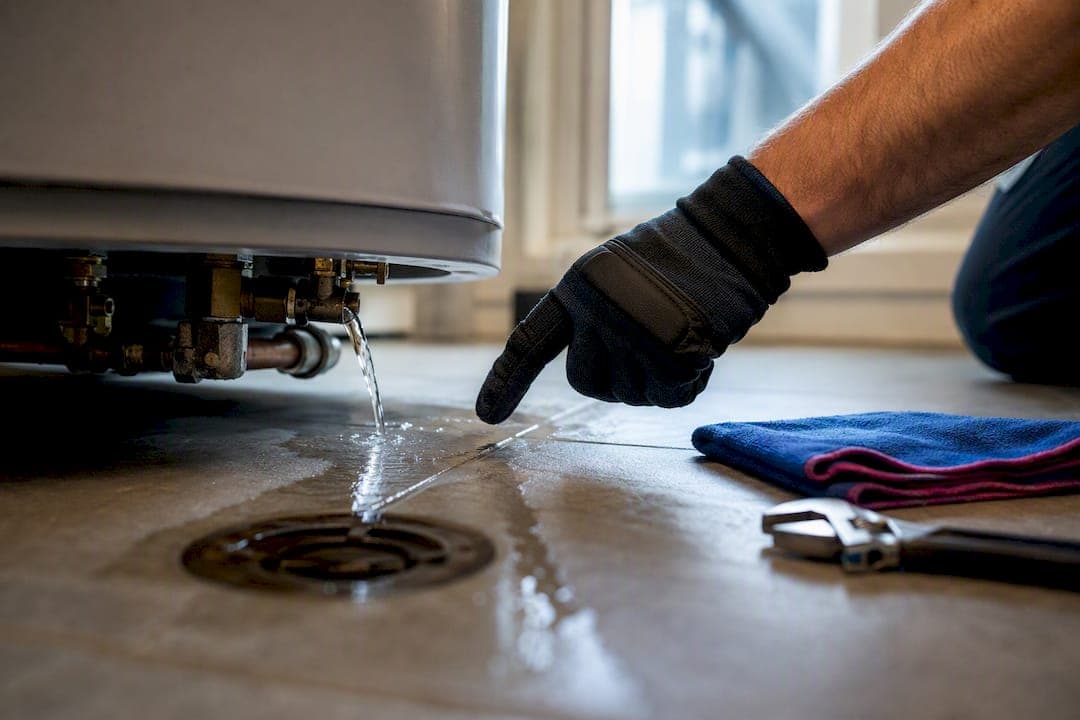
If your hot water system is leaking, isolate power or gas first, then shut the water off at the cold-water inlet if you can reach it safely. A slow drip from a valve or fitting is usually repairable. Water weeping from the tank body itself almost always means replacement. Call a plumber urgently if you see steady flow, water near electrical points, rusted seams, steam, or smell gas.
TL;DR:
- Leaking from the tank body almost always requires replacement, while leaks from valves or fittings are usually repairable with a simple part swap.
- Immediately isolate power or gas, shut the cold-water inlet, and contain the leak to limit water damage before calling a plumber.
- Continuous flow, water near electrical points, or steam and gas smells are urgent signs needing immediate professional attention.
- Leaks from the pressure relief valve are often normal during heating, but persistent or heavy leaks signal a need for inspection and possible replacement.
- Regular maintenance like annual flushing, checking the anode rod, and monitoring pressure can prevent costly repairs and water waste.
Table of Contents
- Hot water system leaking: what to do in the first five minutes
- How do you find where a hot water leak is coming from?
- What causes leaks in different parts of a hot water system?
- Why does the pressure relief valve keep leaking?
- Should you repair the leak or replace the whole system?
- When do you need to call a plumber straight away?
- How do you stop a hot water system leaking again?
- Does a leaking hot water system waste money as well as water?
- Is it cheaper to repair the leak or replace parts?
- How do you stop a hot water leak temporarily until help arrives?
- What Dualflowservices sees on real hot water callouts
- Get your leaking hot water system fixed fast
- Sources
Hot water system leaking: what to do in the first five minutes
Every minute you spend guessing is a minute the water damage gets worse, so work through these steps in order.
- Isolate the power or gas. For an electric system, switch it off at the circuit breaker, not just the wall switch. For a gas unit, turn off the gas isolation valve at the appliance, usually a lever or tap on the gas line feeding the unit.
- Shut the cold-water inlet. This is the valve feeding water into the tank, usually near the top. If you can't find it or it won't budge, close the main stopcock for the property instead.
- Contain the water. Lay towels, place a bucket or tray under the leak, and mop up standing water before it reaches skirting boards, carpet, or a switchboard.
- Clear the area. Keep kids and pets well away from pooled water, especially anywhere near power points or the switchboard.
- Photograph and time the leak. A few phone photos and a note of how fast the water is coming (a slow drip versus a constant trickle) will save the plumber time and help with any insurance claim.
A few things you should never do while you're waiting for help:
- Don't cap, block, or tie off the pressure relief valve, even temporarily. It's a safety device, not a nuisance to be silenced.
- Don't touch a wet switchboard or power point, even to turn something off. Get to the breaker panel a safer way, or wait for a licensed electrician if water has reached it.
- Don't force a stuck isolation valve with pliers or a wrench. A seized valve that snaps off mid-turn turns a manageable leak into a flood.
Isolating the water supply is the single biggest thing you can do to limit damage before a professional arrives, and it buys you time to work out where the leak is actually coming from.
How do you find where a hot water leak is coming from?
Tracing the leak to its exact source is the step that separates a five-minute valve fix from an unnecessary tank replacement, and technicians treat leak location as the primary diagnostic clue for exactly that reason.
Start at the top of the unit and work down:
- Top of the tank: Check the inlet and outlet unions (where the pipes screw into the tank), the anode rod access point, and any side-entry fittings. Loose or corroded connections here are common and usually repairable.
- The overflow or discharge pipe: This runs from the pressure relief valve down to ground level, often ending near the base of the unit. Water travelling down this pipe can pool at the bottom and look like a tank leak when it's actually a valve issue higher up.
- The drain valve: Found near the base, this small tap is used to empty the tank for servicing. It's a frequent source of drips, particularly on older units, and it's a cheap part to replace.
- The tank body itself: Look for rust-coloured staining, damp patches on the insulation jacket, or water that keeps reappearing at the same spot on the tank's side or underneath, even after you've dried it up.
Not every wet patch is a leak. Condensation forms on the cold-water inlet pipe in humid weather or after the tank has just refilled, and it usually dries up and doesn't return. A genuine leak keeps coming back.
Pro Tip: Dry the suspect area completely with a paper towel, then press a dry sheet against it and check back in twenty minutes. If it's damp again, you've found an active leak rather than leftover condensation. Note whether it's a drip, a steady trickle, or a spray, since that detail changes how urgently you need help.
What causes leaks in different parts of a hot water system?
Where the water is coming from tells you a lot about what's wrong and roughly what it'll cost to fix.
- Top-of-tank leaks. These usually trace back to the inlet or outlet unions loosening over time, a worn anode rod gland, or a failing inlet valve. Most of these are straightforward repairs: reseal or replace the fitting, tighten the union, or swap the gland. Cost is generally modest and the tank itself is fine.
- Pressure relief valve and overflow leaks. A short burst of water down the overflow pipe right after heating can be completely normal. A continuous drip usually points to one of three things: mains pressure running too high, a valve that's stuck or worn out, or a failed expansion control on a closed system. This is repairable, but only if the underlying cause gets fixed alongside the valve.
- Base and drain valve leaks. A leaking drain valve is a common, usually simple fix, since these small taps wear out from repeated use and sediment exposure. But persistent leaking from the base can also mean sediment has built up and damaged the tank floor, or the tank itself has corroded from the inside. Leaks coming from the tank body itself are effectively never repairable because the steel has already failed internally, and rust-coloured water is often the first visible sign.
- Pipework and union leaks. Loose fittings, corroded connectors, or a cracked joint in the surrounding pipework can mimic a tank leak until someone traces the water back to its actual source. These are usually cheap and quick to fix once identified.
The location and rate of the leak together set your urgency and rough budget. A slow drip from a top fitting can often wait a day or two for a scheduled repair. A steady leak from the base, or any leak from the tank body, needs attention fast, both because of the water damage and because it's telling you the tank is on its way out.
Why does the pressure relief valve keep leaking?
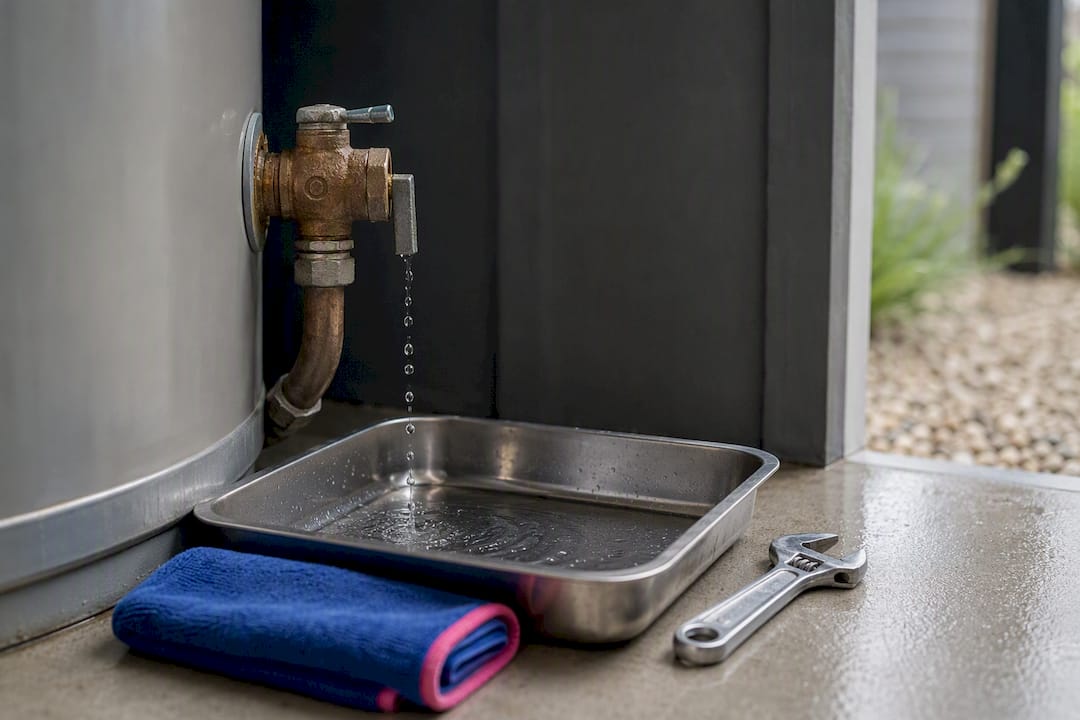
The pressure and temperature relief valve, usually called the TPR valve, is the safety device that stops your tank from turning into a pressure vessel with nowhere for the energy to go. A little discharge during or right after a heating cycle can be normal, since the water expands as it heats and the valve is designed to vent that excess. Continuous or heavy leaking is a different story and usually points to a worn valve seat, mains pressure running too high, or the unit overheating.
Before you touch anything, check what's driving it:
- Mains water pressure above the system's rated range will force the valve open more often than it should.
- A closed system (one with a check valve or pressure-limiting valve on the inlet) without an expansion vessel has nowhere for heated water to expand, so the TPR ends up doing that job constantly.
- A valve that's simply old or mineral-clogged can stick partly open and never fully reseat.
Manufacturers commonly recommend replacing TPR valves once they're around five to six years old rather than repeatedly testing and hoping. Lifting the test lever on an older, scaled-up valve can trigger a permanent drip that wasn't there before, so skip the DIY lift test on an ageing unit and leave it to a plumber. Fixes usually involve a new valve, a pressure-limiting valve or expansion vessel on the inlet side, and sometimes a lower thermostat setting. Whatever you do, never cap or disable the discharge. It's the one part of the system standing between normal operation and a genuine safety hazard.
Should you repair the leak or replace the whole system?
This decision usually comes down to where the water's coming from, how old the unit is, and how many times it's already needed attention.
Repair is generally the right call when:
- The leak is from a valve, union, or the drain tap, all of which are individually replaceable parts.
- The tank has no visible corrosion, rust staining, or seam weeping.
- This is the first fault the system has had in years, not the third callout this year.
Replacement is generally the right call when:
- Water is coming from the tank body itself rather than a fitting. Internal corrosion at this stage can't be patched, and no sealant fixes a steel tank that's rusted through from the inside.
- The unit has had multiple repairs in the past year or two.
- Replacement parts are hard to source for an older or discontinued model.
- The anode rod hasn't been checked or replaced in years and the tank is well past the age where corrosion protection typically holds up.
If you're stuck waiting a day or two for a replacement to be scheduled, isolate the leaking unit at the water and power/gas supply and avoid reheating it unnecessarily. Before you commit either way, ask your plumber what warranty applies to a repair versus a new unit, and whether the parts needed for a repair are still in production.
When do you need to call a plumber straight away?
Some signs mean you pick up the phone immediately, others mean you can book a scheduled visit and manage the leak in the meantime.
- Call immediately if water is coming from the tank body itself, if water has reached electrical points or the switchboard, if you see steam around the unit, or if you smell gas anywhere near a gas hot water system. These aren't wait-and-see situations.
- Treat as high priority if the pressure relief valve is discharging continuously, if a slow drip has clearly gotten worse over a day or two, or if this is a repeat fault on a system that's already been serviced recently.
- When you call, have this ready: the system type (electric, gas, or heat pump), roughly where the leak is coming from, what you've observed (drip, steady flow, steam, smell), and whether the unit is easily accessible or tucked into a tight space.
An emergency callout gets a tradesperson out fast to stop active damage, isolate the system safely, and give you an immediate assessment. A scheduled service visit suits a slow, stable drip you've already contained, where the fix can wait a day without the situation worsening.
How do you stop a hot water system leaking again?
A bit of routine attention catches most leaks well before they become emergencies, and it's cheaper than any callout.
- Do an annual visual check. Look at every fitting, the drain valve, and the base of the tank once a year for early staining or dampness.
- Test the TPR valve annually, but skip this yourself on an older unit, since lifting a mineral-clogged valve can trigger a leak that wasn't there before. Leave the test to a plumber on units more than a few years old.
- Flush the tank periodically to clear sediment buildup, which otherwise sits at the base and accelerates corrosion.
- Check the anode rod on the recommended schedule for your unit and replace it when it's worn down. This sacrificial rod protects the steel tank from corroding, and once it's gone, the tank starts corroding instead.
- Address high mains pressure or a closed system by installing a pressure-limiting valve or expansion vessel, rather than letting the TPR valve compensate every time the water heats.
Pro Tip: Keep a simple service log with dates, what was checked or replaced, and receipts. It speeds up warranty claims and gives any plumber who visits later a clear history instead of a guessing game.
If your unit is approaching the upper end of its expected lifespan and has needed more than one repair recently, replacing it proactively is often cheaper than waiting for a failure that floods a room.
Does a leaking hot water system waste money as well as water?
A leaking hot water system doesn't just make a mess. It quietly drives up both your water and energy bills while it's happening.
Every litre leaking out is a litre of water you've already paid to heat, and one you'll pay for again when the system refills and reheats to replace it. A continuous drip from a faulty TPR valve, in particular, can waste a surprising volume of heated water over a month without ever looking dramatic day to day. Because it's hot water leaking rather than cold, you're paying twice: once for the water itself, once for the energy that heated it before it ran down the drain.
There's a knock-on efficiency cost too. A system with a leak from a fitting or valve tends to run its heating cycle more often, since it's constantly topping up water that's escaping. Gas units cycle the burner more; electric units draw more from the element. Over weeks, that shows up as a bill that's climbed without any change in how much hot water your household is actually using.
Sediment buildup, a common cause of drain valve and base leaks, compounds this. A layer of sediment sitting between the burner or element and the water it's meant to heat forces the system to work harder to reach the same temperature, and it's a factor in both efficiency loss and the corrosion that eventually leads to a full leak. Catching a slow leak early, rather than living with it for months, is one of the more overlooked ways to keep both bills in check.
Is it cheaper to repair the leak or replace parts?
The cost gap between fixing a fitting and replacing the whole unit is wide, which is exactly why getting the diagnosis right matters.
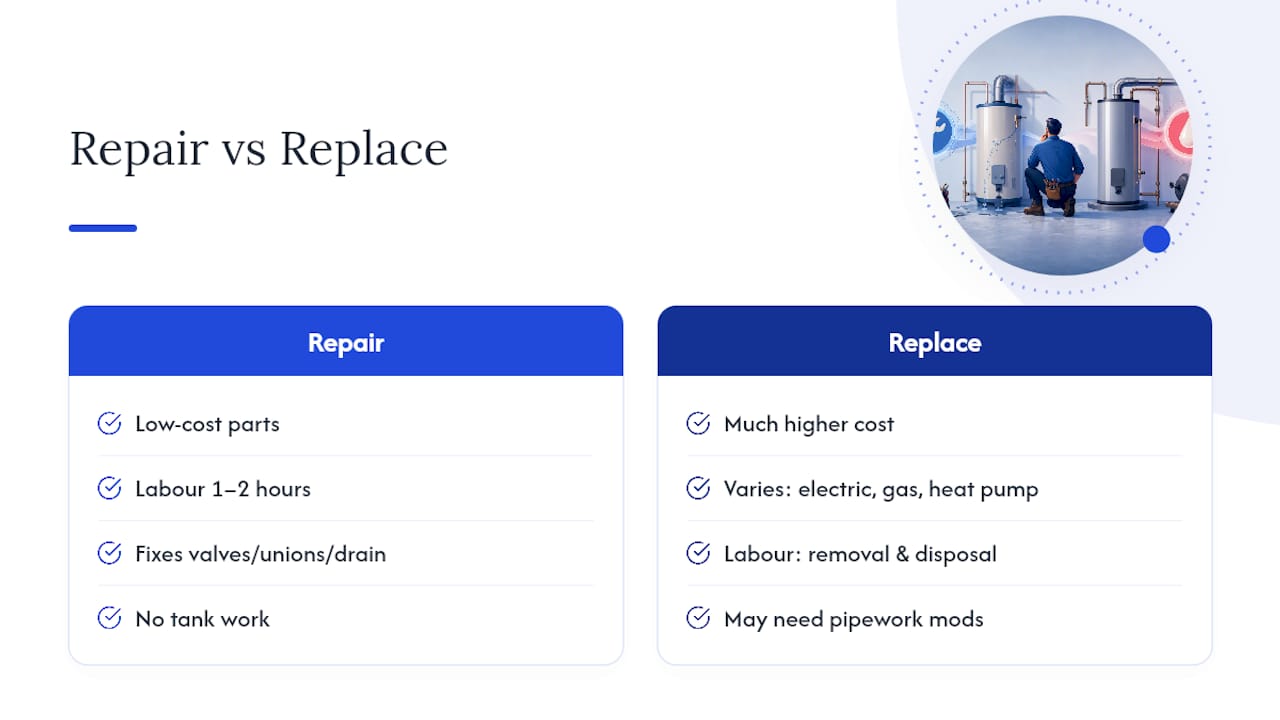
A valve, union, or drain tap replacement is a relatively small job. Parts are inexpensive and the labour is usually measured in an hour or two, not a full day. A new pressure relief valve, a resealed union, or a new drain valve are all the kind of repairs that get a system back to normal without touching the tank itself.
Full hot water system replacement cost sits in a different bracket entirely, and it varies depending on whether you're replacing like-for-like or upgrading system type. The cost to install gas hot water generally runs higher than an equivalent electric hot water service price, partly due to gas fitting and flue requirements, while heat pump systems sit at their own price point again. Beyond the unit itself, expect labour for removal and disposal of the old tank, any pipework modifications needed to fit the new unit, and compliance work if your existing setup doesn't meet current standards.
The trap many homeowners fall into is repairing a tank-body leak that was never actually repairable. Spending money on a valve replacement or a sealant job when the real problem is internal corrosion just delays the inevitable and adds a second cost on top of the replacement you'll still need. That's why nailing down the leak's exact location before spending anything matters more than the size of the fix itself.
How do you stop a hot water leak temporarily until help arrives?
If a plumber can't get to you the same day, a few basic steps will limit the damage without you needing to touch anything electrical or attempt a real repair.
- Isolate first. Confirm power or gas is off and the cold-water inlet or main stopcock is closed, as covered earlier. Nothing else matters if this step is skipped.
- Catch the water at its source. Place a bucket, tub, or oil drain pan directly under the leak point, positioned as close to the drip as possible so it doesn't splash onto the floor around it.
- Redirect an overflow pipe leak. If water's coming down the TPR discharge pipe, run a length of hose or tubing from the pipe outlet into a bucket outside or into a floor drain, if one's nearby.
- Lay absorbent material as a backstop. Old towels or a kitty-litter tray around the base of the unit will soak up any splash-back the bucket misses.
- Elevate anything nearby. Move boxes, stored items, or anything on the floor away from the leak zone, since water travels further than it looks like it will.
- Check on it regularly. Empty collection buckets before they overflow, and recheck the area every hour or two if you're waiting overnight.
None of this fixes the underlying fault. A bucket under a drip is a holding pattern, not a solution, and it only works safely once the system's isolated. Treat it as buying time, not solving the problem.
What Dualflowservices sees on real hot water callouts
Most calls we get about a leaking hot water system fall into one of two buckets: a faulty TPR valve or loose fitting that gets sorted same day, or a tank that's leaking from the body and needs replacing outright. Neither outcome is a surprise once we've had a look, because the leak's location almost always tells the story before we even open the toolbox.
On every visit, we check pressure at the inlet, test the relief valve properly, and give a straight answer on whether it's a repair or a replacement, rather than patching something that's going to fail again in a month. If it's a tank-body leak, we'll say so plainly and talk you through what a replacement involves before any work starts.
— Mike
Get your leaking hot water system fixed fast
Some service providers give you one call that covers the whole job, diagnosis, repair, and replacement if it comes to that, instead of juggling a plumber for the leak and someone else for the electrical isolation. Tradespeople often carry the parts for common fixes like TPR valves and drain valves on their trucks, so a repairable leak can sometimes be sorted in one visit.
When you call, have the system type, the leak's location, and roughly how fast it's leaking ready to go. That gets you an accurate time estimate instead of a guess. If you're seeing any of the urgent signs covered earlier, steam, water near electrics, or a leak from the tank itself, don't wait on it. Book an emergency callout or a scheduled inspection with Dualflowservices and get a straight answer on whether your system needs a repair or a replacement.
Sources
- GXR Plumbing — hot water system leaking causes and fixes
- Network Plumbing — causes and steps when hot water system is leaking
- WaterHeaterChecker — pressure relief valve guide