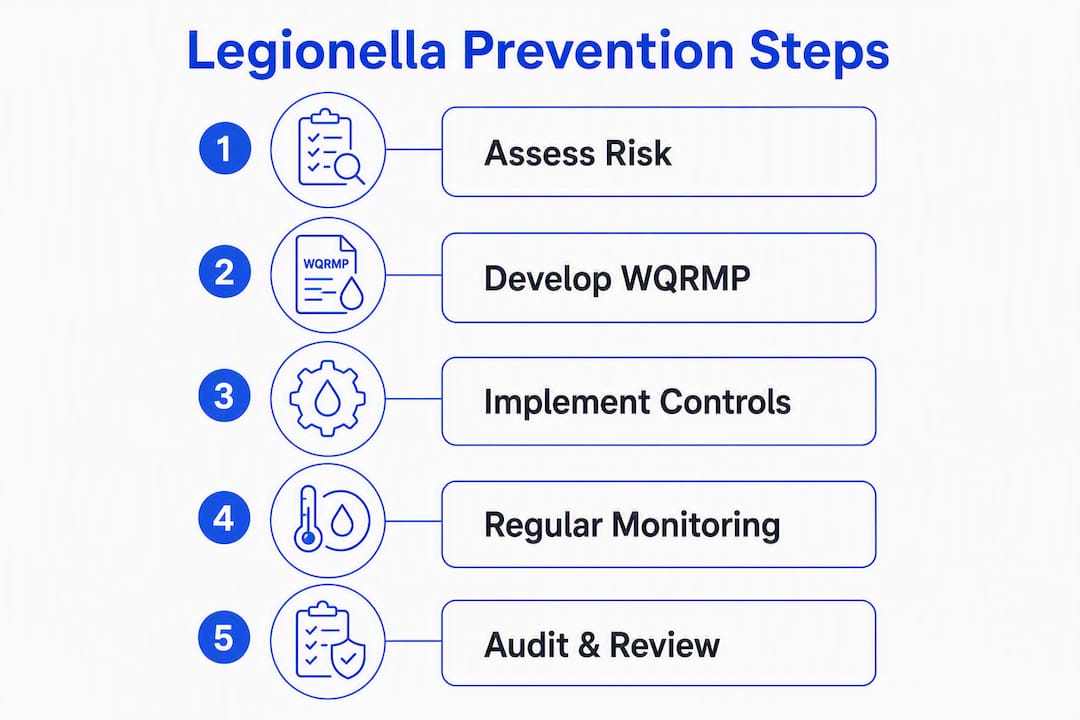
There is no single "top" Legionella prevention system for aged care. The right answer, according to enHealth's Guidelines for Legionella Control, is a site-specific Water Quality Risk Management Plan (WQRMP) that layers multiple controls across your plumbing system. No device, filter, or disinfection unit replaces that plan. If you do not have an auditable WQRMP in place, that is your first priority, not a product purchase. Dualflowservices can support the audit, plan development, and ongoing maintenance across Mornington Peninsula and surrounding Melbourne suburbs.
Three things to do this week while you plan:
- Verify your WQRMP exists and is auditable. If it is more than two years old or does not reflect your current plumbing layout, treat it as absent and schedule a review.
- Confirm hot-water storage temperatures. AS/NZS 3666 guidance recommends adequately high storage and distribution temperatures at distal points. Check your system's actual delivery temperatures, not just the set-point on the heater.
- Start a weekly flushing log for unused outlets. enHealth advises weekly flushing of infrequently used outlets, covering both hot and cold lines where mixing is possible. A simple dated paper log is better than nothing while you set up a digital system.
Table of Contents
- What does Australian regulation actually require for Legionella control?
- What must a WQRMP contain, and how do you make it site-specific?
- What control measures work, and when do you use them in aged care?
- How do you monitor, sample, and respond when Legionella is detected?
- How do you make maintenance auditable?
- What does a staged implementation look like from audit to ongoing monitoring?
- How do you evaluate and procure a qualified Legionella contractor?
- Why do flushing and dead-leg management matter more than any device?
- Key takeaways
- The part most facilities get wrong
- Dualflowservices: aged care water safety across Mornington Peninsula
- Useful sources for WQRMP development and compliance
What does Australian regulation actually require for Legionella control?
The short answer: a documented, auditable plan, regular monitoring, and accredited laboratory testing. The longer answer depends on which state your facility sits in, but the national floor is set by enHealth.
The national framework
enHealth's Guidelines for Legionella Control are the primary national reference for health and aged care facilities in Australia. They require a site-specific WQRMP that identifies risks, assigns control measures, and produces auditable records. This is not a recommendation — regulators and accreditation bodies treat the enHealth guidelines as the expected standard of care for aged care facilities.
AS/NZS 3666 covers air-handling and water systems and sets the technical baseline for temperature control, maintenance, and testing. Compliance with AS/NZS 3666 alone is not sufficient; it works alongside the WQRMP, not instead of it.
State-level obligations
State health departments layer additional requirements on top of the national framework. WA Health provides guidance and self-assessment audit tools specifically for health and aged care facilities, including templates that help managers map their compliance against both AS/NZS 3666 and enHealth expectations. SA Health publishes Legionella-related risk management guidance for care facilities that aligns with the national framework but includes state-specific notification requirements. Victoria's Department of Health also maintains guidance on Legionella and water delivery systems that Victorian aged care managers should review directly.
When to escalate and who to call
If Legionella is detected above your WQRMP's action level, your state public health unit must be notified. The timing and threshold for notification varies by jurisdiction, so confirm the specific trigger in your state guidance now, before you need it. All confirmatory environmental sampling should be conducted by, or in partnership with, a NATA-accredited laboratory. NATA accreditation is the standard that gives your results legal and audit weight; samples processed by non-accredited labs will not satisfy a regulator or an accreditation auditor.
Pro Tip: Download your state health department's self-assessment audit tool and complete it before your next accreditation visit. The gaps it surfaces are exactly what an auditor will look for, and finding them yourself first is far less costly than finding them under scrutiny.
Aged care facilities in Australia are expected to maintain a documented, auditable WQRMP aligned with enHealth guidelines and AS/NZS 3666 — the absence of one is itself a compliance failure, regardless of what physical controls are installed.
What must a WQRMP contain, and how do you make it site-specific?
A generic WQRMP template will fail most audits. enHealth's guidance is explicit: the plan must reflect your facility's actual plumbing topology, not a theoretical building. That means walking the system, drawing it, and identifying every risk point before you write a single control measure.
The core elements every WQRMP must include
- System map (plumbing topology). A schematic showing all water sources, storage tanks, heaters, distribution lines, thermostatic mixing valves (TMVs), dead legs, sentinel outlets, ice machines, cooling towers, and any point-of-use devices. If your map does not match what is in the walls, it is not a compliant plan.
- Risk assessment. A systematic review of each system component against Legionella growth conditions: temperature, stagnation, scale, biofilm potential, and aerosol generation risk. Prioritise areas where immunocompromised residents have direct exposure.
- Critical control points (CCPs). The specific locations and parameters where control is applied and verified — hot-water storage temperature, distal outlet temperature, disinfectant residual, flushing frequency for dead legs.
- Monitoring plan. Who monitors what, at what frequency, using what method, and what the acceptable range is. Temperature checks, disinfectant residual readings, and microbiological sampling all need separate schedules.
- Sampling points and sampling plan. Named outlet locations for routine and triggered sampling, with a clear rationale for why each was chosen (sentinel outlets, high-risk areas, post-remediation verification points).
- Responsibilities matrix. Named roles (not just job titles) assigned to each control task, monitoring activity, and corrective action. Auditors look for this immediately.
- Escalation triggers and corrective action procedures. Defined action levels for each CCP, with a written response procedure for each trigger. "Investigate and remediate" is not sufficient — the procedure must specify who does what, in what timeframe.
- Recordkeeping procedures. How records are created, stored, retained, and made available for audit. Digital, timestamped records are the current expectation.
Mapping your plumbing: what to look for
Dead legs are pipework sections that carry water to a terminal point with no onward flow. They are the highest practical risk in aged care because water stagnates, cools or warms to growth-favourable temperatures, and biofilm accumulates. When mapping, identify every dead leg, every outlet used less than weekly, every TMV, and every storage vessel. Note the distance from the nearest active flow point.
Ice machines and chilled-water systems deserve their own risk assessment entry. They are frequently overlooked in WQRMP templates designed for hot-water systems, yet they can harbour Legionella if not maintained and cleaned on schedule. Cooling system maintenance in aged care follows different protocols to hot-water systems, and your WQRMP should address them separately.
Suggested log types and minimum record fields
A compliant recordkeeping system does not need to be expensive, but it does need to be consistent. Three log types cover most facilities:
- Temperature log. Fields: date, time, outlet ID, measured temperature (°C), operator name, pass/fail against CCP limit, corrective action taken (if any).
- Flushing log. Fields: date, time, outlet ID, duration flushed, temperature confirmed at start and end, operator name, any observations (discolouration, odour).
- Sampling and laboratory log. Fields: date, time, sample location, sample reference number, NATA-accredited lab name, chain-of-custody reference, result received date, result (CFU/L), action taken.
What control measures work, and when do you use them in aged care?
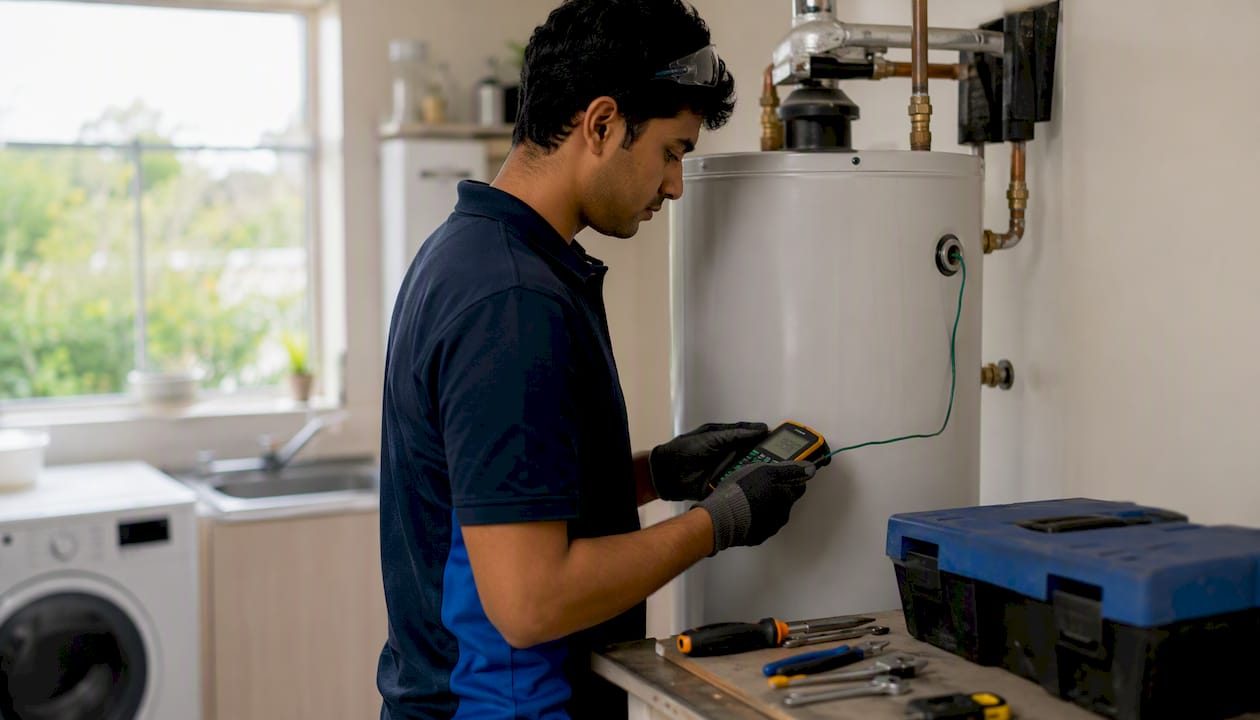
No single control measure is sufficient. CDC and enHealth both state this clearly, and it is the principle that should govern every procurement decision you make. The goal is a multi-barrier approach where systemic controls, localised treatments, and operational disciplines reinforce each other.
The table below compares the main control categories by function, typical application in aged care, and key limitations.
| Control category | How it works | Aged care application | Key limitations |
|---|---|---|---|
| Temperature management | Hot water stored above 60°C; distributed above 50°C at distal points | Whole-of-system baseline control; TMVs required at resident outlets to prevent scalding | Requires regular distal temperature verification; TMVs add maintenance obligation |
| Chlorination (free chlorine) | Residual disinfectant suppresses Legionella growth in distribution | Effective in systems with consistent residual; suits facilities with existing chemical dosing infrastructure | Residual degrades with distance and temperature; corrosive at high doses; requires monitoring |
| Monochloramine | More stable residual than free chlorine; penetrates biofilm better | Suited to large, complex distribution systems | Requires specialist dosing equipment; not suitable for all water chemistries |
| Copper–silver ionisation | Biocidal ions suppress Legionella at point of generation | Useful as a supplemental control in high-risk areas | Efficacy depends on water chemistry (pH, hardness); requires regular monitoring and electrode maintenance |
| UV disinfection | Inactivates Legionella in the water passing through the unit | Point-of-use or whole-building inline application | Does not provide residual protection downstream; lamp replacement schedule is critical |
| Point-of-use microfiltration | Physical barrier removes Legionella at the outlet | High-risk outlets (immunocompromised residents, ICU-equivalent areas) | Filters require regular replacement; does not address the broader system |
| Flushing (operational) | Removes stagnant water and restores temperature | Weekly flushing of all infrequently used outlets | Labour-intensive; must be documented to have compliance value |
| Thermal shock (remedial) | Superheating system to kill Legionella | Emergency remediation after detection | Not recommended as a standalone long-term strategy; must be integrated into overall WQRMP |
Point-of-use multi-barrier systems can deliver very high pathogen reductions when properly validated. Australian efficacy testing recorded a 99.9% reduction in Legionella for a multi-barrier point-of-use system during validation. That figure is useful context for what validated technology can achieve at a single outlet — it does not mean the broader system is protected.
Pro Tip: When evaluating any supplemental disinfection or filtration system, ask the supplier for independent, NATA-accredited efficacy data specific to Legionella, not just general microbial reduction claims. Validated performance under Australian water chemistry conditions is what matters.
The disability-compliant hot water system guidance covers the balance between scalding prevention and Legionella control at TMVs — a tension that is directly relevant to aged care outlets.
How do you monitor, sample, and respond when Legionella is detected?
Monitoring is where a WQRMP either proves its worth or exposes its gaps. The plan tells you what to control; monitoring tells you whether the controls are working.

Sampling cadence by risk profile
Sampling frequency should be risk-driven, not calendar-driven. The National Academies guidance on Legionella in water systems recommends calibrating frequency to the facility's risk profile and population sensitivity. For aged care, the population is almost always high-sensitivity, which pushes frequency upward.
| Facility risk profile | Recommended sampling frequency | Trigger for increased frequency |
|---|---|---|
| Low risk (new build, simple plumbing, active WQRMP) | Quarterly environmental sampling | Any detection above action level; system modification |
| Moderate risk (older building, some dead legs, active WQRMP) | Monthly or bi-monthly sampling at sentinel outlets | Temperature excursion; flushing gap; detection |
| High risk (complex system, known dead legs, vulnerable residents) | Monthly sampling; continuous temperature monitoring at CCPs | Any detection; complaint; system change |
All confirmatory samples must go to a NATA-accredited laboratory with documented chain-of-custody. enHealth guidance and state health bodies are consistent on this point: accredited testing is not optional where results will be used for compliance or public health decisions.
Action levels and what they mean
The National Academies report references a reference action level for Legionella, noting that thresholds should be calibrated to risk tolerance and population sensitivity. In aged care, many facilities adopt a lower trigger given the vulnerability of residents. Your WQRMP must define your facility's specific action levels for each CCP, not rely on a generic national figure.
Response workflow for confirmed detection
- Notify your state public health unit — Check your state's specific notification threshold and timeframe. Do not wait for a second confirmatory result before making contact.
How do you make maintenance auditable?
Auditability is as important as control performance. A facility that runs every control measure correctly but cannot prove it will fail an audit just as surely as one that runs nothing. The goal is to make compliance evidence automatic — generated as a by-product of doing the work, not assembled retrospectively.
Core maintenance tasks and frequencies
Your service contract should specify, at minimum:
- Weekly: Flushing of all infrequently used outlets (documented); visual inspection of sentinel outlets for discolouration or odour.
- Monthly: Distal temperature checks at nominated CCPs; disinfectant residual readings (where applicable); review of flushing logs for gaps.
- Quarterly: TMV cleaning and temperature verification; filter replacement or inspection (point-of-use and inline); UV lamp output check.
- Annually: Full WQRMP review against current plumbing topology; accredited microbiological sampling at all nominated sampling points; storage tank inspection and clean; cooling tower inspection (if applicable).
The maintenance checklist for retirement village facilities provides a practical starting point that can be adapted into a WQRMP servicing schedule.
Recordkeeping that satisfies auditors
Every service visit should produce a timestamped, signed record that includes: the task performed, the location, the result (measured value or pass/fail), the operator's name and qualification, and any corrective action taken. Chain-of-custody documentation for samples must travel with the sample from collection to the laboratory and back to your records file.
Digital logs are strongly preferred. They are harder to lose, easier to search, and produce the timestamped audit trail that enHealth auditors and accreditation bodies expect. If your current contractor delivers handwritten paper records, that is a gap worth addressing in your next contract renewal.
Contract clauses that enforce compliance
When renewing or tendering a maintenance contract, insist on these provisions:
- Named NATA-accredited laboratory for all microbiological sampling, with chain-of-custody documentation delivered to the facility.
- Digital record delivery within 48 hours of each service visit, in a format compatible with your facility's management system.
- Defined response time for urgent corrective actions following a detection event (24 hours is a reasonable minimum for aged care).
- Clear allocation of responsibility for remedial works — who authorises, who performs, who verifies, and who documents.
Pro Tip: Ask prospective contractors to show you a sample service report from a comparable aged care facility (with identifying details redacted). A contractor who cannot produce a clear, timestamped, digitally delivered report is not ready for the audit environment you operate in.
Preventative plumbing maintenance and commercial plumbing maintenance best practices both cover the scheduling and contractor management principles that underpin a compliant maintenance programme.
What does a staged implementation look like from audit to ongoing monitoring?
Most facilities do not start from zero. They start from a partial WQRMP, an outdated system map, and a maintenance history that is partly paper and partly memory. The staged approach below is designed for that reality.
-
Stage 1 — Audit and mapping (weeks 1–4). Commission a physical audit of your water system. Walk every pipe run, identify dead legs, map TMV locations, confirm storage tank configurations, and document all outlets. This is the foundation; everything else depends on it. Engage a qualified plumbing contractor with documented WQRMP experience, such as Dualflowservices, for this stage.
-
Stage 2 — WQRMP development (weeks 3–8). Using the audit findings, develop or update the WQRMP. Assign CCPs, set action levels, define monitoring schedules, and allocate responsibilities. If your facility does not have internal expertise for this, engage a contractor or consultant who has produced compliant WQRMPs for comparable aged care facilities.
-
Stage 3 — Immediate operational controls (weeks 1–8, concurrent). Start the flushing programme immediately. Confirm hot-water temperatures at distal points. These cost nothing beyond staff time and close the highest-probability risk while the formal plan is being developed.
-
Stage 4 — Remedial works (weeks 6–16). Address the physical deficiencies identified in the audit: remove or cap dead legs, replace failed TMVs, repair insulation on cold-water lines running near heat sources, and upgrade storage tanks where required. Plumbing upgrades for disability homes covers the types of pipework modifications that commonly arise during this stage.
-
Stage 5 — Install supplemental systems (weeks 10–20, where required). If the risk assessment identifies areas where temperature and flushing alone are insufficient — high-risk resident areas, complex dead-leg networks, or systems with persistent Legionella history — install supplemental disinfection or point-of-use filtration. Commission and verify each system before declaring it operational.
-
Stage 6 — Commissioning and verification (weeks 16–24). Conduct baseline microbiological sampling across all nominated sampling points using a NATA-accredited laboratory. Results establish the post-remediation baseline for your ongoing monitoring programme.
-
Stage 7 — Ongoing monitoring (continuous from commissioning). Execute the monitoring schedule in the WQRMP. Review records monthly. Conduct the annual WQRMP review. Adjust control measures when the system changes.
Key cost drivers to budget for: pipe remediation and dead-leg removal (the most variable cost, depending on system complexity); supplemental disinfection system installation; NATA-accredited sampling (ongoing); and the maintenance contract covering flushing, temperature checks, TMV servicing, and filter replacement. Infrastructure upgrades that accompany plumbing remediation, such as electrical work for dosing systems, add to the project cost — the aged care electrical upgrade guide covers what to expect on that side.
How do you evaluate and procure a qualified Legionella contractor?
The contractor you choose will either make your WQRMP work in practice or undermine it. Qualifications on paper matter less than the evidence of how they actually deliver.
Minimum qualifications and evidence to request
- Documented experience developing and maintaining WQRMPs for aged care or health facilities of comparable size and complexity.
- Named NATA-accredited laboratory partnerships, with a sample chain-of-custody form they use in practice.
- Demonstrated familiarity with AS/NZS 3666 and enHealth guidelines — ask them to describe how their service programme addresses the enHealth WQRMP requirements specifically.
- Current safe work method statements (SWMS) for all relevant tasks, including confined-space entry for tank inspections.
- Public liability insurance at a level appropriate for aged care environments (confirm the minimum with your insurer or facility operator).
- References from aged care or health facility clients, with contact details.
Contractual items to insist on
- Scheduled visit frequency written into the contract, not left to the contractor's discretion.
- Digital record delivery within a defined timeframe after each visit.
- Guaranteed response time for detection events — specify hours, not "as soon as practicable."
- Clear responsibility for remedial works: who scopes, who performs, who verifies, and who signs off.
Questions to ask and red flags to watch for
Ask: "Walk me through what you do when a sample comes back above the action level." A contractor who cannot describe a clear, step-by-step response process has not done it before. Ask: "Can you show me a sample service report from a comparable facility?" A contractor who hesitates or produces a vague one-page summary is not operating at the standard aged care compliance requires.
Red flags: proposals that lead with a single product or device as the solution; quotes that do not mention WQRMP development or review; contractors who cannot name their NATA-accredited laboratory partner; service schedules that are annual rather than monthly or quarterly for a high-risk facility.
Plumbing compliance in aged care facilities covers the broader compliance context for Victorian facilities and the practical benefits of engaging a maintenance partner who understands the regulatory environment.
Why do flushing and dead-leg management matter more than any device?
Biofilm is the core problem. Legionella pneumophila does not float freely in well-maintained, flowing water — it colonises biofilm on pipe surfaces, particularly in areas of stagnation. Dead legs are the highest-risk locations in any aged care plumbing system because water sits, temperatures drift into the growth range of 25–45°C, and biofilm accumulates undisturbed.
enHealth's guidance is direct on this: scheduled, documented flushing of infrequently used outlets is a critical operational control. No supplemental disinfection system compensates for a dead leg that is never flushed. The importance of regular hot water system flushing explains this mechanism in practical terms.
A practical flushing protocol
- Identify all outlets used less than once per week. Include en-suite bathrooms in unoccupied rooms, utility sinks, hose taps, and any outlet downstream of a dead leg.
- Assign flushing to a named staff member or contractor. Ownership matters. An unassigned task does not get done.
- Flush each outlet for a minimum of two minutes, or until the temperature at the outlet stabilises. For hot outlets, confirm the temperature reaches at least 50°C at the tap. For cold outlets, confirm the temperature is below 25°C.
- Record immediately after flushing. Date, time, outlet ID, start and end temperature, operator name. A digital form on a tablet or phone is faster than paper and produces a timestamped record automatically.
- Prioritise resident room outlets in wings with low occupancy. These are the highest-risk locations because the combination of vulnerable residents and infrequent use creates the worst-case scenario.
Prioritisation checklist for dead legs and low-use outlets
- Outlets in unoccupied rooms: flush weekly without exception.
- Outlets more than 3 metres from the nearest active flow point: flag for physical remediation (capping or removal) and flush weekly until remediated.
- TMVs on low-use outlets: clean and verify temperature performance quarterly; these are biofilm accumulation points in their own right.
- Ice machines and chilled-water outlets: clean and sanitise per manufacturer schedule; include in WQRMP sampling plan.
Converting manual flushing logs to digital is one of the highest-value operational improvements a facility can make. Dualflowservices can integrate digital flushing schedules and temperature logs into your existing facility management system, reducing staff burden while producing the timestamped audit trail your WQRMP requires. Non-toxic remediation approaches are worth considering for biofilm removal at fixtures during remediation, particularly in areas where chemical residue is a concern for residents.
Pro Tip: When a room is vacated and before a new resident moves in, run a full flushing and temperature check on every outlet in that room and record it. This single habit closes one of the most common gaps auditors find in aged care water safety records.
Key takeaways
Effective Legionella prevention in aged care requires a site-specific, enHealth-aligned WQRMP combined with a multi-barrier control regime, auditable records, and a qualified maintenance partner.
| Point | Details |
|---|---|
| WQRMP is the foundation | A site-specific, auditable WQRMP aligned with enHealth guidelines is the non-negotiable starting point — no device replaces it. |
| Multi-barrier approach | Combine temperature control, flushing, disinfection, and point-of-use filtration; no single measure is sufficient per CDC and enHealth guidance. |
| Dead legs are the highest risk | Weekly flushing of infrequently used outlets, documented with timestamped records, is the most critical operational control in aged care. |
| Auditability is compliance | Digital, timestamped logs and NATA-accredited sampling results are what regulators and accreditation bodies actually examine. |
| Dualflowservices for implementation | Dualflowservices provides site audits, WQRMP support, scheduled flushing programmes, and maintenance contracts across Mornington Peninsula and surrounding Melbourne suburbs. |
The part most facilities get wrong
Most aged care facilities I see have some version of a WQRMP. The problem is not usually the absence of a plan — it is the gap between what the plan says and what actually happens in the building.
The plan says outlets are flushed weekly. The flushing log has not been updated in six weeks. The plan says TMVs are cleaned quarterly. The last service record is fourteen months old. The plan names a NATA-accredited laboratory for sampling. The last sample was sent to a general testing service that is not NATA-accredited.
This gap is where Legionella outbreaks in aged care actually originate. Not from a failure to install the right technology, but from a failure to execute the operational disciplines that make any technology work. The National Academies guidance frames it precisely: treat the plumbing system as a living environment that requires active, scheduled management. The moment you treat it as infrastructure that runs itself, you have lost control.
The other thing facilities consistently underestimate is the value of a contractor who delivers digital records. A maintenance partner who hands you a paper form at the end of a visit is putting the compliance burden back on you. A contractor who delivers a timestamped digital record to your system within 48 hours of every visit is building your audit file automatically. That difference matters enormously when an accreditation visit arrives with two weeks' notice.
The technology choices — UV, copper-silver ionisation, point-of-use filtration — are secondary decisions. Get the WQRMP right, get the flushing programme running, get a contractor who documents everything, and then layer in supplemental technology where the risk assessment justifies it.
Dualflowservices: aged care water safety across Mornington Peninsula
Aged care water safety is not a one-time installation job. It is a scheduled, documented, ongoing programme — and the gap most facilities face is not knowing what to install, but having a qualified contractor who shows up, does the work, and delivers the records that prove it.
Dualflowservices provides the full range of services that a compliant Legionella prevention programme requires: site audits and plumbing system mapping, WQRMP development support, scheduled flushing programmes, TMV servicing and temperature verification, installation and commissioning of thermal and supplemental disinfection systems, and digital recordkeeping integration. Every service visit produces a timestamped record delivered to your facility. Every maintenance contract is structured around the frequencies and documentation standards that enHealth and state health auditors expect.
The service area covers Mornington Peninsula and surrounding Melbourne suburbs. If your WQRMP is overdue for a review, your flushing logs have gaps, or you need a maintenance partner who understands the aged care compliance environment, contact Dualflowservices to book a site audit and get a clear picture of where your water safety programme stands.
Useful sources for WQRMP development and compliance
These are the primary references to use when developing your WQRMP, briefing contractors, and preparing for accreditation. Each is linked directly.
-
enHealth Guidelines for Legionella Control — The national reference document for Australian health and aged care facilities. Download this first. It contains the WQRMP framework, control measure guidance, and the audit expectations that accreditation bodies apply.
-
WA Health — Legionella control in health and aged care facilities — Includes self-assessment audit tools and state-specific guidance. Useful even for facilities outside WA as a benchmark for what a thorough self-assessment looks like.
-
SA Health — Legionella-related risk management in care facilities — SA-specific guidance with practical risk management framing for care facility operators.
-
Victoria Health — Legionella and water delivery systems — Victorian regulatory context and guidance for facility managers in Victoria.
-
CDC — Controlling Legionella in Potable Water Systems (toolkit) — A practical toolkit covering control strategies, monitoring, and response. The multi-barrier framework and thermal remediation cautions are directly applicable to Australian aged care settings.
-
NCBI Bookshelf — Strategies for Legionella Control in Building Water Systems — Peer-reviewed chapter covering control strategies from design through remediation. Useful for briefing contractors and understanding the evidence base behind each control measure.
-
Regulatory frameworks for Legionella control in Australia — PMC — Academic review of the Australian regulatory landscape. Useful for understanding how national and state frameworks interact and where gaps exist.
For NATA-accredited laboratory selection, search the NATA register for laboratories accredited for microbiological water testing in your state. Always confirm accreditation scope covers Legionella enumeration before engaging a laboratory for WQRMP sampling.