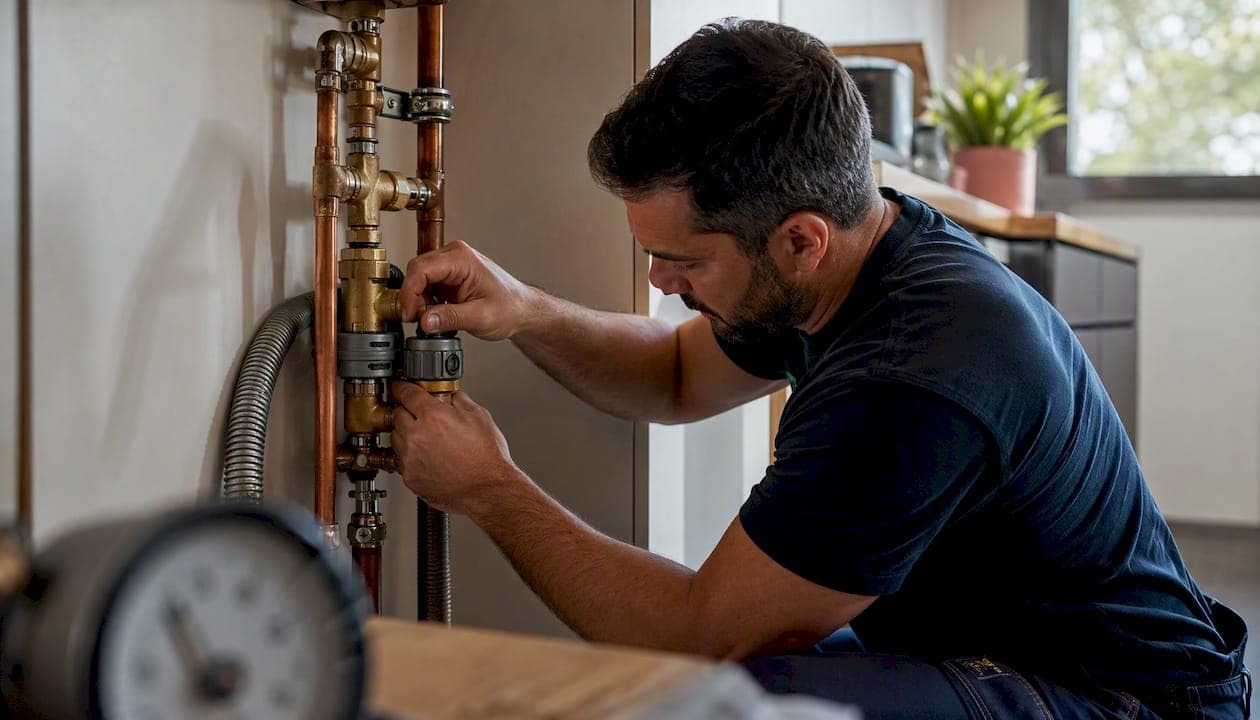
A tempering valve mixes hot and cold water automatically to limit the temperature at your taps and reduce the risk of scalding. If you are unsure whether yours is working correctly, measure the outlet temperature at a tap it serves — anything above 50°C under steady flow is a problem. Book a licensed plumber to inspect or replace it.
Key things to know before you read further:
- A tempering valve is a thermostatic mixing device set to prevent continuous discharge above 50°C, as specified under AS 4032.2.
- Thermostatic mixing valves (TMVs) certified to AS 4032.1 are required in aged care, healthcare, childcare and disability care settings, where outlet temperatures are typically set around 45°C.
- Products such as Watts thermostatic tempering valves and Caleffi 5213 series are commonly installed across Australian residential and commercial properties.
- The Victorian Building Authority (VBA) recommends regular inspection and testing of all hot-water safety devices.
- Installation and adjustment must be carried out by a licensed plumber — this is not a DIY task.
Key takeaways
A tempering valve limits outlet temperature to 50°C under AS 4032.2; high-risk facilities require a TMV certified to AS 4032.1 set to approximately 45°C, and annual servicing is the minimum inspection standard for both device types.
| Point | Details |
|---|---|
| Core function | A tempering valve mixes hot and cold water automatically to prevent outlet temperatures exceeding 50°C. |
| TMV required for high-risk settings | Aged care, childcare, healthcare and disability care facilities need AS 4032.1 TMVs set to approximately 45°C, not standard tempering valves. |
| Annual service is the minimum | Inspect and service regularly — clean strainers, verify outlet temperature, test thermal shutoff, and record results. |
| Call a licensed plumber when | Outlet temperature is unstable, cross-flow is suspected, the valve is leaking, or the facility has regulatory obligations. |
| Dualflowservices | Covers installation, commissioning reports, compliance checks and annual servicing across the Mornington Peninsula and surrounding suburbs. |
Table of Contents
- What is a tempering valve and how does it work?
- Where are tempering valves typically installed?
- When are tempering valves legally required in Australia?
- Tempering valve vs TMV vs pressure-balanced valve
- How to spot a failing tempering valve
- How to test and adjust a tempering valve safely
- How often should you service a tempering valve?
- What to ask your plumber before the job starts
- A local installer's perspective
- Dualflowservices can handle your tempering valve safety check
- Sources
What is a tempering valve and how does it work?
A tempering valve is a thermostatic mixing device fitted to a hot-water system to automatically blend hot supply water with cold water before it reaches your taps, showers or fixtures. The goal is straightforward: keep the outlet temperature at or below a safe limit so occupants cannot be scalded by a sudden surge of dangerously hot water.
Inside the valve, a thermostatic element — typically a wax-filled cartridge or bimetallic strip — expands and contracts in response to the mixed-water temperature. When the outlet runs too hot, the element expands to restrict the hot-water inlet and open the cold-water inlet further. When the outlet cools, the element contracts and the balance shifts back. This happens continuously and automatically, without any manual intervention.
Thermal shutoff is a critical safety feature. If the cold-water supply fails entirely, the thermostatic element closes the hot-water inlet to prevent scalding-temperature water from reaching the outlet. Importantly, installation instructions for standard tempering valves confirm that the thermal shutoff requires a minimum temperature differential of approximately 10°C between the hot inlet and the mixed outlet to function correctly. If your hot-water storage temperature is too close to the set outlet temperature, the shutoff may not trigger reliably.
The valve also compensates for pressure fluctuations. When demand increases across the building — multiple showers running at once, for example — the thermostatic element adjusts the blend in real time to hold the set temperature as steady as conditions allow. Caleffi's 5213 series documentation confirms this same compensation behaviour and repeats the 10°C differential requirement for correct shutoff operation.
Flow path in brief:
- Hot water enters one inlet port, cold water enters a second.
- The thermostatic element modulates a piston or seat assembly between the two inlets.
- Mixed water exits through the outlet at the set temperature.
- If cold supply drops away, the piston closes the hot inlet — flow stops or reduces sharply.
Pro Tip: Supply conditions matter more than most owners realise. Large swings in inlet temperature or pressure force the thermostatic element to work harder and accelerate mineral fouling on the seat. Annual servicing by a qualified plumber is the single most effective way to catch fouling before it causes temperature drift.
Where are tempering valves typically installed?
Location depends on whether the valve is serving the whole building from a central point or protecting a single fixture at the point of use.
Central (hot-water source) installation is the most common arrangement in Australian homes. The valve is fitted at or near the hot-water storage unit — on the outlet of a storage tank or heat pump — and tempers all the hot water before it travels through the building's pipework. One valve covers every tap and shower downstream, which keeps costs down but means the whole system is affected if the valve fails.
Point-of-use installation places a smaller valve directly under a basin, at a shower, or immediately before a specific fixture. This approach is used where a central valve cannot be fitted, where a particular outlet needs a lower temperature than the rest of the building, or where tamper-resistance is needed at an individual fixture. Under-sink tempering valves with locking adjustment caps are common in childcare centres and disability bathrooms.
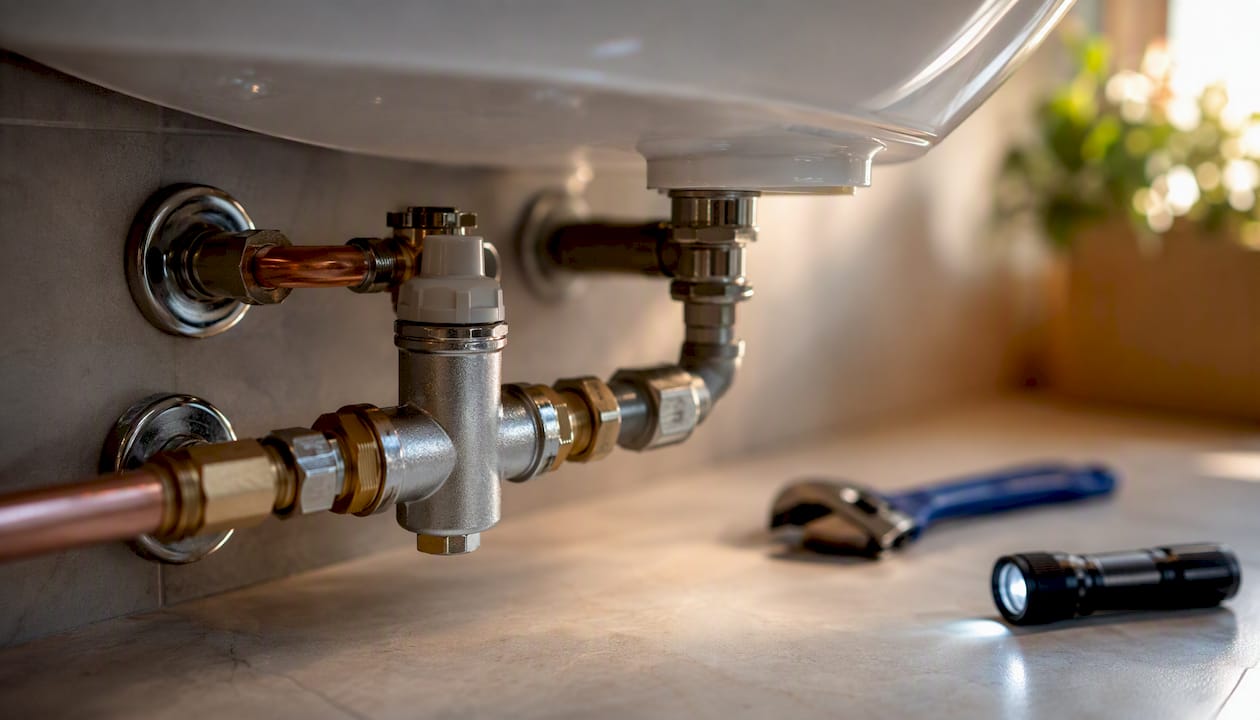
Re-circulation systems in larger apartment blocks or commercial buildings often include a mixing valve at the manifold where the recirculating hot-water loop returns. This prevents the loop from delivering water hotter than the set point to any branch.
Common locations across different property types:
- Residential homes: outlet of the hot-water storage cylinder or heat pump, sometimes at the shower in older homes.
- Apartment blocks: central riser manifold or at individual unit hot-water connections.
- Aged care and retirement villages: point-of-use TMVs (not standard tempering valves) at every basin and shower in resident areas, plus a central valve at the storage unit.
- Childcare and disability care homes: point-of-use valves with tamper-resistant covers at all accessible fixtures. See plumbing upgrades for disability homes in Victoria for more on compliant fixture selection.
Pro Tip: If you manage a multi-tenancy building and cannot locate the tempering valve, check the plant room near the hot-water storage unit first. In older buildings it may be lagged over or hidden behind a panel — a licensed plumber can trace the pipework and confirm its location and condition in a single visit.
When are tempering valves legally required in Australia?
The short answer: in most Australian states, a tempering valve or equivalent mixing device is required on any new or replacement hot-water system serving a residential or public building. The specific standard and device type depend on the setting.
AS 4032.2 covers tempering valves and end-of-line temperature-actuated devices. It specifies that these devices must prevent a continuous discharge above 50°C under steady-state conditions. This is the standard that applies to general residential and commercial ablution outlets.
Where the occupants are at higher risk — aged care, healthcare, childcare, or disability care — AS 4032.1 applies instead. TMVs certified to that standard are set to a lower outlet temperature, typically around 45°C, and must meet tighter accuracy and shutoff requirements. Installing a standard tempering valve in an aged-care bathroom when AS 4032.1 compliance is required creates a non-compliance risk and, more critically, a patient safety risk.
| Standard | Device type | Intended outlet temperature | Typical application |
|---|---|---|---|
| AS 4032.2 | Tempering valve | ≤50°C | General residential, commercial ablution |
| AS 4032.1 | Thermostatic mixing valve (TMV) | ~45°C | Aged care, healthcare, childcare, disability care |
The Victorian Building Authority recommends regular inspection and testing and provides consumer-facing guidance on compliance obligations. Queensland property owners and managers can check obligations via Business. NSW and other states have equivalent building regulation requirements — your licensed plumber should be able to confirm which standard applies to your specific building and use.
Pro Tip: The practical rule of thumb: use a tempering valve (AS 4032.2) for general hot-water safety in homes and standard commercial buildings; specify a TMV (AS 4032.1) wherever regulations or your facility's risk profile demand a lower outlet temperature and tighter accuracy. When in doubt, ask your plumber to confirm in writing which standard the installed device meets.
Tempering valve vs TMV vs pressure-balanced valve
These three device types solve related but distinct problems. Choosing the wrong one for the setting is a compliance and safety issue, not just a technical preference.
| Dimension | Tempering valve | Thermostatic mixing valve (TMV) | Pressure-balanced valve |
|---|---|---|---|
| Adjustability | Adjustable set point, lockable cap | Precision-adjustable, tamper-resistant stops | Fixed compensation, no temperature set point |
| Application | Central hot-water source, general ablution | Point-of-use in high-risk environments | Shower valve to prevent cold/hot shock |
| Temperature accuracy | Moderate (±2–3°C typical) | High (±1°C or better, per AS 4032.1) | Not a temperature-setting device |
| Standards/listing | AS 4032.2 | AS 4032.1 | Varies; not a mixing standard |
| Maintenance complexity | Annual service, strainer clean | Annual service, more critical calibration | Cartridge replacement as needed |
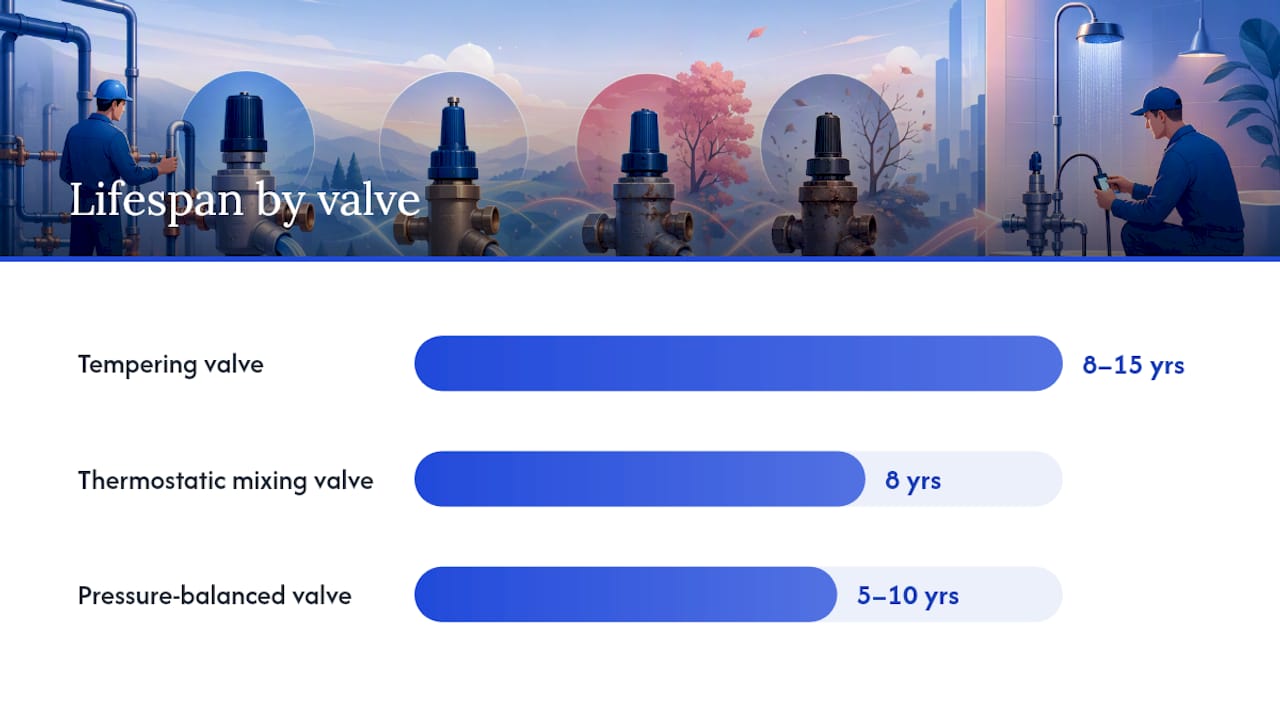
| Typical lifespan | 8–15 years with regular service | 8 years with regular service | 5–10 years |
A pressure-balanced valve is often confused with a tempering valve, but it does a different job. It balances the ratio of hot and cold pressure to prevent a sudden cold shock when a toilet flushes nearby — it does not set or hold a specific mixed temperature. You will find them inside shower cartridges in many Australian bathrooms, but they are not a substitute for a tempering valve or TMV on the hot-water system.
Watts thermostatic tempering valves are available in configurations that include integral check valves, strainers and tamper-resistant adjustment caps — features that bring a standard tempering valve closer to TMV-level tamper resistance for point-of-use applications, without meeting the full AS 4032.1 accuracy requirement.
How to spot a failing tempering valve
A tempering valve rarely fails all at once. The more common pattern is gradual drift — outlet temperatures creeping up or down over months — until something goes wrong quickly.
Safety callout: Water at 60°C can cause a serious scald in under five seconds. Children, elderly people, and anyone with reduced mobility or sensation are at highest risk and may not be able to move away from hot water quickly enough.
Watch for these symptoms:
- Sudden hot spurts at taps or showers that were previously comfortable — the thermostatic element may be fouled or seized.
- Inability to hold a stable temperature — the outlet swings between hot and cold under normal demand.
- Cold water coming from the hot tap — a sign of cross-flow through a failed check valve inside the tempering valve.
- Reduced flow at tempered outlets compared to untempered outlets — a blocked strainer or partially closed seat.
- Complete loss of tempered water — the valve has shut off or the element has failed in the closed position.
If the cold-water supply pressure drops significantly and the thermal shutoff does not trigger, dangerously hot water can reach the outlet. This is most likely when the temperature differential between the hot inlet and the mixed outlet is less than the 10°C minimum that manufacturers specify for reliable shutoff operation.
Immediate steps while you wait for a plumber: turn the hot-water storage thermostat down to reduce the risk of scalding-temperature water reaching outlets, and place a warning notice on affected fixtures. Do not attempt to disassemble the valve yourself. Check the emergency plumbing checklist for Victorian homeowners for further guidance on managing the situation safely.
How to test and adjust a tempering valve safely
Testing is something a responsible property manager can do with a calibrated thermometer. Adjustment and repair require a licensed plumber.
Before you start: confirm the valve is accessible and the adjustment cap is not locked or tamper-sealed. If it is, stop — call a licensed plumber. Do not apply force to a locked cap.
- Run the hot tap served by the tempering valve for at least two minutes to purge the line and reach steady-state temperature.
- Hold a calibrated digital thermometer under the flow and record the temperature. For a general residential outlet, the target is 50°C or below. For a high-risk facility outlet, the target is approximately 45°C.
- Increase demand by opening a second hot outlet on the same system. Check whether the temperature at the first outlet drifts more than 2–3°C. Significant drift under demand suggests the thermostatic element is worn or fouled.
- Briefly close the cold-water isolation valve (where safely accessible and permitted) and observe whether the outlet flow stops or reduces sharply — this tests the thermal shutoff. Restore cold supply immediately. Only do this if you are confident in isolating and restoring the supply safely.
- Record all readings with the date and time.
To adjust the set temperature: remove the adjustment cap (if unlocked), turn the spindle in small increments (typically one-quarter turn), wait two minutes, and re-check the outlet temperature with the thermometer. Set the limit stop once the correct temperature is confirmed, then lock the cap.
Call a licensed plumber when:
- The outlet temperature cannot be stabilised within the target range after adjustment.
- You find evidence of cross-flow (cold water from the hot outlet or vice versa).
- The valve is leaking at any joint or body.
- The facility has regulatory obligations (aged care, childcare, disability care) — all adjustments in these settings must be performed and documented by a licensed plumber.
- The valve is inaccessible, tamper-sealed, or you are not confident in the isolation procedure.
Pro Tip: Use a NATA-calibrated thermometer, not a kitchen probe or infrared gun, for compliance testing. The difference between a reading of 49°C and 51°C matters legally, and a cheap thermometer can easily be that far off.
How often should you service a tempering valve?
Annual inspection is the standard recommendation, and for good reason. Mineral deposits, particularly in areas with hard water, accumulate on the strainer screens and thermostatic element over twelve months of continuous operation. Left unchecked, fouling reduces accuracy and can eventually seize the element in a fixed position.
A proper service visit should cover:
- Strainer and screen cleaning — remove, inspect and flush the inlet strainers to restore full flow.
- Check valve verification — confirm the integral check valves are seating correctly to prevent cross-flow between hot and cold lines.
- Thermostatic element condition — inspect for corrosion, scale build-up or physical damage; replace if the element shows signs of wear.
- Outlet temperature verification — measure and record the mixed-water temperature at the outlet under steady flow and under demand.
- Lockcap and limit stop inspection — confirm the adjustment cap is locked and the limit stop is correctly set.
- Thermal shutoff test — where safely accessible, confirm the shutoff operates within the manufacturer's specified differential.
Tempering valves generally last 8–15 years with regular servicing. Replacement becomes the better option when the element is seized and cannot be freed, when the valve body shows corrosion or cracking, when parts are no longer available, or when repeated service visits fail to bring the outlet temperature within range. Preventative plumbing maintenance is almost always cheaper than emergency replacement — a seized valve that fails during peak demand can mean scalding risk across an entire building until a replacement is sourced and fitted.
What to ask your plumber before the job starts
Verifying competence before work begins protects you legally and practically. Here is a short checklist:
- Licence details: ask for the plumber's licence number and verify it before work starts. In Victoria, check via the VBA licence register; in NSW, use Verify; in Queensland, check through the QBCC online portal.
- Trade insurance: confirm current public liability and professional indemnity cover.
- Experience with tempering valves and TMVs: ask specifically — not all plumbers work on these devices regularly.
- Standards reference: ask which standard the installed valve will meet — AS 4032.2 for a tempering valve, AS 4032.1 for a TMV — and confirm it is appropriate for your building type.
- Commissioning report: request a written report showing the final outlet temperature reading, the date, the valve make and model, and the plumber's licence number.
- Warranty and service terms: confirm the warranty period on parts and labour, and whether the plumber offers a scheduled annual service.
Questions to ask on site:
- "Will you set the outlet at the correct temperature for this application and lock the adjustment cap?"
- "Do you provide a commissioning report with the final outlet temperature recorded?"
- "Which standard will this valve meet, and is that appropriate for this facility type?"
Pro Tip: Keep the commissioning report and all service records in your facility's maintenance file. If a regulator or insurer ever asks for evidence of compliance, that paperwork is your first line of defence. For aged-care and disability care facilities, this documentation is not optional — it is part of your duty of care. See disability-compliant hot water systems for more on record-keeping obligations in those settings.
A local installer's perspective
The most common failure mode seen on the Mornington Peninsula is not a dramatic valve blowout — it is slow drift. A valve that was set correctly at commissioning and never serviced again will often be delivering water at 54°C or 55°C three or four years later, and the property owner has no idea because nobody has measured it. That is the gap between compliance on paper and compliance in practice.
The second thing worth saying plainly: the distinction between a tempering valve and a TMV matters enormously in care settings. Aged-care and disability-care facilities that have a standard tempering valve where an AS 4032.1 TMV is required are non-compliant, full stop. The devices look similar and are often installed in the same location, which is exactly why it is worth asking your plumber to confirm in writing which device is fitted and which standard it meets.
A single annual service visit covers everything: strainer clean, element check, outlet temperature verification, and a written record you can keep on file. That is the rhythm that keeps both the valve and your compliance position in good shape.
Dualflowservices can handle your tempering valve safety check
Safe, compliant hot water is not something to leave to guesswork. Dualflowservices provides tempering valve installation, commissioning, annual servicing, compliance checks and emergency call-outs across the Mornington Peninsula and surrounding Melbourne suburbs — covering homes, businesses, aged care facilities, retirement villages and disability care homes.

One visit covers everything: outlet temperature measurement, strainer cleaning, element inspection, thermal shutoff testing, and a written commissioning report you can keep for compliance records. For facilities with regulatory obligations under AS 4032.1, the team can confirm whether the correct device type is fitted and adjust or replace it to bring the system into compliance.
Book a hot water safety check with Dualflowservices today — or call for an emergency call-out if you have identified a fault that needs immediate attention.
Sources
The sources below are the primary references for standards, regulatory guidance and manufacturer specifications cited in this article.
- AS 4032.2-2005 (R2015) Water supply - Valves for the control of hot water supply temperatures. Part 2: Tempering valves and end-of-line temperature-actuated devices | Building CodeHub
- Installation, commissioning and servicing instructions (5213AUS)
- Caleffi 5213 tempering valve installation and servicing instructions
- Watts thermostatic tempering valves product guide
- Hot water safety — Victorian Building Authority