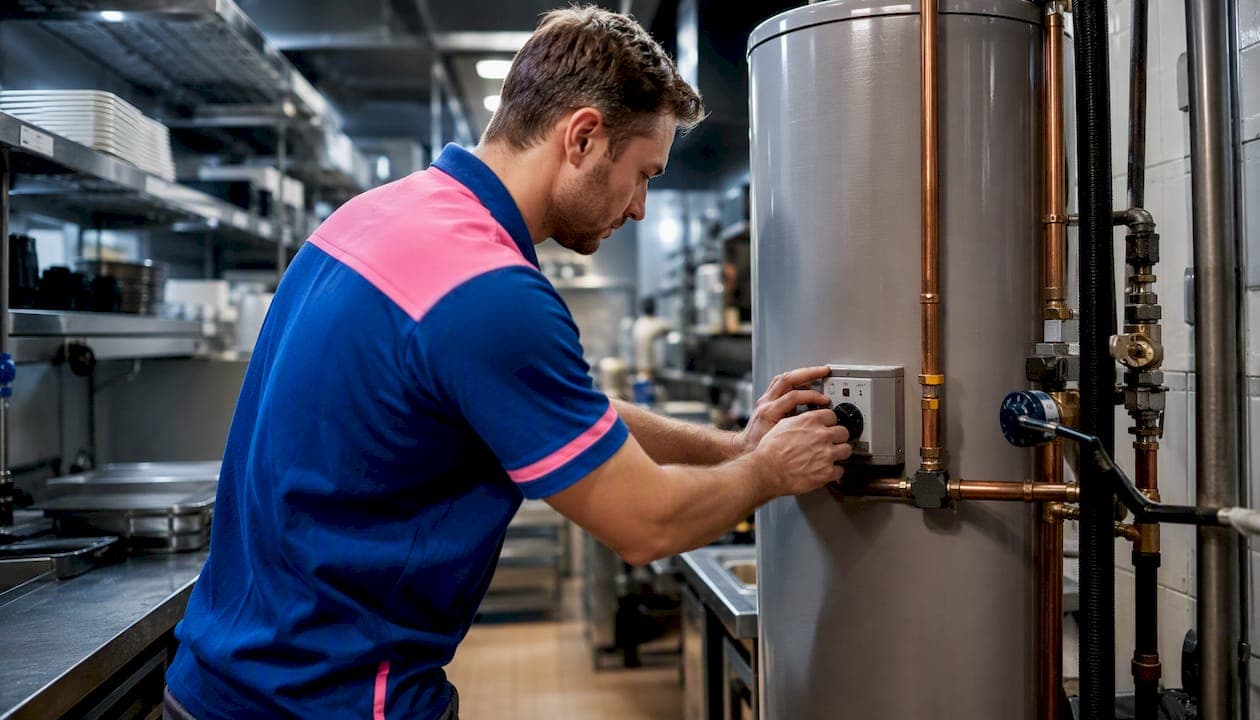
Store your hot water at a temperature not less than 60°C. Deliver it at or below 50°C to personal hygiene outlets such as handwashing basins and showers. Reduce that ceiling to 45°C where children, elderly guests, or people with disabilities are present, as required for early childhood, schools, and aged‑care facilities. Kitchen sinks and cleaning stations are not required to be limited to 50°C under Australian plumbing standards, so they can run hotter to cut grease and support sanitation. Warewashing machines typically need incoming supply around 60°C, then a booster heater to hit final-rinse sanitising temperatures of 74–82°C. Thermostatic mixing valves (TMVs) or tempering valves reconcile the gap between the hot storage you need for Legionella control and the safe delivered temperatures required at the tap.
These guidelines come from the national plumbing standard, state health authority guidance including the Victorian Department of Health, and Food Standards Australia New Zealand (FSANZ). Dualflowservices installs and commissions TMVs, booster heaters, and hot water systems across the Mornington Peninsula and surrounding Melbourne suburbs, and can document the work for your compliance folder.
Key obligations at a glance:
- Store hot water at ≥ 60°C at all times, including during peak service.
- Deliver tempered water at ≤ 50°C to personal hygiene outlets (handwashing basins, showers).
- Deliver at ≤ 45°C where required for early childhood, aged-care, or health facilities.
- Kitchen sinks and janitorial outlets may receive hotter supply; however, staff training and signage are still required.
- Warewashing final-rinse temperatures require a correctly sized and commissioned booster heater.
- TMV installation and commissioning must be carried out by a licensed plumber.
Pro Tip: Keep a printed copy of your temperature setpoints, TMV commissioning certificate, and last three monthly temperature logs in a single compliance folder. Inspectors can ask for these on the spot.
Key takeaways
Australian restaurants must store hot water at ≥ 60°C, deliver it at ≤ 50°C to personal hygiene outlets (such as handwashing basins and showers), and at ≤ 45°C where children, elderly, or people with disabilities are present, using correctly commissioned TMVs and booster heaters to meet both bacterial control and scald prevention obligations.
| Point | Details |
|---|---|
| Storage temperature | Hold hot water at ≥ 60°C at all times to control Legionella and other bacteria. |
| Delivery limits | ≤ 50°C at personal hygiene outlets; ≤ 45°C where children, elderly, or people with disabilities are present. |
| Kitchen sinks and warewashing | Not limited to 50°C; warewashing needs ~60°C incoming supply and a booster to reach 74–82°C final-rinse temperature. |
| TMVs and commissioning | Install TMVs close to fixtures; commissioning must be by a licensed plumber with documented settings on file. |
| Records and inspections | Keep monthly temperature logs, TMV commissioning certificates, and booster heater service records for at least 12 months. |
| Dualflowservices | Provides TMV commissioning, booster heater installation, compliance checks, and emergency call-outs across the Mornington Peninsula and surrounding Melbourne suburbs. |
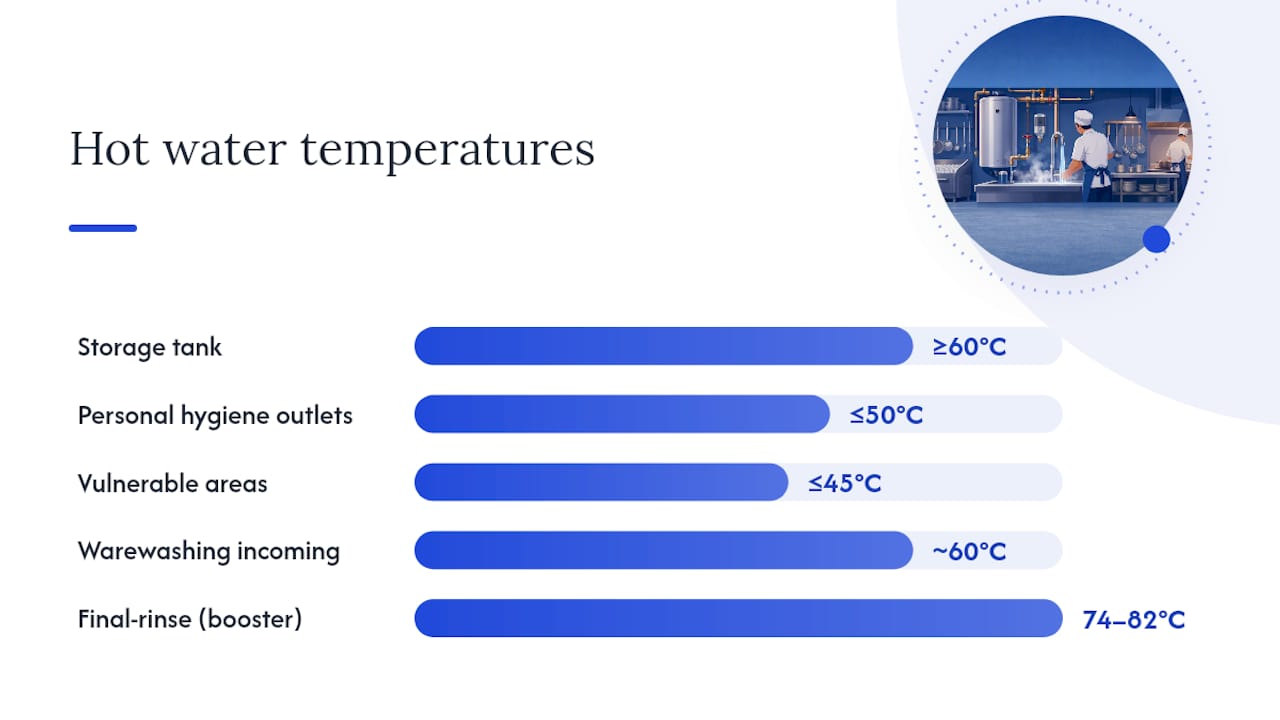
Table of Contents
- What temperature should each fixture receive?
- Why do these temperatures matter so much?
- What do Australian rules and standards require?
- Compliance checklist you can use today
- How to test temperatures and keep inspection-quality records
- Common problems and how to diagnose them
- What technicians see most often in restaurants
- Dualflowservices: hot water compliance for Mornington Peninsula restaurants
- Sources
What temperature should each fixture receive?
The temperature targets for delivered hot water to various fixture types in a commercial kitchen or restaurant are set according to Australian plumbing guidance and local council requirements. These targets reflect Australian plumbing guidance and common local council requirements.
| Fixture | Delivered temp target | Reason | TMV/tempering valve required? |
|---|---|---|---|
| Handwashing basins (general) | ≤ 50°C | Scald prevention; comfort encourages compliance | Yes |
| Handwashing basins (childcare, aged care, health) | ≤ 45°C | Higher scald risk for vulnerable groups | Yes — mandatory |
| Showers (staff amenities) | ≤ 50°C | Scald prevention | Yes |
| Kitchen sinks and food prep sinks | Not limited to 50°C | Grease removal and cleaning effectiveness | Not mandatory; staff training required |
| Janitorial/cleaning sinks | Not limited to 50°C | Heavy-duty cleaning; chemical activation | Not mandatory; signage recommended |
| Warewashing machine inlet | ~60°C incoming supply | Machine manufacturer minimum; booster heater raises to final-rinse temp | Booster heater required |
| Warewashing final rinse (high-temp sanitising) | 74–82°C | Thermal sanitisation of crockery and utensils | Booster heater commissioned to machine spec |
A few practical notes on this table:
- The 50°C and 45°C ceilings apply at the outlet, not at the heater. If your TMV is set correctly but installed far from the fixture, heat loss in the pipe can cause the valve to compensate and deliver hotter water than intended. Install TMVs as close to the fixture as possible.
- Warewashing temperatures vary by machine model. Always cross-reference the manufacturer's data plate and your local council's food premises requirements before commissioning a booster heater.
- The 2022 US Food Code lowered its suggested minimum handwash temperature to 85°F (~29°C) to improve comfort and therefore handwashing compliance — a useful reminder that water temperature alone is not the bactericidal factor for hand hygiene. In Australia, the delivery ceiling (≤ 50°C) is the binding obligation; the lower end is about comfort and staff willingness to wash properly.
Pro Tip: Label every TMV with its commissioning date, set temperature, and the name of the licensed plumber who commissioned it. This takes two minutes and saves significant time during an inspection.
Why do these temperatures matter so much?
The answer comes down to two competing risks pulling in opposite directions.
Bacterial growth, including Legionella, thrives in water held between roughly 25°C and 50°C. Storing hot water below 60°C creates conditions where Legionella and other pathogens can multiply to dangerous concentrations. Australian guidance is clear: hot water must be stored at not less than 60°C to control this risk. The CDC similarly recommends storing hot water above 60°C and maintaining circulating hot water above approximately 49°C in recirculating systems to prevent bacterial colonisation in the distribution loop.
Scalding, on the other hand, happens fast. Water at 60°C can cause third-degree burns in seconds, particularly for a child. At 50°C, the time to serious injury is longer but still measured in seconds for a child and a few minutes for an adult. At 45°C, the risk drops further. This is why the delivery ceiling exists: you need the storage temperature high enough to kill bacteria, but the delivered temperature low enough that a momentary lapse in attention at the tap does not cause a serious injury.
TMVs solve this by blending hot and cold water at the point of use. The storage system runs at 60°C or above; the valve delivers tempered water at the set ceiling. The CDC recommends installing mixing valves close to fixtures precisely because long pipe runs between the valve and the outlet can allow temperatures to drift.
- Legionella risk zone: 25°C–50°C storage temperature.
- Scald risk at 60°C: serious burns in seconds for children.
- TMVs reconcile both risks when correctly installed and commissioned.
- Recirculation loops must stay above ~49°C to prevent bacterial growth in the distribution pipework.
Pro Tip: Train staff never to adjust TMV settings themselves. Internal TMV adjustments must only be made by a licensed plumber. An incorrectly set TMV can deliver water above the legal ceiling without any visible sign.
What do Australian rules and standards require?
The core obligations for restaurant hot water in Australia come from several overlapping sources.
The national plumbing standard sets the technical requirements for hot water system design, installation, and the use of tempering devices. State plumbing regulators adopt and reference it. The Tasmanian plumbing standards summary is a useful plain-language guide to the Australian approach: TMVs or tempering valves must be set to ≤ 50°C for general sanitary fixtures and ≤ 45°C for early childhood, schools, and aged-care facilities. Kitchen sinks are explicitly not required to be limited to 50°C.
State health departments, including the Victorian Department of Health, issue food premises regulations and guidance that sit alongside the plumbing standard. These set out requirements for handwashing facilities, warewashing, and general sanitation in food businesses. FSANZ provides the national food safety framework under the Australia New Zealand Food Standards Code, which requires food businesses to maintain adequate facilities for personal hygiene and cleaning.
Local councils administer food premises registrations and conduct inspections. Their environmental health officers can apply requirements beyond the national minimum, so confirming obligations with your local council is always worth doing before a fit-out or upgrade.
How to confirm which rules apply to your venue:
- Check your state's plumbing regulator website for the current version of AS/NZS 3500 adopted in your jurisdiction.
- Contact your local council's environmental health officer for food premises-specific requirements.
- If your venue serves children, elderly guests, or people with disabilities, the 45°C delivery ceiling applies. See the aged care plumbing compliance guide for Victoria-specific detail.
- For any installation or commissioning work, engage a licensed plumber who can certify the work against the applicable standard.
Pro Tip: Ask your licensed plumber to provide a commissioning certificate that references the specific requirements of the national plumbing standard they worked to. This is the document an inspector wants to see.
Compliance checklist you can use today
Work through this sequence before your next health inspection. Keep a signed and dated copy in your compliance folder.
System design and storage
- Confirm hot water storage temperature is set to ≥ 60°C at the heater thermostat. Record the reading.
- Verify the recirculation pump (if fitted) is operational and the return line temperature stays above ~49°C. A slow recovery can let temperatures fall below safe storage levels during a busy service period, which is why recovery rate matters as much as tank capacity.
- Check the system can meet peak demand without the storage temperature dropping below 60°C. If it cannot, contact a licensed plumber to assess recirculation, staging, or a second heater.
Point-of-use tempering
- Confirm a TMV or tempering valve is installed at every personal hygiene outlet (handwashing basins, staff showers).
- Check each TMV commissioning certificate is on file, signed by a licensed plumber, and shows the set temperature.
- Verify delivered temperature at each outlet with a calibrated thermometer. Record results.
Warewashing and booster heaters
- Confirm the warewashing machine's incoming supply temperature meets the manufacturer's minimum (typically ~60°C). Refer to warewashing supply requirements for sizing context.
- Confirm the booster heater is commissioned to deliver the machine's specified final-rinse temperature (74–82°C for high-temperature sanitising).
- Check the booster heater service record is current.
Signage, training and records
- Post temperature warning signage at kitchen sinks and janitorial outlets where water is not limited to 50°C.
- Confirm staff have been briefed on safe water use, including not adjusting TMVs.
- Maintain a temperature log with entries at least monthly (weekly for high-risk facilities). Keep logs for a minimum of 12 months or as required by your local council.
When to call a licensed plumber or Dualflowservices
- TMV installation, commissioning, or adjustment.
- Booster heater installation or sizing.
- Any time storage temperature cannot be maintained at 60°C.
- Annual TMV servicing and recertification.
- Emergency call-out for hot water system failure during service.
Pro Tip: Print this checklist, complete it with a colleague, and attach it to your compliance folder with the date signed. If an inspector arrives unannounced, you have documented evidence of a systematic approach.
How to test temperatures and keep inspection-quality records
What to measure and where
Measure temperature at four points as a minimum: the storage tank outlet (or as close as safely accessible), the recirculation return line, a representative handwashing basin outlet, and the warewashing machine inlet. For larger venues, add a second handwashing basin on a different branch and the kitchen sink.
How to measure
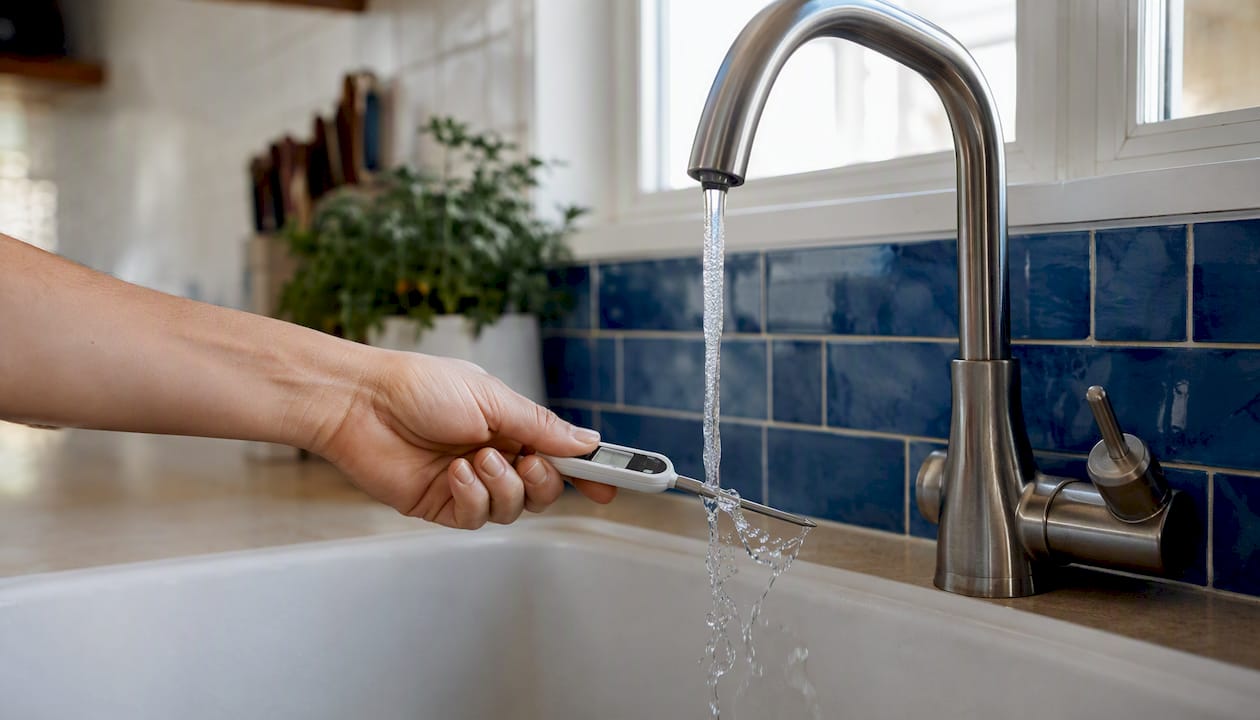
Use a calibrated digital thermometer with a probe suitable for water. Allow the probe to stabilise for at least 30 seconds before recording. For outlet measurements, run the tap for 30 seconds first to flush standing water from the pipe, then measure the flowing temperature. Data loggers are useful for continuous monitoring of storage and recirculation temperatures. A food establishment design guide commonly uses 49°C (~120°F) as a minimum design reference for sizing calculations, which aligns with the recirculation loop minimum.
Suggested testing frequency
Sample log fields
Each log entry should capture: date, time, measurement point, instrument used, reading (°C), pass/fail against target, and the name of the person recording. Retain logs for at least 12 months.
Pro Tip: Calibrate your thermometer against a known reference at least every six months and record the calibration date and result in the log. An inspector may ask when the instrument was last checked.
Common problems and how to diagnose them
Storage temperature below 60°C
Check the thermostat setting first. If the setpoint is correct but the measured temperature is low, the element or gas burner may be failing, or peak demand is outstripping recovery rate. Do not lower the setpoint to compensate. Call a licensed plumber. Regular hot water system flushing also prevents sediment build-up that reduces heating efficiency.
Uneven delivery temperatures across outlets
Often caused by a failing recirculation pump, a blocked or incorrectly balanced recirculation loop, or scale build-up in pipework. Check that the pump is running. Beyond that, a plumber needs to assess flow balance.
Scald complaints at kitchen sinks
Kitchen sinks are not required to be limited to 50°C, but staff still need training and signage. If complaints are frequent, consider whether a tempering valve is appropriate for that outlet even though it is not mandatory.
Poor dishwasher sanitisation results
The most common cause is incoming supply temperature below the machine's minimum or a booster heater that is undersized or has a failed element. Check the incoming temperature at the machine inlet. If it is below ~60°C, the booster cannot compensate adequately.
TMV locking or dripping
A TMV that locks (delivers only cold water) or drips continuously is usually signalling a cartridge fault or scale build-up. Do not attempt internal adjustment. Call a licensed plumber for servicing or replacement.
When to call Dualflowservices for an emergency versus scheduling maintenance: if the storage temperature has dropped below 60°C and cannot be restored quickly, or if a TMV has locked during service, treat it as an emergency. Scale build-up, minor dripping, and annual servicing can be scheduled.
Pro Tip: Replace sacrificial anodes on storage heaters on the manufacturer's schedule. A failed anode accelerates tank corrosion and sediment build-up, both of which reduce heating efficiency and can cause temperature instability.
What technicians see most often in restaurants
The single most common problem Dualflowservices technicians find in restaurant hot water systems is a storage temperature that has drifted below 60°C, usually because a thermostat has been turned down to reduce energy costs or because the system is undersized for peak demand. The fix sounds simple, but simply turning the thermostat back up without checking recovery rate and recirculation often just shifts the problem to a different part of the service period.
The second most common issue is a TMV that was installed but never properly commissioned. A valve set by a non-licensed person, or set at installation and never recertified, may be delivering water above the legal ceiling. You would not know without measuring.
Managers sometimes throttle the entire system to a lower storage temperature to avoid scald complaints at kitchen sinks. This trades one risk for a far more serious one. The correct fix is a TMV at the personal hygiene outlets and staff training and signage at the kitchen sinks, not a system-wide temperature reduction.
For managers preparing for a health inspection, the priority order is: confirm storage temperature, check TMV commissioning certificates are on file, verify delivered temperatures at handwashing basins, and confirm the booster heater is delivering the correct final-rinse temperature for your dishwasher.
Dualflowservices: hot water compliance for Mornington Peninsula restaurants
Getting the temperatures right is one thing. Having the paperwork to prove it is another. Dualflowservices provides hot water compliance checks, TMV supply and commissioning, booster heater installation, and scheduled maintenance for restaurants and food businesses across the Mornington Peninsula and surrounding Melbourne suburbs. Every service visit produces a documented report, commissioning certificate, or maintenance record you can put straight into your compliance folder.
For TMV commissioning and booster heater sizing, a single visit covers both, which reduces downtime during a fit-out or upgrade. Emergency call-outs are available when a system failure threatens your ability to trade. If your storage temperature has dropped, a TMV has locked, or your dishwasher is not reaching sanitising temperatures, contact Dualflowservices to book a service visit or request an emergency call-out.
Sources
The following documents are the primary references for Australian restaurant hot water compliance. Inspectors commonly accept these as evidence of the standards your system is designed and maintained to meet.
- Hot water safety
- Heated water
- CDC toolkit — potable water systems module
- SECTION 4 - FACILITIES TO PROTECT FOOD
- Food establishment guide for design, installation and construction recommendations
- Food Safety Focus — FDA 2022 Food Code lowers hand-washing water temperature
This article is general information, not a substitute for advice from a qualified lawyer. Consult a qualified legal professional about your own circumstances before acting on anything here.