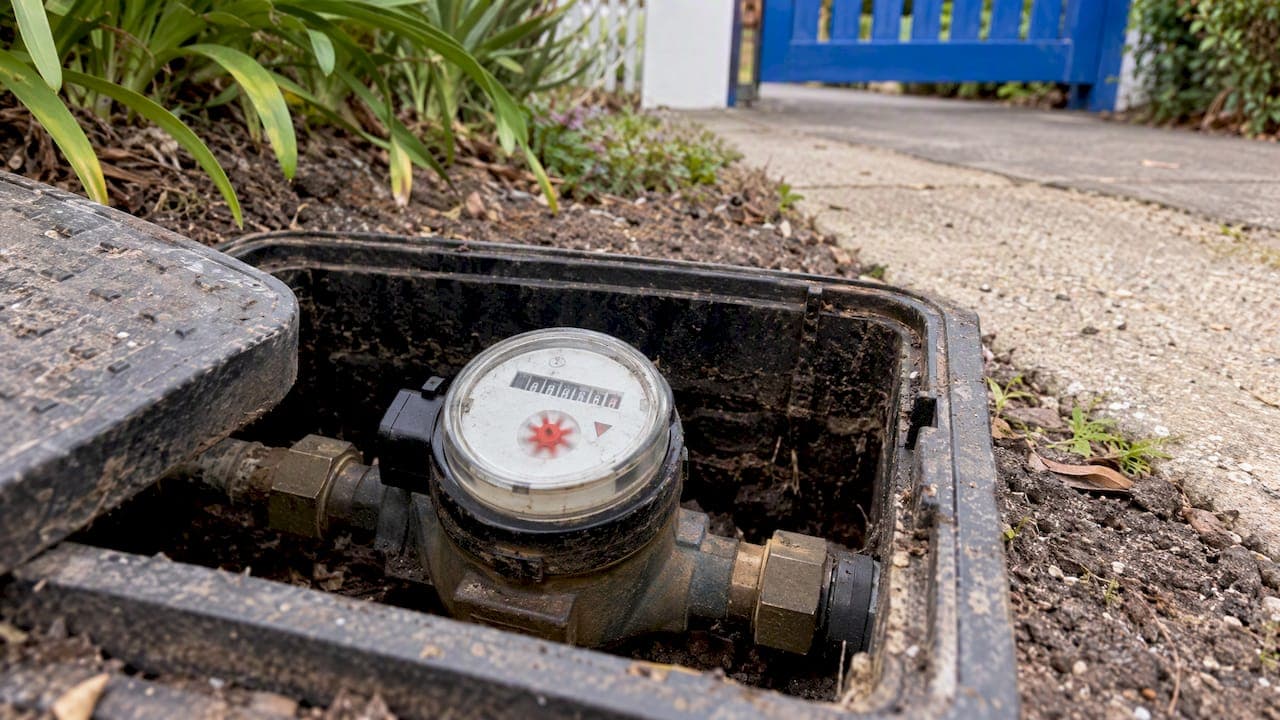
If your water meter is spinning while every tap and appliance is off, water is almost certainly escaping somewhere on your property. The quickest way to confirm it is a one-hour meter test. The most common culprits are a running toilet, a dripping tap, a hot water system valve, an irrigation line or a hidden pipe. This guide walks you through the test, the checks that follow, and the point where a licensed plumber saves you money.
TL;DR
- A moving dial or spinning indicator with no water in use points to a leak, according to the City of Gold Coast.
- Turn everything off, note the reading, wait at least an hour without using water, then read it again. A changed reading means water is going somewhere.
- Check toilets, taps, hoses, irrigation, hot water systems and air conditioning units first. Many leaks are found in these spots.
- A leak that is on your property is yours to fix. If the test shows a hidden or underground leak, book a licensed plumber.
- On the Mornington Peninsula, we handle plumbing, electrical and heating and cooling, so one call covers the leak and anything it has damaged.
Table of Contents
- What a spinning water meter is telling you
- Step 1: Rule out normal use
- Step 2: Run the one-hour meter test
- Step 3: Check the usual suspects
- Quick guide: what the meter is hinting at
- Spinning fast but no leak found?
- When the leak is behind a wall, under a slab or underground
- Who pays for the leak?
- Our perspective: why a spinning meter deserves a quick call
- Get a licensed plumber to track it down
- Stop it happening again
- FAQ
- Sources
What a spinning water meter is telling you
Most household meters have a small indicator that turns whenever water moves through the pipe. It might be a little wheel, a star or a triangle, depending on the model. Our guide to how a water meter works covers the types and how to read them.
The rule is simple. If the indicator moves while you are using water, that is normal. If it moves when nothing is running, the meter is counting water you did not choose to use. The City of Gold Coast says that if the meter dials move while no water is being used, there could be a leak.
A few points are worth knowing before you start:
- Speed matters, but even slow movement counts. A fast spin suggests a bigger flow, such as a burst pipe or a stuck valve. A slow creep suggests a drip, such as a worn tap washer or a toilet that tops itself up.
- Digital and smart meters work differently. On an automatic meter, the bottom numbers increasing when no water is used can signal a leak. Some utilities also send alerts or offer online portals, which catch leaks much sooner than a quarterly bill.
- Your bill is the late warning. By the time a high bill arrives, the leak may have been running for weeks.
Step 1: Rule out normal use
Before you assume the worst, make sure the water is not being used legitimately. Toowoomba Regional Council suggests ruling out visitors, extra garden watering, filling a pool or known fixture leaks when consumption looks higher than usual.
On the Peninsula, a few everyday things can fool you:
- An automatic irrigation system that starts on a timer.
- A dishwasher or washing machine finishing a cycle.
- A water softener, filter or rainwater tank top-up system that draws from the mains.
- A neighbour or tradesperson using an outdoor tap you did not know was connected to your supply.
- An ice maker or a bar fridge with a water line.
Switch off or isolate each of these before you test. If the meter still moves, you have a real flow to chase.
Step 2: Run the one-hour meter test
This is the core of the job. It takes about an hour, but you only need a few minutes of effort.
- Turn off every tap inside and outside, and stop all water-using appliances.
- Do not flush any toilet. Tell everyone in the house not to use water.
- Note the meter reading. Take a photo of the dial and numbers so there is no argument later.
- Wait at least one hour without using water. This is the timeframe Toowoomba Regional Council recommends.
- Read the meter again. If the reading has changed, there may be a leak.
Two cautions. First, a leak can be intermittent, so it may not be running at the moment you test. The City of Gold Coast notes that a leak may not be happening when you check the meter. A clean result is reassuring, not a guarantee. Second, if the meter moves in only some tests, repeat it at different times of day, including overnight when nobody is home and the household is quiet.
Isolate the house from the garden
Once you know there is a leak, narrow down where it is. Many homes have a main isolation valve near the meter or where the pipe enters the house. Turn that off and watch the meter indicator.
- Indicator stops: the leak is on the house side of the valve. Think toilets, taps, hot water, appliances and pipes in walls or under floors.
- Indicator keeps moving: the leak is between the meter and the valve, which usually means an underground pipe, an outdoor tap or an irrigation line.
This single step often saves a plumber an hour of searching, and you can tell them exactly what you found.
Step 3: Check the usual suspects
Toowoomba Regional Council lists the common places to look: dripping taps, washing machine and dishwasher connections, toilet cisterns, outdoor taps, hoses, irrigation and sprinklers, hot water systems and air conditioning units. Here is how to work through them.
Toilets
A toilet is the most frequent cause of a meter that will not stand still, and the leak is often silent. A worn flap or valve lets water trickle from the cistern into the bowl.
Use the dye test. The Queensland Department of Regional Development, Manufacturing and Water advises that you add a few drops of food colouring to the cistern. If colour shows up in the bowl without flushing, the cistern is leaking. Leave it for 10 to 30 minutes. We have a step-by-step page on this: toilet keeps running? the dye test, and a wider guide to hidden toilet leaks.

The waste is not small. The same Queensland department says a continuously running toilet can waste nearly 70,000 litres a year, and a fast-dripping tap can waste more than 10 buckets a week.
Taps, mixers and flexi hoses
Look under the vanity, laundry trough and kitchen sink with a torch. Feel the flexible hoses and the isolation taps with a dry paper towel. Damp, rust marks or mineral crust mean a slow weep. Replace perished flexi hoses early; they tend to fail without much warning.
Hot water system
Check the pressure relief valve discharge pipe on a storage hot water system. If water drips steadily from it, the system or its valve needs attention. Look around the base of the tank and at the connections for moisture too. This is gas and electrical work territory as well as plumbing, so we recommend a licensed tradesperson rather than adjusting valves yourself.
Outdoor taps, hoses and irrigation
Walk the yard after the meter test. Look for soggy patches, unusually green strips of lawn, or water pooling along a path. Check every outdoor tap and hose connection for drips, and run your eye along drip lines for splits.
Irrigation is a big one in Peninsula gardens, where sandy soil can swallow a leak without it ever surfacing. A Unitywater representative has made a similar point about beachside suburbs, saying that leaks may go unnoticed for a long time because water seeps into the sand. For a close look at sprinklers, valves and drip lines, this guide to irrigation leak troubleshooting is a good next stop.
Air conditioning and appliances
A blocked condensate drain on an air conditioner can drip steadily, and some systems have water connections. If you suspect an aircon, see our notes on fixing aircon leaks safely. Also look behind the fridge, the washing machine and the dishwasher for damp floors and kinked or weeping hoses.
Quick guide: what the meter is hinting at
| What you see | Likely cause | First check |
|---|---|---|
| Slow creep, house valve off, stops | Dripping tap, toilet flap, appliance hose | Dye test, then under sinks |
| Steady movement, stops with house valve off | Hidden pipe in wall or floor, hot water system | Damp patches, hot water valve, water stains |
| Keeps moving with house valve off | Underground pipe, outdoor tap, irrigation | Soggy ground, outdoor taps, irrigation zones |
| Fast spin only at certain times | Irrigation timer, appliance, tank top-up | Timers and automatic systems |
| Moves only in some tests | Intermittent leak | Repeat test overnight |
The table is a starting point, not a diagnosis. Overlapping causes are common, and one fixed leak can reveal another.
Spinning fast but no leak found?
A fast spin does not always mean a pipe has burst. It can mean someone is using a lot of water. Revisit the "rule out normal use" list: visitors, a pool top-up, garden watering or an appliance on a long cycle. If you have ruled all of that out and the spin continues, treat it as a leak you have not found yet and move on to a professional.
On the flip side, can you have a leak without the meter spinning? Yes, in two ways. The leak may be intermittent, as noted above, or it may be on the supply side of an appliance that only runs under pressure at certain times, such as a sprinkler zone that triggers once a day. Damp walls, mould, low pressure or an unexplained patch of lawn are signs to act on even when the meter looks still.
When the leak is behind a wall, under a slab or underground
If the meter test confirms a leak and your checks find nothing, stop poking around. The City of Gold Coast recommends engaging a licensed plumber when a leak is confirmed but the location is unknown, as some leaks are hidden underground or behind walls.
Signs that point to a hidden leak:
- Warm patches on a floor, which can suggest a hot water line.
- Cracked tiles, lifting floorboards or a musty smell.
- Stains or bubbling paint on walls or ceilings.
- A meter that moves with every fixture off and the house valve closed.
We have written two practical guides here. One shows how to prove a wall leak in 20 minutes without cutting. The other explains slab leak signs to check before digging. If the leak is showing up as a stain below a bathroom, read what to do first about a ceiling leak.
Who pays for the leak?
Responsibility depends on where the leak is, and rules differ by water corporation. As a general principle, Toowoomba Regional Council states that leaks on the property are the owner's responsibility to fix. That council also says that if its test shows no change in the meter number, the leak is the council's to deal with, and you should report it as soon as possible. That is one Queensland council's process, so check with your own water retailer in Victoria about where its responsibility starts and whether any bill adjustment applies to you.
If you may claim on insurance, keep records. Photos of the meter, dated test readings and a written plumber's report all help. Our page on a plumbing report for insurance explains what insurers tend to need.

Our perspective: why a spinning meter deserves a quick call
We see the same pattern again and again. A homeowner notices the meter moving, does the test, and then spends a weekend lifting mulch or opening cupboards. Sometimes that works. When it does not, the leak keeps running while they hunt.
Our view is that the meter test is the best thing you can do yourself, and the next best thing is to hand over what you found. A plumber who hears "the meter moves with the house valve off" starts at the supply line, not at the bathroom. That saves time and keeps costs down.
Water rarely stays in one trade. A leaking hot water system can sit beside electrical wiring. An aircon drain overflow can wet a ceiling with lighting in it. A leak in a wall can reach a power point. That is why we work across plumbing, electrical and heating and cooling. One team can stop the water, check that the electrical side is safe, and repair the system, without you juggling three businesses.
It matters even more for facilities. In aged care, retirement villages and disability care homes, a leak is not only a cost. It can affect residents' comfort, hot water supply and safety. Facility managers need fast answers and clear records, and we offer 24/7/365 emergency availability for exactly this reason. Regular scheduled maintenance, including checks of valves, hot water systems and fittings, is the way to catch a slow leak before the meter ever tells you about it.
If your meter is spinning, do not wait for the next bill to confirm it.
— Mike
Get a licensed plumber to track it down
If your test shows a leak and you cannot find it, or you find it and it is not a simple tap washer, our team can help. We cover homes, businesses, aged care, retirement villages and disability care homes across the Mornington Peninsula and surrounding Melbourne suburbs, with emergency call-out and scheduled maintenance. See our plumbing services or visit Dualflow Services to book.

When you call, tell us your meter test result, whether the leak stops with the house valve off, and any damp patches you spotted. It helps us bring the right gear on the first visit. If water is near power points, switch off the power at the switchboard only if it is safe to reach, and call us straight away. Our emergency plumbing checklist for Victorian homeowners covers what to do while you wait.
Stop it happening again
Prevention is mostly routine:
- Take a meter reading on the same day each month and note any jump you cannot explain.
- If your supplier offers an online portal or smart meter alerts, switch them on. Unitywater reports that it improved leak notification from quarterly reads to within three days of identifying a leak for more than 90% of its customers.
- Replace old flexi hoses and worn tap washers before they fail.
- Test toilets with dye once or twice a year.
- Have hot water systems, valves and irrigation checked as part of scheduled maintenance.
- For aged care and similar facilities, build leak checks into the maintenance schedule and keep dated records.
FAQ
Is it normal for a water meter to spin?
It is normal while water is being used. If the dial or indicator moves when every tap and appliance is off, it is not normal. The City of Gold Coast says movement with no water use could mean a leak. Run the one-hour test to confirm.
Should a water meter spin very slowly?
Not when nothing is running. A very slow movement usually means a small leak, such as a dripping tap or a toilet that is topping up. Small leaks add up over weeks, so check toilets with dye and inspect taps and hoses.
Why is my water meter spinning fast but there is no leak?
Something is probably using water that you have not counted. Think of visitors, garden watering, a pool top-up, an irrigation timer or an appliance cycle. If you have ruled all of those out, there is likely a leak you have not found, and a licensed plumber can trace it.
Can you have a water leak without the meter spinning?
Yes. A leak can be intermittent, so it may not be running while you check. Signs like damp walls, mould, a soggy lawn patch or low water pressure are worth acting on even if the meter looks still. Repeat the test at different times, including overnight.
Who should I call if the meter keeps spinning?
Call a licensed plumber once you have confirmed a leak and cannot find or fix it yourself. Official guidance recommends this for concealed leaks. Tell them what the meter did when you turned the house valve off.
Sources
- Water leaks, City of Gold Coast
- Water meters, water leaks and water usage, Toowoomba Regional Council
- MyTRC Water Portal, Tamworth Regional Council
- Detecting leaks and reading your water meter, Queensland Department of Regional Development, Manufacturing and Water
- Digital neighbourhood brings financial savings, Inside Water