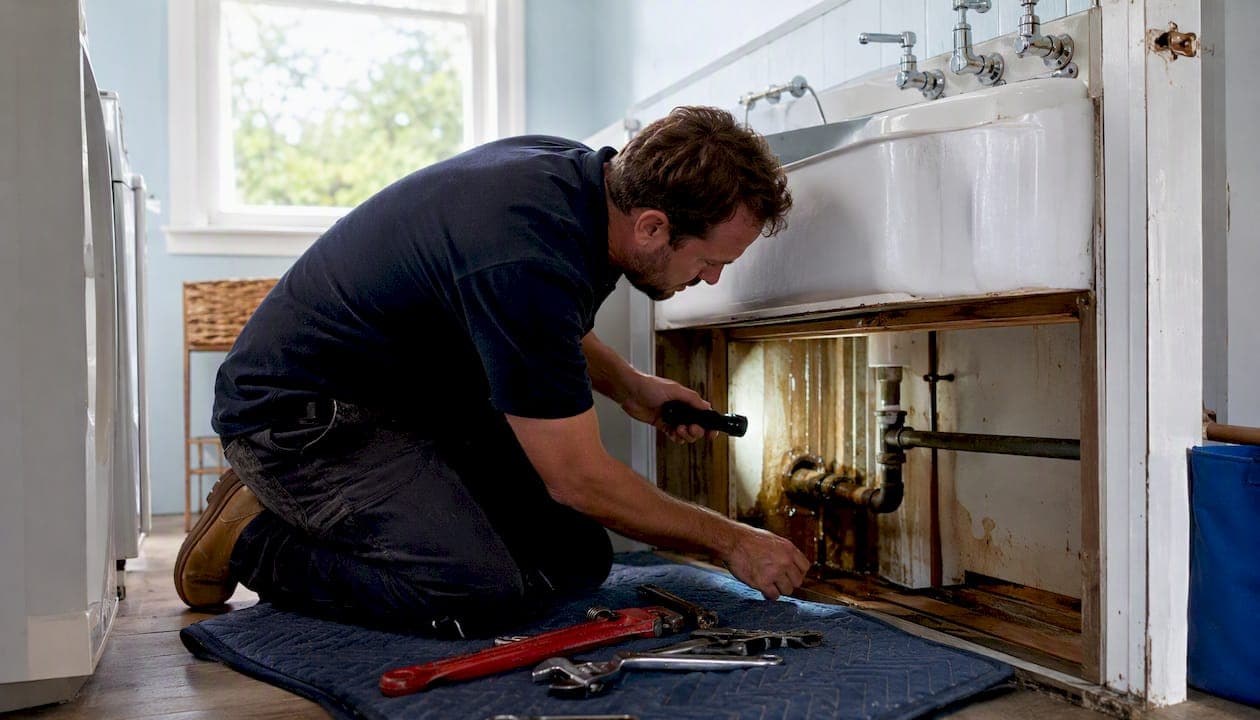
An insurer-ready plumbing report is a licensed plumber's written assessment that states what failed, why it failed (sudden versus gradual), and which tests or evidence support that conclusion. Submit it to your insurer or hold it ready for a loss adjuster. That document is often the single thing that separates a paid claim from a disputed one.
Before the plumber arrives, take these steps:
- Stop the water at the isolation valve or mains stopcock immediately.
- Photograph and video everything before any cleanup or temporary repairs. Timestamped images are the most useful evidence you can give an insurer.
- Notify your insurer as soon as the damage is contained. Most policies require prompt notification.
- Book a licensed plumber to attend, inspect, and produce a signed written report.
When the plumber arrives, have ready: your insurance policy number and insurer contact, photos you have already taken, clear access to the affected area, the location of shut-off valves, and any relevant maintenance history (receipts, previous plumber invoices).
For a practical emergency checklist, the Victorian homeowners emergency guide covers the immediate steps in detail.
Key takeaways
A signed causation statement from a licensed plumber, supported by timestamped photos and documented test results, is the foundation of any successful insurance plumbing claim in Australia.
| Point | Details |
|---|---|
| Preserve evidence before cleanup | Photograph and video damage before any repairs; keep the failed component for the plumber to inspect. |
| Signed causation statement is non-negotiable | The report must state sudden versus gradual cause and include the plumber's licence number and signature. |
| Tests must be recorded with values | Pressure tests, camera logs, and thermal or acoustic findings need actual values, not vague references. |
| Act quickly on notification | Notify your insurer promptly and commission the report before permanent repairs are made. |
| Dualflowservices for local reports | Dualflowservices provides same-day insurer-ready reports across the Mornington Peninsula, including direct insurer liaison. |
Table of Contents
- What counts as an insurer-ready plumbing report?
- When do you need a plumbing report for an insurance claim?
- What a typical insurer-ready plumbing report includes
- How a plumbing report supports your insurance claim
- What does an insurer-ready plumbing report cost in Australia?
- Who can prepare an insurance-grade plumbing report in Australia?
- How to commission an insurer-ready plumbing report
- How Dualflowservices prepares insurer-ready plumbing reports
- Dualflowservices: insurer-ready reports for the Mornington Peninsula
- Sources
What counts as an insurer-ready plumbing report?
Not every plumbing document carries the same weight with an insurer. There are three types you are likely to encounter, and each serves a different purpose.
Condition report. A general assessment of the plumbing system's current state. Useful for pre-purchase checks and scheduled maintenance reviews, but on its own it rarely satisfies an insurer's need to understand why damage occurred. Australian guidance on when a plumbing report is needed lists pre-purchase checks, post-damage insurance evidence, and compliance requests as the three most common triggers.
Forensic or causation report. This is what most insurers actually want after a water damage event. It goes beyond condition to state a cause: was the failure sudden and accidental, or the result of gradual deterioration? A licensed plumber or forensic plumbing specialist prepares it, documents the tests used to reach that conclusion, and signs a declaration. For a deeper look at how a defect report differs from a causation statement, the plumbing defect report guide explains the distinction clearly.
Compliance or certification report. Confirms that plumbing work meets the relevant Australian Standard or local council requirement. Insurers may request this after repairs are completed, or councils may require it before issuing an occupancy certificate.
A standard plumbing inspection can be converted into a forensic statement when a plumber identifies a clear cause during their visit and is willing to sign a declaration to that effect. The key difference is the signed causation statement, not the inspection itself.
When do you need a plumbing report for an insurance claim?
Homeowners insurance typically covers sudden and accidental plumbing failures but excludes damage from gradual deterioration. That distinction drives almost every coverage decision an insurer makes, and a well-prepared report is how you prove which side of the line your damage falls on.
Situations that commonly require an insurer-ready report:
- A burst pipe or sudden supply line failure causing water damage to walls, floors, or ceilings.
- A hidden leak discovered only after significant damage has accumulated (the report establishes when the failure likely began).
- Sewer backup, if your policy includes a water backup endorsement — without that endorsement, sewer events are usually excluded.
- An appliance failure (hot water system, washing machine inlet valve) that causes water entry into the structure.
- Storm-related water ingress where a plumbing component failed under pressure.
Situations that usually do not trigger a covered claim:
- Minor drips from a worn tap washer or slow-seeping joint that has been visible for months.
- Long-term seepage behind tiles or under a slab attributed to gradual pipe corrosion or root intrusion over years.
- Damage an insurer can attribute to deferred maintenance, such as a flexi hose that showed visible corrosion before it failed.
Timing and documentation matter more than most homeowners realise. A photo taken before any cleanup, showing water pooling and the intact failed component, is far stronger evidence than a photo taken after the area has been dried and the pipe replaced. Preserve the failed component itself if you can — a plumber can examine it during the inspection.
Good preventative plumbing maintenance records also help here, because they demonstrate you were not ignoring a known problem.
What a typical insurer-ready plumbing report includes
A report that satisfies an insurer's requirements covers several distinct areas. Standard plumbing inspection templates structure these into discrete checks for water supply, drainage, waste and vent systems, fixtures, hot water systems, and safety items — with fields for photos and a summary. A standard plumbers' report template adds property information, a system overview, condition assessment, recommendations, and a signed declaration, which together give the document legal standing.
Core sections an insurer expects:
- Executive summary stating the cause of damage (sudden versus gradual) and the plumber's confidence level in that finding.
- Defect location and description including pipe material, age where known, and visible damage extent.
- Test results with recorded values: pressure tests (the commonly assessed range is within a normal pressure range considered appropriate for plumbing inspections), dye tests, thermal imaging findings, acoustic leak detection results, and camera inspection logs with footage reference.
- 2D diagrams or annotated floor plan showing defect location relative to the building layout.
- Dated photographs and video with labels identifying each image. Inspection templates explicitly instruct inspectors to attach photos and include signatures — labelled images improve clarity for loss adjusters considerably.
- Plumber's signed declaration including full name, licence number, and a statement of qualifications.
- Recommendations with an urgency rating (immediate stabilisation versus planned repair) and a scope description. A cost estimate is optional unless the insurer specifically requests a formal quote.
- File format: a signed PDF with photos embedded or attached as a clearly named folder (e.g.
ClaimDate_Address_Photos).
Pro Tip: Ask the plumber to narrate their video walkthrough aloud, identifying each component and its condition as they film. A narrated video is far more useful to a loss adjuster than silent footage, and it takes no extra time on site.
Chain of evidence matters. Do not discard the failed component before the plumber inspects it, and do not let a tradesperson make permanent repairs before the report is signed. Temporary stabilisation is fine; permanent repairs before documentation can undermine a claim.
How a plumbing report supports your insurance claim
Insurers use the report to answer two questions: was the cause sudden and accidental, and what is the reasonable scope of loss? A clear causation statement from a licensed plumber answers the first question directly. Detailed test results and a 2D diagram answer the second by defining exactly where damage begins and ends.
The typical submission flow:
- Notify your insurer as soon as damage is discovered. Most policies have a notification requirement, and late notification can complicate a claim.
- Document the damage yourself with timestamped photos and video before any cleanup.
- Commission a licensed plumber to inspect and produce a signed report. Practical filing guidance recommends getting a plumber's written assessment as a core step in the claims process.
- Submit the report to your insurer and, if a loss adjuster has been appointed, send a copy directly to them.
- Provide supporting documents the insurer may request: repair quotes, mitigation receipts (drying equipment, emergency plumber call-out), and proof of maintenance such as previous service invoices.
Common shortfalls that lead to requests for clarification or outright rejection:
- No signed statement of cause — a report that describes damage without stating whether it was sudden or gradual leaves the insurer to draw their own conclusion, which rarely favours the claimant.
- Missing timestamped photos, or photos taken after cleanup rather than before.
- No licence number or qualifications statement from the plumber.
- Vague test references ("pipe was tested") without recorded values or methods.
- Absence of a 2D diagram when damage spans multiple rooms or floors.
What does an insurer-ready plumbing report cost in Australia?
Turnaround and cost vary significantly depending on what the inspection requires. Most licensed plumbers offering insurance reporting work to one of three timeframes:
- Same day: Reasonable for emergency situations where the insurer or loss adjuster needs an immediate assessment. Expect an after-hours or urgency premium.
- 24–48 hours: The most common window for standard insurance reports. Many local plumbers market this turnaround for straightforward burst pipe or appliance failure scenarios.
- 3–7 business days: Typical when the report requires specialist equipment (thermal imaging, acoustic leak detection), a forensic specialist, or significant report-writing time for a complex multi-room loss.
Cost drivers to ask about upfront:
- Site access difficulty (under-slab, concealed pipework, multi-storey).
- Whether invasive inspection is needed to expose the defect.
- Camera inspection of drain or sewer lines.
- Thermal imaging or acoustic leak detection.
- Specialist forensic plumbing assessment versus standard licensed tradesperson report.
- Report writing and signed declaration time.
- Travel distance and after-hours fees.
| Report type | Typical scope | Indicative range |
|---|---|---|
| Inspection + written report | Visual inspection, pressure test, signed statement | Lower end of market |
| Inspection + camera inspection | Above plus drain/sewer camera footage and log | Mid-range |
| Forensic causation report | Full test suite, specialist assessment, detailed causation statement | Higher end |
Exact pricing is not publicly listed and varies by location, access, and complexity. Always ask for an itemised fee estimate before booking, and confirm whether the quoted fee includes the signed PDF report or charges it separately.
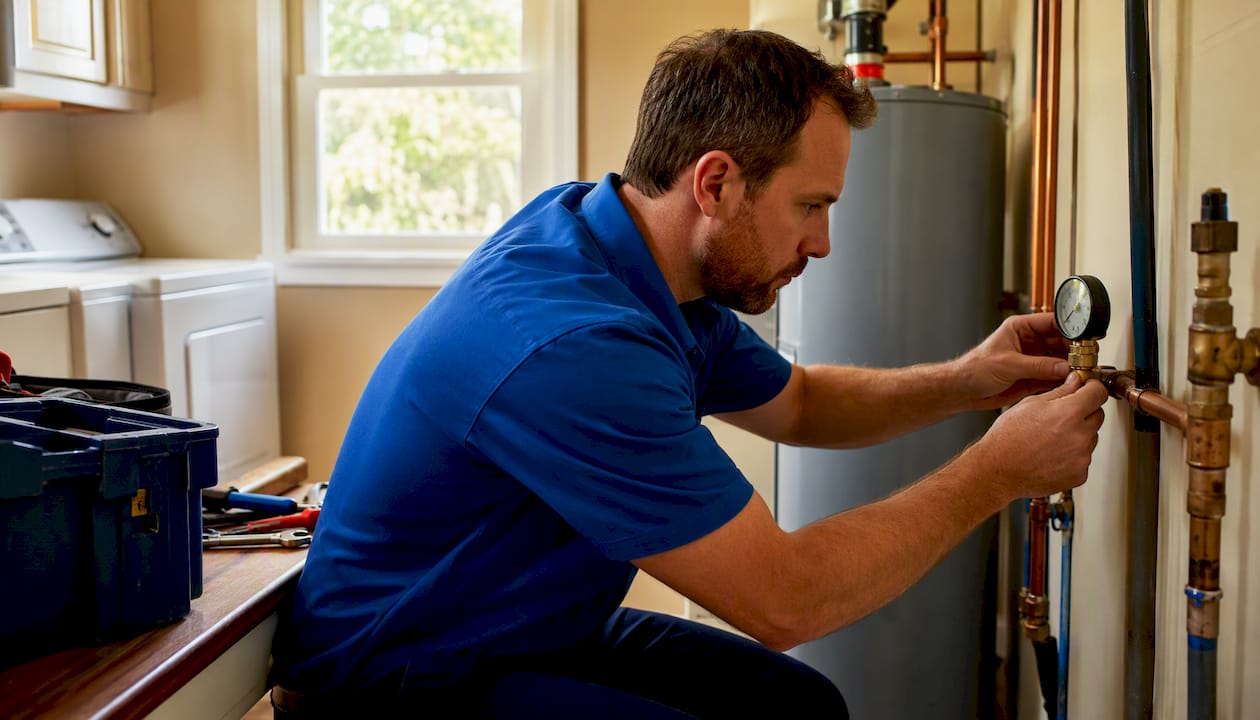
Pro Tip: When you call to book, say explicitly: "I need an insurer-ready report with a signed causation statement." That phrase signals to the plumber exactly what the document needs to contain, and it filters out anyone who would otherwise hand you a basic service docket.
Who can prepare an insurance-grade plumbing report in Australia?
In Australia, a plumbing report submitted to an insurer must be prepared by a licensed plumber. That licence number must appear in the report — it is the insurer's primary check that the assessment comes from a qualified, accountable professional.
What to verify before you book:
- Current plumbing licence issued by the relevant state authority (in Victoria, VBA — the Victorian Building Authority). Ask for the licence number and check it on the VBA register before the visit.
- Experience with insurance reporting specifically, not just general plumbing work. Ask whether they have produced reports for loss adjusters before.
- Familiarity with relevant tests: pressure testing to the 40–80 psi range documented in standard inspection templates, backflow prevention verification, camera inspection protocols, and thermal or acoustic leak detection where the situation warrants it.
- Compliance with local Victorian standards where applicable, particularly for aged care or disability care properties where plumbing compliance requirements are more stringent.
When to engage a forensic plumbing specialist rather than a general licensed tradesperson: when the cause of damage is genuinely disputed, when the insurer has appointed a loss adjuster who is questioning the claim, or when the damage involves concealed pipework where the failure mechanism is not immediately visible.
Red flags to watch for:
- A report with no licence number or plumber signature.
- Vague causation language ("pipe appears to have leaked") with no test data to support it.
- No photographs attached, or photos with no labels or timestamps.
- A plumber who cannot provide a sample report or template before you book.
- Pressure to complete permanent repairs before the report is signed.
How to commission an insurer-ready plumbing report
Getting a usable report on the first visit comes down to preparation on your side and clear communication before the plumber arrives.
- Gather your policy documents. Have your policy number, insurer contact details, and any claim reference number ready to give the plumber.
- Compile your own photos and video. Send these to the plumber before the visit so they understand the scope before arriving.
- Prepare access. Clear the affected area, identify shut-off valve locations, and note any areas of concealed pipework the plumber may need to access.
- Collect maintenance history. Previous plumber invoices, service records, or receipts for recent repairs demonstrate the property has been maintained and counter any "gradual deterioration" argument.
- Ask the right questions when booking:
- What is your current plumbing licence number?
- Can you provide a sample report or template?
- What tests will you perform, and will results be recorded with values?
- Will the report include a signed causation statement?
- What is your turnaround time, and is same-day available if needed?
- Do you liaise directly with insurers or loss adjusters?
- On site: ask the plumber to narrate their video walkthrough, label all diagrams before leaving, and confirm the final report will be delivered as a signed PDF.
- Request direct liaison with your insurer or loss adjuster if the claim is complex or if the insurer has already appointed an assessor. A plumber who can speak directly to a loss adjuster often resolves technical disputes faster than written correspondence.
For more on what to expect during an emergency call-out, the emergency plumbing guide for homeowners covers the on-site process in detail.
How Dualflowservices prepares insurer-ready plumbing reports
Dualflowservices operates across the Mornington Peninsula and surrounding Melbourne suburbs, responding to both emergency call-outs and scheduled inspection requests. The process for an insurer-ready report follows a consistent sequence:
- Rapid response to the site, with same-day attendance available for urgent insurance situations.
- Non-invasive leak detection first using acoustic and thermal imaging equipment to locate the source without unnecessary damage to walls or floors.
- Documented testing including pressure tests with recorded values, dye tests where applicable, and camera inspection of drain and sewer lines when the situation warrants it.
- Photo and video capture on site, with images labelled and timestamped as they are taken.
- Annotated 2D diagrams showing defect location relative to the building layout.
- Signed causation statement from a licensed plumber, including licence number and qualifications, stating whether the failure was sudden or gradual and the evidence basis for that conclusion.
The final report is delivered as a signed PDF and includes: an executive summary, test results with recorded values, labelled photographs, diagrams, plumber qualifications, and repair recommendations with urgency ratings. Dualflowservices can liaise directly with your insurer or loss adjuster, which is particularly useful when a claim is being assessed and technical questions arise.
For property managers overseeing aged care or disability care facilities on the Mornington Peninsula, Dualflowservices also handles plumbing in disability homes and compliance-sensitive environments where reporting standards are higher.
What the evidence actually tells you about claim outcomes
Most denied or disputed plumbing claims share a common thread: the homeowner acted quickly to fix the problem but slowly to document it. By the time an insurer or loss adjuster reviews the damage, the failed component is gone, the area is dry, and the only evidence is a repair invoice. That sequence makes it genuinely difficult for even a sympathetic insurer to approve a claim, because the document trail does not establish sudden cause.
The difference between a smooth claim and a protracted dispute often comes down to three things: a timestamped photo taken before cleanup, a plumber's signed statement that names the cause, and a maintenance history that shows the property was not neglected. Guides on practical claims filing consistently reinforce that prompt mitigation and clear documentation of the sudden nature of the event are the factors that most influence outcome.
One scenario worth considering: a homeowner discovers water damage behind a bathroom wall on a Saturday morning. They photograph the damage, isolate the water, and call a plumber who attends the same day. The plumber performs a pressure test, identifies a failed flexi hose connector, photographs the component in situ, and produces a signed report by Monday. The insurer receives the report, the loss adjuster confirms sudden cause, and the claim is approved within the week. That outcome is not unusual when the evidence chain is intact from the start.
The one item homeowners most often forget: preserve the failed component. A plumber can examine a burst flexi hose or cracked fitting and state in their report exactly what caused the failure. Once it goes in the bin, that physical evidence is gone.
Dualflowservices: insurer-ready reports for the Mornington Peninsula
When water damage happens, the gap between a fast claim resolution and a drawn-out dispute usually comes down to the quality of the first report on site. Dualflowservices delivers exactly what insurers need: a licensed plumber's signed causation statement, documented test results, labelled photos, and a 2D diagram, all in a signed PDF ready for your insurer or loss adjuster.
Dualflowservices covers the Mornington Peninsula and surrounding Melbourne suburbs, with same-day attendance available for urgent insurance situations. The fee includes the on-site inspection, all testing, and the signed report. Direct liaison with your insurer or loss adjuster is available on request.
To book an insurer-ready plumbing report or request a sample report template, contact Dualflowservices directly. Have your policy number and access details ready, and the team will confirm attendance time and what the visit covers.
Sources
For homeowners and property managers who want to go deeper or verify specifics before commissioning a report, these resources are worth bookmarking:
- Plumbing Inspection Report
- Filing a Plumbing Damage Claim: Step-by-Step Process | Coverage Worth Having
- Does Homeowners Insurance Cover Plumbing Issues? – Policygenius
- Plumbers Report for Insurance Template Form - Fill Out and Sign Printable PDF Template | airSlate SignNow
- Free Plumbing Inspection Report Template for Fast, Accurate Work
- Why Would I Need to Get a Plumbing Report?
Victorian-specific note: Plumbing licences in Victoria are issued and verified through the Victorian Building Authority (VBA). If your property is in Victoria, confirm the plumber's licence on the VBA register before the inspection. Requirements can differ between states, so if your property is outside Victoria, check with the relevant state authority for licence verification.
For further reading on Dualflowservices' technical approach, the plumbing inspection homeowner's guide and the commercial plumbing maintenance guide cover inspection scope and maintenance records in more detail.