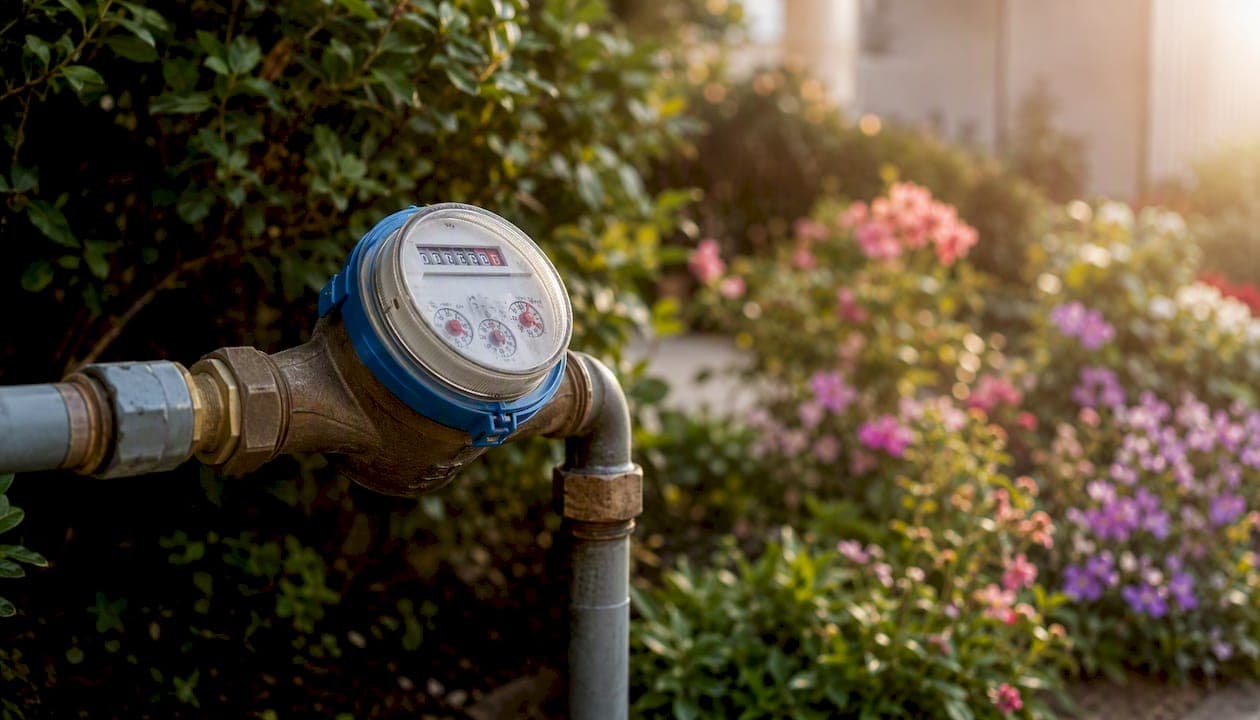
A water meter measures the total volume of water that passes through it and records that as a running total on its register. Every litre that flows through the pipe moves a sensing element, and that movement is converted into a number you can read on the face or digital display. Two core measurement families cover the vast majority of meters in service: positive-displacement (PD) meters, which physically fill and empty a chamber to count volume directly, and velocity-based meters, which infer volume from how fast water moves through a known pipe cross-section.
- Positive-displacement meters are the most common type in residential properties.
- Velocity meters (turbine, multi-jet, propeller) are more common in commercial and irrigation applications.
- International metrology guidance for water meters is set out in OIML R49, which defines components, calibration procedures and verification requirements.
- Modern meters can be paired with AMR (Automated Meter Reading) or AMI (Advanced Metering Infrastructure) technology for remote data collection.
- Dualflowservices provides licensed meter checks, leak diagnostics and installation across the Mornington Peninsula.
Key takeaways
Water meters measure volume using either positive-displacement or velocity principles, and poor installation rather than meter failure is the most common cause of inaccurate readings.
| Point | Details |
|---|---|
| Two core measurement families | Positive-displacement meters count volume directly; velocity meters infer it from flow speed through a known pipe diameter. |
| Units and reading | Most meters display cubic metres (m³) or kilolitres (kL); 1 m³ equals 1,000 litres, and red digits typically show sub-unit litres. |
| 30-minute leak test | Record the reading, stop all water, wait 30+ minutes — any movement in the low-flow indicator or odometer signals a probable leak. |
| Smart meters add data, not new physics | AMR collects readings remotely; AMI enables two-way communication and interval data for near-real-time leak detection. |
| Dualflowservices | Licensed meter checks, leak diagnosis, and emergency call-outs across the Mornington Peninsula and surrounding Melbourne suburbs. |
Table of Contents
- How a water meter measures flow
- What types of water meters are there?
- How to read the register and understand the units
- How to read your meter and spot a leak
- Smart meters: AMR vs AMI and automatic readings
- Why meters give wrong readings and how installation affects accuracy
- What you can check yourself and when to call a plumber
- A plumber's perspective on what meters actually tell you
- Dualflowservices can help with meter checks and leak diagnosis
- Sources
How a water meter measures flow
The physics behind a water meter is straightforward once you separate the two approaches.
Positive-displacement meters work by repeatedly filling a precisely machined chamber with water and then emptying it. A nutating disc wobbles in a circular path as water pushes through, or an oscillating piston rocks back and forth inside a cylinder. Each complete cycle represents a fixed, known volume. The register simply counts the cycles. There is no inference involved: volume in equals volume counted.
Velocity meters take a different route. They measure how fast water is moving through a pipe of known diameter, then calculate volume from that speed. A turbine spins faster when flow is high; a multi-jet meter directs water at a small impeller from several ports to average out turbulence. The register converts rotational speed into a volume total.
Modern electronic meters add a layer on top of either approach: the mechanical or sensor signal is converted into electrical pulses, and a microprocessor logs those pulses into a running total. That total is what you see on the display, and it is also what gets transmitted to your utility via AMR or AMI. Goulburn-Murray Water's metering guidance describes how both displacement and velocity elements feed into mechanical or electronic registers to track flow.
Pro Tip: If you ever see the register ticking over with no taps open, that movement is real. The meter is not malfunctioning — something downstream is using water.
What types of water meters are there?
Goulburn-Murray Water confirms the two primary families, but several other technologies serve specialist applications. Here is how they compare.
Positive-displacement (nutating disc / oscillating piston) These are the workhorses of residential metering. They are highly accurate at low flow rates, which matters for a home where a dripping tap is the only thing running. They do not cope well with dirty or particulate-laden water because debris can jam the close-tolerance chamber.
Single-jet and multi-jet meters Single-jet meters direct one stream of water at an impeller; multi-jet meters use several ports to balance the load. Multi-jet meters are more accurate than single-jet across a wider flow range and are common in small commercial premises. Neither handles dirty water well.
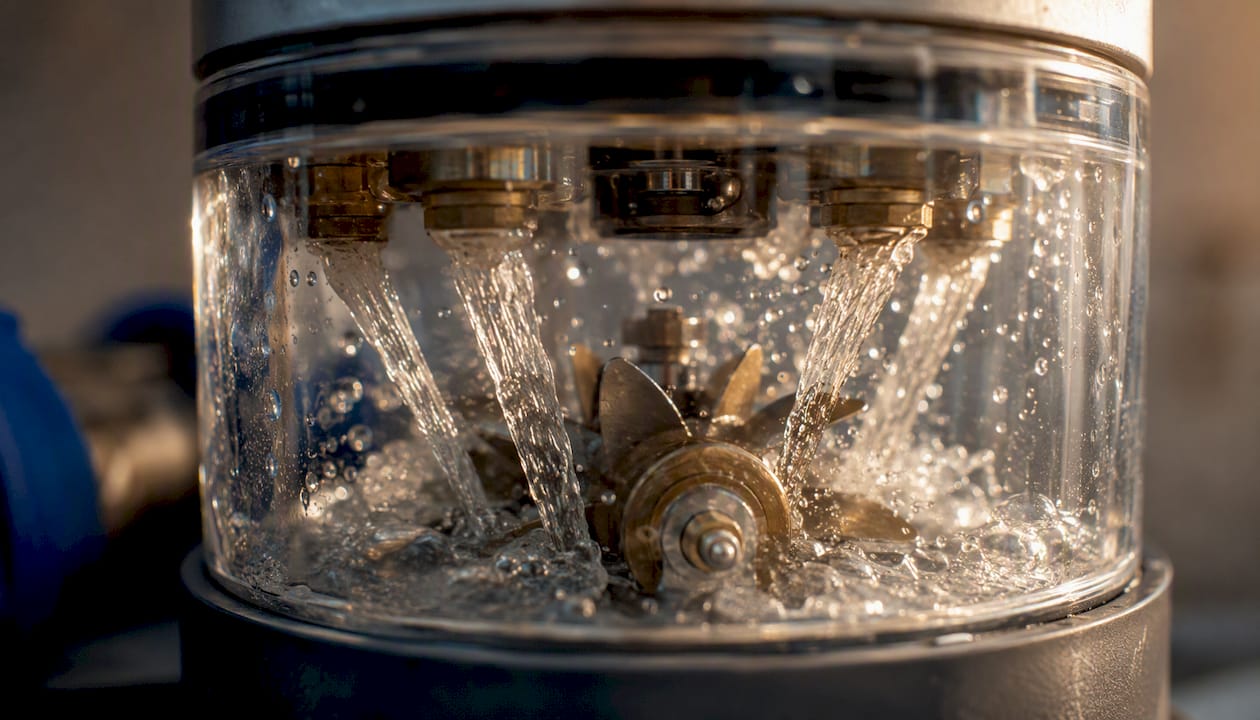
Turbine meters A turbine spins freely in the flow stream. These meters are accurate at medium-to-high flow rates and are well suited to large commercial or industrial pipelines. Accuracy drops off at very low flow, so they are rarely used where trickle flows need to be captured.
Electromagnetic (mag) meters Mag meters use Faraday's law: a magnetic field is applied across the pipe, and the voltage induced by the moving water is proportional to its velocity. No moving parts means no mechanical wear and no clogging, which makes them suitable for raw water, wastewater or any application where debris would destroy a turbine. They require a power supply and proper grounding, and they only work with conductive fluids.
Ultrasonic meters Ultrasonic meters send sound pulses through the water and measure the time difference between pulses travelling with and against the flow. They are highly accurate across a wide range, have no moving parts, and are increasingly common in smart-metering rollouts. They require power and are sensitive to air bubbles and pipe scaling.
Coriolis meters Coriolis meters measure mass flow directly by vibrating a tube and detecting the phase shift caused by the flowing fluid. They are extremely accurate but expensive and bulky, so they appear in high-value industrial or laboratory settings rather than residential pipes.
Compound meters A compound meter combines two measuring elements, typically a turbine for high flow and a PD or multi-jet element for low flow, with an automatic valve that switches between them. This gives accurate readings across a very wide flow range, making them the right choice for large buildings or facilities where demand swings dramatically.
| Meter type | Best for | Accuracy at low flow | Dirty/wastewater suitability | Installation/power | Maintenance notes |
|---|---|---|---|---|---|
| Positive-displacement | Residential, small commercial | Excellent | Poor — debris jams chamber | Gravity-fed, no power | Periodic strainer cleaning |
| Multi-jet | Small commercial, light industrial | Good | Poor | Gravity-fed, no power | Low; keep upstream clean |
| Turbine | Large commercial, irrigation | Poor | Moderate with strainer | Gravity-fed, no power | Bearing wear at high velocity |
| Electromagnetic | Raw water, wastewater, industrial | Excellent | Excellent — no moving parts | Requires power and grounding | Electrode fouling check |
| Ultrasonic | Smart metering, commercial | Excellent | Moderate — sensitive to debris | Requires power | Transducer scaling check |
| Coriolis | High-value industrial, lab | Excellent | Good | Requires power, large footprint | Low but costly to service |
| Compound | Large buildings, aged care, facilities | Excellent across full range | Moderate | Gravity-fed, no power | Two-element inspection needed |
If you recognise your meter as a positive-displacement type, the reading and leak-detection steps below are directly applicable. If you manage a facility with a compound or turbine meter, the accuracy and installation section is worth reading carefully.
How to read the register and understand the units
Most residential meters use one of two display styles: an odometer-style register (a row of numbered wheels that roll forward like a car's trip counter) or a sweep-hand dial with a series of smaller dials for each decimal place. Many modern meters combine both, with the odometer showing the main reading and a sweep hand for the last decimal.
Look for a small star or triangle on the face. This is the low-flow indicator, sometimes called a leak detector. It rotates with even the smallest flow through the meter. If it is spinning with all taps closed, water is moving somewhere.
Units you will see:
- Cubic metres (m³): the standard billing unit in most Australian utilities. One cubic metre equals 1,000 litres.
- Kilolitres (kL): exactly the same volume as one cubic metre. Utilities use kL and m³ interchangeably on bills.
- Litres: shown on the smaller dials or the last digits of the odometer, usually in a different colour (often red).
A quick example: if your meter reads 00123.456, the bold black digits (123) represent 123 cubic metres (or 123 kL) of total consumption. The red digits (456) represent 456 litres of the next cubic metre. Your utility bills you per cubic metre or kilolitre, so the red digits are sub-unit fractions that only matter when you are tracking small changes for a leak test.
Urban Utilities' meter-reading guidance notes that digital meters can also display rate-of-flow alongside the total volume, which is useful for spotting continuous flow at a glance.
How to read your meter and spot a leak
Silent leaks are one of the most expensive problems a property can have. A dripping toilet cistern or a weeping irrigation fitting can waste thousands of litres before anyone notices. Your meter is the fastest way to find them.
- Locate the meter. It is usually in a small pit near the street boundary, sometimes under a lid marked "Water." Bring a torch.
- Activate the display (digital meters only). Some digital meters have a light sensor that wakes the screen when you shine a torch directly at it. If the screen appears blank, try this before assuming the meter is faulty.
- Record the reading. Write down the full odometer reading, including the red (litre) digits.
- Stop all water use. Turn off every tap, appliance, and irrigation zone. Do not flush toilets or run dishwashers during the test.
- Watch the low-flow indicator. If the star or triangle is spinning immediately after you stop all water, there is already a continuous flow.
- Wait at least 30 minutes, then return and record the reading again.
- Compare. Mackay Regional Council's meter-reading guide confirms that any movement in the low-flow indicator or the odometer digits during this period indicates a probable leak between the meter and your fixtures.
For a timed test, note the reading, wait exactly one hour with all water off, and check again. A change of even a few litres points to a slow leak; a change of tens of litres suggests something more significant, like a running toilet or a weeping underground pipe.
Pro Tip: Property managers overseeing multiple tenancies should run this test quarterly. A leak that goes undetected for three months can add hundreds of dollars to a water bill and cause structural damage that costs far more to fix.
Smart meters: AMR vs AMI and automatic readings
The measurement principle inside a smart meter is the same as a conventional one. What changes is what happens to the data after it is recorded.
AMR (Automated Meter Reading) is a one-way system. The meter transmits its reading wirelessly to a collection device, typically a vehicle-mounted reader or a fixed receiver, so the utility can gather data without sending someone to open the pit. It reduces manual reads but does not allow the utility to send commands back to the meter.
AMI (Advanced Metering Infrastructure) is a two-way network. The meter communicates with the utility's system continuously or at set intervals, enabling remote commands (such as shutting off supply), frequent data collection (sometimes every 15 minutes), and near-real-time leak alerts. Jacobs' work supporting advanced metering adoption in Toowoomba illustrates how utilities use secure wireless transmissions to collect this data and reduce the need for manual site visits.
For homeowners and property managers, the practical implications are:
- More frequent billing data. AMI-enabled utilities can provide daily or 15-minute interval data through a customer portal, so you can see exactly when consumption spiked.
- Automatic leak alerts. If the meter records continuous flow over a set period, the utility's system can flag it and notify you before the next bill arrives.
- No meter-reader visits. Readings are collected remotely, which means fewer access requests and less disruption for tenants.
Urban Utilities notes that smart and digital meters can record flow in intervals and display continuous-flow indicators, making it easier to identify ongoing leaks without waiting for a quarterly bill.
Why meters give wrong readings and how installation affects accuracy
A meter that is correctly installed and maintained will hold its accuracy across its rated flow range. Most accuracy problems trace back to installation, not the meter itself.
Common installation issues:
- Incorrect orientation. Many meters are rated for horizontal installation only. Fitting them vertically or at an angle can affect the measuring element's movement and skew readings.
- Insufficient straight-run pipe. Velocity meters in particular need a straight length of pipe upstream and downstream to allow the flow profile to settle. Elbows or valves too close to the meter create turbulence that distorts the reading.
- Upstream debris. Without a strainer upstream, sediment and pipe scale can enter the meter chamber, wearing moving parts or jamming them. This typically causes under-reading over time.
- Operating outside the design flow range. Every meter has a minimum and maximum flow rate. Running a turbine meter at very low flow, or a PD meter at very high flow, pushes the meter outside its accurate range.
OIML R49 sets the international framework for meter calibration and verification, covering the measurement transducer, calculator and indicating device. Meters are factory-calibrated sealed systems, and the standard's requirements exist precisely because installation conditions have a measurable effect on long-term accuracy.
Calibration matters: meters can be tested on benches that compare their output to a reference standard across multiple flow rates. If you suspect your meter is reading high, you can request an official meter test through your utility before disputing a bill.
Before raising a billing dispute, check the following: confirm the meter is the correct type for your property's flow profile, inspect the upstream strainer for blockage, and verify the meter is installed in the orientation specified on its nameplate. If those checks do not resolve the concern, engage a licensed plumber for a full inspection before contacting the utility, so you have independent documentation.
Preventative plumbing maintenance that includes periodic meter checks and strainer cleaning is one of the most cost-effective ways to preserve long-term accuracy.
What you can check yourself and when to call a plumber
Some meter checks are safe and straightforward for any homeowner. Others carry real risks or legal implications.
Checks you can do yourself:
- Locate the meter and confirm the pit lid opens safely (no standing water, no visible damage).
- Record the reading and run the 30-minute leak test described above.
- Inspect the meter face for obvious physical damage, cracks, or fogging of the glass.
- Check whether the low-flow indicator moves with all water off.
- Confirm the upstream isolation valve (the one closest to the street) turns freely.
When to call a licensed plumber:
- The leak test shows movement but you cannot find the source inside the property.
- The meter pit has standing water, damaged pipework, or signs of ground movement.
- You need the meter replaced or repositioned.
- The meter appears to have been tampered with or the seal is broken.
- You want an independent accuracy check before disputing a bill.
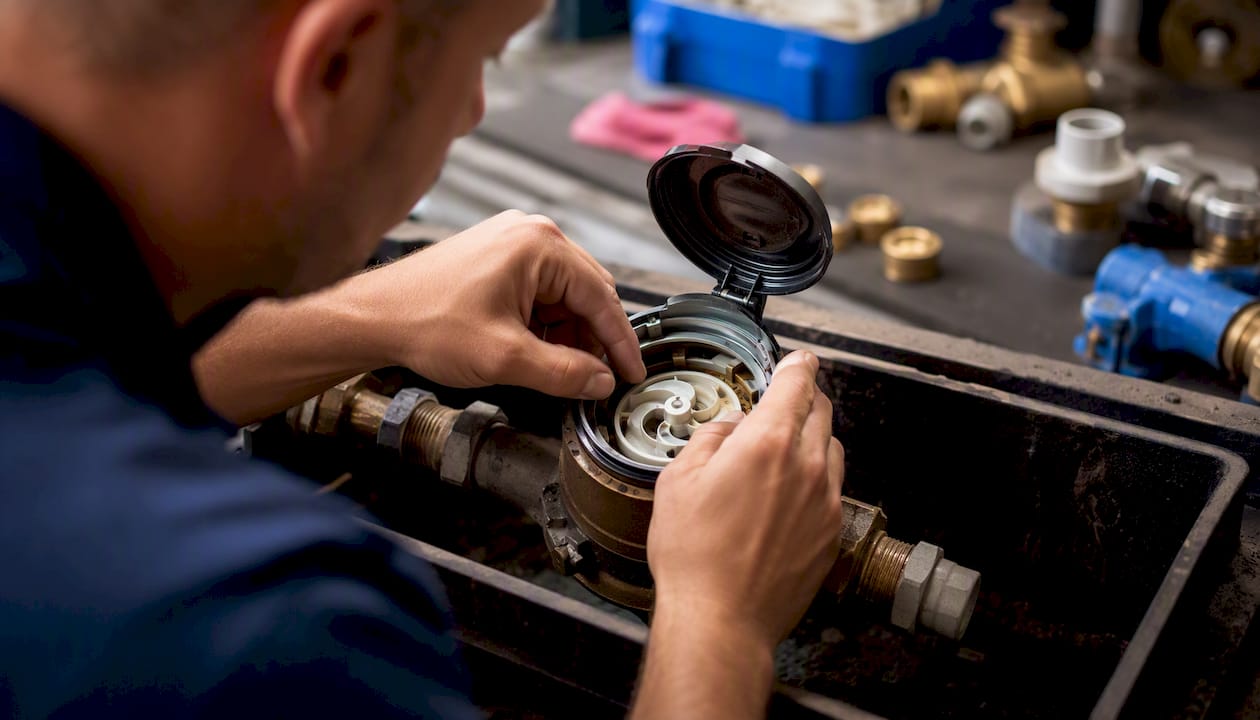
Do not tamper with meter seals or internal components. Water meters are factory-calibrated sealed systems under OIML R49. Opening or adjusting the measuring chamber voids the calibration, almost certainly affects accuracy, and may breach your utility's conditions of supply. If you suspect a fault, document what you observe and call a licensed plumber — never attempt to open the meter body yourself.
For property managers responsible for aged care or disability facilities, meter anomalies may also trigger plumbing compliance obligations that require formal documentation. If a meter-detected leak has already caused damage, a plumbing report for insurance may be needed before lodging a claim.
A plumber's perspective on what meters actually tell you
Most homeowners treat their water meter as a billing device. That is underselling it considerably.
The meter is the only instrument on your property that measures every litre of water that enters the building. A pressure gauge tells you about the supply side; a flow sensor on a single fixture tells you about that fixture. The meter tells you about everything, all at once. That makes it the fastest diagnostic tool available for a property manager who suspects something is wrong but cannot pinpoint where.
The part most people miss is the low-flow indicator. That small star or triangle is sensitive enough to detect a dripping tap or a weeping toilet cistern. In my experience working across residential and commercial properties, the majority of "unexplained" bill increases trace back to a running toilet that nobody noticed because the leak was silent. The meter knew. The low-flow indicator was spinning. Nobody looked.
Smart metering with AMI closes that gap by alerting you automatically, but the manual 30-minute test costs nothing and works on any meter made in the last 50 years. Run it once a quarter. If the indicator moves, call a plumber before the next bill arrives, not after.
The other thing worth saying plainly: meter accuracy disputes are almost always installation disputes. The meter itself is rarely wrong. What is wrong is the pipe configuration around it, a blocked strainer, or a meter that was never the right type for the property's flow profile. OIML R49 exists because these installation variables are well understood and measurable. A licensed plumber who knows metering standards can identify the problem in a single site visit.
Dualflowservices can help with meter checks and leak diagnosis
When your meter tells you something is wrong, knowing what to do next matters. Dualflowservices provides meter checks, leak diagnosis, meter installation, compliance testing, and emergency call-outs across the Mornington Peninsula and surrounding Melbourne suburbs. Whether you have spotted a spinning low-flow indicator, received an unexpectedly high bill, or need a meter replaced to meet compliance requirements, the team can attend the same day for urgent situations.
Property managers overseeing aged care, retirement villages, or disability care homes can also book scheduled maintenance visits that include meter inspection as part of a broader plumbing compliance check. No guesswork about whether the reading is accurate or the installation is correct. Book an inspection with Dualflowservices and get a licensed plumber on site who can read the meter, trace the leak, and fix the problem in one visit.
Sources
The following primary sources were used throughout this article and are worth consulting directly for more detail.