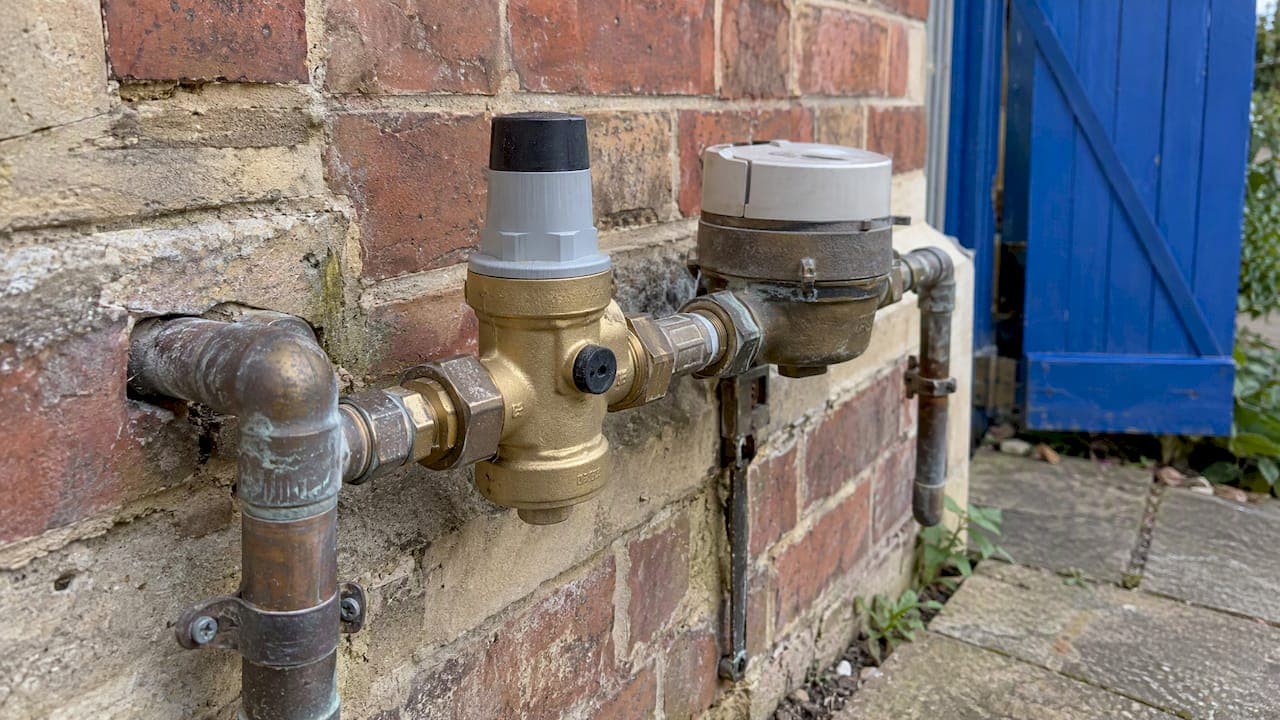
A water pressure regulator (also called a pressure reducing valve or PRV, or a pressure limiting valve) is a spring-loaded valve that cuts the high pressure coming from the mains down to a safe, steady level for your pipes, taps and appliances. In Victoria, static pressure at any outlet in a building must not exceed 500 kPa, so if your home or facility tests above that, a valve is not optional. Fitting or replacing one is plumbing work that a licensed plumber has to do.
This guide explains how the valve works, how to check whether your property needs one, what the rules say, what installation involves, and how to spot a regulator that has stopped doing its job.
TL;DR
- Victorian rules cap static water pressure at 500 kPa at any outlet (fire-service outlets excepted). If your test reading is higher, a pressure limiting or reducing valve must be installed.
- You can test pressure yourself with a gauge on an outside tap. Fitting, replacing or adjusting the valve is licensed plumbing work, and only a licensed plumber can issue a compliance certificate.
- Warning signs of a failing regulator include hammering pipes, a sudden jump or drop in pressure, and leaking or short-lived taps and appliances.
- For aged care, retirement villages and disability homes, a regulator is part of a wider compliance and maintenance routine, not a one-off fix.
Table of Contents
- What a water pressure regulator actually does
- Do you need a water pressure regulator?
- How to test your water pressure
- Can you install or adjust one yourself?
- Where the valve goes and how it is installed
- What affects the cost of installing a regulator
- Signs a regulator is failing
- Regulators in aged care, retirement villages and disability homes
- Our perspective: treat the regulator as a maintenance item
- Get your pressure tested on the Peninsula
- FAQ
- Sources
What a water pressure regulator actually does
Mains water is delivered at whatever pressure the network needs to reach everyone, and in lower-lying suburbs or close to a reservoir that can be far more than your plumbing was designed for. A regulator sits on the supply line and holds the pressure downstream at a lower, more functional level, however much the mains pressure rises and falls.
Inside is a spring-loaded valve. Turning the adjustment screw changes the spring force, which changes the pressure on the house side. Because it has moving parts, a regulator can wear, seize or fail and cause abnormally low or abnormally high pressure. That is why a valve that has been fine for a decade can quietly stop protecting your pipes.
You will see three names used for similar devices:
| Term | What it means in practice |
|---|---|
| Pressure reducing valve (PRV) | Lowers incoming pressure to a set downstream level |
| Pressure limiting valve (PLV) | Caps pressure so it cannot exceed a set figure |
| Water pressure regulator | The everyday name for either of the above |
For a homeowner the practical difference is small. What matters is the downstream figure the valve is set to and whether it still holds it.
Do you need a water pressure regulator?
The rule in Victoria is clear. The Victorian Building Authority (VBA) states that maximum static pressure at any building outlet is 500 kPa, except at fire-service outlets. Where measured pressure exceeds that, a pressure limiting and/or pressure reduction valve must be installed. The guidance applies to new and altered cold and hot water plumbing.
The VBA has also issued a reminder that a pressure limiting valve is mandatory where static pressure exceeds 500 kPa. It warns that excessive pressure can cause piping and appliance failure, water hammer and excessive water use, and may affect warranties and insurance.
So the honest answer to "do I need one?" is: it depends on a reading, not on a feeling. Strong pressure in the shower does not prove you are over the limit, and weak pressure does not prove you are under it.
Signs your pressure may be too high
- Pipes bang or shudder when a tap or washing machine valve shuts off (water hammer)
- Taps drip soon after a new washer is fitted
- Toilet cisterns keep running or refill noisily
- Flexible hoses, appliance inlets or the relief valve on your hot water system fail or weep repeatedly
- A water bill that has crept up with no change in household habits
If several of these sound familiar, read our guide to high water pressure at 80 PSI and the tests that confirm it.
How to test your water pressure
The VBA guidance points to testing with a calibrated gauge at the boundary meter outlet or at an adjacent garden tap. Here is a sensible way to do it at home.
- Buy or borrow a pressure gauge with a hose-tap fitting, one that reads comfortably past 500 kPa.
- Turn off every tap and appliance in the house, so water is static, not flowing.
- Screw the gauge onto an outdoor tap, ideally the one closest to the meter.
- Open the tap and read the gauge.
- Repeat late at night or early in the morning. Mains pressure is usually highest when demand is lowest.
A reading above 500 kPa means a valve is required. A reading well below it, with weak flow at the taps, points elsewhere: a partly closed stop tap, a clogged strainer or ageing galvanised pipe. Our five to ten minute low pressure diagnosis walks through those causes, and there is a separate article on low hot water pressure and how to fix it.
If you already have a regulator and the gauge shows it is not holding, do not keep turning the screw. Call a plumber.
Can you install or adjust one yourself?
In Victoria, no. The VBA says plumbing work must be done by a licensed practitioner, or by a registered or provisionally registered person or trainee under a licensed plumber's supervision. The VBA classes installation, replacement, repair, alteration, maintenance, testing and commissioning of connected hot and cold water services as water-supply plumbing work. A pressure valve on your supply line falls squarely inside that.
There are practical reasons beyond the legal one:
- Compliance certificate. Only a licensed plumber can issue one, and licensed plumbers must hold insurance for defective plumbing work. A DIY job gives you neither.
- Product requirements. Manufacturer instructions for a common Australian valve say installation must be by a licensed plumber and comply with AS/NZS 3500 and local requirements.
- Insurance. Excessive pressure and unlicensed work are exactly the sort of things an insurer may query after a water damage claim. Our note on a plumbing report for insurance covers what insurers look for.
What you can do yourself is the testing above, plus noticing and reporting symptoms early.
What about adjusting the setting?
Many residential valves are factory set, and some are adjustable. For one widely sold Australian model, the installation instructions say the valve is factory-set at either 350 kPa or 500 kPa. On adjustable versions, turning the screw clockwise raises downstream pressure and anticlockwise lowers it, while the right-angle model is fixed.

That is useful for understanding what your plumber is doing, not a prompt to do it yourself. Adjustment changes the pressure on every tap, hot water unit and appliance in the house, and it is also part of commissioning, which falls under licensed work. Ask your plumber to set it and to tell you the final figure in kPa.
Where the valve goes and how it is installed
The VBA says pressure limiting and reduction valves may be installed anywhere in the supply line, provided they are readily accessible. In houses that is typically near the meter or boundary, or where the supply enters the building, so the whole property is protected.
A typical installation by a licensed plumber covers:
- Test and confirm. Measure static pressure to confirm the valve is needed and choose the right rating.
- Isolate and flush. Shut off the supply and flush the line. The manufacturer instructions require flushing the system so debris does not lodge in the new valve.
- Fit in the right orientation. The same instructions allow vertical or horizontal mounting, never upside down, and require the flow-direction arrow to match the water flow.
- Choose a protected, accessible spot. Watts Australia's boundary valve documentation says the valve should be easily accessible, and fitted below ground only in a suitable approved box. It also says the valve must not be exposed to a torch flame or heat, which matters when copper is being soldered nearby.
- Set, test and certify. The plumber sets the downstream pressure, re-tests with a gauge and issues the compliance certificate.
A tidy installation also leaves space around the valve for future servicing. A regulator buried behind a new fence or garden bed is one nobody checks until it fails.
What affects the cost of installing a regulator
We do not publish fixed prices for this job, because the work genuinely varies from property to property. Here is what moves the quote:
- The valve itself. Boundary valves, standard residential valves and fixed or adjustable models differ in price and rating.
- Access. A meter in an accessible, dry spot is quicker than one under paving or in a pit that needs digging.
- Existing pipework. Corroded or mismatched fittings may need replacing so the valve seats properly.
- Extra work. Replacing a worn valve alongside a hot water system change, or adding isolation valves or an approved box, adds time.
- Timing. After-hours work costs more than a booked visit.
The best way to get a number you can rely on is to have the plumber test your pressure and quote on the spot. Be wary of any quote given blind, and of any quote that does not mention a compliance certificate.
Signs a regulator is failing
Because the spring and seat wear over time, a regulator rarely fails dramatically. Watch for:
- Pressure creeping up over months, shown by water hammer, dripping taps or noisy cisterns
- Pressure that swings between very high and very low during the day
- Sudden low pressure throughout the house while the mains and stop taps are fully open
- Weeping from the valve body or a hissing sound at the meter
- Repeated appliance failures, such as dishwasher inlets, mixer cartridges or hot water relief valves
Sediment is a common culprit. Manufacturer information for one Australian heat pump hot water system notes that sediment can clog valve screens, reduce pressure delivery or affect anti-scald valve operation, and recommends contacting the installing plumber about servicing. The same logic applies to a regulator's internal screen and seat.
Tempering valves also protect against high-temperature and pressure imbalances, and they are a separate component with their own testing needs. If you are unsure which valve is causing a problem, our guide to tempering valves, safety and compliance explains how they differ.
When high pressure turns into an emergency
A failed valve that lets full mains pressure into old pipes is one of the ways a joint or flexible hose can burst. If water is already escaping, shut off the main stop tap first and then call a plumber. This overview of burst pipe emergency steps covers the first minutes, and our emergency plumbing checklist for Victorian homeowners lists what to do and what to photograph for your insurer.
Regulators in aged care, retirement villages and disability homes
In a care setting the stakes are higher than a noisy pipe. Residents may be vulnerable to scalds and to slips from water damage, and a facility manager answers for compliance across many outlets, rooms and buildings. Pressure that is too high stresses fixtures and hot water equipment across the whole site, and pressure that is too low can undermine tempering valves and shower performance.
For these sites we recommend:
- Recording static pressure at the boundary and at representative outlets, and keeping those readings on file
- Including the regulator in scheduled maintenance, not just emergency response
- Checking that tempering valves, regulators and isolation valves are tested as a set
- Keeping compliance certificates and service records together for audits and insurers
Our Victorian guides on plumbing compliance in aged care facilities and plumbing upgrades for disability homes go into the wider requirements. If you are renovating bathrooms at the same time, the types of bathroom plumbing upgrades article shows where pressure control fits in.
Our perspective: treat the regulator as a maintenance item
Most pressure valves we see are never thought about until something else breaks. A dishwasher hose lets go, a hot water relief valve starts to weep, or a bathroom reno reveals pipes that have been under strain for years. The regulator is cheap compared with what it protects, yet it is routinely forgotten.
Our view is simple. Test the pressure when you buy or move into a property, test it again after any major plumbing change, and put the regulator on the same schedule as your hot water system and tempering valves. In care facilities, where we work regularly, we prefer to look at the plumbing, electrical and heating and cooling systems together, because a pressure problem often turns up alongside a hot water or tempering problem. Having one team that understands all three means fewer visits and fewer handovers for a facility manager.
And please do not turn that adjustment screw to fix a pressure complaint. Changing a setting without a gauge and a licence is how a minor annoyance becomes a burst hose.
— Mike
Get your pressure tested on the Peninsula
DualFlow Services is a team of plumbing, electrical and heating and cooling tradespeople on the Mornington Peninsula, serving homeowners, business owners, aged care, retirement villages and disability care homes. We can test your static pressure, advise whether a regulator is needed or due for replacement, and include it in a scheduled maintenance plan.
We offer emergency call-out around the clock, scheduled maintenance and compliance-related visits. To book a pressure test or a valve replacement, see our plumbing services or start from the DualFlow Services home page.
FAQ
What is the maximum water pressure allowed in a Victorian house?
Static pressure at any outlet, other than fire-service outlets, must not exceed 500 kPa. If your measured pressure is higher, a pressure limiting or reducing valve must be installed. The VBA publishes the requirement in its CW 03 guidance.
How do I adjust my water pressure regulator?
On adjustable models, turning the screw clockwise increases downstream pressure and anticlockwise decreases it, but the work counts as plumbing and must be done by a licensed plumber. Ask them to set it with a gauge and tell you the final reading. Some models are fixed and cannot be adjusted at all.
Can I install my own pressure reducing valve?
No. In Victoria, installing or replacing a valve on your water supply is licensed plumbing work. Only a licensed plumber can issue the compliance certificate, and manufacturers also require licensed installation to AS/NZS 3500.
How much does a plumber charge to install a regulator?
It depends on the valve, access to your meter or supply line, the condition of the existing pipework and the time of the visit. A plumber can quote accurately after testing your pressure on site. Ask that the quote includes the compliance certificate.
Where is the pressure regulator in my house?
It is usually near the water meter or where the supply enters the building, though it can be anywhere in the supply line if accessible. Look for a bell-shaped brass body with an arrow showing flow direction, sometimes inside a box in the ground.
Sources
- VBA: CW 03 Maximum static water pressure within a building
- VBA: Reminder to install pressure limiting valves
- VBA: Engaging a plumber
- VBA: Water supply plumbing registration and licensing
- Tomson Pressure Reducing Valve installation instructions
- Watts Australia: Pressure Reduction Valve Boundary (PRVB)
- MyWater: Water 101, Water Pressure Regulators
- iStore Heat Pumps: Why is my hot water pressure reduced?