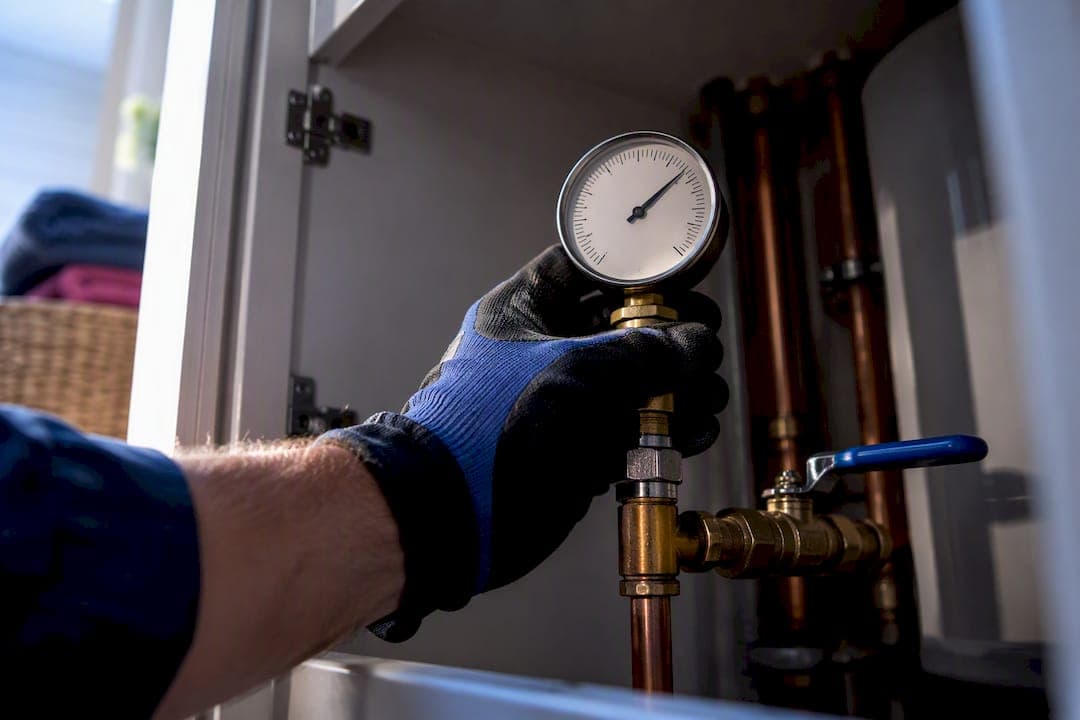
Yes, sustained high water pressure and sudden pressure spikes damage pipes, joints, and appliances, and the damage compounds the longer it goes unchecked. Anything above roughly 550 kPa (about 80 PSI) puts real strain on your plumbing system. Test your pressure with a gauge today, and if the reading is high or you're already seeing drips and banging pipes, book a licensed plumber before a slow leak becomes a burst pipe.
TL;DR:
- Water pressure above 550 kPa (80 PSI) can cause long-term damage to pipes, joints, and appliances, leading to leaks or burst pipes.
- Copper pipes are especially vulnerable to pinhole leaks caused by sustained high pressure, which often appear as stains before actual leaks develop.
- A pressure gauge costing under $20 can quickly identify if your static pressure exceeds the safe threshold, prompting installation of a regulator.
- Installing a pressure-reducing valve and adding water hammer arrestors can prevent damage caused by pressure spikes and water hammer shocks.
- Regular testing and professional diagnosis help avoid costly repairs by catching high water pressure early through proper inspection and targeted fixes.
Table of Contents
- What counts as high water pressure?
- How high pressure damages pipes, fixtures and appliances
- Signs and how to test your home's water pressure
- Fixing high pressure and repairing the damage it causes
- How a plumber diagnoses and prioritises the fix
- Why I'd test pressure before replacing another part
- Get your pressure tested by DualFlow Services
- Sources
- FAQ
What counts as high water pressure?
Most residential plumbing runs comfortably at 40 to 60 PSI, which converts to roughly 280 to 410 kPa. Anything up to 80 PSI (about 550 kPa) is generally tolerable, but guidance on diagnosing high water pressure treats that figure as the point where a pressure-reducing valve becomes worth installing rather than optional.
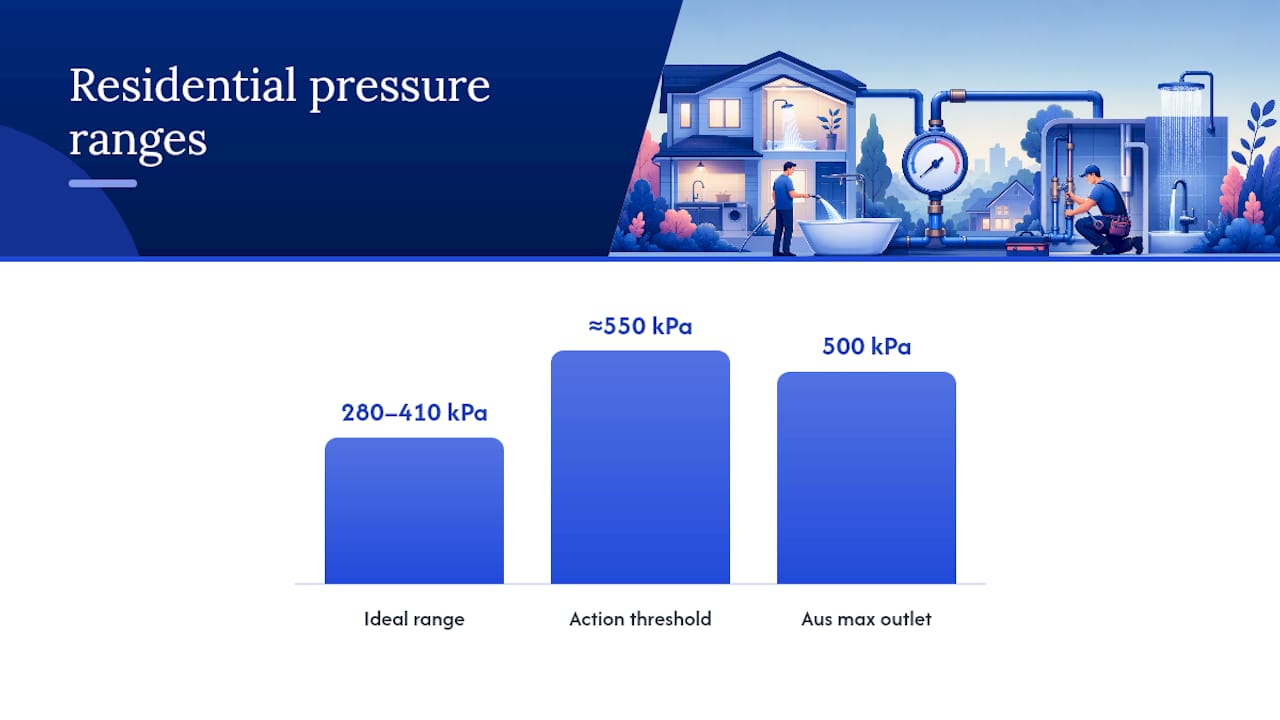
Australian plumbing guidance caps maximum outlet pressure at 500 kPa under AS/NZS 3500 references, which sits just below that international action threshold. The two figures roughly line up, and that overlap matters: it tells you the safe ceiling isn't a rough guess, it's the number your local code is built around.
Your quick reference:
- Ideal range: 280 to 410 kPa (40 to 60 PSI)
- Acceptable upper limit: around 550 kPa (80 PSI)
- Action level: above 550 kPa, or above 500 kPa at any outlet under Australian guidance
- Watch for the gap: the pressure your water authority delivers to the street main can be considerably higher than what actually reaches your taps once elevation, pipe run, and existing regulators are factored in
Council mains often run higher than your household ever needs, especially on sloped blocks or near pumping stations. That's precisely why a regulator sits between the meter and your house rather than at the source.
How high pressure damages pipes, fixtures and appliances
Overpressure doesn't usually announce itself with a single dramatic failure. It wears things down first, then breaks something.
Pressure fatigue and pinhole leaks develop when water is forced through pipe walls and fittings at a force they weren't built to handle for years on end. Copper pipe is particularly vulnerable. Constant high pressure increases turbulence at joints and elbows, and that turbulence combined with water chemistry accelerates pinhole formation in copper lines long before a homeowner notices anything wrong. You'll often see a small green or white stain on a wall or ceiling months before an actual leak appears.
Burst pipes are the dramatic end of that same process. A pipe that's been fatigued by years of overpressure eventually gives way at its weakest point, usually a joint, an elbow, or a spot where corrosion has already thinned the wall. Sudden bursts tend to follow a temperature change or a pressure spike, not steady pressure alone. That's an important distinction: slow pinhole leaks come from sustained overpressure, while catastrophic bursts are often the last straw after a spike hits an already-weakened section.
Water hammer is the banging sound you hear when a fast-closing valve, such as a washing machine solenoid or a toilet fill valve, slams shut and sends a shockwave back through the pipe. That shockwave can spike momentary pressure well above your static reading, and it's brutal on soldered joints and old galvanised fittings.
Did you know? A pressure spike from water hammer can momentarily exceed your home's static pressure reading by a significant margin, which is why arrestors matter even in homes that test within the acceptable range.
Appliances take the hit too:
- Washing machine and dishwasher inlet valves wear out faster and can fail open, flooding a laundry
- Solenoid valves in ice makers and fridge water lines are especially prone to splitting under excess pressure
- Hot water systems show it through a weeping temperature and pressure (T&P) relief valve, which is designed to open under excess pressure and often the first visible sign something upstream is wrong
- Braided supply hoses bulge or rupture at the crimp fitting
Pro Tip: If your hot water system's T&P valve is dripping intermittently, don't just tighten it. It's usually reacting to a pressure problem elsewhere in the system, and replacing the valve without checking upstream pressure just delays the next drip.
Signs and how to test your home's water pressure
Some symptoms show up long before a leak does. Loud banging when a tap shuts off, a toilet that keeps running after flushing, dripping under the kitchen sink, and appliance hoses that feel rock hard under pressure are all early warnings worth acting on.
Testing takes five minutes and one cheap tool:
- Buy a pressure gauge that screws directly onto a garden tap thread (most hardware stores stock one for under $20).
- Turn off any water use inside the house, including irrigation and dishwashers.
- Screw the gauge onto an outdoor hose bib and turn the tap on fully.
- Read the static pressure in kPa or PSI, whichever the gauge displays.
- Compare the reading against the 550 kPa (80 PSI) action threshold from residential plumbing guidance.
A reading consistently above 550 kPa (80 PSI) means it's time to book a regulator, not wait and see.
If your static reading sits comfortably in range but you still hear banging when appliances cycle, you're dealing with water hammer, not high static pressure. That's a different fix, and it means arrestors and pipe securing rather than a new regulator. If the static reading itself is high, that's the whole-house problem, and it needs a PRV.
Fixing high pressure and repairing the damage it causes
A pressure-reducing valve (PRV) is the standard long-term fix for excessive water pressure. It sits on the main line after the meter and brings mains pressure down to a set, safe level for the whole property. Installing or replacing one commonly falls into a modest cost band, though cost guides note that price rises with difficult access, older pipework, or corroded fittings that need extra labour to remove.
Beyond the PRV itself, a few targeted fixes handle spike damage and appliance-level risk:
- Water hammer arrestors fitted near fast-closing valves absorb the shockwave before it reaches vulnerable joints
- Pipe securing with brackets or clamps stops loose runs from banging against wall studs every time a valve shuts
- Braided stainless hoses on washing machines and dishwashers handle spikes far better than the rubber hoses many appliances ship with
- Expansion tanks on closed hot water systems absorb thermal expansion so the T&P valve isn't doing all the work
- Appliance-specific repairs, like replacing a worn inlet valve, address damage already done rather than the cause
Homeowners can safely handle a few things themselves: swapping a rubber supply hose for a braided one, tightening a loose pipe bracket, or running the gauge test described above. Anything involving the PRV itself, the meter connection, or work that could affect compliance with local plumbing code belongs with a licensed plumber, both for safety and because unpermitted work on pressure regulation can create code violations that surface later at sale or inspection.
Pro Tip: Ask for a quote that separates the regulator cost from labour and any emergency call-out fee. Cost guides show those fees are where quotes vary the most, not the part itself.
How a plumber diagnoses and prioritises the fix
A proper diagnostic visit doesn't start with the PRV. It starts with the meter.
- Static pressure gets tested at the meter first, then again at an internal outlet, to see whether the problem is supply-side or something inside the house is amplifying it
- The PRV and expansion tank both get inspected for wear, corrosion, or a valve that's simply been set too high
- Appliance inlet valves get checked individually, since a single failing valve can mimic whole-house symptoms
- Any visible staining, pitting, or moisture around joints gets logged as evidence of existing pinhole leak activity
That sequence decides whether the fix is a straightforward PRV replacement or something bigger. If pipework already shows fatigue in multiple spots, a plumber will usually recommend a broader inspection rather than patching one leak and leaving the rest exposed to the same pressure that caused it. Where the fault lies with the hot water system specifically, immediate safety comes first: shut off the water supply to the unit and isolate power or gas before anything else, a sequence covered in more detail in our guide to hot water system leaks.
Why I'd test pressure before replacing another part
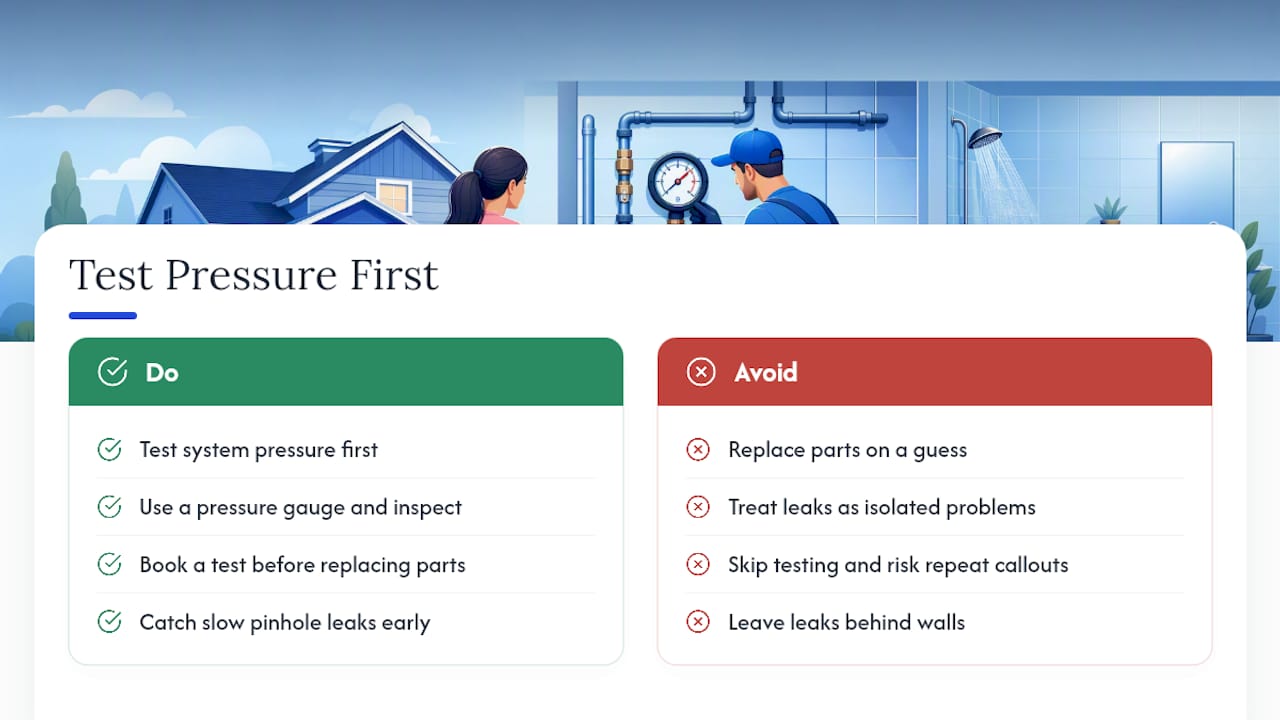
Most homeowners treat a leaking hose or a weeping T&P valve as an isolated part failure. In my reading of how these systems actually break down, it's rarely isolated. It's usually the same pressure problem showing up wherever the plumbing happens to be weakest that week.
Booking a pressure test before swapping another valve or hose saves money twice: once by avoiding a repeat callout in six months, and again by catching the kind of slow pinhole leak that turns into a water damage claim if it's left behind a wall. Let a gauge reading and a proper inspection make the call, not a guess.
— Mike
Get your pressure tested by DualFlow Services
If your gauge reading came back high, or you're already dealing with banging pipes, a weeping hot water valve, or an appliance hose that feels ready to split, a professional service team can handle it end to end rather than sending you chasing separate trades. As a plumbing, electrical, and heating and cooling business, the service covers pressure testing, PRV installation or replacement, fitting expansion tanks, servicing hot water systems, and emergency call-outs, aiming to provide comprehensive solutions under one roof to avoid multiple separate visits.
On a service visit, expect a proper diagnostic first (meter and outlet pressure, PRV condition, appliance inlet checks), a written quote before any work starts, and safety checks on anything connected to gas or electricity near the affected fixtures. Catching high pressure early is far cheaper than replacing a burst pipe or a flooded laundry later. If you've noticed any of the warning signs covered above, or you're overdue for a full plumbing system check, book a visit through Dualflowservices and get a gauge on your line before it costs you more than a regulator would have.
Sources
- Business
- Washingtonplumbers
- How much does it cost to replace a water pressure regulator? (2026) | HomeGuide
FAQ
What happens when your water pressure is too high?
Pipes, joints, and appliance valves wear out faster, and you get pinhole leaks, weeping T&P valves, and eventually burst pipes. Water hammer spikes make it worse by hitting weakened joints with a shockwave every time a fast valve shuts.
How can I fix high water pressure in my house?
Install or have a licensed plumber install a pressure-reducing valve (PRV) after your water meter, which is the standard long-term fix for whole-house pressure problems. Add water hammer arrestors near fast-closing valves and braided hoses on appliances to handle spikes the PRV alone won't stop.
How much does it cost to fix high water pressure in a house?
PRV installation costs vary with pipework access, age of fittings, and whether corrosion adds labour time, and emergency call-outs add to the total. A professional service provider typically offers a written quote after diagnosing your specific setup rather than a flat figure, since access and existing pipe condition change the price significantly.
At what psi does water pressure become a concern?
Pressure above 80 PSI (roughly 550 kPa) is generally treated as the action threshold where a PRV becomes worthwhile. Australian guidance caps outlet pressure at 500 kPa under AS/NZS 3500, so anything testing above that on your gauge warrants a professional look.