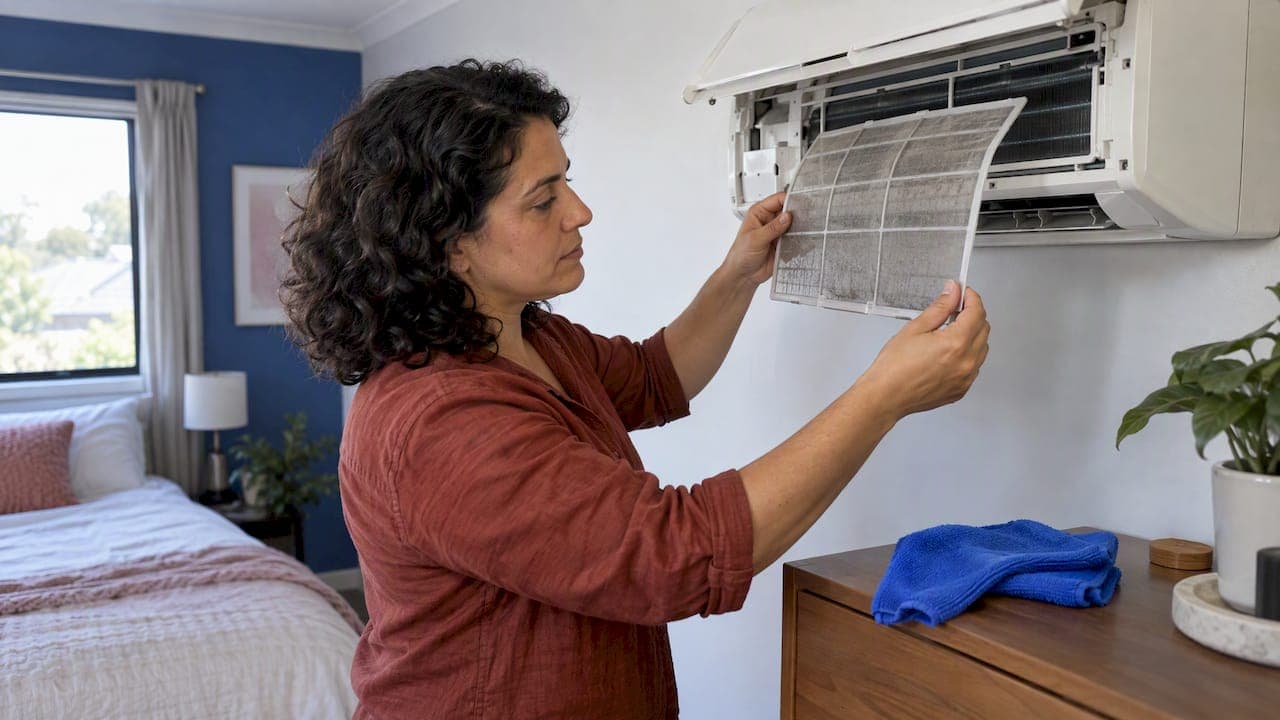
You can safely clean the filters, wipe the indoor unit and clear leaves from around the outdoor unit yourself, with the power off at the wall. Anything behind a panel is a job for a licensed technician: coils, drain trays, fans, electrical parts and refrigerant. This guide covers how to do the home part properly, how often, the signs that a split system needs a professional clean, and what facility managers in aged care, lifestyle villages and disability care should have in place.
TL;DR
- Switch the unit off at the wall (and the isolator or breaker) before touching anything, and read your model's manual first.
- Clean the filters every few weeks while the system is in heavy use, and let them dry completely before refitting.
- Wipe accessible indoor surfaces with a soft damp cloth. Never pour water into the indoor unit or open the outdoor unit.
- Musty smells, weak airflow, dripping water or ice mean it is time for a licensed technician.
- Care facilities should treat air conditioning as safety-critical: documented servicing, records and a pre-summer check.
Table of Contents
- Why split system cleaning matters
- Safety first: isolate the power
- What you can clean yourself
- How often should you clean a split system?
- Signs your split system needs professional attention
- What a professional service covers
- Aged care, lifestyle villages and disability care in Victoria
- Our perspective
- Book a split system service on the Peninsula
- Common mistakes to avoid
- FAQ
- Sources
Why split system cleaning matters
A split system moves a lot of air through a fine filter and a damp coil. Dust builds up, and in humid conditions mould can follow. CHOICE notes that clogged filters make an air conditioner work harder and push up running costs, and that dust or mould inside the unit can reduce performance and contribute to water leakage if the drain blocks.
The Australian Government treats filter cleaning as an efficiency measure, not just housekeeping. Its energy guidance says cleaning air-conditioner filters every two weeks during use helps appliances operate more effectively.
On the Mornington Peninsula the case is practical. Coastal air, bushland dust, pet hair and a long cooling season followed by a long heating season (most split systems here run reverse-cycle) mean the filters work most of the year. A system that is cleaned a little and often rarely needs a big rescue job.
Safety first: isolate the power
A split system is a live electrical appliance with a refrigerant circuit. NT WorkSafe's bulletin on cleaning split systems warns that the units contain live electrical parts that can be exposed when covers are removed, and that electricity must be isolated at the source before cleaning. It names three common ways to do that:
- Switch off, and tag, the outdoor isolator.
- Unplug the unit, if it is a small one with a plug.
- Switch off, and tag, the dedicated circuit breaker.
The bulletin is written for the Northern Territory, but the physics is the same in Victoria. At home, a sticky note on the switchboard is a simple version of a tag, especially if other people are in the house. Turning the unit off with the remote is not isolation: the control board is still live.
Also read the manual for your model. CHOICE's Australian guide says to read the manual and turn the unit off at the wall before any maintenance. Panels, filter clips and warnings differ between brands.
What you can clean yourself
The safe home list is short, and that is the point.
| Part | DIY? | How |
|---|---|---|
| Air filters (indoor unit) | Yes | Remove as the manual directs, vacuum or wash, dry fully, refit |
| Indoor unit surfaces and vents | Yes | Soft damp cloth, unit isolated |
| Extra air-purifying filters | Yes, per manual | Clean or replace as the manufacturer says |
| Area around the outdoor unit | Yes | Clear leaves, cobwebs and debris from outside the casing |
| Coils, fins, drain tray, blower fan | No | Licensed technician |
| Refrigerant, thermostat, wiring | No | Licensed technician |
Step by step: cleaning the filters
You need a vacuum with a dusting brush, a soft cloth, and for very dirty filters, warm water and mild detergent. That is what CHOICE recommends, and it is all you need.
- Isolate the power as described above.
- Open the front panel and lift out the filters, following your manual. One Australian manual, the Kaden owner's manual, warns against touching the metal edges of the unit when removing filters. The fins are thin and sharp, so go slowly.
- Vacuum the dust off with the brush attachment. If the filter is greasy or grimy, wash it gently in warm water with mild detergent.
- Let it dry completely, away from direct heat. A damp filter refitted into the unit invites the mould you were trying to avoid. Drying and refitting a filter properly is the same principle that applies to any filtration in indoor air quality: clean media does its job, wet or clogged media does not.
- Refit the filters, close the panel, restore power and run the unit for a few minutes to check airflow.
If a filter is torn or warped, replace it. CHOICE advises replacing damaged filters rather than carrying on with them.
Wiping the indoor unit
With the power still off, wipe the front panel, louvres and any reachable vents with a soft damp cloth. Damp means wrung out. The Kaden manual specifically warns against putting water inside the indoor unit, so no sprays, no hose and no soaked rags. Skip abrasive cleaners and solvents, which can mark or crack plastics and are not suggested by the sources above.
Looking after the outdoor unit
Stay on the outside. Clear fallen leaves, grass clippings and cobwebs from around the casing and keep plants trimmed back so air can flow. Do not remove the cover or poke into the fins. CHOICE says to leave the inside of the outdoor unit to a professional, and the Kaden manual says outdoor-unit maintenance and repair belong with an authorised dealer or licensed service provider.

How often should you clean a split system?
There are two figures worth knowing. The federal energy guidance points to a clean every two weeks during use. CHOICE says manufacturers commonly recommend every few weeks, and that at the very minimum filters should be cleaned a couple of times a year, with more frequent cleaning for heavy use, dusty homes or falling performance.
A realistic routine for a Peninsula home:
- Peak cooling and heating months: check the filters every two to four weeks. If you can see a grey mat of dust, clean them.
- Shoulder seasons: once a month or so, or whenever the unit has been running a lot.
- Homes with pets, smokers, open-plan dust or building work nearby: lean towards the shorter interval.
- Before each season: a proper look at the whole system, which is also a good time to book a technician.
For a wider routine, our guide on how HVAC maintenance schedules work for homeowners shows how filter cleaning fits with annual servicing, and the summer air conditioning maintenance checklist is handy to run through before the first hot week.
Signs your split system needs professional attention
Filter cleaning does not fix everything. Call a licensed technician if you notice:
- A musty or sour smell when the unit starts, which can point to mould or a damp coil and drain tray.
- Weak airflow even with clean filters.
- Water dripping from the indoor unit. CHOICE links leaks to blocked drainage.
- Ice on the unit or pipes. Turn it to fan only to thaw it and have it checked. We cover this in aircon freezing up.
- Rattling or unusual noises. Our checks for aircon rattling noise separate the harmless from the serious.
- Tripping breakers, burning smells or error codes. Switch off and call.
CHOICE says professional cleaning may be worth considering in dusty or humid areas, and that a professional service can include cleaning the coils, fins and drainage and checking refrigerant levels and thermostat operation.
What a professional service covers
A technician can do what is off-limits at home: open the unit, clean the coil and drain tray, check the blower, inspect the outdoor unit, test electrical connections and check refrigerant. Handling refrigerant is regulated work in Australia and requires the right licence, which is one more reason the sealed parts of a split system are not a weekend job.
A service is also the point where small faults are found early: a partially blocked drain, a loose fan, a worn capacitor. That is cheaper than an emergency call on the hottest day.
Prices vary with the number of units, how dirty they are and access, for example a high-wall unit above a staircase. We do not publish a flat price for cleaning, because a fair quote depends on the system in front of us. Ask any provider what is included (indoor and outdoor units, drain, coil, a test run) before you compare quotes, and make sure the person working on the unit is licensed.
Aged care, lifestyle villages and disability care in Victoria
In these settings a split system is not a comfort feature. Residents are more vulnerable to heat, and a failed system during a heatwave is a safety event. Victoria's heatwave guidance for residential aged care, a Department of Health resource, points facilities towards a documented equipment register and maintenance program, accurate service records and repair contacts, servicing and testing before summer, monitoring of indoor temperatures in extreme heat, and plans for failures and power outages. It is an older document, revised in 2013, but the practices still hold up.
On the workplace side, WorkSafe Victoria's compliance code for workplace facilities says heating and cooling must be serviced regularly and kept in proper working order, and further public-health obligations may apply.
What that means for a facility manager:
- Do not rely on staff or residents for cleaning. Routine filter checks can be a documented task for trained maintenance staff, but coils, drains and electrical work go to a competent, licensed provider.
- Keep a register. List every split system, its location, age, last service and who services it.
- Service before summer, not during the first heatwave, and keep the record.
- Have an emergency contact who answers on a public holiday, and a plan for rooms that lose cooling.
- Match filter work to the building. Our filter maintenance guide for care homes covers schedules and records, and the guides on maintaining cooling systems in aged care, disability care ventilation and commercial air conditioning servicing go further.
Our perspective
Most split system call-outs we attend were avoidable. The pattern is familiar: filters left for a season, a drain that slowly blocked, and a unit that fails on the first 38 degree day. The homeowner who cleans the filters regularly and books a service once a year rarely sees us in an emergency.
In care settings the same rule applies with higher stakes. A facility manager does not want three contractors for one problem: a plumber for the drain, a sparky for the supply, a cooling tech for the unit. That is why we run plumbing, electrical and heating and cooling under one roof, with 24/7/365 emergency availability and experience in care environments. One call, one record, one accountable team.
Our advice: do the simple things yourself, often, and never open what you cannot isolate and identify. Everything else is cheaper to book than to fix.
— Mike
Book a split system service on the Peninsula
If your split system smells, drips or struggles, or you manage a facility that needs documented servicing, our team covers the Mornington Peninsula and surrounding Melbourne suburbs. See our heating and cooling services or get in touch through DualFlow Services to book a scheduled maintenance visit or an emergency call-out. If the fault involves the electrical supply or a leaking drain, our electrical and plumbing teams can sort it in the same visit.
Common mistakes to avoid
- Cleaning with the unit only switched off at the remote. Isolate at the wall, isolator or breaker.
- Refitting damp filters. Dry them completely first.
- Spraying water or cleaner into the indoor unit. Use a damp cloth on accessible surfaces only.
- Removing outdoor unit covers. Live parts and refrigerant are inside.
- Ignoring a drip. It usually means a drain issue that gets worse.
- Skipping the record. A short note of the date and what was done helps with warranty questions and, for facilities, compliance.
FAQ
How often should I clean a split system filter?
During regular use, about every two to four weeks is a sensible habit. The Australian Government's energy guidance suggests every two weeks while the system is running, and CHOICE says a couple of times a year is the bare minimum. Clean more often with pets, dust or heavy use.
What is the three-minute rule for an air conditioner?
Some units have a built-in protection delay that stops the compressor restarting for about three minutes after it is switched off. It is an operating feature, not a cleaning step. If you turn the unit off and on and it does not respond at once, wait a few minutes before assuming a fault.
How can I clean my air conditioner at home?
Isolate the power, remove and vacuum or gently wash the filters, dry them fully, wipe accessible indoor surfaces with a damp cloth and clear debris from around the outdoor unit. Do not open the outdoor unit or put water inside the indoor unit. Leave coils, drains and refrigerant to a licensed technician.
How much does it cost to clean an air conditioner?
It depends on the number of units, their condition and access, so any honest figure is a range after an inspection. We do not publish a set price, and we quote after hearing about your system. Ask what is included, such as indoor and outdoor units, drain and coil, before comparing quotes.
Sources
- How to clean your air conditioner (CHOICE)
- Electrical safety: Cleaning split system air-conditioners (NT WorkSafe)
- Design for your climate and keep cool (energy.gov.au)
- Kaden Multi Air Conditioner owner's and controller manual
- Residential aged care services heatwave ready resource (Department of Health Victoria)
- Compliance code: Workplace facilities and the working environment (WorkSafe Victoria)
- The role of filtration in indoor air quality