
Eight things stop most summer breakdowns: check the filter, clear the outdoor unit, confirm the thermostat is set to Cool at about 26°C, check the condensate drain, look at the circuit breaker, and run a 15 minute cooling test. Do these now, before the first heatwave, and you cut the odds of a mid-summer "no cool" emergency dramatically.
- Check or replace the air filter
- Clear leaves, grass clippings and debris from the outdoor unit
- Confirm thermostat mode is set to Cool, target around 26°C
- Inspect the condensate drain for blockages
- Check the dedicated AC circuit breaker hasn't tripped
- Run the system for 15 minutes and feel for cold air at the vents
- Listen for unusual noises, hissing or grinding
- Note any ice forming on the indoor coil or lines
Pro Tip: Most emergency call-outs trace back to one of three things: the thermostat mode, a tripped breaker, or a blocked condensate drain. Check those three first before assuming the compressor has failed.
Beyond this list, faults involving refrigerant, wiring or sealed components need a licensed technician. Dualflowservices handles exactly that kind of fault across the Mornington Peninsula, and the checklist below tells you when it's time to make that call.
Key Takeaways
Reliable summer cooling comes down to consistent monitoring, not a single big service: check filters every 30–45 days, clear the outdoor unit, verify the drain and thermostat, and call a licensed technician the moment refrigerant, electrical or drainage faults appear.
| Point | Details |
|---|---|
| Filter cadence | Check or replace every 30–45 days during heavy summer use, more often with pets or dust. |
| Outdoor unit clearance | Keep 600mm to 1m clear around the condenser and hose the coil gently, never with a power washer. |
| Thermostat setpoint | Set to Cool at around 26°C, and wait 15 minutes after any change before judging performance. |
| Warning signs | Ice on the coil, warm air despite a running compressor, or an electrical smell all mean stop and call a technician. |
| Professional backup | Dualflowservices provides scheduled summer checks, same-day call-outs and written service reports across the Mornington Peninsula. |
Table of Contents
- Air conditioning maintenance checklist summer: start with the filter
- How do you clean the outdoor condenser unit?
- What thermostat settings keep an AC running efficiently?
- Why does airflow feel weak at some vents?
- How do you clear a blocked condensate drain?
- What electrical checks are safe to do yourself?
- How do you test whether your AC is cooling properly?
- When should you call a licensed technician?
- How often should you actually check your AC in summer?
- Printable summer checklist and safety rules
- Sources
Air conditioning maintenance checklist summer: start with the filter
Check the filter every 30 to 45 days during heavy summer use, and swap or clean it the moment airflow feels weaker or it looks visibly clogged. A dirty filter forces the system to work harder, which drives up energy bills and shortens the compressor's working life.
- Switch off the unit at the wall or isolation switch.
- Slide out the filter (usually behind the front intake grille).
- Hold it to the light. Dust building up so thickly you can't see light through it means it's time to act.
- Rinse washable filters with lukewarm water and let them dry fully before refitting. Replace disposable pleated filters outright.
- Slot it back in the correct airflow direction (check the arrow printed on the frame).
Filter check cadence during heavy summer use: every 30–45 days, according to guidance from ACT Climate Choices.
- Homes with pets, smokers or high dust: check every two to three weeks
- Window units: clean more often than central systems, given tighter, more exposed filter housings
- Skip the DIY approach if you smell burning, spot mould inside the housing, or the filter frame itself is cracked or warped
How do you clean the outdoor condenser unit?
Keep at least 600mm to a metre of clear space around the outdoor unit, and give the coils a gentle clean if you can see dirt, grass clippings or cobwebs caked on the fins. Skip the power washer entirely. It bends the delicate aluminium fins and can push water into electrical components.
- Switch off power at the isolation switch before touching anything.
- Clear leaves, mulch, grass clippings and any plant growth from around the unit.
- Rinse the coil gently with a garden hose from the inside out, following the fin direction.
- Straighten any bent fins carefully with a fin comb or a butter knife.
- Let the unit dry completely, then restore power and test.
- Bent fins across a large section of the coil, or oil residue on the coil surface, usually point to a refrigerant leak that needs a professional look
- Pet urine and lawn fertiliser both corrode the casing over time, so hosing the base down occasionally protects the unit longer
Pro Tip: Keeping 600mm–1m clearance around outdoor units isn't just about cleaning access. Restricted airflow around the condenser makes the whole system run hotter and shortens compressor life.
What thermostat settings keep an AC running efficiently?
Set the thermostat to Cool with a target of a moderate comfortable temperature when you're home, and use a setback of 5 to 8 degrees when the house is empty for extended periods. According to the SA Department for Energy and Mining, each degree of setback saves roughly 1% on cooling costs.
- Confirm the mode is Cool, not Fan or Auto, if you want reliable dehumidifying performance
- Replace thermostat batteries if the display looks dim or unresponsive
- Wait about 15 minutes after changing the setpoint before judging performance or adjusting again
Bouncing the setpoint up and down repeatedly forces the compressor into short cycling, which wears components faster than steady, sensible use.
Why does airflow feel weak at some vents?
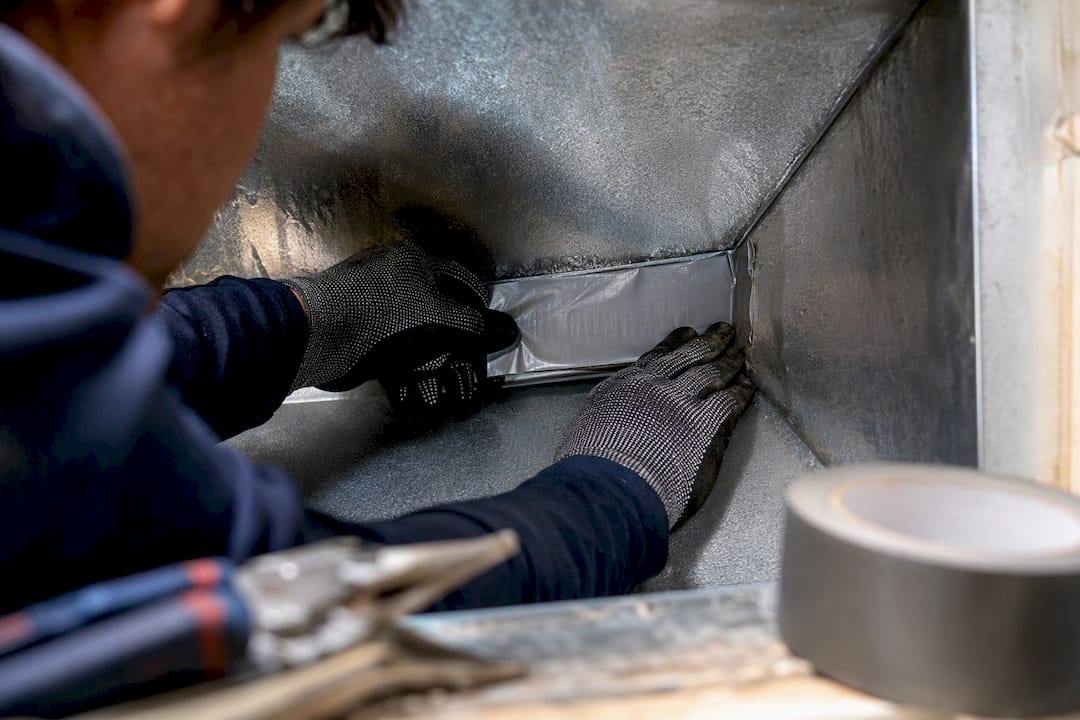
Feel the air at both supply and return vents in a few rooms. If one room runs noticeably warmer or the airflow feels weak, you've probably found a duct problem rather than a unit problem.
- Check exposed duct joins for gaps, loose tape or disconnected sections
- Make sure furniture, rugs or curtains aren't blocking registers
- Vacuum dust build-up from grilles, which restricts flow more than people expect
Taping a visibly separated joint is a fine stopgap, but a long-running leak wastes cooled air into the roof space or under the floor, which shows up as a bigger power bill long before you notice reduced comfort.
Pro Tip: A taped seam bought you a week, not a season. If the same vent is still weak after a temporary fix, it's a duct repair job, not a cleaning job.
How do you clear a blocked condensate drain?
Flush the condensate drain line quarterly during heavy summer use, and act immediately if you spot standing water near the indoor unit or a musty smell. A blocked drain is one of the more common reasons systems shut down mid-heatwave, because most units have a safety switch that cuts cooling the moment the pan overflows.
- Locate the drain line, usually a PVC pipe running from the indoor unit outside.
- Use a wet/dry vacuum on the outdoor end to pull out sludge and algae build-up.
- Flush with a cup of diluted white vinegar or a low-concentration bleach solution to slow algae regrowth.
- Run the system and confirm water drains steadily from the outdoor end.
Visible mould or a persistent musty smell that flushing doesn't fix means it's time for a professional look, not another DIY attempt. Our guide on why air conditioners smell musty covers the common causes in more detail.
What electrical checks are safe to do yourself?
Check the dedicated circuit breaker for the AC unit and confirm it hasn't tripped, and stop immediately if you smell anything burning near the indoor or outdoor unit. Never open the electrical panel on the compressor or air handler. Capacitors inside can hold a dangerous charge even with the power off.
- If the breaker has tripped and won't reset, that's an electrical fault, not a nuisance trip
- A burning smell, scorched wiring, or a loud humming noise from the outdoor unit all warrant an immediate call to a licensed technician
- Before calling, note what you've already tried: filter changed, breaker checked, drain cleared
Our electrical safety checklist for homeowners covers broader household wiring checks if you want the fuller picture.
Pro Tip: Write down exactly what you observed and when. "Breaker tripped twice on Tuesday afternoon" tells a technician far more than "it stopped working."
How do you test whether your AC is cooling properly?
Run the system for 15 to 30 minutes, then compare the air feel at a return vent against a supply vent. A noticeable, steady temperature difference means the system is doing its job. Warm air at the supply vents despite the compressor clearly running is the clearest sign something's wrong inside the sealed system.
- Ice forming on the indoor coil or refrigerant lines
- A hissing sound near the indoor unit
- Warm air blowing from vents even after 30 minutes of continuous running
- A noticeable drop in airflow strength compared to last summer
A wide gap or a very narrow gap between supply and return air temperature (the Delta T test) points to either restricted airflow or a refrigerant charge problem — a diagnostic technicians rely on because it's fast and doesn't require opening the system.
Never attempt to top up or handle refrigerant yourself. It requires a licence in Australia, and getting it wrong damages the compressor permanently.
When should you call a licensed technician?
Call a licensed technician the moment you see ice on the coil, feel persistent warm air despite the compressor running, smell anything electrical burning, or notice a drainage fault you can't clear yourself. These are the faults that sit outside safe DIY territory.
A standard professional service visit typically includes, per ENERGY STAR's maintenance checklist:
- Full visual inspection of indoor and outdoor components
- Refrigerant pressure check
- Capacitor and motor testing
- Tightening of electrical connections
- Coil cleaning where needed
- Condensate drain clearing
- Controls and thermostat test
- A written service checklist left with you
- Property managers running aged care, retirement or disability care sites should keep dated service records for compliance purposes and book visits during off-peak periods where possible. Our guide to maintaining cooling systems in aged care covers the documentation side in more depth.
Pro Tip: When you book, tell the technician the system type and rough age, when the filter was last changed, and exactly what you've already checked. It cuts diagnostic time significantly.
How often should you actually check your AC in summer?
Treat summer as a monitoring season, not a heavy service window. Manufacturers and HVAC professionals generally recommend saving the big service push for spring, then using summer for filter checks and quick fixes between visits, according to Trane's maintenance guidance.
- Filters: every 30–45 days during heavy use
- Condensate drain: quarterly flush
- Outdoor unit clearance: check monthly for debris build-up
- One professional tune-up: spring, ahead of peak demand
- One post-season check: autumn, before the system sits idle
Watch your power bill closely too. A jump of more than 15% over the same month last year, with no change in usage habits, is an early sign the system is losing efficiency before it fails outright. Our piece on how HVAC maintenance schedules work has a printable version of this cadence if you want it on the fridge.
Printable summer checklist and safety rules
Run these in order, once a month during summer:
- Check the filter and clean or replace it
- Clear debris from around the outdoor unit
- Confirm thermostat mode and setpoint
- Flush the condensate drain
- Check the breaker hasn't tripped
- Run a 15-minute cooling test
- Do switch off power at the isolation switch before touching any component
- Do photograph any leak, wiring damage or ice build-up to show a technician
- Don't open the compressor housing or handle refrigerant lines yourself
- Don't ignore a tripped breaker that won't reset
Why monitoring beats waiting for the emergency call
Most systems fail in summer for reasons that showed early warning signs weeks earlier. A weak vent, a slightly higher power bill, a breaker that trips once and resets easily. Homeowners who check these monthly rarely get the 40°C day breakdown.
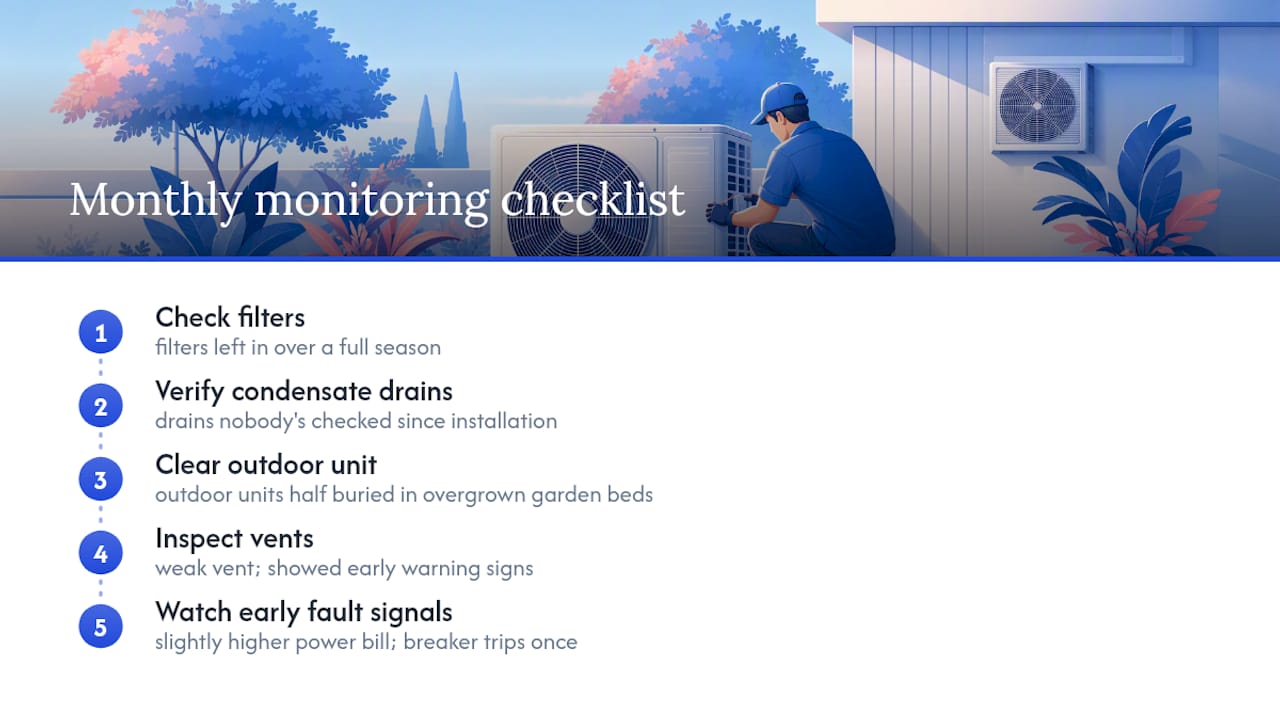
What we see most often at Dualflowservices is the same handful of oversights: filters left in over a full season, condensate drains nobody's checked since installation, and outdoor units half buried in overgrown garden beds. None of it is complicated to fix early.
Book a summer AC check with Dualflowservices
Dualflowservices runs scheduled summer checks, same-day emergency call-outs, and full pro tune-ups across the Mornington Peninsula, backed by a written service checklist you can keep on file. That written record matters most for aged care, retirement village and disability care facility managers juggling compliance paperwork across multiple sites.

Every visit covers the same ground a technician would run through in the checklist above: coil condition, drain clearance, electrical tightness, refrigerant pressure and controls testing, plus a follow-up recommendation if something needs watching before next season. Facility managers get compliance-ready documentation with every visit rather than a verbal "it's fine."
If your system failed one of the checks above, or you'd rather have a professional confirm everything before the next heatwave hits, book a service visit with Dualflowservices and get a printable service report for your records.
Sources
- Summer cooling guide (SA Department for Energy and Mining)
- Climate Choices — How to stay cool in summer and save (ACT government PDF)
- HVAC maintenance checklist: seasonal DIY guide (HVAC Base)
- Maintenance checklist (ENERGY STAR)
These sources underpin the filter cadence, thermostat and professional service scope covered throughout this checklist.