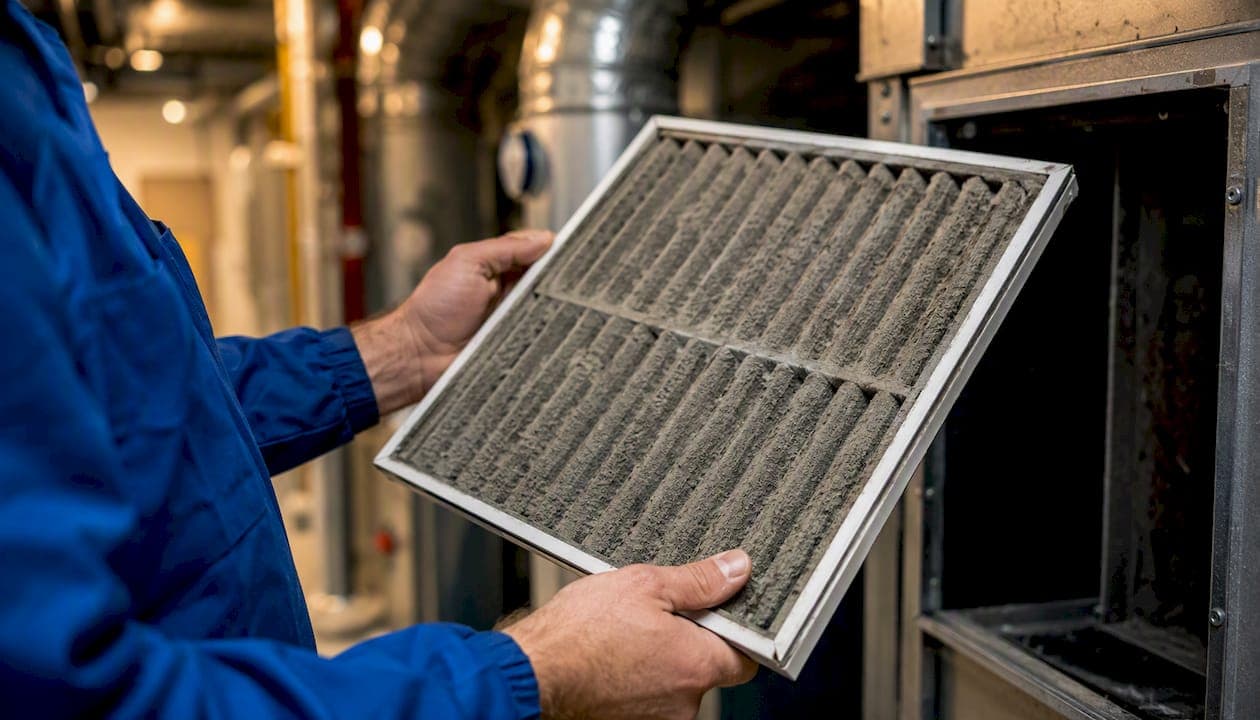
Run daily visual checks, clean accessible pre-filters weekly, and use pressure-differential readings to trigger final filter replacement. Before upgrading to MERV 13 or higher, get a professional HVAC assessment first — higher-efficiency media increases pressure drop and can starve your fans of airflow, reducing the air changes per hour (ACH) that protect residents.
ASHRAE residential healthcare guidance recommends MERV 13 as the baseline for capturing virus-sized particles in healthcare settings, but it explicitly warns that upgrading without checking system static pressure can cause mechanical failure or reduced airflow. The Royal Commission into Aged Care Quality and Safety makes clear that environmental controls, including HVAC maintenance and records, sit squarely within a facility's duty of care.
Your three fastest safeguards:
- Daily: Walk the plant room and accessible units. Check for unusual noise, visible dust loading on filter faces, or odour.
- Weekly: Clean accessible pre-filters (split systems, fan coil units) using the procedure below.
- Call out: Contact a qualified HVAC contractor when differential pressure rises above the filter manufacturer's limit, when you suspect mould or moisture, or before any filter efficiency upgrade.
Pro Tip: Inspect gaskets and filter frames at every change. A loose frame or cracked gasket lets unfiltered air bypass the media entirely, making even a MERV 14 filter functionally useless.
Key takeaways
Consistent HVAC filter maintenance in aged-care facilities requires daily visual checks, pressure-based replacement triggers, professional assessment before any efficiency upgrade, and complete documentation at every service event.
| Point | Details |
|---|---|
| Daily and weekly checks | Visual checks every shift; clean accessible pre-filters weekly to prevent bypass and maintain airflow. |
| Pressure-based replacement | Use differential pressure readings, not calendar dates alone, to trigger final filter replacement. |
| Professional assessment first | Always measure static pressure and fan capacity before upgrading to MERV 13 or higher to avoid reduced ACH. |
| Document every event | Record unit ID, filter spec, differential readings, technician details, and observations at every service visit. |
| Dualflowservices | Provides scheduled maintenance, static-pressure assessments, commissioning, and emergency call-out for care homes on the Mornington Peninsula. |
Table of Contents
- How do you clean HVAC filters safely in a care home?
- What does a practical maintenance schedule look like for aged-care facilities?
- Which filters should you specify, and when do you replace rather than clean?
- How do you monitor filter and HVAC performance without specialist equipment?
- Why does a professional assessment matter before you upgrade filters?
- What signs mean filters or HVAC equipment need urgent attention?
- What should you ask contractors and how do you document it?
- A local contractor's perspective on Mornington Peninsula care homes
- Dualflowservices: scheduled HVAC maintenance and assessment for care homes
- Sources
How do you clean HVAC filters safely in a care home?
The answer is short: shut down the unit, confirm whether the filter is washable or disposable, then follow the steps below. Disposable filters are never washed — they go straight to safe disposal.
Step-by-step cleaning procedure
- Don PPE. Minimum: P2 respirator, nitrile gloves, safety glasses. If a resident in the served zone has a confirmed respiratory infection, treat the filter as potentially contaminated and add a disposable gown.
- Isolate the unit. Switch off at the isolator or circuit breaker and tag out. Never clean a filter in a running unit.
- Label the filter before removal. Mark airflow direction with a marker or arrow tag before pulling the filter. Reinstalling it backwards reduces efficiency significantly.
- Remove and inspect. Check for visible mould, moisture, or structural damage. A wet or mouldy filter is not cleaned — bag it immediately and replace.
- Vacuum loose dust. Use a low-pressure vacuum with a HEPA-filtered exhaust. Work from the clean face inward. Avoid compressed air indoors; it disperses particulates into the room.
- Wash if washable. Washable polypropylene mesh pre-filters can be rinsed under cool running water. Never use detergent on electrostatic media — it strips the charge and destroys filtration performance. Check the manufacturer's label first.
- Dry completely. A damp filter reinstalled in a warm unit grows mould within days. Stand the filter vertically in a clean, ventilated area until bone dry. This typically takes several hours; overnight is safer.
- Reinstall and check the seal. Confirm the filter seats flush against the frame with no gaps at the edges. Press the gasket firmly. A filter that rocks or has visible light gaps around the frame is bypassing air.
- Restore power and log the event. Record the unit ID, date, filter condition, action taken, and your initials.
The ASHE infection control guide for health care facilities managers notes that many split systems and fan coil units carry only a single low-MERV pre-filter designed to protect equipment, not to provide infection control. Knowing which type of unit you are servicing changes how you handle it.
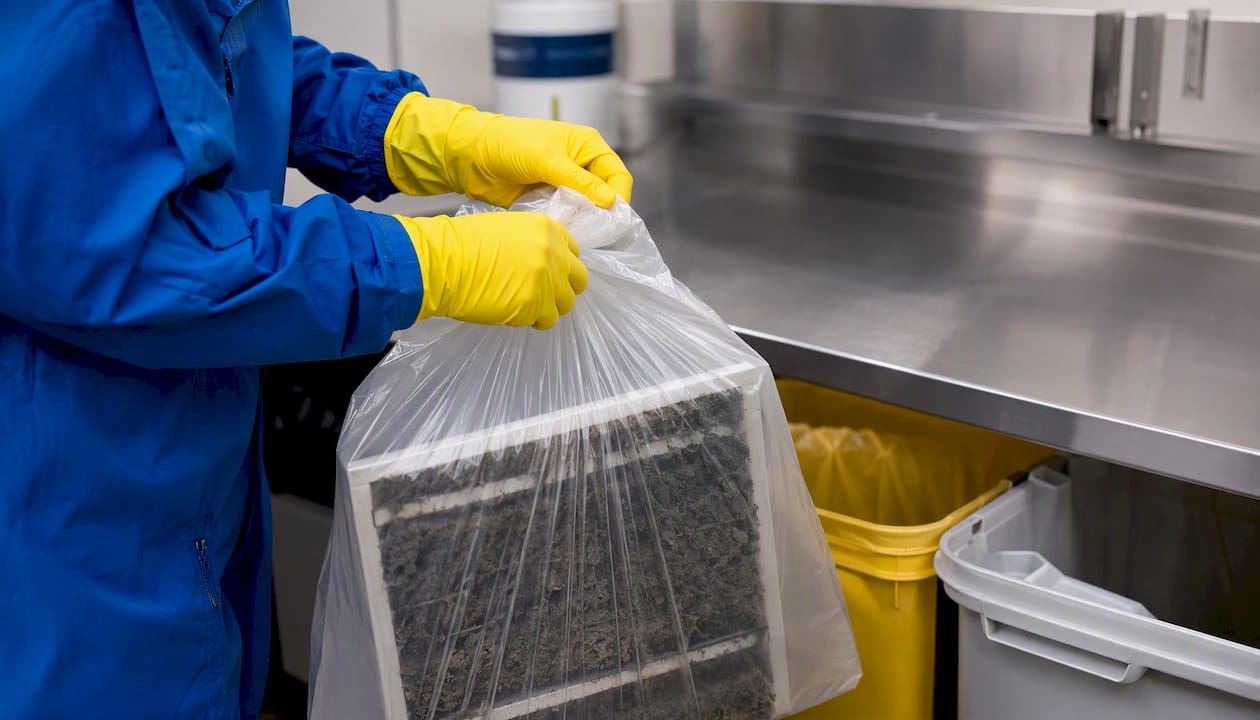
Safe disposal: Place used disposable filters in a heavy-duty plastic bag, seal it before removing from the unit, and dispose of it as clinical waste if the filter served a room with a confirmed infectious resident.
Pro Tip: If a washable filter has deformed pleats, torn media, or has been cleaned more than the manufacturer's recommended cycle count, stop cleaning and replace it. A degraded filter that looks clean still passes particles.
What does a practical maintenance schedule look like for aged-care facilities?
Daily visual checks, weekly accessible cleaning, monthly inspections, quarterly system checks, and annual commissioning — that is the cadence. The table below maps each task to the right person and records what to capture.
| Frequency | Task | Responsible | Trigger / Condition | Record fields |
|---|---|---|---|---|
| Daily | Visual check: filter face, airflow, noise, odour | On-shift staff | Every shift | Unit ID, date, time, observation, initials |
| Weekly | Clean accessible pre-filters (split systems, FCUs) | Maintenance staff | Scheduled or visible dust loading | Unit ID, filter type, action, condition, initials |
| Monthly | Inspect all filter housings, gaskets, frames; check differential pressure gauges | Maintenance team | Calendar or pressure rise | Differential reading, gasket condition, any remediation |
| Quarterly | Full system check: fans, dampers, coils, drain pans, duct condition | Maintenance team or contractor | Calendar | Fan operation, damper position, coil cleanliness, drain pan status |
| Annual | Commissioning: TAB (test, adjust, balance), magnehelic calibration, particle count post-filter change | Licensed HVAC contractor | Calendar | TAB report, particle count results, filter spec confirmation, technician licence number |
The Brookaire filtration planning guide for long-term care recommends using differential pressure as an objective replacement trigger rather than relying solely on calendar dates. A filter in a high-dust or high-pollen environment may need replacement well before the scheduled date; one in a low-load zone may last longer. Pressure tells you what the calendar cannot.
Simple record template for each filter event:
- Date and time
- Unit ID and location (building, floor, room)
- Filter type and MERV rating
- Action taken (visual check / clean / replace)
- Differential pressure before and after (if gauge fitted)
- Operator name and initials
- Observations (odour, moisture, damage, mould)
- Next scheduled action date
For facilities with multiple units, a maintenance checklist for retirement village facilities approach works well: one master log per building, with individual unit sheets filed behind it. Auditors and infection-control teams can then pull a unit's full history in under two minutes.
During high-risk periods such as bushfire smoke events or respiratory illness outbreaks, set HVAC systems to continuous ON rather than AUTO mode to maintain recirculation and filtration. Increasing the outdoor air fraction where the system allows it also helps dilute indoor contaminants.
Which filters should you specify, and when do you replace rather than clean?
Start with layered filtration: a pre-filter (MERV 8–11) to catch coarse dust and protect the final filter, plus a final filter at MERV 13 for most long-term care spaces, or MERV 14 for assisted living and skilled nursing areas. NAFA best practice guidelines recommend MERV 13 for independent living and MERV 14 for higher-acuity settings, with annual integrity checks by a certified air filtration specialist.
HEPA filtration (MERV 17+) is appropriate for isolation rooms or high-risk clinical spaces, but rarely fits standard care home air handling units without significant fan and duct upgrades.
| Filter type | MERV range | Typical use | Key limitation | Replace when |
|---|---|---|---|---|
| Fibreglass panel | 1–4 | Equipment protection only | Captures almost no fine particles | Monthly or when visibly loaded |
| Pleated polyester | 8–11 | Pre-filter in AHUs and FCUs | Not suitable as sole filter for infection control | Every 1–3 months or at pressure trigger |
| High-efficiency pleated | 13–14 | Final filter in AHUs for care home zones | Increases static pressure; needs system check | Every 3–6 months or at pressure trigger |
| Electrostatic | 10 | Washable pre-filter option | Loses charge if washed with detergent | Replace if charge loss suspected or media torn |
| HEPA (box or bag) | 17+ | Isolation rooms, portable air cleaners | High pressure drop; requires fan capacity check | Per manufacturer schedule or after contamination event |
Replacement triggers to act on immediately:
- Differential pressure exceeds the filter manufacturer's rated final pressure drop
- Visible mould, discolouration, or wet media
- Persistent odour after cleaning
- Physical damage: torn media, bent frame, failed gasket
- Moisture exposure from a drain pan overflow or roof leak
Pro Tip: Before specifying a MERV 13 or higher final filter for an existing unit, measure the static pressure across the filter bank at full fan speed. If the unit is already running near its design static pressure, adding a higher-resistance filter will reduce airflow and ACH — the opposite of what you want. This is the assessment step that most facilities skip, and it is the one that causes the most problems.
How do you monitor filter and HVAC performance without specialist equipment?
Three checks give you most of what you need: differential pressure across the filter bank, a visual dust-loading assessment, and a spot PM2.5 reading after each filter change. Together they tell you whether the filter is working, whether it needs replacement, and whether the new filter was installed correctly.
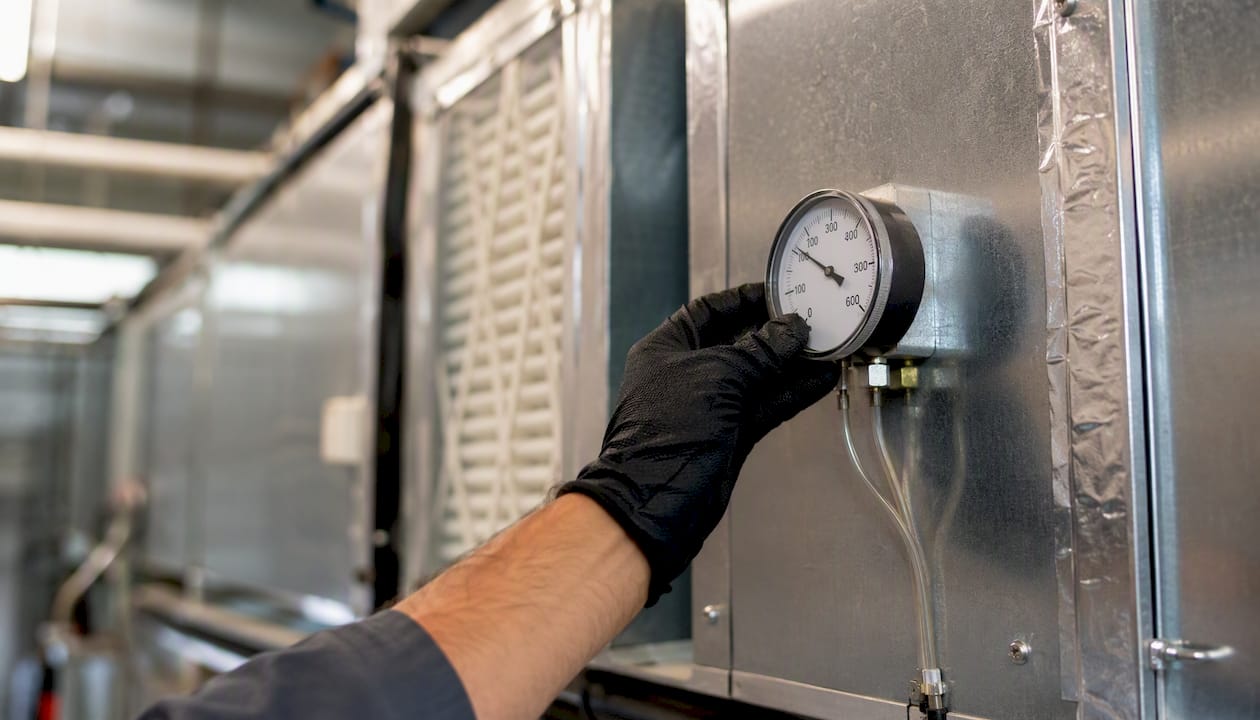
Differential pressure (magnehelic gauge): Fit a magnehelic gauge across each final filter bank. A reading rising toward the filter's rated final pressure drop means the filter is loaded and approaching replacement. Log every monthly reading and plot the trend — a filter that loads twice as fast as usual signals a problem upstream (a failed pre-filter, a damper stuck open, or a construction dust event).
Visual dust loading: Pull the filter slightly and inspect the upstream face. A uniformly loaded face is normal. Channelling (clean strips alongside heavily loaded strips) means air is bypassing part of the media, usually through a frame gap or a missing gasket.
PM2.5 spot counts: A pocket particle counter (such as a Temtop or Laser Egg) placed downstream of the filter immediately after a change confirms the new filter is seated correctly. A high downstream count after a fresh filter installation almost always means bypass, not filter failure.
A multicentre study of congregate living settings found median ACH values of 3.3 in common areas and 3.5 in resident rooms, with closed outside air dampers and fans off associated with marked ACH decreases. Those numbers matter because ACH below 6 in higher-risk zones leaves residents exposed to recirculated air for longer. Check that dampers are open and fans are running before assuming a filtration upgrade will solve an air quality problem.
Quick field checks to run each quarter:
- Smoke pencil or incense stick near supply diffusers to confirm airflow direction and distribution
- Magnehelic reading at full fan speed, recorded against the previous quarter
- PM2.5 reading in a representative resident room, compared to outdoor ambient
- Visual check of all damper positions (open/closed/stuck)
Pro Tip: Move to pressure-based replacement rather than calendar-based as soon as you have three months of differential pressure trend data. A filter that hits its final pressure drop in six weeks during pollen season should not wait until the quarterly calendar date.
Why does a professional assessment matter before you upgrade filters?
Upgrading filter efficiency without checking fan capacity is one of the most common and costly mistakes in care home HVAC upkeep. Higher-efficiency media has higher resistance. More resistance means lower airflow at the same fan speed, which means fewer air changes per hour reaching residents. The filter upgrade intended to protect residents can end up making ventilation worse.
ASHRAE guidance is direct on this: verify system static pressure before upgrading filters, and use PPE during filter handling. The same guidance notes that MERV 13 is an effective baseline for capturing airborne virus-sized particles, but that the system must be capable of handling the additional pressure drop.
A qualified HVAC contractor should measure static pressure across the filter bank, review the fan curve, check duct leakage, and verify that all filter frames and gaskets are intact before any efficiency upgrade is commissioned. Without that baseline, you are guessing at the outcome.
Contractor assessment checklist:
- Static pressure measurement across the existing filter bank at full fan speed
- Fan curve review to confirm available static pressure margin
- Duct leakage check (pressurisation test or smoke test)
- Verification of filter frame integrity, gasket condition, and seal
- Confirmation of damper operation and outdoor air fraction
- ACH calculation for key zones (common areas, resident rooms, isolation rooms)
- Particle count downstream of filters after installation of new media
For commissioning documentation, the contractor should provide a TAB report, magnehelic installation records, and a particle count result. These go into the facility's compliance file alongside the filter specification sheet and the service job sheet.
NAFA guidelines recommend annual integrity checks by a certified air filtration specialist, which aligns with the annual commissioning cadence in the schedule above. For Mornington Peninsula facilities, maintaining cooling systems in aged care covers the commissioning process in more detail.
Pro Tip: Ask the contractor to install magnehelic gauges at the same time as any filter upgrade. The cost is modest and the ongoing monitoring value is significant — you will never again need to guess when a filter needs changing.
What signs mean filters or HVAC equipment need urgent attention?
Act immediately on any of these:
- Mould visible on filter media, housing, or supply grilles
- Moisture or water staining on filter faces or inside the air handling unit
- Sudden rise in differential pressure (more than 20% above last reading in a short period)
- Loss of airflow from supply diffusers in a zone
- Unusual noise from fans: grinding, rattling, or high-pitched whine
- Persistent musty or chemical odour from supply air
Immediate triage steps
- Isolate the affected unit if it is safe to do so without cutting heating or cooling to vulnerable residents. If isolation is not immediately safe, increase natural ventilation in the affected zone by opening windows where possible.
- Bag and replace contaminated filters. Don full PPE (P2 respirator, gloves, gown). Bag the filter before removing it from the housing — fold the dirty face inward, seal the bag inside the unit, then remove. This limits particulate release into the room.
- Inspect the housing. Check for standing water in drain pans, mould on coil surfaces, and damaged insulation. Photograph everything before cleaning.
- Call a contractor if you find fan strain (motor running hot, tripping overloads), persistent pressure issues after filter replacement, or any mould on coil surfaces or ductwork. These are not maintenance tasks — they require a licensed technician.
- Notify the infection-control team if the unit served a zone with confirmed infectious residents. Document the event, the filter condition, the disposal method, and the actions taken.
For context on the resident safety risks that HVAC failures create, the heating system breakdowns in care homes guide covers the duty-of-care implications in detail.
Limit cross-contamination during changeout: work from clean zones toward contaminated zones, never carry an open used filter through a resident area, and decontaminate tools after use.
What should you ask contractors and how do you document it?
Have your questions and required deliverables ready before the contractor arrives. A contractor who cannot answer these questions or provide these documents is not the right contractor for a care home environment.
Questions to ask before booking:
- Can your fan handle a MERV 13 or MERV 14 final filter? Show me the pressure curves.
- What is your process for verifying filter seal and gasket integrity after installation?
- Do you carry calibrated magnehelic gauges and a particle counter?
- Can you provide a TAB report if airflow changes are made?
- What is your warranty on the work, and what does it cover?
- Are your technicians familiar with infection-control requirements in aged-care settings?
Required deliverables from each service visit:
- Signed job sheet with technician name, licence number, date, and unit IDs serviced
- Filter specification confirmation (brand, MERV rating, dimensions, part number)
- Differential pressure readings before and after filter change
- Photographic evidence of filter condition before removal and after installation
- TAB report if any airflow adjustments were made
- Magnehelic calibration record if gauges were installed or checked
- Particle count result downstream of filters after installation
Essential record fields for each filter event:
- Date and time of service
- Technician name and licence or registration number
- Unit ID and location
- Filter specification (type, MERV, dimensions)
- Differential pressure before and after
- Observations (mould, moisture, damage, odour)
- Remediation actions taken
- Next scheduled service date
The Royal Commission into Aged Care findings reinforce that documentation is not optional — it is evidence of duty of care. Keep all filter maintenance records, TAB reports, and commissioning documents in the facility's compliance file for a minimum of five years, or as required by your state regulator. For a broader view of commercial air conditioning servicing workflows, that guide covers what to expect from a contractor visit end to end.
A local contractor's perspective on Mornington Peninsula care homes
Mornington Peninsula facilities face a filter load profile that most generic guides do not account for: coastal salt air accelerates corrosion on coil fins and filter frames, spring pollen from the Peninsula's significant tree cover spikes pre-filter loading between August and November, and bushfire smoke events — increasingly common in summer — can load a MERV 13 filter to its final pressure drop in days rather than months.
That shapes three practical adjustments for local facilities managers. First, standardise your filter specifications across all units in the facility. Stocking three or four different filter sizes creates supply chain risk; a single smoke event that loads every filter simultaneously becomes a crisis if you cannot source replacements quickly. Talk to your supplier about holding a minimum two-cycle buffer stock on site, particularly heading into summer. Second, shift to a seasonally adjusted schedule rather than a fixed calendar: increase inspection frequency to fortnightly during pollen season and have replacement stock staged before the fire season begins in December. Third, coordinate filter changeouts with your infection-control team rather than treating them as a purely maintenance task. A filter change in a wing with an active respiratory illness outbreak needs the same PPE and disposal protocol as a clinical procedure.
Out-of-hours commissioning is worth the premium for care homes. Scheduling TAB work and particle counts during a quiet period — early morning or a weekend — avoids disrupting residents and gives the contractor clean baseline readings without occupancy-generated particulates skewing the numbers.
Dualflowservices: scheduled HVAC maintenance and assessment for care homes
Aged care facilities on the Mornington Peninsula need a contractor who understands both the technical requirements and the compliance obligations. Dualflowservices provides scheduled filter maintenance, static-pressure assessments, commissioning and TAB work, and emergency call-out for aged care, retirement villages, and disability care homes across the Peninsula and surrounding Melbourne suburbs.
Specific services relevant to care home facilities managers include pressure testing before filter upgrades, magnehelic gauge installation and calibration, ongoing maintenance contracts with documented service records, filter supply and responsible disposal, and full commissioning reports suitable for compliance files. Every service visit produces a signed job sheet, filter specification confirmation, and differential pressure readings — the records your auditors and infection-control team will ask for.
To arrange a site visit or request a quote for scheduled HVAC maintenance or a one-off assessment, contact Dualflowservices directly. A site visit takes the guesswork out of filter selection and gives you a pressure baseline before any upgrade decision is made.
Sources
The sources below underpin the recommendations in this guide. Keep PDFs and commissioning reports with your site compliance files so auditors can access them alongside your maintenance records.
- ASHRAE residential healthcare COVID-19 guidance
- Risk mitigation of shared room ventilation and filtration on SARS-CoV-2 transmission: a multicenter test-negative study
- The guide to filtration planning for long-term care facilities — Brookaire
- Infection control guide on HVAC for health care facilities managers — ASHE
- Best practice guidelines — NAFA (Continuing care / retirement communities)
This article is general information, not a substitute for advice from a qualified doctor. Consult a qualified healthcare professional about your own circumstances before acting on anything here.