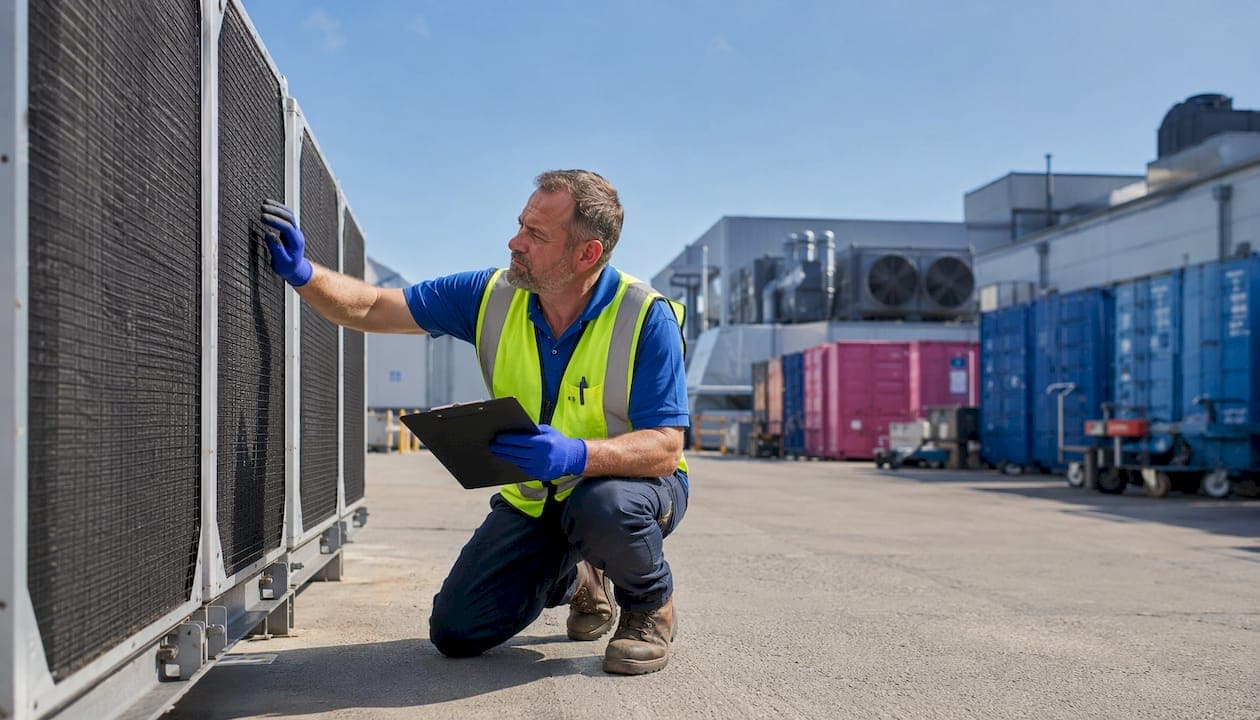
A commercial air conditioning service visit is a scheduled, preventive inspection where a licensed technician checks airflow, electrical safety, refrigerant charge, drainage, and controls, then hands you a written report with findings prioritised as urgent, recommended, or monitor. That report, not the visit itself, is what drives your next decisions.
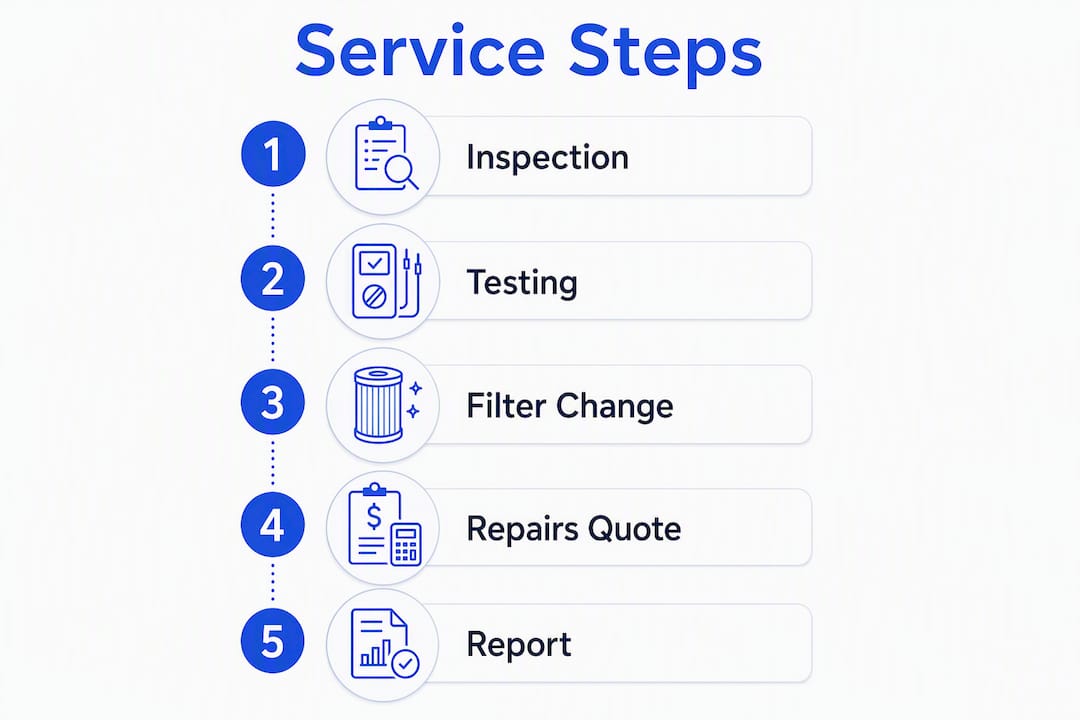
Before the technician arrives, confirm roof and plant room access, set your internal approval thresholds for minor repairs, and brief your site contact. During the visit, expect measured baseline readings: refrigerant pressures, temperature split across the coil, and motor amp draws. After the visit, you receive a signed service checklist, a prioritised recommendation list, and a quote for any defects found. Repairs are separate from the service unless you have pre-approved minor works.
Service deliverables to expect:
- Signed service checklist with task-by-task sign-off
- Measured readings: supply/return temperature split, refrigerant superheat and subcooling, amp draws on compressor and fan motors
- Defect photos with priority codes (urgent / recommended / monitor)
- Parts used and refrigerant quantities logged
- Written quote for any repair work identified
- Invoice for the service visit itself
Table of Contents
- How do commercial air conditioning systems actually work?
- What does a technician check during a commercial AC service?
- How often should you service a commercial air conditioner?
- What licences and compliance obligations apply in Australia?
- What happens when a service visit finds a fault?
- What are the measurable benefits of planned servicing?
- How do you choose a commercial HVAC servicing provider?
- Ready-to-use service checklist and report template
- Key takeaways
- The thing most facility managers get wrong about servicing
- Dualflowservices: scheduled servicing and emergency call-outs on the Mornington Peninsula
- Authoritative Australian standards and sources to check
How do commercial air conditioning systems actually work?
Understanding the components tells you exactly why each service check matters. A commercial system moves heat, not cold air. Refrigerant absorbs heat from inside the building and releases it outside, driven by a compressor. That cycle runs through four main stages: compression, condensation, expansion, and evaporation.
| Component | Function | Common failure mode prevented by servicing |
|---|---|---|
| Compressor | Pressurises refrigerant to drive the cycle | Overheating from dirty coils or low refrigerant |
| Condenser coil | Releases heat to outdoor air | Fouled fins reducing heat transfer capacity |
| Expansion device | Drops refrigerant pressure before evaporator | Blockage causing erratic superheat |
| Evaporator coil | Absorbs heat from indoor air; dehumidifies | Ice formation from restricted airflow or low charge |
| Air handling unit (AHU) | Distributes conditioned air through ductwork | Filter blockage, belt wear, bearing failure |
| Cooling tower / chiller | Large-scale heat rejection for central plant | Legionella risk, scale buildup, pump wear |
| VAV boxes | Zone-level airflow control | Actuator failure causing hot/cold spots |
| Building automation system (BAS) | Monitors and controls all zones | Sensor drift causing inefficient setpoints |
Dirty coils are one of the most common preventable causes of compressor failure. Fouled coils can reduce efficiency by 10–25%, and low refrigerant almost always signals a leak rather than normal consumption. Clogged condensate drains cause water damage to ceilings and walls. Each of these failures has a corresponding check on the service checklist, which is why skipping visits compounds risk quickly.
Air distribution and dehumidification matter as much as the refrigeration cycle itself. An AHU with a blocked filter starves the evaporator of airflow, causing the coil to ice over and the compressor to run under abnormal load. A VAV box with a seized actuator creates hot spots that generate occupant complaints and often trigger unnecessary emergency call-outs.
What does a technician check during a commercial AC service?
A standard commercial PM visit follows a consistent sequence: intake review, filter work, electrical and mechanical checks, refrigerant and performance checks, controls verification, and a written report. Here is what each stage covers.
Filters and airflow
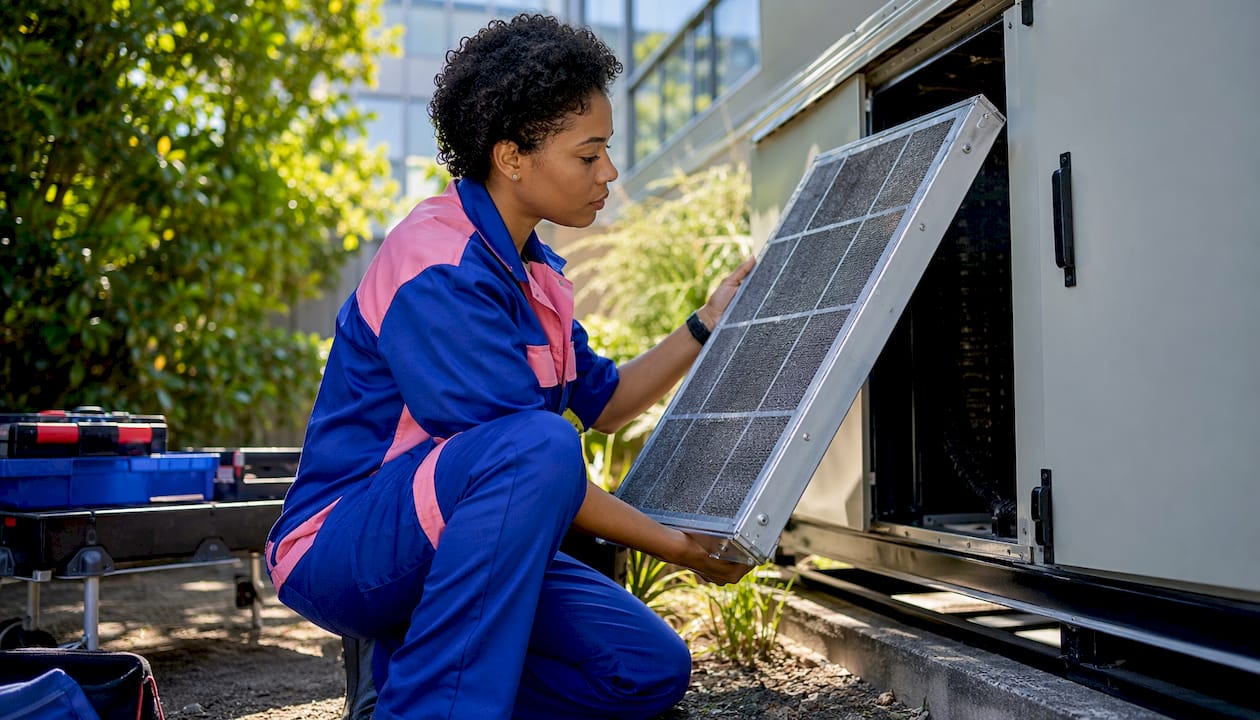
- Inspect and replace or clean all return air and supply filters
- Check filter differential pressure where gauges are fitted
- Inspect ductwork connections and dampers for leaks or seized actuators
Coils and heat transfer
- Clean evaporator and condenser coils (chemical wash or pressure rinse depending on fouling)
- Straighten bent condenser fins
- Check economiser operation and outdoor air dampers
Condensate and drainage
- Flush condensate drain lines and treat drain pans for algae and bacterial growth
- Inspect drain pan for corrosion or standing water
- Check condensate drainage and overflow protection
Electrical and mechanical
- Tighten all electrical connections; check contactors for pitting or burn marks
- Test capacitors and safety controls
- Measure compressor and fan motor amp draws against nameplate ratings
- Inspect belts for wear and tension; lubricate motor bearings
- Check fan blade balance and condition
Refrigerant and performance
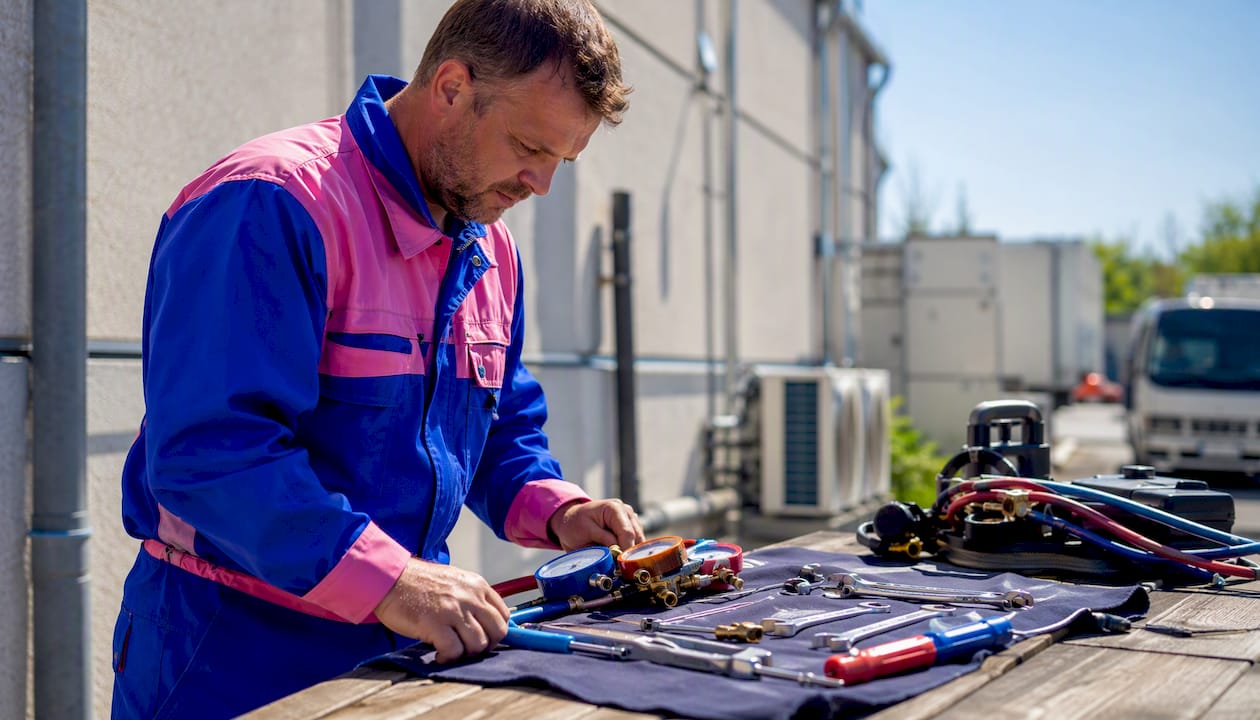
- Measure suction and discharge pressures; calculate superheat and subcooling against manufacturer targets
- Record refrigerant readings alongside outdoor ambient temperature to build a baseline for future visits
- Check for refrigerant leaks using electronic leak detector; log any refrigerant added
Controls and BAS
- Calibrate thermostats and zone sensors
- Verify BAS setpoints, schedules, and alarm thresholds
- Test safety shutdowns and high-pressure cut-outs
Priority coding criteria:
- Urgent: Safety risk or imminent failure (refrigerant leak, electrical fault, failed safety control)
- Recommended: Efficiency or reliability impact within 1–3 months (worn belt, dirty coil, low refrigerant charge)
- Monitor: Trend to watch at next visit (minor bearing noise, slightly elevated amp draw)
Pro Tip: Keep a folder of baseline readings from the first two service visits. When a technician flags an elevated amp draw six months later, you can compare it against your own records rather than relying solely on their assessment.
Neglected filtration is the single most common preventable cause of commercial AC failure. A strict filter-change regime, matched to your environment, extends equipment life more than any other single action. Restaurants and manufacturing sites typically need filter attention every 4–6 weeks; a low-traffic office may manage up to 3 months.
How often should you service a commercial air conditioner?
Industry guidance recommends a minimum of twice per year for most commercial systems, timed before the cooling season (September in Australia) and before the heating season (March). High-use or high-dust environments, including restaurants, medical centres, aged care facilities, and 24/7 warehouses, need quarterly inspections.
Seasonal timing matters because spring start-up checks catch condenser coil fouling and refrigerant issues before peak demand. Skipping the pre-summer service is one of the most common reasons for early-season breakdowns.
Factors that push frequency higher:
- Continuous operation (24/7 facilities)
- High occupant density or high cooking/process heat loads
- Coastal or industrial environments with airborne contaminants
- Regulated environments (aged care, disability care, food production)
- Systems older than 10 years
Visit duration and cost factors:
A split system or packaged rooftop unit typically takes 60–90 minutes per unit for a thorough service. A central chiller plant or AHU serving multiple floors will take considerably longer. Cost drivers include access complexity (roof, confined space, after-hours), system age, parts required, labour rates, and whether refrigerant needs to be added or recovered.
The repair vs replacement question:
The practical threshold most facilities managers use is roughly $5,000 in repair cost relative to remaining equipment life. If a repair quote exceeds that figure on a system over 12–15 years old, it is worth requesting a replacement cost comparison. Factors to weigh: remaining warranty, energy penalty of the ageing system, parts availability, and whether the unit meets current efficiency standards. Poor PM compliance can inflate energy consumption by 15–30% in commercial buildings, so an old, poorly maintained system may be costing you far more in running costs than the repair quote suggests.
Statistic: Systems with poor preventive maintenance compliance often consume significantly more energy than well-maintained equivalents, according to Oxmaint's commercial HVAC guidance.
For structured scheduling guidance that applies to both residential and commercial contexts, the HVAC maintenance schedule principles around seasonal timing and frequency tiers translate directly to commercial settings.
What licences and compliance obligations apply in Australia?
Commercial HVAC servicing in Australia sits across several regulatory frameworks. Getting this wrong exposes you to insurance voids, WorkSafe liability, and warranty disputes.
Licences to verify before work begins:
- Refrigerant handling licence: Any technician who handles refrigerants must hold an ARCtick authorisation. Verify the licence number on the ARCtick registry before work starts. Unlicensed refrigerant handling is a federal offence under the Ozone Protection and Synthetic Greenhouse Gas Management Act.
- Electrical licence: Work on mains-connected equipment, three-phase systems, or control wiring requires a licensed electrician. Commercial rooftop units and chillers operate at three-phase voltages that are outside the scope of a refrigeration mechanic's licence alone.
- Trade licence (state/territory): In Victoria, HVAC contractors must hold the relevant plumbing and gasfitting licence where applicable, issued under the Building Act framework. Verify current licence status with the Victorian Building Authority (VBA).
- Public liability and professional indemnity insurance: Minimum $10 million public liability is standard for commercial work; confirm the certificate of currency is current.
Standards and duty of care:
- AS 1668.2 governs mechanical ventilation and air conditioning in buildings; compliance is relevant to any work affecting air distribution or ventilation rates.
- AS/NZS 3666 covers air handling and water systems in buildings, including Legionella risk management in cooling towers and evaporative systems. For aged care and regulated facilities, cooling system hygiene under this standard is a mandatory compliance obligation, not a recommendation.
- Safe Work Australia guidance on plant and equipment maintenance applies to commercial HVAC work; employers have a duty of care to maintain plant in safe condition.
- ASHRAE Standard 180 provides a recognised framework for commercial HVAC inspection and maintenance procedures, widely referenced by insurers and auditors.
Record-keeping requirements:
Written service reports, refrigerant logs, parts records, and defect photographs form your audit trail for warranty claims, insurance disputes, and regulatory inspections. For aged care facilities, maintenance records are subject to the Aged Care Quality Standards; for disability care, the NDIS Practice Standards apply. Keep records for a minimum of seven years.
What happens when a service visit finds a fault?
Most facility managers are surprised to learn that a service visit does not automatically fix everything found. The workflow is deliberate.
The technician documents each defect with a photograph and a written description, assigns a priority code, and provides a diagnostic estimate or formal quote before any repair work proceeds. You then approve repairs within your internal thresholds or escalate to procurement. This separation protects your budget and gives you a defensible paper trail.
Suggested internal approval thresholds:
- Auto-approve (site manager): Repairs under $500, consumables, minor adjustments within scope of the service agreement
- Manager approval: $500–$5,000, non-urgent defects, parts with lead times
- Procurement / board: Over $5,000, capital replacement, system modifications
Pre-setting these thresholds in your service agreement avoids the most common source of delay: a technician waiting on-site for an approval that takes three days to reach the right person.
Emergency triage:
Some faults cannot wait for a scheduled repair. Treat the following as immediate call-outs:
- Refrigerant leak affecting occupied spaces (health risk; refrigerant global warming potential is also a regulatory concern)
- Electrical fault with fire risk (burning smell, tripped safety, visible arcing)
- Complete system failure in a regulated environment (aged care, operating theatre, cold storage)
- Condensate overflow causing active water damage
For multi-site operations, pre-arranged access procedures and a named site contact materially reduce missed service windows and emergency response times.
What are the measurable benefits of planned servicing?
Reactive repairs typically cost two to three times the equivalent scheduled service. That figure alone justifies a PM programme for most facilities, but the full business case runs deeper.
| KPI | Definition | Why it matters |
|---|---|---|
| System uptime (%) | Hours of normal operation ÷ total scheduled hours | Direct measure of PM effectiveness |
| PM completion rate (%) | Completed PM visits ÷ scheduled visits | Flags gaps in the programme |
| Repeat work orders per asset | Recurrence of the same fault within 12 months | Identifies chronic failures needing replacement |
| Energy use per cooling tonne | kWh consumed per unit of cooling delivered | Quantifies efficiency gains from clean coils and correct charge |
| Mean time between failures (MTBF) | Average operating time between unplanned breakdowns | Tracks lifecycle trend across the asset fleet |
A simple ROI template: take your last 12 months of emergency call-out costs, add the energy penalty from any systems with poor PM compliance, and compare that total against the annual cost of a structured PM programme. Most facilities find the programme pays for itself within the first year, with the remainder of the benefit flowing through extended equipment life and reduced capital replacement spend.
Beyond the numbers, occupant comfort affects productivity. Research from Lawrence Berkeley National Laboratory links room temperature and productivity directly, with performance declining measurably outside the 21–23°C comfort band. For aged care and disability care facilities, thermal comfort is also a duty-of-care obligation.
How do you choose a commercial HVAC servicing provider?
The wrong provider costs more than no provider. A technician who cannot produce a written report, show their ARCtick licence, or explain their refrigerant log is a liability, not an asset.
Questions to ask before signing:
- Can you show your ARCtick authorisation and electrical licence?
- Do you carry a current certificate of public liability insurance (minimum $10 million)?
- Can I see a sample service report before we start?
- What is your emergency response SLA for critical systems?
- Do your technicians have BAS and controls competency, or do you subcontract that?
- Can you service three-phase commercial equipment and chillers?
- Do you have experience with multi-site programmes?
Red flags:
- No written report offered, or only a brief handwritten note
- Reluctance to show refrigerant handling licence or ARCtick number
- Vague emergency response commitment ("we'll get there as soon as we can")
- High technician turnover or different technician every visit
- Quoting refrigerant top-ups without leak investigation
Service agreement clauses worth insisting on:
- Reporting cadence and format (digital report within 24 hours of visit)
- Emergency response time by priority tier
- Pre-approved minor repair threshold (e.g., auto-approve up to $500)
- Parts warranty (minimum 12 months on supplied parts)
- Escalation path for capital replacement recommendations
For regulated environments such as aged care and retirement villages, also confirm the provider understands aged care cooling system obligations and can document compliance against the relevant quality standards.
Ready-to-use service checklist and report template
Use this template to brief your provider, verify the visit was completed properly, and maintain your compliance records.
Pre-visit preparation checklist
- Confirm roof, plant room, and ceiling space access with building management
- Notify affected tenants or staff of potential brief interruptions
- Provide technician with asset register and last service report
- Set and communicate internal approval thresholds for minor repairs
- Confirm a site contact person will be available for the full visit duration
On-site tasks (technician to complete)
- Filter inspection, cleaning, or replacement (record filter condition on arrival)
- Evaporator and condenser coil inspection and cleaning
- Condensate drain flush and drain pan treatment
- Electrical connection tightening; contactor and capacitor testing
- Belt and bearing inspection; lubrication of motor bearings
- Refrigerant pressure measurement; superheat and subcooling calculation
- Leak check with electronic detector; log any refrigerant added
- Fan blade and motor amp draw measurement
- Thermostat and zone sensor calibration
- BAS setpoint and alarm verification
- Damper and economiser operation check
- Safety control test (high-pressure cut-out, freeze stat)
Pro Tip: For facilities with cooling towers or evaporative condensers, a preventive maintenance cleaning programme running in parallel with your HVAC service schedule significantly reduces Legionella risk and keeps AS/NZS 3666 compliance straightforward.
Sample service report: mandatory fields
- Site name and address
- Unit ID / asset tag
- Technician name, licence number, ARCtick authorisation
- Date and time of visit
- Baseline readings: supply temperature, return temperature, temperature split, suction pressure, discharge pressure, superheat, subcooling, compressor amp draw, fan motor amp draw, outdoor ambient temperature
- Defect photographs: numbered and referenced to checklist items
- Parts used: description, quantity, part number
- Refrigerant log: type, quantity added, reason, leak check result
- Priority-coded recommendations: urgent / recommended / monitor with brief description
- Authorised approver signature (for any repairs approved on the day)
- Next service due date
For aged care and disability care environments, add fields for: access control compliance, tenant privacy considerations (no photos of residents), staged approval contacts, and the relevant quality standard reference (Aged Care Quality Standards or NDIS Practice Standards). The maintenance checklist for retirement village facilities provides a useful governance framework to sit alongside this template.
Key takeaways
Commercial air conditioning servicing works as a structured, preventive process: a licensed technician inspects, measures, and documents system condition, then hands you a prioritised report that drives separate, approved repair decisions.
| Point | Details |
|---|---|
| Service is not repair | A service visit identifies faults and provides quotes; repairs are approved and scheduled separately. |
| Minimum twice yearly | Schedule before the cooling season (September) and heating season (March); quarterly for heavy usage or high-dust sites such as restaurants, medical centres, aged care facilities, and 24/7 warehouses. |
| Energy penalty of poor PM | Systems with poor maintenance compliance can consume 15–30% more energy than well-maintained equivalents. |
| Licence verification is mandatory | Confirm ARCtick authorisation and electrical licence before any technician handles refrigerant or mains wiring. |
| Dualflowservices for the Mornington Peninsula | Dualflowservices provides scheduled maintenance, compliance checks, and emergency call-outs across the Mornington Peninsula and surrounding Melbourne suburbs. |
The thing most facility managers get wrong about servicing
The most persistent misconception in commercial facilities management is treating the service visit and the repair budget as the same line item. They are not, and conflating them creates two problems simultaneously: you either underspend on servicing (because you are saving budget for "when something breaks") or you overspend on emergency repairs (because the servicing that would have prevented them never happened).
The smarter approach is to treat servicing as lifecycle intelligence gathering. Every visit builds a baseline. The second visit tells you whether a trend is worsening. By the third visit, you can predict which assets are heading toward failure and schedule replacement during a planned shutdown rather than an emergency one. That shift from reactive to predictive is where the real cost savings live, and it only works if the service report is detailed enough to support trend analysis.
The other thing worth saying plainly: a cheap service that produces a one-page handwritten note is not a service. It is a liability. If your provider cannot show you measured refrigerant readings, photographed defects, and a priority-coded recommendation list, you have no audit trail, no warranty protection, and no basis for a capital replacement decision. The report is the product. The visit is just how you get it.
Dualflowservices: scheduled servicing and emergency call-outs on the Mornington Peninsula
When a system fails in an aged care facility at 2 AM or a commercial kitchen loses cooling on a Friday afternoon, the response time and the technician's competency are what matter. Dualflowservices covers scheduled maintenance, compliance checks, and emergency call-outs across the Mornington Peninsula and surrounding Melbourne suburbs, with multi-discipline capability across HVAC, plumbing, and electrical under one provider.
That multi-discipline coverage means condensate drainage issues, electrical faults on three-phase equipment, and refrigerant work are all handled by the same accountable team, with licensed technicians for each scope. Managers can request a sample service report before booking to confirm the documentation standard meets their compliance requirements.
Service assurances:
- ARCtick-authorised refrigerant handling and licensed electrical work
- Public liability insurance; certificates of currency available on request
- Written service reports with measured baselines, defect photos, and priority-coded recommendations
- Emergency call-out capability for critical systems
- Multi-site programme capability across Mornington Peninsula and Melbourne suburbs
Book a scheduled service or compliance check with Dualflowservices, or contact the team to request a sample report before committing.
Authoritative Australian standards and sources to check
Use these to verify contractor credentials and confirm your compliance obligations before work begins.
- ARCtick registry (arctick.org): The federal registry for refrigerant handling authorisations. Search by licence number or company name to confirm a technician is authorised to handle refrigerants. Mandatory check before any refrigerant work.
- AS 1668.2 (Standards Australia): Mechanical ventilation and air conditioning in buildings. Relevant to ventilation rates, air distribution, and any work affecting building air quality.
- AS/NZS 3666 (Standards Australia): Air handling and water systems in buildings. Covers Legionella risk management in cooling towers, evaporative condensers, and AHUs. Compliance is a legal obligation in Victoria under the Public Health and Wellbeing Act.
- Safe Work Australia (safeworkaustralia.gov.au): Guidance on plant and equipment maintenance, confined space work, and working at heights. Relevant to rooftop unit servicing and plant room access.
- Victorian Building Authority (vba.vic.gov.au): Verify current trade licence status for HVAC, plumbing, and electrical contractors operating in Victoria.
- Department of Climate Change, Energy, the Environment and Water (dcceew.gov.au): Administers the Ozone Protection and Synthetic Greenhouse Gas Management Act. Relevant to refrigerant handling obligations and HFC refrigerant global warming potential reporting.
Before any contractor starts work: request their ARCtick authorisation number, electrical licence number, VBA trade licence, and a current certificate of public liability insurance. Cross-check each against the relevant registry. A reputable provider will have these ready without being asked.
For commercial cleaning frequency guidance in high-traffic or foodservice environments, where filter and coil fouling rates are significantly higher than in standard office settings, the risk-based approach to cleaning cadence applies directly to your HVAC maintenance scheduling.
This article provides general information for facility managers and does not constitute legal, regulatory, or professional advice. Confirm current licence requirements, standards obligations, and compliance thresholds with the relevant statutory bodies or a qualified professional for your specific situation.