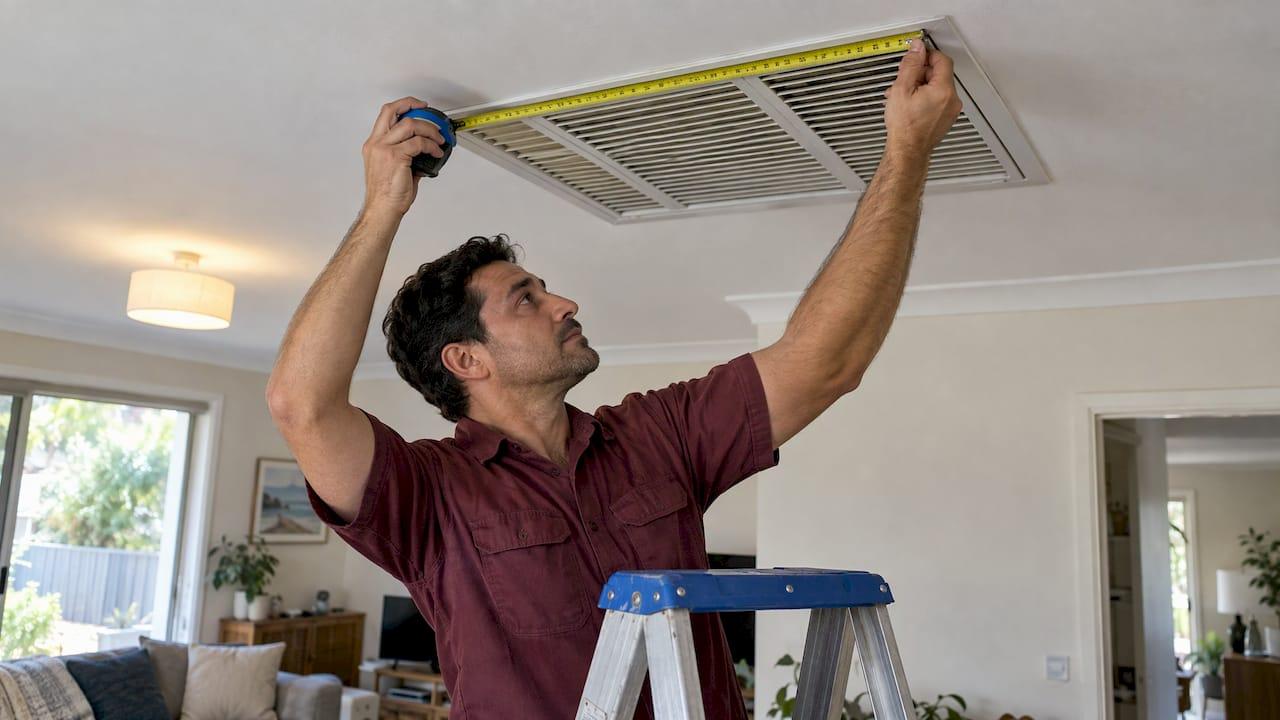
The right return air grille size is set by your system's airflow, not by the hole it needs to cover. The grille's free area, the open space between its blades, must be large enough to pull the system's full airflow at a quiet face velocity. For many Australian ducted systems that works out to around 2.5 m/s across the grille. You then choose a grille whose duct opening and frame suit the wall or ceiling it sits in.
Below we cover what "size" means on a grille, how to measure an existing opening, how to calculate the area you need, and what changes when the grille holds a filter. We also cover when a licensed tradesperson should check the numbers, especially in aged care and disability care buildings.
TL;DR
- Grille sizes can mean three different things: the duct opening, the visible face, or the free area. Airflow is decided by free area.
- Many Australian manufacturers size return grilles on a face velocity of about 2.5 m/s. Divide the airflow in m³/s by the velocity to get the free area needed.
- Measure the opening behind the old grille, not the outside of the grille. The frame overlaps the wall by a margin.
- A filter behind the grille adds resistance, so filter grilles are generally sized larger or run slower.
- An undersized return causes noise and poor performance. Multi-room and care facility systems should have sizing verified by a qualified tradesperson.
Table of Contents
- What "return air grille size" actually refers to
- How to measure an existing return air opening
- How to calculate the size you need
- Face velocity, noise and pressure drop
- Sizing a return air grille with a filter
- Quick reference: choosing a grille
- Care facilities and multi-room buildings
- When to have the sizing checked
- Our perspective
- Need a return grille checked or replaced?
- FAQ
- Sources
What "return air grille size" actually refers to
When someone quotes "600 x 600", they might be describing any of three measurements. Mixing them up is the most common reason a replacement grille doesn't fit or doesn't perform.
The duct opening. This is the hole in the wall, ceiling or bulkhead that the grille covers or fits into. Grilles from many suppliers are ordered by this dimension.
The face size. This is the visible outer dimension, including the frame. It is always bigger than the opening because the frame has to overlap the surface around it. Typical overlap is a few centimetres on each side.
The free area. This is the unobstructed area between the blades or perforations, and it is the figure that determines how much air can actually pass through. One HVAC sizing guide separates gross face area (used for face velocity calculations), free area, and the manufacturer's own catalogue core area, which may differ from both.
The Australian manufacturer documents are clear about this. ActronAir's airflow application guidelines say its return grille sizes are based on a face velocity of 2.5 m/s and that the sizes shown are free area, not nominal grille dimensions. So a grille that looks big enough can still be too small once the blades are taken out of the picture.

Why free area is smaller than the face
Blades, bars and perforations block part of the face. How much depends on the grille design:
- Air Diffusion's half chevron return grille is an aluminium grille with 45° blades at 26 mm centres and an approximate free area of 60% for the grille only.
- ActronAir's installation guide works from a figure of 80% free face area when recommending grille sizes.
- Bradflo's air handling catalogue applies a correction factor to the nominal area. For a 300 x 150 mm single-deflection grille with a factor of 0.79, the free area is 0.0355 m². With double deflection and a further 0.80 factor, it drops to 0.0284 m².
So two grilles with the same face size can move noticeably different amounts of air. Always compare free area, not face size.
How to measure an existing return air opening
If you are replacing a grille on an existing ducted system, the job starts with the opening. Your technician will normally do this on a site visit, but it helps to know what is being measured so the quote makes sense.
- Remove the old grille. Most are held by screws or clips. Filter grilles usually have a hinged door or removable core.
- Measure the opening, width first, then height. Measure the hole or the recess in the framing, not the outside of the old grille.
- Note the depth and what's behind it. A ducted return might open into a plenum, a ceiling space or a wall cavity. The depth matters for filter-bearing grilles and for fitting a grille with a removable core.
- Record the clearances. Check the space around the grille for door swing, skirting and nearby fixtures. Advantage Air's Slimline return grille instructions call for a hole size of 382 mm x 562 mm with at least 120 mm between the bottom of the hole and the floor, so the filter can be slid out and cleaned.
- Check the existing airflow rating. The size of the old grille tells you what was installed, not what the system needs. Look at the indoor unit's specifications for nominal and maximum airflow.
The last step matters because grilles installed years ago may have been undersized to begin with, or the system may have been upgraded since. Older ducted systems can have undersized return paths, particularly after an upgrade, which can cause a roaring sound at the grille, as a Melbourne duct specialist has noted.
If the opening needs to change
Sometimes the best fix is a bigger opening, or a second return in another room. That might mean cutting plasterboard, brick or even concrete. For masonry or slab work, specialist concrete drilling for HVAC installs keeps the cut clean and avoids damage to surrounding structure. Your HVAC tradesperson can coordinate this so the opening matches the grille you've selected.

How to calculate the size you need
The calculation is simple once you know the system's airflow.
Free area (m²) = airflow (m³/s) ÷ face velocity (m/s)
Airflow is usually listed in L/s, so divide by 1000 first.
Worked example
Take a ducted unit with a nominal supply airflow of 650 L/s and a maximum of 780 L/s. ActronAir's Advance 2 installation guide lists the following for that model:
| Condition | Airflow | Minimum return grille free area |
|---|---|---|
| Nominal | 650 L/s | 0.26 m² |
| Maximum | 780 L/s | 0.31 m² |
Check it with the formula: 0.65 m³/s ÷ 2.5 m/s = 0.26 m². At the maximum, 0.78 ÷ 2.5 = about 0.31 m². The numbers match.
The guide then recommends a 550 x 750 mm grille with 0.41 m² of free area, based on 80% free face area. That is above the minimum, which is deliberate. The same guide notes that to reach maximum airflow you may need to go one size larger than the recommended grille.
A second example from ActronAir's application guidelines: a unit at 630 L/s nominal needs a minimum free area of 0.26 m², and at 900 L/s maximum it needs 0.36 m². The recommended grille is 540 x 640 mm with 0.35 m² of free area.
Grille sizes and free area from catalogues
Once you know the free area, you pick a grille that meets or beats it. Catalogues list free area per size. Bradflo's catalogue gives, for its ARG return air grille, 0.434 m² at 600 x 900 mm and 0.888 m² at 900 x 1200 mm.
Advantage Air's Purtech return grille comes in three sizes with effective face areas as shown:
| Grille size | Effective face area |
|---|---|
| 1200 x 600 mm | 0.529 m² |
| 900 x 400 mm | 0.309 m² |
| 750 x 550 mm | 0.337 m² |
Notice that the 900 x 400 mm grille has a smaller face than the 750 x 550 mm grille, and the figures follow. Face size and free area move together only within a single product line, so never compare across brands without checking the numbers.
What if you only know the system in tons or kW?
US references often use CFM and feet per minute. The same logic applies, only the units change. Hart & Cooley's engineering data states that returns should be at 400 to 600 FPM maximum and that the total capacity of the return grilles must equal or exceed the total capacity of all the supply diffusers. For Australian systems, work in L/s and m/s, and take the airflow from the manufacturer's data for your specific indoor unit.
Face velocity, noise and pressure drop
Make a grille too small and the air has to speed up to get through it. That causes three problems:
- Noise. Whistling or a rushing sound at the grille, especially at high fan speeds.
- Restricted airflow. The system struggles to pull air back, so supply output drops and rooms don't reach temperature.
- Extra load on the fan. Higher resistance means more static pressure for the system to push against.
ActronAir's guidelines say to consider pressure drops through return grilles, filters and tight duct bends, and to identify the return air path for each zone. That may include undercut doors or extra return duct and grilles.
For ducts behind the grille, CCC Engineering's return air pathways memo advises sizing return ducts for 3.5 to 5.0 m/s, with branches at the low end and mains at the high end. It also says every return grille needs a clear, unobstructed path to the air handling unit. A big grille on a blocked path doesn't help.
Oversizing a return
A return can generally be sized up with little downside for a single return point, while a supply cannot. Hart & Cooley's data says you can't oversize a single-point return the way you can a supply, because the system is improved rather than harmed. With multiple return locations, balancing becomes more important so each room contributes its share of air. That is a real consideration in multi-zone buildings.
Sizing a return air grille with a filter
Many Australian homes have a filter grille, where the filter sits directly behind the face. That changes the sizing in three ways.
It needs more area. The filter adds resistance, and that resistance rises as dust loads on it. Air Diffusion's filtered return grille is rated at a design airflow of 1297 L/s per m² on a clean filter. Its nominal sizes run from 450 x 600 mm at 350 L/s up to 550 x 1150 mm at 820 L/s, based on 2.0 m/s, which is slower than the 2.5 m/s used for plain grilles.
It has its own resistance rating. Filter test data differs between products. Advantage Air's Purtech electrostatic filter shows an initial resistance of 50 Pa at 2.02 m/s and a final resistance of 125 Pa, with a G2 class average arrestment of 78.30%. The Bradflo removable core filter shows an initial resistance of 27 Pa at 1.8 m/s. These are different products tested to different standards, so treat each datasheet on its own terms.
It needs to be reachable. Slimline grilles need clearance below the opening so the filter can slide out for cleaning, and Air Diffusion recommends cleaning its filter at least every 6 months in domestic applications. A grille placed behind furniture or too close to the floor gets neglected, and a clogged filter is the fastest way to turn a correctly sized grille into an undersized one.
For how to look after filters in larger buildings, see our HVAC filter maintenance guide for care homes. For a seasonal routine at home, our air conditioning maintenance checklist for summer covers filters alongside the rest of the system.
Quick reference: choosing a grille
| Step | What to confirm |
|---|---|
| 1. Airflow | Nominal and maximum L/s from the indoor unit's data |
| 2. Face velocity | About 2.5 m/s for a plain return per ActronAir; lower (around 2.0 m/s) for filter grilles |
| 3. Minimum free area | Airflow in m³/s ÷ velocity |
| 4. Grille selection | Free area from the datasheet meets or exceeds the minimum |
| 5. Opening | Measured behind the old grille, with the frame overlapping the wall |
| 6. Access | Room to open, remove and clean the filter or core |
| 7. Return path | Clear route back to the unit from every room, including door undercuts |
Care facilities and multi-room buildings
Aged care, retirement villages and disability care homes add layers that a single-room replacement doesn't have. Rooms are often closed off for privacy, corridors act as return paths, and ventilation has to meet building and health requirements.
CCC Engineering notes that AS 1668.2:2012 and its 2024 revision set requirements for mechanical ventilation in Australian buildings. It also says transfer air between enclosures counts toward the effective outdoor airflow rate, and that the pressure difference between a room and its corridor should be kept at or below 3 Pa with doors closed. Return grille size and placement directly affect those pressure relationships. See our disability care HVAC ventilation guide for how this plays out in practice.
Maintenance frequency also changes. ActronAir's installation guide recommends servicing by a qualified technician every 12 months for residential applications and every quarter for commercial applications. Its checklist covers filters clogged by dust and measuring air on and air off with temperature probes in the return and supply air. For commercial sites, our article on how commercial air conditioning servicing works explains what a visit involves, and our aged care cooling maintenance guide covers care-specific routines.
When to have the sizing checked
Bring in a licensed HVAC tradesperson when:
- The system is noisy at the return grille, particularly at high fan speed.
- Rooms don't reach set temperature, even though the unit runs constantly.
- You've upgraded the indoor unit, added zones or extended the ducting.
- A filter keeps clogging quickly, or the grille is hard to get to.
- You're replacing a grille on a system with several return points that need balancing.
- The building is a care facility where ventilation and pressure relationships matter.
The same applies if you're choosing a new system. Our guide on how to choose a ducted heating system in Victoria and our air conditioner sizing guide cover the system side, and the return grille needs to be matched to whatever you choose.
Our perspective
Most return grille problems we see are not about the grille itself. They are about the system around it. A grille gets replaced with one that looks the same, the free area is lower than the original, and the owner ends up with a noisy return and rooms that never quite warm up.
We think the right way to approach it is to start from the airflow, work back to free area, and only then talk about face size and finish. That is how a grille ends up quiet, easy to service and matched to the equipment.
It also helps to have one team look at the whole picture. Because we handle plumbing, electrical and heating and cooling under one roof, we can check the return path, the electrical supply to the unit and any hot water or ventilation issues in the same visit. For facility managers in aged care, retirement villages and disability care homes, that means fewer contractors to coordinate and a single point of contact, with 24/7/365 emergency availability if something fails.
Mike
Need a return grille checked or replaced?
If your ducted system is noisy, underperforming or due for a service, we can inspect the return path, measure the opening, confirm the airflow and fit a grille that suits. We work with homeowners and business owners across the Mornington Peninsula and surrounding Melbourne suburbs, as well as aged care, retirement village and disability care sites. Our heating and cooling services include scheduled maintenance, installation and emergency call-outs.

For a facility with multiple zones or compliance needs, our scheduled maintenance and legal compliance services can fold return air checks into your regular plan. Our four step maintenance plan for aged care shows how that fits together.
FAQ
What size return air grille do I need for a ducted system?
It depends on the indoor unit's airflow. Divide the airflow in m³/s by the face velocity, around 2.5 m/s for many Australian ducted systems, to get the minimum free area. Then pick a grille whose listed free area meets or exceeds that figure. The manufacturer's installation guide for your unit usually lists the minimum.
Do I measure the grille or the hole behind it?
Measure the opening behind it. The frame of a grille is larger than the hole so it can overlap the wall or ceiling. Measuring the outside of the old grille can lead you to order a size that doesn't fit, or one with too little free area.
Can a return air grille be too big?
For a single return, a larger grille generally lowers velocity and noise, and Hart & Cooley's engineering data says it does not harm the system. It is different where there are several return points, because the air has to be balanced between rooms. A tradesperson can check this before you commit.
How often should I clean the filter in a return grille?
Manufacturers give different intervals. Air Diffusion recommends cleaning its filter at least every 6 months in domestic applications. A dusty home, pets, or a commercial or care setting may need it more often, and a technician can set the right schedule at your annual or quarterly service.
Does a filter change the grille size I need?
Yes. A filter adds resistance, so filter grilles are usually sized for a lower face velocity than plain grilles. Air Diffusion's filtered grille sizing is based on 2.0 m/s. Check the datasheet for the specific grille and filter you are using.
Sources
- Return Air Grille Sizing: Free Area and Pressure Drop
- Bradflo Air Handling Reference Catalogue
- ActronAir Airflow Application Guidelines
- ActronAir Advance 2 Installation Guide
- Air Diffusion half chevron return air grille specifications
- Advantage Air Slimline heating return air grille
- Advantage Air Purtech return air grille
- Hart & Cooley Engineering Data
- CCC Engineering: Return Air Pathways and Transfer Air Design
- FreshDuct: Return Air Vents Explained
- Vic Sawing: HVAC installation concrete drilling