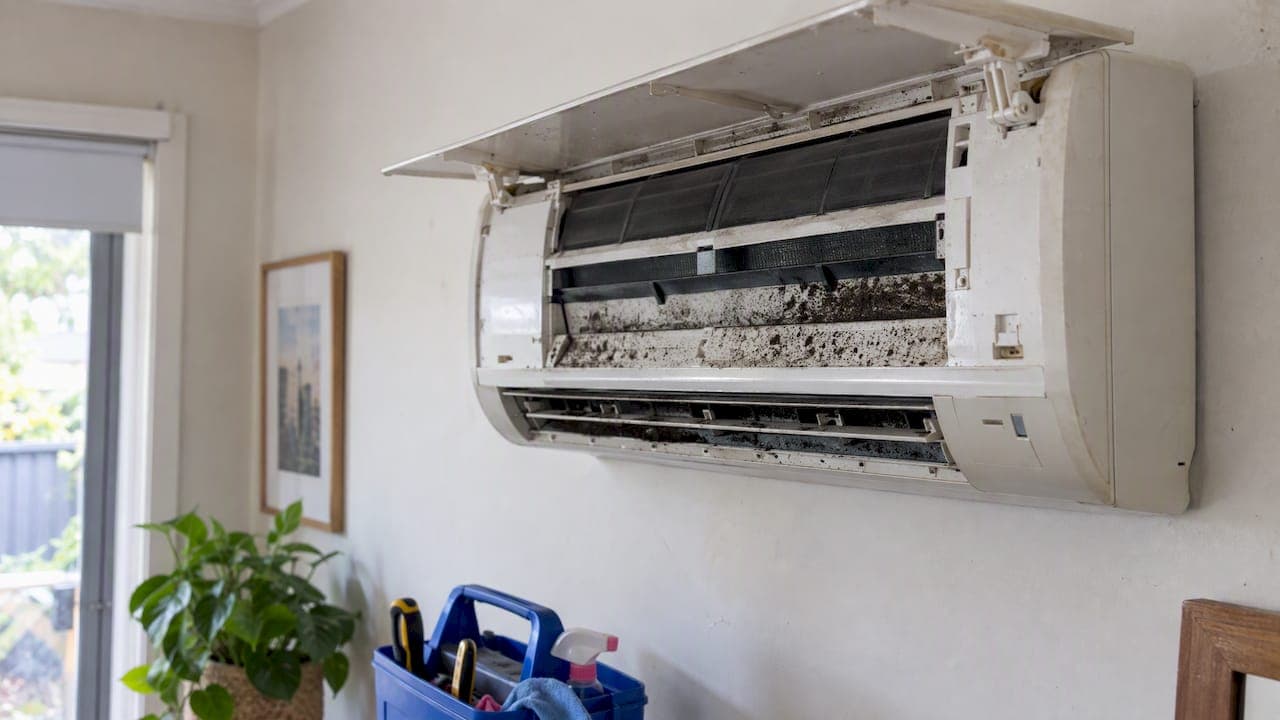
If your air conditioner smells musty or you can see black or green spotting on the vents, you probably have mould growing inside it. Switch the unit off, clean only what you can safely reach (the filters), and book a licensed technician to inspect the coil, drain pan and drain line, because that is where mould usually takes hold and where the real fix lies. Running the system "to dry it out" is the wrong move, as it can push spores through the room.
This guide covers how to recognise mould in a split system or ducted unit, what the health risk is, what you can safely do yourself, and when it becomes a job for a tradesperson. It also covers what home owners, business owners and care facility managers on the Mornington Peninsula should be doing before summer.
TL;DR
- A musty, earthy or sour smell when the aircon starts is the most common sign of mould, often with black spotting on vents or the front of the indoor unit.
- Mould is a moisture problem. If the drain is blocked or airflow is poor, cleaning the surface only buys you a few weeks.
- A contaminated unit can spread spores around the room, so turn it off rather than running it to dry it out.
- Filters are the only part most people should clean themselves. Coils, drain pans and blower wheels need a licensed technician.
- For aged care, retirement villages and disability homes, mould in HVAC is a compliance and resident safety issue. Get systems checked and documented before the hot months.
Table of Contents
- Why mould grows inside an air conditioner
- Signs of mould in your air conditioner
- The health side: who is at risk
- What to do the moment you notice mould
- What you can safely do yourself
- What professional mould removal involves
- Mould in aged care, retirement villages and disability homes
- Our perspective: treat the moisture, not just the mould
- Getting help on the Mornington Peninsula
- Preventing mould from coming back
- FAQ
- Sources
Why mould grows inside an air conditioner
Mould is a fungus that feeds on organic matter and grows best in damp, poorly ventilated spots, reproducing through spores. Victorian health guidance describes exactly that pattern: airborne spores land on a damp surface indoors, then start to grow and spread.
An air conditioner supplies every ingredient:
- Moisture. When the unit cools, it pulls water out of the air. That condensation forms on the evaporator coil and should run out through a drain.
- Dust and organic matter. Skin cells, pet hair, pollen and household dust collect on filters and coils.
- Darkness and low airflow. The inside of the indoor unit is dark, and a clogged filter reduces airflow, so the coil stays damp for longer.
The result is a damp, dusty, dark space that is cooled and warmed on repeat. This Old House makes the same point: dirty filters trap moisture and restrict airflow, so spores settle and grow.
In practice, most mould problems trace back to one of four faults:
- A dirty or overdue filter.
- A blocked or poorly sloped condensate drain, leaving water sitting in the pan.
- Oversized or short-cycling units that cool the room quickly and switch off before the coil dries.
- Long periods of disuse, such as a unit sitting idle after winter or in a holiday home.
That last one matters on the Peninsula, where many holiday and part-time homes sit empty for weeks.
Signs of mould in your air conditioner
Smell is the earliest and most reliable signal. Mould typically smells musty, earthy or sour, and it appears each time the system cycles on. It differs from a plain dusty smell, which tends to fade after a minute or two.
Other signs to look for:
- Black, green or grey spots on the louvres, the front panel, or the visible part of the coil once the filter is out.
- Water stains or drips from the indoor unit, which suggest a drain problem feeding the growth.
- Reduced airflow or weak cooling, because mould and grime on the coil restrict air.
- Symptoms that ease when you leave the room or house, such as congestion, sneezing, coughing or wheezing.
If the smell is the main complaint, our short guide on why an air conditioner smells musty walks through the quick checks homeowners can try first.
Is it mould, or something else?
Not every smell is mould. A rotten-egg or sewer smell often points to a dry trap or plumbing issue. A burning smell can mean an electrical fault, and you should switch the unit off at the wall and call an electrician. A musty smell with visible growth is far more likely to be mould. If you are unsure, a licensed technician can tell you which it is, and because we cover plumbing, electrical and HVAC, we can trace a smell across all three rather than guessing at one.
The health side: who is at risk
Victorian health guidance notes that mould can cause nasal congestion, sneezing, coughing, wheezing and respiratory infections, and can make asthma and allergies worse, particularly for vulnerable people. Healthdirect lists mould among common allergic asthma triggers, and its children's asthma page lists dampness or mould as a trigger for kids.
People who need to take it most seriously:
- People with asthma, hay fever or other allergies. Healthdirect notes that mould can drive allergy symptoms, and that fixing the source matters more than treating symptoms.
- Children and older adults.
- Anyone with a weakened immune system or lung condition.
An air conditioner is a particular concern because it moves air through the whole room. If the coil or ducts are contaminated, the system can circulate spores every time it runs.
If someone in your home has trouble breathing, treat that as a medical matter, not a maintenance one. Speak to your GP about ongoing symptoms, and for a child who is struggling to breathe, Healthdirect advises going to the nearest hospital.
What to do the moment you notice mould
Here is the order we would follow.
- Turn the unit off at the remote and, if you are going to work on it, at the isolating switch or wall. Do not keep running it to dry it out. A contaminated unit can spread spores through the building.
- Open windows in the room to ventilate.
- Protect yourself. The US EPA's mould guidance advises against touching mould with bare hands, getting it in your eyes, or breathing it in, so wear gloves, eye protection and a P2 or N95-style mask if you handle filters.
- Check the filter. If it is dirty or has spots, wash it per the manufacturer's instructions, dry it fully in the shade and refit it.
- Look for the moisture source. Is the drain dripping inside? Is the room unusually humid? Is there a leak nearby?
- Book a licensed technician if mould is on the coil, in the drain pan, inside the casing, or returns after cleaning.
What not to do
- Do not spray household bleach or strong chemicals into the unit. Electronics and coil fins are easily damaged, and fumes recirculate.
- Do not remove covers around live electrical components. Work on wiring and refrigerant is licensed work in Australia.
- Do not rely on a deodorising spray. It masks the smell and leaves the mould in place.
What you can safely do yourself
For a typical split system, the safe DIY list is short.
| Task | DIY? | Notes |
|---|---|---|
| Remove, wash and dry filters | Yes | Every few weeks in heavy use. Follow the manual. |
| Wipe the outside panel and louvres | Yes | Unit off, damp cloth, mild detergent. |
| Run fan-only mode after cooling | Yes | Helps the coil dry. Only on a clean, healthy unit. |
| Clean the evaporator coil | No | Easily damaged. Needs the right tools and containment. |
| Clear a blocked condensate drain | Usually no | Often needs access to the drain line and a check of the slope. |
| Clean the blower wheel | No | Requires partial disassembly. |
| Ducted system, return air plenum, ducts | No | Needs a professional assessment. |
Prevention beats removal. Washing filters regularly and using fan mode after cooling to flush out condensation are the two habits most often recommended. Our summer air conditioning maintenance checklist gives you a full routine, and our guide to how HVAC maintenance schedules work for homeowners explains how often a licensed service should happen.
What professional mould removal involves
"Cleaning the visible bit" is where many cheap fixes end, and why mould returns within weeks. A proper job treats the whole system and the cause.
The national standard for professional mould remediation, AS-IICRC S520:2025, sets out the procedures and precautions for the work. Good practice for an air conditioner follows the same logic:
- Assess the system. Inspect the evaporator coil, condensate drain pan, drain line, blower assembly and filters, plus ducts if it is a ducted system.
- Isolate and protect. Switch off power, protect the surrounding room and use appropriate protective equipment.
- Clean and treat the affected components. Coils, pans and blower wheels get cleaned with products suitable for HVAC, not household sprays.
- Fix the moisture source. Clear and, if needed, re-grade the drain, replace damaged insulation, or correct airflow problems.
- Test and document. Confirm the unit drains properly and run it to check performance, then record what was found and done.
Step four is what separates a lasting repair from a temporary one. Mould that keeps coming back almost always signals an unresolved moisture or airflow fault.
When to replace rather than keep cleaning
You may hear about a "$5000 rule" for air conditioners. It is not an official Australian standard. It is a rule of thumb used when repair costs on an old, inefficient unit approach the price of replacing it. If your unit is old, has repeated mould problems and mechanical faults, ask for a repair-versus-replace opinion in writing. We would rather give you an honest view than sell a repair that will not hold.
Mould in aged care, retirement villages and disability homes
For facility managers, mould in an HVAC system is not only a maintenance task. Victorian health resources treat heat and indoor conditions in residential aged care as a safety issue, and a contaminated system that spreads spores through shared spaces puts residents with respiratory conditions at real risk.
What we recommend for care environments:
- Preventative, not reactive, maintenance. Victorian guidance on heatwave readiness for residential aged care points to getting cooling equipment serviced well before the summer peak. October is the target, so this is the month to book.
- Don't lean on fans. The same resource explains that fans can fail to cool people and, in some conditions, can be dangerous. A working, clean air conditioner is the safer option.
- Keep records. Document every inspection, filter change, clean and repair. Informal, undocumented repairs leave a facility exposed if a resident's health is affected.
- Know the ventilation standard. AS 1668.2:2024 covers mechanical ventilation in buildings, with updated methods for working out minimum outdoor airflow.
- Watch water systems. Larger buildings with cooling towers fall under Victoria's Legionella risk management requirements, which is a different hazard from mould and needs a different process.
For more depth, see our guides on maintaining cooling systems in aged care, a four-step maintenance plan for aged care requirements, HVAC filter maintenance for care homes, disability care HVAC ventilation and how commercial air conditioning servicing works.
Our perspective: treat the moisture, not just the mould
We work across plumbing, electrical and heating and cooling, and that shapes how we look at a mouldy air conditioner. The mould is the symptom. The cause is usually water in the wrong place, or air not moving the way it should.
A blocked drain is a plumbing-style problem. A failing fan motor or a tripped safety switch is electrical. A dirty coil and poor airflow belong to HVAC. When one business covers all three, you do not have to work out which trade to call first, and nobody argues about whose job it is. For facility managers, that also means one point of contact and one set of records.

Two habits make the biggest difference in our experience: servicing before the cooling season starts rather than after the first heatwave, and keeping a written record of every visit. Neither is glamorous, but both stop the 2 am emergency call and keep residents and staff comfortable.
If we find mould on the coil or in the drain pan, we tell you what we found, show you where it is and explain what needs to change so it does not come back.
— Mike
Getting help on the Mornington Peninsula
DualFlow Services provides plumbing, electrical and heating and cooling services, including emergency call-outs, scheduled maintenance and compliance checks, for homes, businesses, aged care, retirement villages and disability care homes across the Mornington Peninsula and surrounding Melbourne suburbs. Our emergency service runs 24/7/365.
If your aircon smells musty, shows visible growth, or keeps dripping, our heating and cooling team can inspect it and recommend the right fix. For facilities that want a regular program, our scheduled maintenance service is built around before-summer checks and documented records. We do not publish set prices, so contact us for a quote.
Preventing mould from coming back
A short routine does most of the work:
- Wash filters regularly, more often if you have pets or run the unit daily.
- Switch to fan-only mode for a short period before turning the unit off, so the coil dries.
- Do not leave a unit idle for months. Run it briefly in each season, and have it checked before you rely on it.
- Keep the room ventilated and deal with leaks or high humidity at the source.
- Book a licensed service annually, ahead of summer. Care facilities should add a documented pre-summer check.
- Act on the first musty smell, not the tenth.
Two cautions apply to the routine. Fan-only drying is only suitable on a unit with no visible mould. If mould is visible, turn the unit off and have it assessed. And if the unit is freezing up, which also leaves the coil wet, read our guide on an aircon freezing up and call a licensed technician for repairs.
FAQ
How do you get rid of mould in an air conditioner?
Wash and fully dry the filters yourself, then have a licensed technician clean the coil, drain pan and blower and fix the cause, such as a blocked drain. Surface cleaning alone usually fails because the moisture problem remains. Wear gloves, eye protection and a mask if you handle mouldy parts.
Will mould go away if it dries out?
No. Drying stops mould growing, but the mould and its spores remain and can be released into the air when the unit runs. Mould needs to be cleaned from the surfaces, and the moisture source fixed so it does not return.
What are the first signs of mould sickness?
Common signs are a stuffy or runny nose, sneezing, coughing and wheezing, and worsening asthma or allergies, according to Victorian health guidance. These symptoms have many causes, so see your GP if they persist, and seek urgent care for breathing difficulty.
What is the $5000 rule for air conditioners?
It is an informal rule of thumb, not an Australian standard. It suggests replacing a unit when repair costs on an old, inefficient system approach the cost of a new one. Get a written repair-versus-replace opinion before deciding.
Sources
- Floods: mould and your health, Victorian Department of Health
- Residential aged care services heatwave ready resource, Victorian Department of Health
- Legionella risk management, Victorian Department of Health
- Hay fever (allergic rhinitis), healthdirect
- Asthma in adolescents and adults, healthdirect
- Asthma in children 6 to 11 years, healthdirect
- Mould remediation in schools and commercial buildings, Chapter 3, US EPA
- Spotlight on AS 1668.2:2024, Standards Australia
- AS-IICRC S520:2025, Standards Australia Store
- How to clean mold out of an AC, This Old House