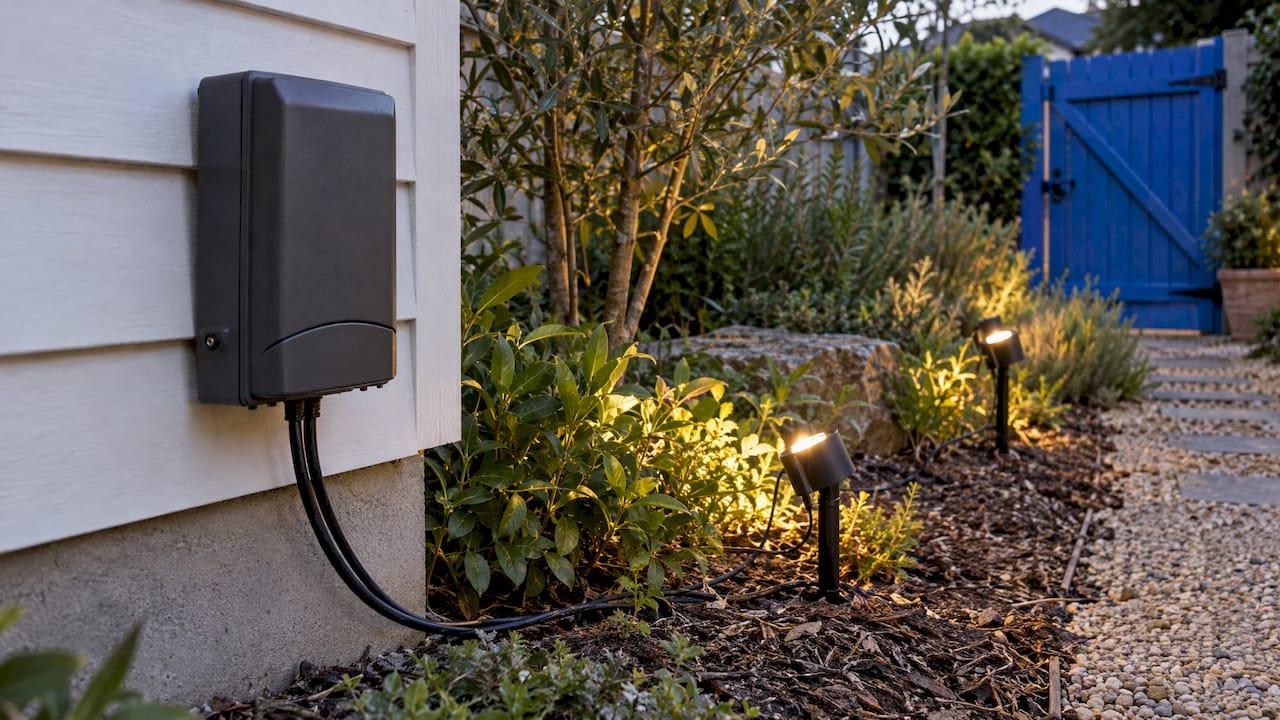
A garden lighting transformer steps 240V mains power down to a safe low voltage, usually 12V, so path lights, uplights and step lights can run through wet gardens. Choosing the right one comes down to three things: the total load of your lights plus room to grow, an outdoor-rated enclosure, and who does the mains-side wiring. In Victoria, the 240V side of that job is licensed electrical work. For homes, businesses, aged care facilities, retirement villages and disability care homes on the Mornington Peninsula, getting it done once and properly by an electrician is the lowest-risk path. Our electrical team works across the Peninsula and surrounding Melbourne suburbs.
TL;DR
- A transformer converts 240V mains to low voltage (commonly 12V) so garden lights and cables are safer around people, pets and wet soil.
- Add up the wattage of every fitting and keep the load at or below about 80% of the transformer's rating, with room for future lights.
- Pick a transformer whose output (AC or DC) matches your lights, and an outdoor rating of at least IP64, with IP66 or higher near garden beds, irrigation or pools.
- Voltage drop on long cable runs is the most common cause of dim, yellowish or flickering lights, so cable size and layout matter as much as the transformer.
- Hard-wiring a transformer, adding or moving a power point, or running any 240V cable in Victoria is work for a licensed electrician.
Table of Contents
- What a garden lighting transformer actually does
- How to size a garden lighting transformer
- AC or DC: the output must match your lights
- Weatherproofing: IP ratings that suit Victorian gardens
- Voltage drop: why lights at the end of the run look dim
- What needs a licensed electrician in Victoria
- Wiring principles an electrician follows
- Common reasons garden lighting transformers fail
- Home, business or care facility: what changes
- Getting it done on the Mornington Peninsula
- FAQ
- Sources
What a garden lighting transformer actually does
Mains power in Australia is 240V. That is too much voltage to run in a light cable buried through a garden bed. A transformer (sometimes called a driver or power supply) reduces it to something far lower, most often 12V. According to TorTech's technical manual, the lower voltage makes it safer and easier to run cables across beds and lawns than mains voltage would be.
The practical benefits for a property owner are:
- Lower shock risk. A 12V or 24V system is classed as safety extra-low voltage (SELV). Schnap's technical guide notes that Australian wiring requirements point to SELV systems, typically 12V or 24V AC, for most garden lighting because they are considered safe for human contact in wet environments.
- Lighter cable. Low-voltage cable is thinner and more flexible than mains cable, which makes planning runs through landscaped areas simpler.
- Flexibility. You can add fixtures later, provided the transformer has the capacity.
If you manage a retirement village or aged care site, this matters beyond looks. Pathways, entries and courtyards need dependable lighting after dark, and the transformer is the single component every fitting on that circuit depends on.
How to size a garden lighting transformer
Undersizing is the most common mistake. The method is simple.
- List every fitting and its wattage. If the manufacturer lists VA rather than watts (for example a light shown as 3W but 5VA), use the VA figure.
- Add them up. This is your connected load.
- Divide by 0.8. Keeping the load at or below about 80% of the transformer rating avoids running it flat out. Lumini's sizing guide gives the example that a 90W load wants a transformer rated around 120VA, not 100.
- Add room for growth. The same guide uses a front garden of six 6W uplights, three 3W path lights and two 2W step lights, a 49W load, which points to roughly a 75VA transformer, and suggests 150VA if the rear garden is likely to be added next season.
- Round up to the next standard size.
A worked example
Say a courtyard at a retirement village has eight 3W path lights and two 6W feature lights.
- Load: (8 × 3W) + (2 × 6W) = 36W
- Divide by 0.8: 45W minimum
- Add allowance for two more path lights later (6W): 42W ÷ 0.8 = 52.5W
A transformer in the 60W to 105W class would suit. Moving up costs little compared with replacing a unit and re-terminating cables later.
LED and halogen are not rated the same way
Some manufacturers specify how their transformers treat different lamp types. The HPM RGL series instruction manual lists 60, 105, 150 and 200VA models and gives a formula for mixed loads: LED globes multiplied by wattage and by two, plus halogen globes by wattage. Under that rule a 60VA unit supports up to 60W of halogen or 30W of LED. Always read the rating label and the manual for the exact model, because ratings differ between brands.

If your property has older halogen fittings that are being converted to LED, the load calculation changes. Our guide on how electrical load calculations work explains the same principle for household circuits.
AC or DC: the output must match your lights
This is the detail that catches people out. A transformer outputs AC, while a driver outputs DC. Smart Water's installation guide states that AC lights need transformers and DC lights need drivers. Buying the wrong type can mean lights that flicker, run poorly or fail early.
Before you order anything:
- Check the label on the existing fittings for voltage and AC or DC.
- Confirm the voltage: 12V and 24V systems are not interchangeable.
- Note that 12V systems are more sensitive to voltage drop than 24V, per the same guide.
- Check whether the lights contain their own driver.
If you are replacing a failed transformer on a large site and are unsure what the original system was, that is a good moment to have an electrician identify it rather than guess. Dimming adds another layer; see our guide on LED dimmer compatibility if the lights are on a dimmer.
Weatherproofing: IP ratings that suit Victorian gardens
An IP rating tells you how well an enclosure resists dust and water. The first digit covers solids and the second covers water. For garden use:
| Rating | What it suits |
|---|---|
| IP55 or higher | Surface mounting on a wall in a sheltered spot |
| IP64 | Generally the minimum acceptable outdoor rating, per Schnap |
| IP66 or IP67 | Recommended near garden beds, irrigation systems or pools |
| IP68 | Suitable where the unit may be submerged or buried |
As an example of what a spec sheet shows, the Brilliant 12VDC SELV outdoor transformer specification lists an IP68 rating, Class II construction, 240V 50Hz input, outputs of 24W, 36W or 60W, and compliance with AS/NZS 61347.2.13 and AS/NZS 61347.1. Look for the equivalent compliance information on whichever model you choose, plus the RCM mark that shows a plug-in supply meets Australian requirements.
Moisture is also a joint problem, not just an enclosure problem. TorTech's technical sheet warns that without correct waterproof joints a cooling lamp pulls in moisture from the ground and atmosphere, which rapidly deteriorates the lamp and causes failure. Wet joints are the usual culprit when one fitting keeps failing.
Voltage drop: why lights at the end of the run look dim
Low voltage travels poorly over distance through thin cable. Schnap explains that a 12V fixture at the end of a long run may receive only 9 to 10V, which causes dimming, colour inconsistency, flicker or premature LED failure. TorTech describes the same effect as light that looks slightly yellow or dimmer at the end of the run.
The fixes are well established:
- Use heavier cable on longer runs. Larger gardens often need 4mm² or 6mm² cable to hold voltage stable, per Schnap.
- Split long runs into shorter branches. Several shorter legs from the transformer beat one long daisy chain.
- Use a multi-tap transformer. Models with 12V, 13V and 14V taps let an installer compensate for loss by feeding a long run from a higher tap.
- Move the transformer. Placing it near the middle of the lighting layout shortens the longest run.
For reference, Lumini's guide describes its fixtures as accepting a 9 to 17 volt AC/DC input, which gives some tolerance, but tolerance is not a substitute for good design.
One practical planning note: cables and fittings sit in a living landscape. Overgrown branches, roots and falling limbs damage cables and fixtures, and it helps to understand tree growth near power lines before routing runs near mature trees. For storm-prone sites, our storm season home preparation guide covers what to check before the weather turns.
What needs a licensed electrician in Victoria
This is where garden lighting stops being a shopping question and becomes a compliance question.
Section 38 of the Electricity Safety Act 1998 (Victoria) provides that a person must not carry out or offer to carry out prescribed electrical work unless licensed, with a penalty of 50 penalty units. The current version of the Act is published on legislation.vic.gov.au.
In practical terms, these jobs are licensed electrical work:
- Hard-wiring a transformer into the mains supply
- Adding or moving a power point to supply it
- Running 240V cable of any kind, including to a transformer location away from the house
- Any work on a switchboard to add a circuit
Energy Safe Victoria's electricians' toolkit explains that all low-voltage installation work must be tested in accordance with Part 8 of AS/NZS 3000 (the Wiring Rules), under Regulation 240 of the Electricity Safety (General) Regulations 2019. It also says a licensed electrical inspector must be physically present to inspect and test all prescribed work before signing a certificate of inspection. Energy Safe Victoria's 2025 to 2028 strategy confirms its role in ensuring electrical work is done by competent licensed people and that electrical equipment supplied in Victoria is safe.
Why this matters for facility managers: unlicensed work can leave an operator without a compliance certificate, and in a care setting the risk falls on residents who may be less mobile or less able to respond to a hazard. Our overview of why Victoria's electrical safety regulations matter and our guide to retirement village electrical duties in Victoria set out the wider obligations.
Wiring principles an electrician follows
The 240V and 12V sides are kept apart. Lighting for Gardens advises that 12V and 240V cables be segregated, often with a three-box arrangement, and that surface-mounted garden transformers be rated IP55 or higher, or IP68 for ground burial. It also advises that ordinary electronic transformers are not sealed against moisture, so exterior installations should use potted units rated IP67 or magnetic types in IP66 enclosures.
A sound installation typically involves:
- Confirming the load and choosing the transformer with spare capacity.
- Mounting it in a protected, ventilated spot that is accessible for servicing.
- Connecting the mains side on a protected circuit, tested to the Wiring Rules.
- Running UV-stable low-voltage cable sized for the load and distance.
- Making joints watertight.
- Checking voltage at the last fixture on every run.
- Labelling the circuit at the switchboard. Our guide to switchboard labelling requirements explains why.
That last check, voltage at the end of each run, is the one that separates a good installation from one that looks fine on the day and fails in a year.
Common reasons garden lighting transformers fail
Most failures trace back to a short list of causes:
- Overloading. Schnap's team identifies ignoring the 80% sizing margin as a common cause of failure, particularly in hot outdoor conditions. A unit running at full capacity generates excess heat and shortens its life, which is why sizing up is sensible.
- Water ingress. Unsealed joints or a unit placed where water pools.
- Voltage drop. Thin cable or runs that are too long, shortening LED life.
- Mismatched parts. An AC transformer feeding DC lights, or the reverse.
- Flicker from incompatible electronics. Lighting for Gardens notes that some electronic transformer circuitry can interact with LEDs and cause flickering on longer cable runs, which is why magnetic types are often preferred for LED garden systems.
A scheduled inspection catches most of these before the lights go out. For commercial and care sites, we recommend adding outdoor lighting circuits to a regular plan; our 12 month electrical schedule shows how sites structure that.
Home, business or care facility: what changes
Homeowners. A single front-garden scheme with a modest load is the typical job. The decisions are capacity, location and getting the mains supply done correctly.

Business owners. Car parks, entrances and signage lighting usually carry a higher load and run longer distances, so cable sizing and multiple branches become the main design question.
Aged care, retirement villages and disability care homes. Lighting is a safety measure: paths, ramps and entries must stay lit reliably. Failure of one transformer can darken an entire courtyard. These sites benefit from spare capacity, clear labelling and routine checks, and from one contractor who understands both the electrical work and the care environment.
We see garden lighting as part of the property's electrical system, not an accessory. When one trade handles the transformer, the mains supply, the testing and the labelling, nothing falls between contractors. That is the reason we keep plumbing, electrical and heating and cooling under one roof, and why facility managers on the Peninsula can call one number for any of them, including after hours.
We would size the transformer with headroom, keep the mains work to licensed standards, and check the voltage at the last light before we leave.
Mike
Getting it done on the Mornington Peninsula
DualFlow Services provides electrical installation, servicing, scheduled maintenance and compliance work for homes, businesses, aged care facilities, retirement villages and disability care homes across the Mornington Peninsula and surrounding Melbourne suburbs. Emergency call-out is available 24/7/365, so a failed lighting circuit does not have to wait for business hours.
If you are planning new garden lighting or replacing a transformer, book through our electrical page or start from the DualFlow Services home page.
FAQ
Why do garden lights need a transformer?
Low-voltage garden lights cannot be connected directly to household current. A transformer reduces 240V mains to a safer voltage, commonly 12V, which is much safer than standard household lighting, especially where children or pets are present.
What size transformer do I need for LED garden lights?
Add the wattage of all fittings, divide by 0.8, then allow for future additions. For example, a 36W load becomes 45W at the 80% rule, and a 60W or larger unit gives room to expand. Check the manufacturer's rating method, since some brands rate LED and halogen loads differently.
Can I use any transformer with any garden light?
No. The output voltage and type must match the lights. AC lights need a transformer, DC lights need a driver, and 12V and 24V fittings are not interchangeable. Always check the label on the existing fittings before choosing a replacement.
Who can install a garden lighting transformer in Victoria?
Any work connecting the transformer to the 240V supply, such as hard-wiring it, adding a power point or running mains cable, must be done by a licensed electrician under the Electricity Safety Act 1998. We can carry out that work and test it to the Wiring Rules.
What IP rating should a garden transformer have?
IP64 is generally regarded as the minimum for outdoor use. IP66 or IP67 is recommended near garden beds, irrigation systems or pools, and IP68 suits ground burial.
Sources
- TorTech outdoor transformer manual
- Schnap: technical standards for the garden lighting transformer
- Lumini: transformer sizing
- HPM RGL series instruction manual
- Smart Water landscape garden lighting installation guide
- Brilliant 12VDC SELV outdoor transformer specification sheet
- Electricity Safety Act 1998 (Victoria), copy of the Act
- Electricity Safety Act 1998, legislation.vic.gov.au
- Energy Safe Victoria: electricity safety general regulations
- Energy Safe Victoria: Strategy 2025 to 2028
- Lighting for Gardens: 12V garden lighting transformers
- Managing tree growth near power lines