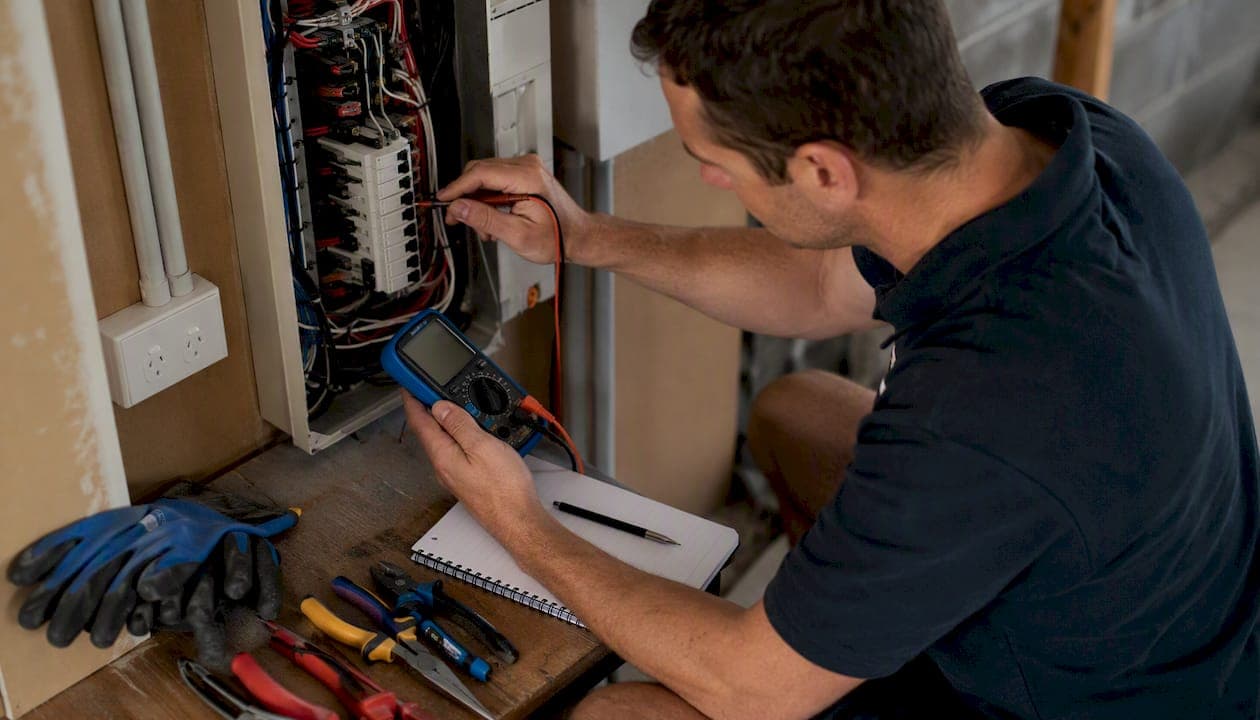
An electrical load calculation totals every watt your home draws, converts that figure to amps, and tells you whether your switchboard can handle it. The single most useful thing you can do right now: find the ampere rating stamped on your main switch (typically 63 A, 100 A, or 200 A) and compare it to your calculated demand. If your calculated amps exceed that number, you have a problem worth acting on.
A few things to orient you before the detail:
- What it measures: total expected electrical demand across all circuits, expressed in volt-amperes (VA) then converted to amps at 240 V (Australia's standard supply voltage).
- The 125% rule: any load that runs continuously for three hours or more must be sized at 125% for breaker and cable selection. This is separate from the service total.
- The governing standard: AS/NZS 3000 sets the wiring rules and compliance obligations for Australian residential installations.
- When to call a professional: if your numbers are close to or exceed your service rating, or if you are planning an EV charger or switchboard change, contact a licensed electrician. Dualflowservices performs verified load calculations and switchboard assessments across the Mornington Peninsula.
Table of Contents
- What is electrical load, and what types do you have at home?
- How do you calculate your home's electrical load step by step?
- How does your calculated load compare to your switchboard capacity?
- When do you need a licensed electrician for safety and compliance?
- Quick reference: formulas, conversions, and typical appliance wattages
- Key takeaways
- What to expect when you call Dualflowservices
- Dualflowservices: book a verified load calculation on the Mornington Peninsula
- Useful sources and standards for further reading
What is electrical load, and what types do you have at home?
Electrical load is the total power demand placed on your supply at any given moment. Capacity (or service rating) is the maximum your switchboard and incoming supply can safely deliver. The gap between the two is your safety margin.
Load types matter because they behave differently under calculation rules:
- Continuous loads (EV chargers, electric hot water systems, underfloor heating): run for three hours or more at a stretch. Under NEC Article 220 and equivalent AS/NZS 3000 principles, these must be sized at 125% for breaker and conductor selection, even though the service total uses the actual nameplate figure.
The practical difference: a 7.2 kW EV charger running overnight is a continuous load. Its branch circuit breaker must be rated for at least 37.5 A (30 A × 1.25), even though the service calculation adds 7,200 VA at face value. A kettle, by contrast, runs for two minutes and barely registers in a service total.
How do you calculate your home's electrical load step by step?
This is the core of electrical load analysis. The method below follows the optional (two-tier) approach used by electricians for single-family dwellings, as described by PermitDeck's NEC 220 guide. It is simpler than the standard method and usually produces a smaller required service size, though eligibility must be confirmed.
Worked example: a typical four-bedroom Australian home
| Load item | Calculation | VA |
|---|---|---|
| General lighting (floor area multiplied by general lighting density) calculated according to standard code values | ||
| Small-appliance circuits added as a minimum number of circuits, each rated per code | ||
| Laundry circuit load added as per code without specifying exact number | ||
| Electric oven/cooktop load taken from appliance nameplate or typical range | ||
| Dishwasher load from appliance nameplate or typical values | ||
| Clothes dryer load based on appliance nameplate or typical values | ||
| Electric hot water system load per typical nameplate rating | ||
| EV charger load calculated according to typical level and rating | ||
| Ducted reverse-cycle AC load taken as larger of heating or cooling loads | ||
| Subtotal before demand factors | 34,000 VA | |
| First tier of demand factor applied at full value to initial load portion | ||
| Second tier of demand factor applied at reduced percentage to remainder | ||
| Fixed appliance loads summed as per nameplate values or typical estimates | ||
| HVAC load added separately as per code rule for larger of heating or cooling | ||
| Total VA | 47,300 VA | |
| Total amps at 240 V | — | 197 A |
That result points clearly to a 200 A service. A standard load calculator confirms the 100 A minimum sizing floor for single-family dwellings, but this example exceeds it significantly once an EV charger and full electric appliances are included.
Pro Tip: Add 20–25% to your calculated total when planning future additions. If you are moving to induction cooking, a heat pump hot water system, or a second EV, run the numbers before you commit. The upgrade cost is far lower when planned ahead than when forced by a tripped main.
How does your calculated load compare to your switchboard capacity?
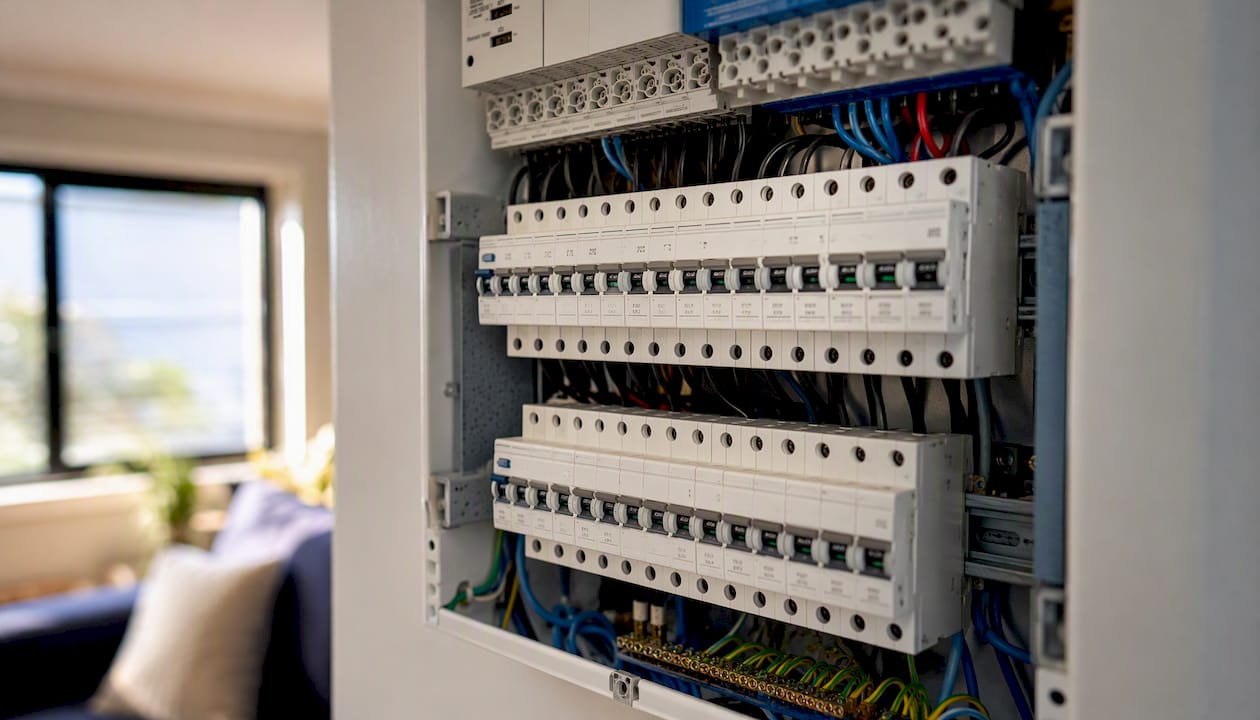
Your switchboard's main switch carries a current rating stamped directly on it. Common residential ratings in Australia are 63 A, 80 A, 100 A, and 200 A. Finding it takes thirty seconds: open the switchboard door and read the label on the largest breaker at the top.
A switchboard audit compares your calculated demand to that rating and flags whether individual circuits are also correctly sized. Three outcomes are possible:
- Adequate margin: calculated amps are comfortably below the service rating (say, 75 A calculated against a 100 A main). No immediate action needed, but document the figure for future reference.
- Marginal: calculated amps sit within 10–15% of the service rating. You are not overloaded today, but adding a single large appliance could push you over. Plan any additions carefully and get a professional assessment before proceeding.
- Overload: calculated amps exceed the service rating. This is not a theoretical risk. It means your main switch may trip under peak demand, or worse, it may not trip when it should, allowing conductors to overheat.
Physical warning signs of an overloaded service include:
- Circuit breakers tripping repeatedly under normal use
- Lights dimming when large appliances start
- Warm or discoloured switchboard faceplates
- A burning smell near the board (treat this as an emergency)
Pro Tip: Before calling an electrician, photograph every nameplate on your major appliances and jot down the floor area of your home. That ten minutes of prep can cut the site visit time noticeably and gives the electrician a head start on the load worksheet.
When do you need a licensed electrician for safety and compliance?
The short rule in Australia: minor tasks like replacing a light globe or a power-point cover are generally DIY-safe. Anything that touches the switchboard, adds a permanent load above 20 A, or alters the service wiring requires a licensed electrician and, in most cases, a permit.
Specific triggers that require a licensed electrician under Australian law:
- Installing or upgrading a switchboard or main switch
- Adding a dedicated circuit for an EV charger, heat pump, or ducted air conditioning
- Upgrading from a 100 A to a 200 A service
- Any work on the consumer mains or metering equipment
- Replacing wiring in walls or ceilings
AS/NZS 3000 (the Australian and New Zealand Wiring Rules) sets the technical requirements for all fixed electrical installations. Compliance with this standard is not optional. When an electrician completes notifiable work, they issue an Electrical Safety Certificate (or equivalent state documentation), which records the load calculation, the work performed, and the inspector's sign-off. Keep that document. It is required for future permit applications and property sales.
An inspector or certifier will typically expect to see:
- Nameplate data for all fixed appliances
- A completed load schedule showing each circuit's VA contribution
- The floor area used for lighting calculations
- The demand factor method applied and the final ampere result
- Confirmation that continuous loads have been sized at 125%
You can review what a wiring inspection covers and what documentation is expected before you book.
Pro Tip: If you are planning a full electrification of your home (induction cooktop, heat pump hot water, EV charger), budget for a 200 A service upgrade from the start. Retain a copy of the load calculation. It will be required for every subsequent permit on the property.
Quick reference: formulas, conversions, and typical appliance wattages
Typical Australian household appliance wattages
| Appliance | Typical wattage | VA (approx.) |
|---|---|---|
| Electric oven | 2,000 W | 2,000 |
| Cooktop (induction, 4-zone) | 7,200 W | 7,200 |
| Ducted reverse-cycle AC | 3,500 W | 3,500 |
| Electric hot water system | 2,400 W | 2,400 |
| Clothes dryer | 2,000 W | 2,000 |
| EV charger (Level 2, 7.2 kW) | 7,200 W | 7,200 |
| Dishwasher | 1,800 W | 1,800 |
| Pool pump (motor load) | 750 | 850 |
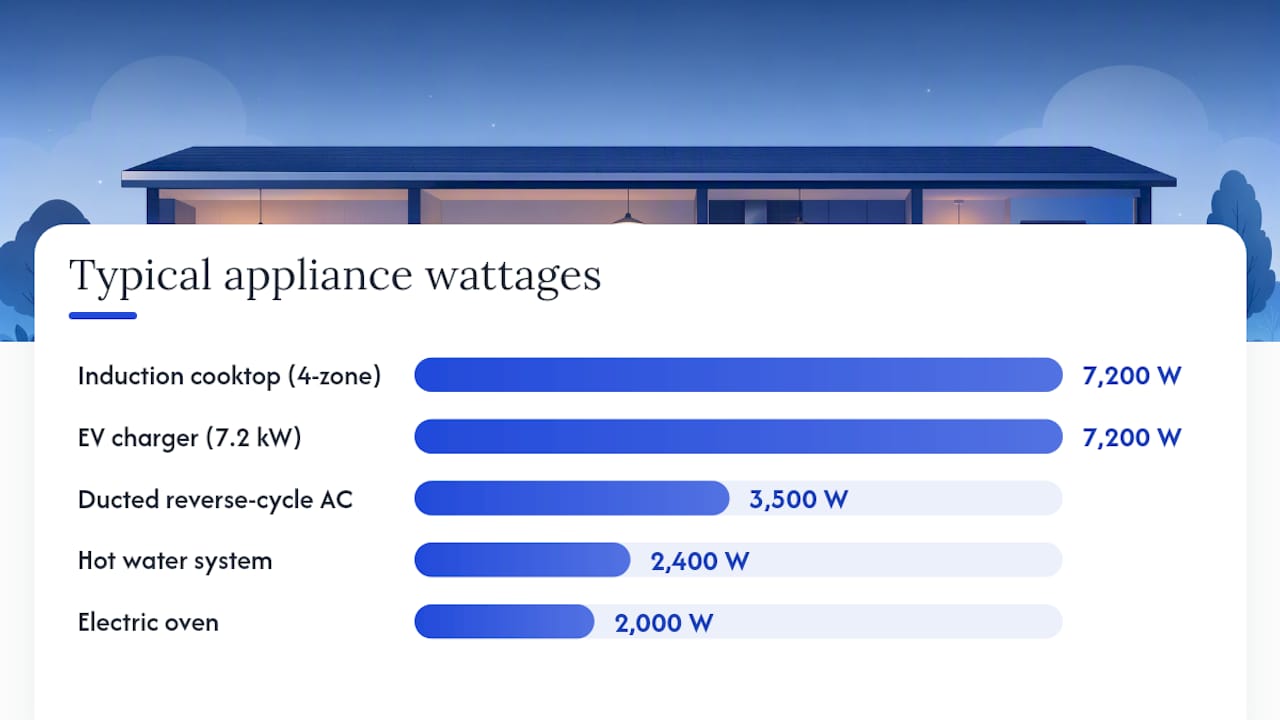
Where a nameplate is missing or illegible, use the midpoint of the typical range above as a conservative estimate, then confirm with the manufacturer's specification sheet before finalising the calculation.
AS/NZS 3000 expresses load density in VA/m² for lighting and general circuits. The NEC equivalent (3 VA/ft²) translates to roughly 32 VA/m², though Australian practice and the standard's own tables should take precedence for any formal calculation submitted to an inspector.
Key takeaways
Electrical load calculations are the foundation of safe residential wiring: total your VA, apply demand factors, convert to amps, and compare the result to your switchboard's service rating before adding any major appliance.
| Point | Details |
|---|---|
| Compare amps to service rating | Divide your total VA by 240 to get amps, then check it against the rating on your main switch. |
| Continuous loads need 125% | Any load running 3+ hours (EV charger, hot water) requires a breaker sized at 1.25× the load amps. |
| Optional method reduces required service size | The two-tier demand factor (100% on first 10 kVA, 40% on remainder) often yields a smaller service rating than the standard method. |
| Keep your load worksheet | Inspectors and future permit applications require a documented load schedule; store it with your compliance certificate. |
| Dualflowservices for switchboard and service work | Book a verified load calculation and switchboard assessment with Dualflowservices for Mornington Peninsula properties. |
What to expect when you call Dualflowservices
Most homeowners who call about a load calculation have already noticed something: a breaker that trips too often, a switchboard that looks dated, or a planned addition (EV charger, heat pump) that they suspect will push the limits. That instinct is usually right.
On a typical site visit, the process runs like this. The electrician walks the property, captures nameplate data from every fixed appliance, measures the floor area, and builds a load schedule on the spot. The calculation is done to AS/NZS 3000 requirements, not a rough estimate. You get a written report showing the total VA, the calculated amps, and a clear recommendation on whether your current service rating is adequate.
A few things you can do before the visit to speed things up:
- Photograph the nameplate on every fixed appliance (oven, AC unit, hot water system, dryer)
- Note the floor area of your home (from your building plans or council records)
- List any additions you are planning in the next two to three years
What Dualflowservices delivers after the visit:
- A completed load worksheet with all inputs documented
- A recommended service size (and upgrade path if needed)
- Identification of any safety issues found during the inspection
- Compliance paperwork for any notifiable work carried out
Common reasons for an upgrade recommendation: adding an EV charger to a 63 A or 100 A service that already carries a full electric kitchen and hot water system, or a switchboard with rewirable fuses that has not been assessed in decades. Both are straightforward to address when caught early.
Dualflowservices: book a verified load calculation on the Mornington Peninsula
If your numbers are close to your service rating, or you are planning any addition that draws more than 20 A, a professional assessment is the right next step.
Dualflowservices provides verified electrical load calculations, switchboard assessments, and compliance inspections for homeowners across the Mornington Peninsula and surrounding Melbourne suburbs. The team handles the full scope: from the initial calculation and written report through to switchboard upgrades, EV charger installations, and the compliance certificate your permit requires. Fees are quoted before work begins, and you receive full documentation of the load schedule and any work completed.
To book a load calculation or switchboard assessment, contact Dualflowservices directly through the website. Bring your appliance nameplates and floor area to the conversation and the visit will move faster.
Useful sources and standards for further reading
The following references underpin the load calculation methods and compliance requirements covered in this guide:
- Residential Load Calculation 2026: NEC 220 Standard vs Optional Method | PermitDeck
- Electrical Load Calculator
- Electrical system load calculations: NEC methods and applications | Electrical Trade Network
- Dualflow Services
- Electrical safety checklist for homeowners
- How electrical wiring inspection works: a clear guide
- Why electrical switchboard audits matter for Victorian properties
Keep links to the AS/NZS 3000 standard and your compliance certificate together. If you add a major load or sell the property, both documents will be requested.
This article provides general information about electrical load calculation methods. It is not a substitute for advice from a licensed electrician. Always confirm current requirements with a qualified professional or the relevant authority in your state.