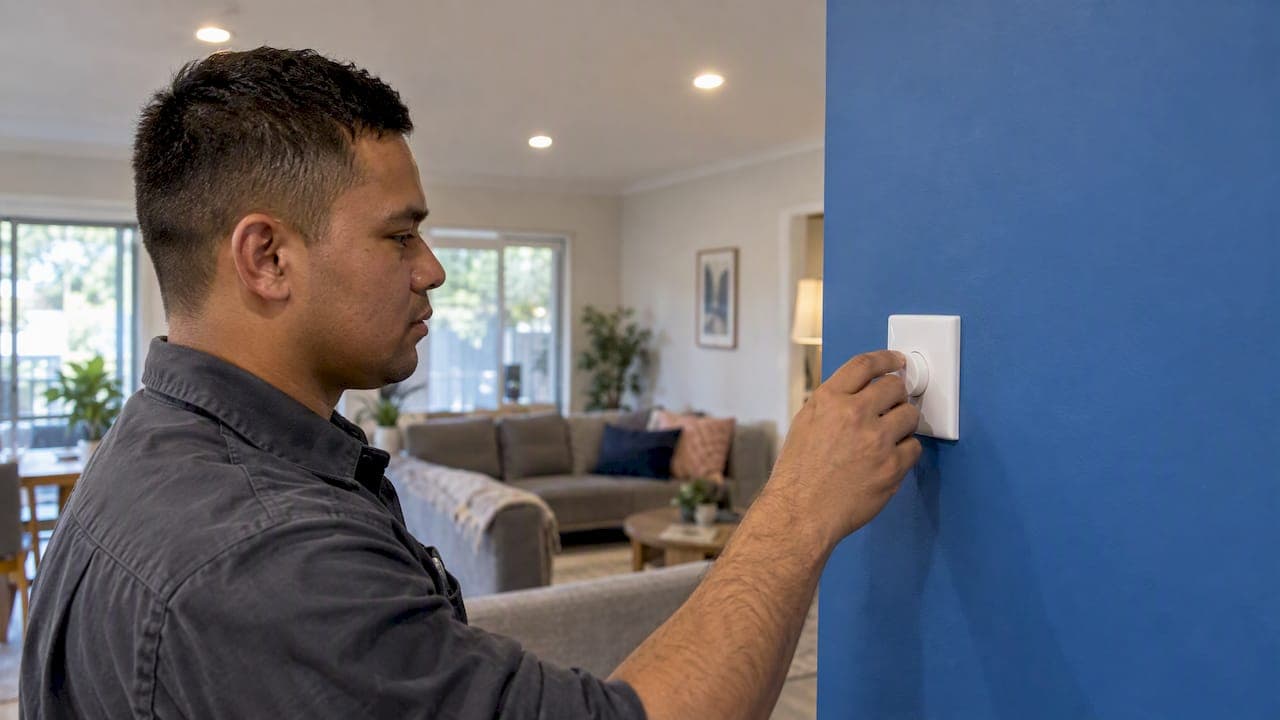
LED dimming works when three things agree: a globe or driver marked dimmable, a dimmer designed for low-wattage LED loads, and a total load that sits inside the dimmer's working range. If one is wrong, you get flicker, buzzing, a dimmer that won't go low, or globes that die early. Compatibility with an existing wall dimmer cannot be guaranteed, so the safest approach is to test before you commit. This guide shows you how, and where a licensed electrician needs to take over.
TL;DR
- Use only globes and fittings marked dimmable, and ask the supplier which dimmers they have been tested with.
- Old dimmers built for halogen or incandescent lamps are often the real problem. Many need replacing with an LED-rated model.
- Test one globe on your existing dimmer before you buy a whole room's worth.
- Flicker, buzzing or globes that keep failing can point to a poor-quality product, a mismatch or a wiring fault. Stop and get it checked if it persists.
- Swapping a 240 V dimmer or driver must be done by a licensed electrical contractor.
Table of Contents
- Why LEDs and dimmers don't always get along
- The three parts that must match
- Minimum load: the hidden mismatch
- Leading-edge and trailing-edge dimmers
- Why your LED lights flicker on a dimmer
- How to check compatibility before you buy
- Why light bulbs keep blowing or burning out early
- When to stop and call a licensed electrician
- Our perspective on LED dimming
- Get your dimmers and lighting circuits sorted
- FAQ
- Sources
Why LEDs and dimmers don't always get along
A traditional dimmer was designed for a filament globe, which is a simple resistive load. It cuts part of each mains cycle and the filament just glows a little less. An LED is different. Inside every LED lamp or fitting is a driver that converts mains power into the low-voltage current the LEDs need. The US Department of Energy explains that how an LED behaves on a phase-cut dimmer depends on the driver, the number and type of light sources, and the dimmer's characteristics. That is why the same globe can look perfect on one dimmer and shimmer on another.
The same document lists what can go wrong on phase-cut circuits: flicker, flashing, ghosting (a faint glow when off), audible noise, a light that won't operate, and premature failure. So compatibility is not a nicety. It affects how long your gear lasts.
The Australian Government's E3 program recognised the problem for households. NECA tested dimmers against dimmable LED lamps to help people avoid replacing dimmers they already own when they switched to LED. If you want to check a specific model, that resource is worth a look, though dimmer and lamp ranges change, so treat any list as a starting point and still test.
The three parts that must match
1. The globe or fitting
LEDs come in different types and not all suit dimming. NSW Environment, Energy and Science advises checking compatibility before you buy. Look for the word "dimmable" on the packaging or datasheet. If it isn't there, assume it's not dimmable.
What happens if you put a non-dimmable LED on a dimmer? Integral LED notes it may damage the lamp or the circuit. Even a dimmable globe can misbehave on the wrong dimmer, with flicker, dropout, uneven dimming or failure.
2. The driver or transformer
Many downlights, strip lights and low-voltage fittings have a separate driver. Older low-voltage halogen downlights often have a transformer built for halogen. Swap in an LED MR16 and you can end up with an incompatible transformer, as Integral LED describes. In that case the fix may be a new driver or transformer, not a new globe.
3. The dimmer
The dimmer needs to be rated for LED loads. Lighting Council Australia says older manual dimmers are generally not compatible with LED lamps and may need replacing by an electrical contractor. If your dimmer is a rotary knob from the halogen era, expect trouble.
Minimum load: the hidden mismatch
This catches a lot of people. An older dimmer might need a minimum load to work properly, say 25 watts. Replace a 50 W halogen with a 5 W LED and the dimmer sees a tiny load. Integral LED gives this exact example: a dimmer wanting 25 watts and a replacement drawing 5 to 6 watts.
The US Department of Energy lists related causes of incompatibility: a low LED load, the dimmer's switching element failing to stay closed, driver impedance affecting dimmer timing, and current stresses beyond the dimmer's rating.
Practical takeaway: check both the minimum and maximum load printed on the dimmer or in its datasheet. Add up the actual wattage of your LEDs, not the old halogen wattage. If the total is under the minimum, expect flicker or a light that won't turn off cleanly. Lowering the number of globes on one dimmer makes this worse. Adding LED loads, within the maximum, often helps.

Leading-edge and trailing-edge dimmers
These are the two common types of phase-cut dimmer. A leading-edge dimmer switches on partway through each mains cycle. A trailing-edge dimmer lets the cycle start normally and cuts it off before the end. Trailing-edge designs are generally gentler on electronic drivers and are commonly chosen for LED fittings, while leading-edge dimmers suit incandescent lamps and some transformers. Treat that as a rule of thumb only. The manufacturer's own list of tested lamps matters more than the dimmer type. As Leviton's guide puts it, choose the LED and dimmer as a tested combination, because incompatible pairings can cause flicker, slow start-up, a limited dimming range or inconsistent light.
Some dimmers have a setting or trim adjustment for the low-end level. If yours does, an electrician can tune it once the LEDs are in.

Why your LED lights flicker on a dimmer
The Australian Government's Energy Rating site says noticeable flicker can mean a poor-quality product, incorrect installation or incompatibility with the dimmer. It also suggests considering returning a poor-quality lamp.
Use this table to narrow down the cause.
| What you see | Likely cause | What to try |
|---|---|---|
| Flicker at low settings only | Load below the dimmer's minimum | Check the dimmer's minimum load; add compatible fittings or fit an LED-rated dimmer |
| Flicker across the whole range, one globe | Poor-quality or faulty globe | Swap in a known dimmable globe; return the faulty one |
| Flicker in a whole room of new globes | Dimmer and globe mismatch | Ask the supplier for tested dimmers; have an electrician fit an LED-rated dimmer |
| Light glows faintly when switched off | Driver and dimmer interaction (ghosting) | Electrician to assess the dimmer and wiring |
| Buzzing or humming | Dimmer, driver or loose connection | Read our guide to a buzzing light switch |
| Lights dip when the air conditioner starts | Voltage drop or a circuit fault, not the dimmer | See why lights flicker when aircon starts |
The last two rows matter. Not every flicker is a dimmer issue. If lights flicker on a non-dimmed circuit, or when large appliances run, the cause may be in the wiring or the switchboard.
How to check compatibility before you buy
- Note what you have. Photograph the dimmer face and record its brand and model. Count the fittings on the circuit and note whether they are downlights with transformers, plug-in globes or integrated LED fittings.
- Read the dimmer's load range. Find the minimum and maximum watts for LED loads, not just the incandescent rating.
- Ask the LED supplier for a recommendation. Lighting Council Australia advises seeking the supplier's advice, consulting an electrician and testing a single replacement before replacing multiple lamps on an existing dimmer or transformer.
- Buy one globe and test it. Run it from lowest to highest and back. Watch for flicker, shimmer, a delay when switching on, buzzing, and whether it turns fully off.
- Roll out only after it passes. If it fails, don't blame the globe alone. Try another dimmable model, or move to an LED-rated dimmer.
The same logic applies to new builds and renovations. Specify dimmable fittings and an LED-rated dimmer together so you aren't relying on luck.
Why light bulbs keep blowing or burning out early
Globes that fail again and again are a sign something is off. Common reasons include:
- Low-quality or non-compliant LEDs. Lighting Council Australia says such products may flicker when dimmed or fail prematurely, and recommends checking the product's RCM and registration where required. The Regulatory Compliance Mark should be visible, and unmarked equipment should not be purchased.
- A dimmer mismatch. Phase-cut stress can cause premature failure, which is why a repeat failure on a dimmed circuit is worth investigating.
- Heat. LEDs in tightly enclosed fittings can run hot. Check the fitting is rated for the lamp you've installed.
- Second-hand or imported gear. Consumer authorities advise that electrical equipment be approved as safe for Australia, and that second-hand items be checked by a qualified repairer or licensed electrician. That guidance comes from Tasmania, but the principle is sound anywhere.
- A wiring or supply fault. If globes die across different fittings and rooms, or a circuit's protection keeps tripping, the problem isn't the globes. Our explainer on why safety switches trip covers what to do.
The search "old fuses keep blowing" usually describes the same thing in older homes: a protective device operating repeatedly because of an overload or fault. That is not something to fix by fitting a bigger fuse or resetting repeatedly. It needs a licensed electrician to find the cause.
When to stop and call a licensed electrician
Treat these as your cut-off points:
- The dimmer, switch plate or fitting is warm, discoloured or smells of burning.
- Lights flicker even with the dimmer at full, or across several rooms.
- Buzzing persists after you've swapped to a known dimmable globe.
- Globes or drivers fail repeatedly on the same circuit.
- The fitting is a recessed downlight with a separate driver or transformer you need to change.
- You want to replace a wall dimmer.
Lighting Council Australia notes that a licensed electrical contractor is required for any work other than lamp replacement on 240 V mains-connected fittings, drivers or dimmers. Changing a globe is fine. Opening a wall plate is not a DIY job. After electrical work, you should receive paperwork; our guide to the electrical compliance certificate explains what to expect.
Our perspective on LED dimming
We see the same pattern on the Mornington Peninsula again and again. A homeowner upgrades every halogen to LED, keeps the old dimmer, and then spends months chasing flicker and buzzing, or replacing globes that never last.
The fix is rarely another trip to the hardware shop. It is a matched set: dimmable fittings, the right driver or transformer, and an LED-rated dimmer chosen for the actual load. That is a small job when planned up front and a frustrating one when it's done piecemeal.
It is also why we like handling the whole picture. Because we cover plumbing, electrical and heating and cooling under one roof, we can look at the switchboard, the circuits and the fittings in a single visit rather than sending you from trade to trade. For aged care, retirement villages and disability homes, where lighting needs to be reliable and compliant, a single team that understands those environments cuts down on repeat call-outs and paperwork. Our emergency service runs 24/7/365, so a dead or faulty circuit isn't left waiting.
If a light is flickering and you can't tell why, don't guess. Get it looked at properly.
Mike
Get your dimmers and lighting circuits sorted
If you've got flickering lights, a buzzing dimmer or globes that won't last, our licensed electricians can check the dimmer, the fittings and the circuit, then fit a compatible set. We work with homeowners, business owners and care facilities across the Mornington Peninsula and surrounding Melbourne suburbs. See our electrical services or get in touch through the DualFlow Services website.
Facility managers can also plan lighting checks alongside scheduled maintenance, so faults are found before they become call-outs.
FAQ
Are LED lights compatible with dimmer switches?
Yes, if the LED is marked dimmable and the dimmer suits LED loads. Compatibility with an existing dimmer can't be assumed, so ask the supplier which dimmers they recommend and test one globe first. Older halogen-era dimmers often need replacing.
What happens if you put a non-dimmable bulb on a dimmer?
It can damage the lamp or the circuit, according to Integral LED. Expect flicker, buzzing or early failure. Swap it for a dimmable globe, and have an electrician look at the circuit if problems continue.
What happens if you use the wrong dimmer with LED lights?
The lights may flicker, drop out, dim unevenly, have a short dimming range or fail early. The US Department of Energy also lists audible noise and ghosting. A matched, LED-rated dimmer normally solves it.
Why do my LED lights flicker with a dimmer?
The cause is usually a poor-quality globe, incorrect installation or a dimmer mismatch, as the Energy Rating guidance explains. A load below the dimmer's minimum is a frequent culprit. Try a known dimmable globe, then call an electrician if it persists.
Can I change a dimmer myself?
No. Replacing a 240 V dimmer or driver must be done by a licensed electrical contractor. You can safely change a globe, but anything behind the wall plate is licensed work.
Sources
- LED Buyer's Guide, Lighting Council Australia
- LED Buyer's Pocket Guide, Lighting Council Australia
- LED Lamp and Dimmer Testing Compatibility, Energy Rating
- Health issues, Energy Rating
- Household lighting, NSW Environment, Energy and Science
- LED Dimming: What you need to know, US Department of Energy
- Dimmable and Non-Dimmable LED lamps, Integral LED
- FAQ and Support Centre, Integral LED
- LED/Dimmer Compatibility Guide, Leviton
- Purchasing electrical equipment, CBOS Tasmania