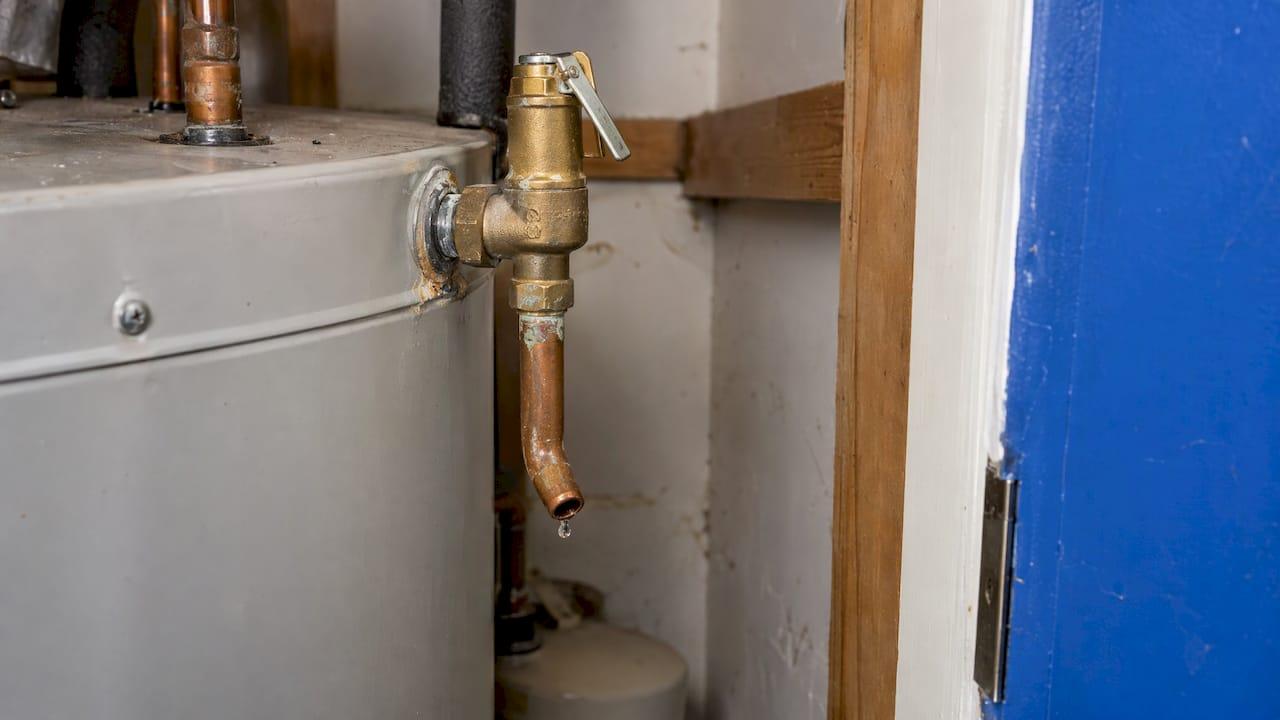
A small drip from the pipe under your hot water system's TPR valve (temperature and pressure relief valve, also called a PTR valve) during heating is normal. Continuous or heavy discharge is not, and in most cases the valve is not the part that has failed. The cause is usually high water pressure, a missing expansion control valve or a blocked drain line, and a new valve will not fix any of those. If yours is running steadily, our plumbers on the Mornington Peninsula can find the real cause and fix it, at any hour, because we cover emergency call-outs 24/7/365.
TL;DR
- Small drips while the system heats are normal. Discharge of more than a bucket in 24 hours, or a continuous flow, points to a problem.
- The usual culprits are mains pressure above what the heater is rated for, no expansion control valve where one is needed, a blocked drain line, or a worn valve.
- You can safely lift the easing lever briefly twice a year to check the valve. Stand clear, because the water is scalding.
- Replacing the valve alone often fails when the real fault is pressure. Find the cause first.
- A valve that will not discharge, will not reseal, or floods the floor needs a licensed plumber promptly.
Table of Contents
- What the TPR valve does and where to find it
- Normal drip or a real leak?
- The five usual causes
- Safe checks you can make yourself
- Why a new valve often does not fix it
- When to call a licensed plumber
- Aged care, villages and disability homes
- Our view: fix the cause, not the drip
- Book a plumber for your hot water system
- FAQ
- Sources
What the TPR valve does and where to find it
A hot water system heats water, and heated water expands. In a sealed system that extra volume has nowhere to go, so the TPR valve lets a little out. It also has a second job: if the thermostat fails and the water overheats, the valve opens and discharges hot water to protect the tank. The manufacturer's installation instructions for Australian systems describe the valve as fitted at the top, hot side of the system, with a drain line attached.
Look for a brass valve near the top of the tank or on its upper side, with a small lever and a copper pipe running down and away. That pipe is the discharge or drain line. The dripping you see is at the end of it, not at the valve itself. Overseas guidance also describes the valve as having a temperature probe and a spring-loaded pressure mechanism, which is why it reacts to both heat and pressure.

Normal drip or a real leak?
The first question a plumber asks is not "is the valve faulty?" but "when does it drip?" The pattern tells you most of what you need.
| What you see | What it usually means |
|---|---|
| A few drips or a small trickle while the system heats, then it stops | Normal thermal expansion |
| More than a bucket of water in 24 hours | Likely a pressure or installation problem |
| Steady discharge at all hours | Pressure, blocked drain line or a faulty valve |
| High flow, especially overnight | Mains pressure may be above the heater's design pressure |
| Large volumes of hot water discharged now and then | Possible thermostat fault (turn the power off and call a plumber) |
The bucket test comes from a manufacturer's Australian installation booklet. It says a small quantity of water through the drain line during heating is normal, but more than a bucket in 24 hours, or continuous discharge, suggests another problem. It also notes that high-flow discharge at night may mean the water pressure exceeds the heater's design pressure, and that a pressure limiting valve should be fitted by the installer.
Place a bucket under the end of the drain pipe for a full day and measure it. That one reading is more useful to a plumber than any guess about the valve.
The five usual causes
1. Mains pressure is too high
This is the most common cause we would look at first. Another Australian TPR maintenance guide states that where static inlet pressure exceeds 500 kPa, a 500 kPa pressure limiting valve (PLV) must be installed. It adds that discharge caused by excessive inlet pressure or incorrect installation should not be treated as a product fault.
The night-time pattern fits this. Household demand drops after dark, mains pressure climbs, and the valve starts to dump water. If you notice banging pipes, noisy taps or a dripping tap that never seems to stay fixed, high pressure may be the common thread. Our guides on high water pressure and plumber fixes and whether you need a pressure regulator explain how pressure is measured and what fitting a regulator involves.

2. Thermal expansion with no expansion control
The same Australian guide lists a missing or incorrectly installed expansion control valve as a cause of continuous discharge. A pressure reducing valve can behave like a one-way valve, which traps the expanding water in the home's pipes. The valve then does what it is built to do, again and again.
A US manufacturer's technical bulletin on leaking T&P valves says intermittent weeping or dribbling is pressure actuation, often from thermal expansion in a closed system. Its separate bulletin on high water pressure and thermal expansion says drips from the discharge pipe are a sign of high household pressure. Those figures are in psi and for US systems. In Australia we work in kPa and to local rules.
3. A blocked or restricted drain line
The discharge pipe must stay open. The installation instructions for one Australian system say the drain line must comply with the plumbing code AS/NZS 3500.4, and that the outlet pipe is never to be sealed or blocked. If it is, a secondary pressure relief device opposite the drain line will discharge water instead.
The NSW Government's Building Commission summarises the same standard. Clause 5.11.3 of AS/NZS 3500.4:2021 requires TPR drain lines to have no taps, valves or restrictions, to fall continuously from the valve to the point of discharge, and to end where steam or hot water cannot injure anyone. It is a NSW page, but the standard is national. Never cap or plug a drain line to stop a drip. That removes the safety path.
4. A worn valve or a build-up under the seal
TPR valves wear out. A service manual for Australian electric heaters notes that continuous leakage may indicate a problem with the water heater itself. A manufacturer's Australian installation booklet says the valve is not serviceable and must be replaced at intervals of no more than five years, more often in scaling-water areas. Mineral deposits under the seal stop it closing fully, which is why a regular lever test matters.
5. A leak that is not the valve at all
Water around the base of the valve can come from a loose threaded connection or from the tank. The A. O. Smith bulletin linked above distinguishes the cases. Leakage at the threaded connection is fixed by resealing. Seepage at the welded tank fitting means the heater itself should be replaced. A heater that leaks from the tank is at the end of its life, and a plumber can confirm this quickly.
Safe checks you can make yourself
You can test the valve without tools. The safe order is:
- Check the drain line. Make sure the pipe is open, runs downhill and ends in a safe place. Do not block it.
- Stand clear of the outlet. The water that comes out is hot enough to scald.
- Lift the easing lever for about 10 seconds. A manufacturer's owner's guide says to confirm water discharges to waste, then lower the lever gently and check that the valve closes properly. If the system has an expansion control valve, repeat the test on it.
- Watch the outcome. If no water flows, or the valve keeps running after you lower the lever, stop and call a plumber. The Australian service manual cited above says to contact a serviceman if no water flows when the lever is operated.
- Record the pattern. Note when it drips, and do the 24-hour bucket test.
The maintenance guide cited earlier recommends inspecting and testing the valve every six months, checking for leaks and corrosion and making sure the drain line is clear. Watts' Australian documentation gives the same six-month interval to flush deposits from under the seal, with a scalding caution. One owner's guide warns that never operating the lever risks the heater exploding. That is the reason to make it a diary item rather than something done after a problem appears.
If you find water pooling and are not sure where it is coming from, a method for how to detect a water leak at home helps you separate a valve problem from a leaking pipe. For the broader first-response steps once water is on the floor, our guide to what to do first when a hot water system leaks covers isolating the power, gas and water.
For electric systems, a different warning applies. The US bulletin says several gallons of water on the floor around the discharge pipe is not thermal expansion. Switch the power off at the breaker and have the thermostats and elements checked.
Why a new valve often does not fix it
The most common mistake is to treat the valve as the fault. A plumbing expert from a US home renovation programme described a homeowner emptying a bucket three times a day under a leaking valve and replacing it three times. The real problem was a pressure reducing valve acting like a check valve. Fitting a potable-water expansion tank dropped the pressure and stopped the dripping altogether.
The lesson holds on the Peninsula. If you have replaced a valve and it is still discharging, the valve was almost certainly doing its job against a pressure problem. The next step is to measure the static pressure, check for an expansion control valve and confirm the pressure limiting valve is correct and working. It is not a fourth valve.
When to call a licensed plumber
Call promptly if any of these apply:
- The valve does not discharge or does not reseal when you operate the lever. The Australian installation booklet says an authorised person must attend without delay.
- Discharge is continuous, or more than a bucket a day.
- Hot water is dumping in large, sporadic volumes. That can mean a thermostat fault.
- The valve is more than five years old and has never been replaced. One owner's guide says it should be checked by a licensed tradesperson or replaced at intervals of no more than five years.
- The valve has been replaced and the problem has come back.
If the system is gas, our guide to gas hot water servicing explains what a proper service covers. If the water is also running too hot at the taps, read about scalding prevention and tempering valves.
Aged care, villages and disability homes
In a facility, a discharging relief valve is more than a nuisance. Residents are more vulnerable to scalds, wet floors are a fall risk, and one failing system can affect many rooms. Put the six-monthly lever test into the maintenance schedule for every storage system on site, record the result, and treat any change in the discharge pattern as a reason to book a visit. A scheduled maintenance program covering the valve, drain line, pressure and tempering arrangement is simpler than chasing separate call-outs. Home and business owners can use the same routine for their own systems.
Our view: fix the cause, not the drip
We are plumbers, electricians and heating and cooling tradesmen working across the Mornington Peninsula, and a dripping relief valve is one of the calls where the quickest job is often the wrong one.
A valve swap takes minutes, and it feels like progress. But if the discharge is pressure related, the owner will be calling again in a month. That is why we look at the whole hot water arrangement together: the pressure coming in, the expansion control, the drain line, the valve and the heater.
We deal with plumbing, electrical and heating and cooling under one roof. For a hot water fault that matters. A relief valve that dumps water can be a plumbing problem, an electrical thermostat problem, or both, and one team can work through that without handing the job around. For care facilities, that means one point of contact for compliance checks, scheduled maintenance and emergency call-outs.
If your valve is running and you are not sure why, call us before you replace anything.
Mike
Book a plumber for your hot water system
We provide plumbing, electrical, and heating and cooling services, including hot water servicing, scheduled maintenance, compliance checks and emergency call-outs, for homes, businesses, aged care facilities, retirement villages and disability care homes on the Mornington Peninsula and surrounding Melbourne suburbs. Our emergency service runs 24/7/365. Start with our plumbing services page to arrange a visit.

FAQ
How do I know if my TPR valve is bad?
Operate the easing lever briefly while standing clear of the drain outlet. A good valve discharges water and then closes completely when you lower the lever. If no water flows, it keeps dripping afterwards, or it is corroded, it needs replacing by a licensed plumber. Also check how old it is, because five years is the usual maximum interval.
Is it normal for a hot water relief valve to drip?
Yes, a small amount while the system is heating is normal, because heated water expands and needs somewhere to go. It becomes a concern when the flow is continuous or exceeds about a bucket in 24 hours. Heavy discharge at night often points to mains pressure that is too high for the system.
Can I block the drain line to stop the dripping?
No. The discharge pipe must stay open to the atmosphere and never be plugged, capped or fitted with a tap or valve. Blocking it removes the safety path and can cause the system to discharge elsewhere or fail. A plumber should find the cause of the discharge instead.
Why does my TPR valve keep leaking after I replaced it?
A new valve cannot cure excess pressure, a missing expansion control valve or a faulty pressure limiting valve. These faults make even a healthy valve discharge. Have the static water pressure measured and the installation checked rather than replacing the valve again.
Sources
- Installation instructions for an Australian hot water system (ART0120)
- How and Why To Maintain a Temperature-and-Pressure Valve
- Hotflo electric hot water service installation booklet
- TPR Valve Installation and Maintenance Guide
- Technical Bulletin #52: Leaking Temperature and Pressure Relief Valve
- High Water Pressure, Thermal Expansion and T&P Relief Valve Dripping
- Heat pump installations for plumbing, NSW Government
- Domestic electric water heater service manual
- Electric and gas storage owner's guide
- Pressure & Temperature Relief Valve, PTR
- How To Diagnose and Repair a Leaking Water Heater
- How to detect a water leak in your house