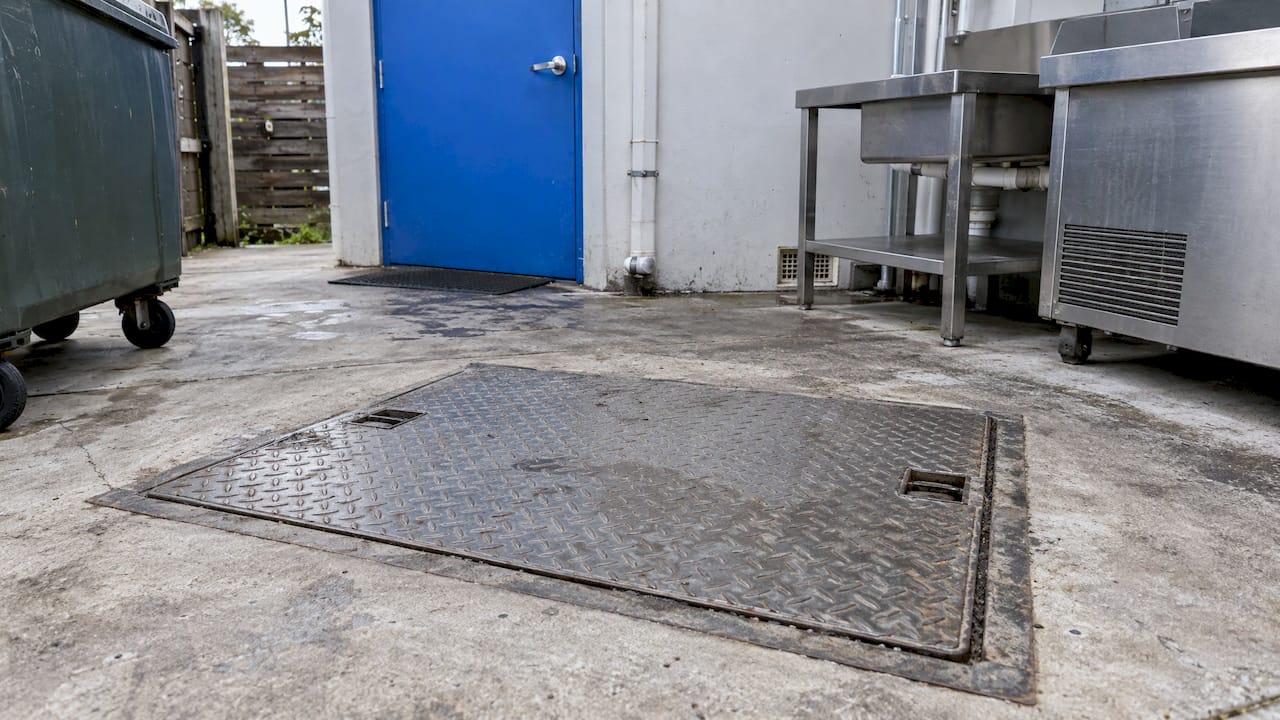
A grease trap that smells is telling you it is full, overloaded or no longer sealing. The fix is almost always the same: have it emptied and scraped out in full, then check the lid, the seal and the venting so the smell does not come back. For a kitchen in an aged care home, a lifestyle village or a café, a persistent grease odour is also an early warning of a blockage or a trade waste compliance problem. It is worth acting on the same week.
This guide explains why grease traps smell, what actually controls the odour, how often traps need servicing, and what to do when the smell is inside the building. It is written for owners and facility managers on the Mornington Peninsula and across Victoria.
TL;DR
- A grease trap smells because grease, food solids and water have built up and are going rancid. Cleaning it out completely is the fix, not masking the smell.
- Some smell is normal when the lid is lifted. A strong smell with the lid down means the trap needs emptying.
- Gas-tight lids, a sound seal and proper venting stop odour escaping between services.
- In Victoria, cleaning and maintenance must be done by an EPA-licensed waste collector, so keep your service records in order.
- A smell inside the building can be a dry trap, a vent problem or a sewer blockage, not the grease trap itself.
Table of Contents
- Why a grease trap smells
- Is some smell normal?
- What to put in a grease trap for smell
- How often should a grease trap be cleaned?
- When the smell is inside the building
- Why grease traps overflow
- A routine that keeps odour away
- Compliance: the smell is not just a nuisance
- Where DualFlow Services fits
- Our view on grease trap odour
- FAQ
- Sources
Why a grease trap smells
A grease trap, also called a grease interceptor or grease arrestor, is a tank that sits in the drain line from your kitchen sinks and dishwashers. It slows the wastewater so fats, oils and food solids separate out and stay in the tank instead of going into the sewer. Everything it catches stays there until it is pumped out, and it breaks down in warm, wet conditions. That is the smell.
The most common causes are these.

1. The trap is overdue for a pump-out. Goulburn Valley Water says that a grease trap that is not maintained can produce rancid grease and oil odours, send greasy waste into the sewer pipes where it causes blockages, and lead to greasy waste spills on your property. As the layer of solids and grease thickens, less room is left for incoming water, so the trap works less well and the smell gets worse.
2. The trap is too small for the kitchen, or the kitchen has grown. One of the more direct statements in the sources is that grease traps smell, block or need pumping too often when they cannot handle the amount of greasy wastewater coming in. A café that has added a dishwasher, extended its menu or started serving more meals can outgrow a trap sized for the original fit-out. A council fact sheet from NSW notes that a trap should give wastewater about one hour of retention time and be large enough to let it cool to 38°C or below at the outlet. Correct sizing also means less frequent servicing.
3. Lids and covers are not sealing. A Queensland council guideline states that grease arrestors must be vented and that lids must be gas-tight to prevent odour escaping. A cracked, warped or badly seated cover lets gas out into the kitchen, the yard or the loading area. Water Corporation advises checking covers regularly for damage and deterioration, greasing them where applicable at least once a year to keep a gas-tight seal with the frame, and making sure they sit flush.
4. Too much grease is going in. Scraping plates into the bin before washing, using sink strainers and keeping waste oil out of the drain all reduce the load. The NSW fact sheet above says waste oil should never be poured down the drain or into the trap. Deep fryer and BBQ oil should be collected in sealed containers and taken by an oil recycler.
5. Food waste from a grinder or pre-rinse. A plumbing reference, Inspectapedia, notes that garbage disposers and the pre-rinse function of some dishwashers are a substantial source of fats, oils and grease. Where a trap is installed, the grinder drain is normally required to bypass it.
6. Gas is escaping from the wastewater system itself. Water Corporation says grease, fats and solids that build up in drains can produce odorous and toxic gases, corrosion, blockages and overflows.
Is some smell normal?
Yes. The Northern Territory Government says all grease traps smell bad when the surface is disturbed, and that with the lid down the smell should not be overly powerful. If you can smell a strong odour with the lid closed, get the trap cleaned out. That is a handy rule for staff: opening the lid will always smell, but standing in the kitchen and smelling grease is not normal.
What to put in a grease trap for smell
People often ask for a product to pour in. The honest answer is that odour control is about removal and sealing, not additives. Here is what works.
- Empty it fully. The method in Water Corporation's FOGMan Code of Practice is to remove all covers, empty each section completely with a suction hose, scrape the internal walls, hose down the inside and suction out the residue, then replace the covers securely.
- Skip the detergents. The WCRA Code of Practice for Grease Trap Waste says surfactants or detergents must not be used when cleaning a grease trap, and that the trap must be pumped out completely with the surfaces scraped and washed at every service.
- Do not flush it with hot water or drain cleaner. The NSW fact sheet advises against drain cleaners and excess hot water, because both cause further problems with the trap.
- Do not mix chemicals. Kitchen forums suggest ammonia and bleach combinations. Never mix household chemicals: the fumes are dangerous in a closed kitchen, and they do nothing a proper clean-out does not do better.
If the smell returns within days of a proper clean, the cause is usually the seal, the venting or the size of the trap, not the cleaning product.
How often should a grease trap be cleaned?
There is no single number for every kitchen. The rules in the sources give a good picture of how it is judged.
| Source | Guidance |
|---|---|
| NSW council fact sheet | Start at a minimum of every 13 weeks, then adjust for trap size and the amount and quality of greasy wastewater |
| WCRA Code of Practice (2015) | Default of 13 weeks for a correctly sized trap, with a minimum of every 26 weeks and a maximum of every 4 weeks in the Sydney Water system |
| Water Corporation (WA) | Pump out when floating and settled solids exceed 30% of the effective depth, or when oil and grease or solids are visible downstream of the trap |
These come from NSW and Western Australia, so they are reference points, not Victorian rules. In Victoria your frequency is set by your water authority and your trade waste agreement. On the Peninsula that is normally the retail water corporation for your area. Check your agreement for the schedule that applies to you.
A practical test sits behind all of these: if the trap is smelling with the lid down, it is already overdue, whatever the calendar says. A kitchen that cooks heavily, such as a care home preparing three meals a day for residents, may need more frequent service than a small café.

Who is allowed to clean it
Goulburn Valley Water states that, in Victoria, grease trap cleaning and maintenance must be performed by an EPA-licensed waste collector, who removes the entire contents and disposes of them in line with federal, state and local laws. Staff topping up with a bucket and hose is not a clean-out. Keep a record of every service: the NSW fact sheet advises recording the dates, the frequency and the name of the company.
When the smell is inside the building
If you can smell grease or sewage inside, in a resident's bathroom or at a kitchenette sink, the grease trap is only one of the suspects. Look at these.
- A dry trap. Every sink, shower and floor waste has a small water seal. Inspectapedia explains that a dry trap has lost its seal, so sewer gases can come up through the drain. The two main defences against sewer gas are these water seals and the vent system that carries gas above the roof. A rarely used shower, a vacant unit or a floor waste in a plant room can dry out. Running water for a minute often restores the seal. If the smell returns, there is a leak or a fault.
- A vent problem. A blocked or leaking drain vent can push odour back into the building. This guide to the signs of a plumbing vent leak is useful for telling a vent issue apart from a kitchen trap problem.
- A sewer blockage. Goulburn Valley Water lists a strong sewer smell, slow-draining sinks, baths or toilets, gurgling drains, and sewage overflowing in the yard as signs of a blockage. Its water-authority emergency line can help work out whether the blockage is in your plumbing or in the authority's assets.
We have also written on the home side of this problem: a 30 second test for a sewer smell and three quick checks for a bathroom sewer smell. If the smell comes and goes with the dishwasher or the kitchen sinks, suspect the trap. If it follows the bathrooms, suspect the seals or the vents.
Sewer gas contains methane, which Inspectapedia notes can be an explosion hazard and, in a confined space, a risk of fatal asphyxiation. If you smell gas strongly in an enclosed area, ventilate it, keep ignition sources away and call for help straight away.
Why grease traps overflow
Overflow is the smell's next stage. Once solids fill the trap, there is no room for water to slow down and separate, so grease flows on into the pipes and the trap backs up. Goulburn Valley Water explains that fats and oils combine with wet wipes and other non-flushables to form "fatbergs" that lodge in pipes and pumps and cause major, expensive blockages. Greasy waste can also cause sewage to overflow into premises.
Warning signs:
- Sinks and floor drains in the kitchen drain slowly.
- Gurgling when the dishwasher empties.
- Standing water or a greasy film around the trap lid.
- A smell that is strongest at the pit or at the lid line.
The NSW fact sheet says that slow draining may mean a blockage in the pipework or that the trap needs servicing, and that a licensed plumber should be called to find the problem. It also says not to pour drain cleaner down the sink or run excess hot water, as that will make things worse. If the trap is overflowing now, stop using the kitchen sinks and dishwasher, keep staff and residents away from the spill and call a plumber. Our guide to why drains block frequently covers the wider causes.
A routine that keeps odour away
- Scrape and strain. Scrape plates and pots into the food waste bin before washing. Fit sink strainers and empty them daily.
- Keep oil out. Collect fryer oil and used cooking oil in sealed containers for an oil recycler.
- Check the lid weekly. Look for cracks, a poor fit and grease build-up on the frame. Covers should sit flush.
- Service on schedule, not on complaint. Book the licensed collector at the interval your water authority and your volumes call for, and file the docket.
- Watch the signs between services. A smell with the lid down, slow drains or visible grease downstream means book early.
- Have the plumbing around the trap checked. Seals, venting, pipework and inlet and outlet condition decide whether the smell stays gone. Our checklist for trade waste audits and grease traps in Victoria and the three compliance checks for commercial kitchens set this out in detail.
Compliance: the smell is not just a nuisance
Grease management is a legal matter for food businesses. Water Corporation states that under Western Australia's Water Services Act 2012, food handling businesses need a trade waste permit before discharging waste to the wastewater system, and that pre-treatment such as a grease arrestor is required to protect the system. Victoria runs its own scheme through the local water corporation, but the principle is the same: you are responsible for keeping the trap working. Goulburn Valley Water says pre-treatment devices such as grease interceptor traps must be installed by a licensed plumber in line with AS/NZS 3500, the Australian plumbing standard, and its own conditions of connection.
For an aged care kitchen or a retirement village dining room, the stakes are higher: residents are vulnerable, kitchens run every day, and a sewage backup or a persistent odour cannot wait. Our article on Victorian restaurant plumbing and trade waste fines covers what inspectors look at, and best practices for commercial plumbing maintenance covers the routine side.
Where DualFlow Services fits
We are plumbers, electricians and heating and cooling tradespeople on the Mornington Peninsula. For a grease trap smell, our part is the plumbing around the trap: finding out whether it is the trap, the seals, the venting or a blockage in the drain line, and fixing what is found. We also offer scheduled maintenance and compliance checks for homes, businesses, aged care facilities, retirement villages and disability care homes, plus emergency call-out around the clock if a kitchen drain backs up. If your trap needs its contents removed, that step goes to an EPA-licensed waste collector, and we work with that process, not around it.
If you want one trade team to look at the whole kitchen drainage system, book our plumbing service or start from our main page.
Our view on grease trap odour
Most grease trap complaints we hear about start the same way: the smell was ignored for a few weeks because the kitchen was busy. By the time someone calls, a smell has become a slow drain, and a slow drain has become a backup.
We think the right way to manage a trap is as part of the building's maintenance plan, not as an emergency. That means a service schedule, records, regular checks of lids and seals, and one team that looks at the kitchen, the drains and the vents together. It matters most in care settings, where facility managers carry the load for dozens of residents and cannot afford a closed kitchen.
That is why we offer plumbing, electrical and heating and cooling under one roof, with emergency availability 24/7/365. One call, one trade team that knows your site, and fewer things for you to coordinate.
Mike
FAQ
Why does my grease trap smell even after cleaning?
The usual causes are a lid that does not seal, a vent problem, a trap that is too small for the kitchen, or a clean that did not remove everything. The WCRA code says the trap must be fully pumped out and scraped and washed each service. If the smell returns quickly, have a plumber check the lid seal, venting and pipework.
How do I control grease trap odour between services?
Keep lids gas-tight and flush with the frame, grease the cover seal at least once a year where it applies, scrape food waste into the bin and keep waste oil out of the drain. Do not pour detergents or drain cleaners into the trap. A strong smell with the lid down means it is due for emptying.
Why can I smell grease inside my building?
A dry floor waste or sink trap, a faulty vent or a sewer blockage can all let odour in. Run water in rarely used fixtures to refill the seals, and if the smell stays, book a plumber. A strong gas smell in an enclosed space needs ventilation and urgent help.
Can I clean a grease trap myself?
In Victoria, Goulburn Valley Water states that cleaning and maintenance must be carried out by an EPA-licensed waste collector. Staff can look after the daily habits: scraping, straining, keeping oil out and checking the lid. The clean-out itself belongs to the licensed collector.
Sources
- Greasy waste, Goulburn Valley Water
- Sewer blockages, Goulburn Valley Water
- Trade Waste Customers, Goulburn Valley Water
- Food handling and preparation, Water Corporation
- Grease arrestor cleaning and maintenance, Water Corporation
- Fats, Oils and Grease Management (FOGMan), Water Corporation
- Using a grease trap for your food business, NT Government
- Grease trap installation, operation and maintenance, Federation Council
- Grease Trap Maintenance Guideline, Douglas Council
- Code of Practice for Grease Trap Waste, WCRA
- Plumbing traps, requirements, codes, defects, sewage odors, Inspectapedia