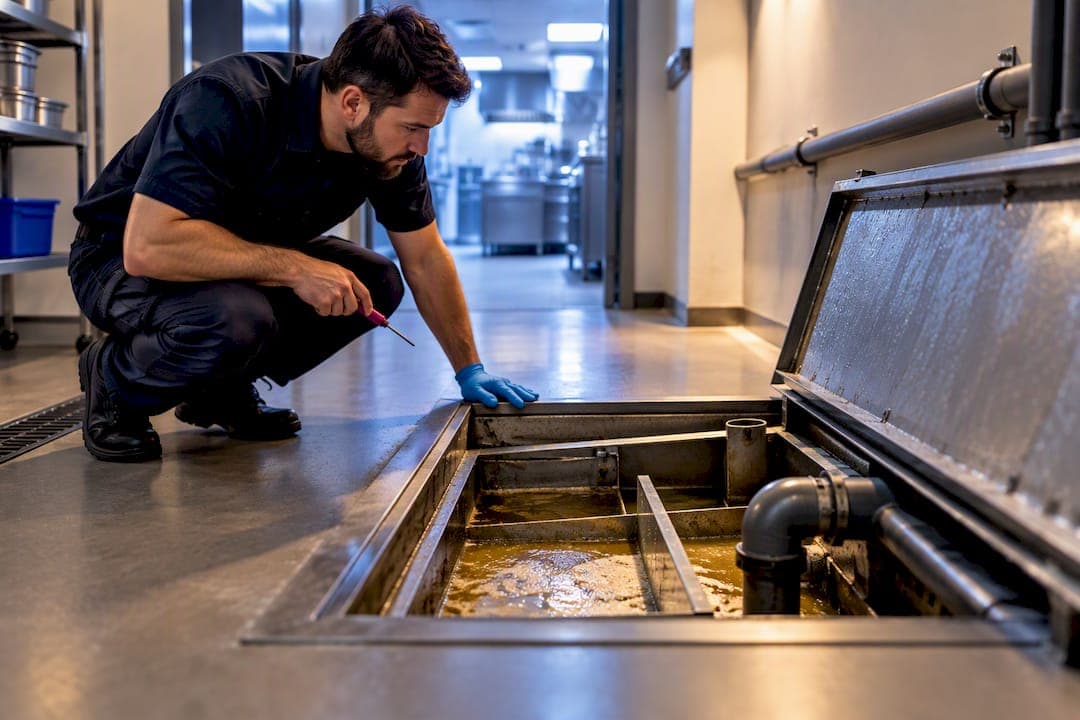
Yes, grease traps are mandatory for most commercial kitchens discharging trade waste in Victoria, and you also need a Trade Waste agreement with your water authority. Three things to do this week: check whether you already hold that agreement, contact your water corporation for written sizing approval before touching any hardware, and confirm your pump-out contractor holds an EPA licence. Skip any of these and you risk fines, forced upgrades, or a shutdown notice.
TL;DR:
- Most Victorian commercial kitchens must have a licensed grease trap and a trade waste agreement before beginning operations to avoid fines or shutdowns.
- Size and installation approval are based on fixture count, flow rates, and FOG load; never install without written authorization from your water authority.
- Pump-out intervals vary from monthly to quarterly, and only EPA-licensed operators can legally pump waste, requiring documented certificates for each service.
- Water authorities can inspect and enforce compliance, with non-compliance leading to fines, upgrades, or costly emergency responses if issues arise.
- Regularly review and update your trade waste documentation and equipment sizing, especially after equipment changes or if regulations update.
Table of Contents
- Who needs a grease trap and what a trade waste agreement requires
- Sizing and installation: approvals, plumbers and standards
- Maintenance, pump-out frequency and record keeping
- Inspections, enforcement and the cost of getting it wrong
- Audit-ready checklist for trade waste compliance
- How Dualflowservices works with Victorian water authorities
- The step-by-step path from installation to ongoing inspection
- Common compliance problems and how to fix them
- Upgrading or replacing an ageing grease trap
- What changing regulations mean for your kitchen
- Why scheduled compliance beats reactive fixes
- Get your kitchen compliant with Dualflowservices
- Where to check the official rules yourself
- Sources
- FAQ
Who needs a grease trap and what a trade waste agreement requires
"Trade waste" is any liquid waste from a business that isn't ordinary domestic sewage. Cooking oil, food scraps, detergents and grease all fall into this category the moment they go down a commercial kitchen drain, and Victorian water corporations treat it as a regulated discharge, not just wastewater.
Almost any food business with a working kitchen needs a grease trap and a trade waste agreement, including:
- Restaurants, cafes and takeaway shops
- Caterers and commercial kitchens supplying multiple sites
- Butchers and delis processing meat on site
- Bakeries with commercial ovens and wash-down areas
- Aged care and retirement village kitchens preparing meals at scale
The legal foundation sits in the Water Act 1989, which gives water corporations the power to set discharge conditions, inspect premises and require specific equipment. Depending on your flow volumes and waste type, you'll be classed under a minor or major trade waste agreement, or as a "deemed" customer with standard conditions already applied. The Australian Business Licence and Information Service's trade waste guidance confirms this agreement is required before you start discharging waste, not after.
Contact your water authority's trade waste team before you sign a lease or order kitchen equipment. They'll ask about fixture counts, expected flow, and what's actually going down the drain, and that early conversation shapes everything that follows.
Sizing and installation: approvals, plumbers and standards
Grease trap size isn't a guess. Water authorities calculate it from trap capacity in litres, the number and type of fixtures connected (pot sinks, commercial dishwashers, floor wastes), peak flow rates during service, and the fat, oil and grease (FOG) load your menu generates. A busy fry kitchen needs a bigger trap than a sandwich bar with the same floor area.
The process runs in a fairly fixed order:
- Contact your water corporation's trade waste team and describe your kitchen setup.
- Use their sizing guide or technical drawings to work out the right unit for your fixture count and flow.
- Get written approval for the specific unit and its installation location before you order anything.
- Install with a licensed plumber who confirms compliance and issues a certificate on completion.
Yarra Valley Water is explicit that installing without prior written approval can mean removal at your own expense, and South East Water's technical standards set out venting, access and lid diameter requirements that a lot of installers get wrong on the first attempt. Poor venting and undersized remote suction lines are among the most common reasons an installation fails inspection.
Your plumber must hold any necessary water authority approvals before starting work, not apply for them retrospectively. If you're in a shopping centre or shared commercial building, the trap may be communal and managed by a body corporate. Confirm who actually holds the trade waste agreement before assuming it's you.
Pro Tip: Ask your plumber to show you the water authority's written sizing approval before installation day, not after. A verbal "it'll be fine" from a tradesman is not the same as a signed approval from your water corporation, and only the second one protects you at audit time.
Maintenance, pump-out frequency and record keeping
Your trade waste agreement sets the pump-out frequency, and it's not a one-size-fits-all number. Depending on trap size and how much FOG your kitchen produces, most Victorian agreements set pump-out frequency on a case-by-case basis, often ranging from monthly to quarterly servicing. A high-volume fry kitchen might need monthly cleans; a low-oil café could stretch to quarterly.
Only EPA-licensed liquid waste collectors can legally pump out a grease trap. Doing it yourself, or hiring an unlicensed operator because they're cheaper, breaches your trade waste agreement and Victoria's waste handling rules. EPA Victoria's guidance on grease interceptor trap waste classifies this waste and sets expectations for how it's handled and disposed of.
Every pump-out should generate a waste transport certificate. Keep these details on file:
- Date of service and volume of waste removed
- Name and licence details of the transporter
- Destination disposal or recycling facility
- Your business details and trap location
Emergency call-outs for an overflowing trap typically cost three to four times more than a scheduled pump-out, according to South East Water's guidance. Set calendar reminders tied to your agreement's frequency, and keep both digital and physical copies of every certificate. Our guide to commercial plumbing maintenance covers how to build this into a broader maintenance schedule.
Inspections, enforcement and the cost of getting it wrong
Water authorities can inspect your premises and sample your discharge outlets under the Water Act, and they don't need much notice to do it. A typical inspection checks device size against your agreement, physical access for cleaning, which fixtures actually connect to the trap, your cleaning schedule, and your waste transport certificates. East Gippsland Water's trade waste management manual outlines these inspection and enforcement powers in detail, and most other Victorian authorities operate on similar terms.
Non-compliance escalates in stages, usually:
- A formal notice identifying the breach
- A requirement to upgrade an undersized or failing trap within a set timeframe
- Fines for continued non-compliance
- Remediation costs if a blockage causes an overflow or sewer backup
The financial gap is stark. A scheduled clean might cost a few hundred dollars; an emergency response to a blocked or overflowing trap, including possible trading disruption, runs several times higher once you add contractor call-out rates and lost service time.
If an inspector turns up, produce your trade waste agreement and recent transport certificates immediately, and if something's out of date, book corrective work with a licensed contractor rather than waiting for a follow-up notice.
Audit-ready checklist for trade waste compliance
Getting audit-ready doesn't require a consultant. It requires working through a short list in the right order.
- Find your existing trade waste agreement and confirm it's current, or apply for one if you don't have it.
- Identify your grease trap's type, location and last pump-out certificate.
- Check the pump-out interval specified in your agreement and confirm your transporter's EPA licence is active.
- Arrange a sizing recheck if your menu, fixture count, or trading hours have changed since installation.
- Test physical access and venting to make sure nothing's been boxed in or blocked since the last service.
- Schedule ongoing maintenance against your agreement's frequency, not a rough guess.
- Keep records for at least 12 months, or longer if your water authority specifies it.
- Notify your water authority of any operational changes, including closure, fit-out, or a change of tenancy.
Pro Tip: If you've taken over an existing kitchen fit-out, don't assume the previous operator's trade waste agreement transfers to you automatically. Call the water authority in your first week of trading and confirm the agreement is in your business's name.
How Dualflowservices works with Victorian water authorities
Some professional services handle the parts of this process that trip up most kitchen operators, such as licensed installation, compliance certificates, and maintaining ongoing paperwork to stay audit-ready. This may include liaising with trade waste officers on sizing approvals, planning maintenance schedules around your agreement's pump-out frequency, and responding promptly to trap backups outside business hours.
A few local pointers worth knowing. Confirm which water corporation covers your suburb, because Yarra Valley Water, Greater Western Water and South East Water each administer their own trade waste conditions and technical drawings. Check your council's health officer requirements around trap location too, since plumbing approval and council placement rules don't always align automatically. And always confirm your plumber holds the water authority's trade waste installation approval before work starts, not once the job's underway.
If your aged care or retirement facility kitchen needs a compliance review, our aged care plumbing compliance guide covers the extra layer of requirements those sites carry.
The step-by-step path from installation to ongoing inspection
Compliance isn't a single event. It's a sequence that starts before you order equipment and continues for as long as you trade.
Start by notifying your water authority's trade waste team of your business type and expected fixture load. They'll issue sizing guidance or ask for drawings of your kitchen layout. Once you've settled on a unit and location, get written approval before ordering, because retrofitting an approved unit into an already-built kitchen costs far more than getting the sizing right up front.
Installation follows with a licensed plumber, who checks venting, access clearance and lid specifications against the authority's technical standards, then issues a compliance certificate. That certificate becomes part of your permanent record, alongside the original trade waste agreement.
From there, the cycle becomes routine: scheduled pump-outs at the interval set in your agreement, a transport certificate filed after each service, and periodic self-checks on access and venting between services. Most Victorian authorities don't announce inspections in advance, so the businesses that pass cleanly are the ones treating every pump-out as if an inspector might ask for proof the same week.
Annually, or whenever your menu or trading hours change significantly, revisit your sizing. A kitchen that added a fryer line or doubled its dinner service since installation may have outgrown its original trap, even if nothing else about the compliance paperwork has changed. Building this review into your yearly business planning, rather than waiting for a water authority to flag it, is the difference between a minor adjustment and a forced emergency upgrade.

Common compliance problems and how to fix them
The same handful of issues account for most compliance failures we see across Victorian commercial kitchens.
Undersized traps top the list, usually because a kitchen's fit-out changed after installation without a sizing recheck. Added fryers, a second dishwasher, or extended trading hours all increase FOG load, and a trap sized for the original layout can't keep up. The fix is a sizing review with your water authority whenever equipment or service volume changes materially.
Poor access is close behind. Traps get boxed into cabinetry, buried under storage shelving, or positioned where a pump-out contractor physically can't get a hose to them. This is one of the most common reasons installations fail inspection in the first place, according to South East Water's technical standards. Keep at least the clearance specified in your authority's drawings, permanently.
Missed pump-outs happen when the interval in the agreement doesn't match what's written on a calendar anywhere. Tie your reminder system to the agreement, not a generic monthly guess.
Ownership confusion catches out tenants in shared premises. If you're leasing a kitchen in a shopping centre or food court, the grease trap may be a body corporate asset, and the trade waste agreement may sit with the landlord, not you. Confirm this in writing before assuming either way, because fines for another tenant's non-compliance have landed on the wrong business before.
Lost or incomplete certificates are an easy own goal. If your contractor doesn't hand over a transport certificate after every service, ask for one on the spot.

Upgrading or replacing an ageing grease trap
Grease traps don't last forever, and an old unit that passed inspection five years ago might not meet current technical standards today. Corrosion, cracked liners, and outdated venting configurations are common reasons an older trap fails a fresh assessment even without any change to your kitchen's operations.
Start any upgrade the same way you'd start a new installation: contact your water authority's trade waste team before ordering a replacement. They'll confirm whether your current agreement's sizing still applies or whether growth in your business means you need a larger unit. This step matters more than operators expect, because installing a like-for-like replacement without checking current standards can mean repeating the whole approval process a second time.
Budget for both the equipment and the plumbing work, since a straight swap is rarely straightforward. Access points, venting, and suction line diameters that were compliant when first installed sometimes fall short of updated technical drawings, particularly in older buildings that have had multiple fit-outs since the original trap went in.
Timing an upgrade around a planned renovation or fit-out, rather than waiting for a failure, gives you room to negotiate trading disruption and get the sizing right the first time. A trap replaced under pressure after an overflow rarely gets the careful sizing conversation it deserves.
What changing regulations mean for your kitchen
Victorian trade waste rules aren't static, and water authorities periodically revise technical standards, acceptance criteria and charging structures as environmental expectations shift. EPA Victoria's ongoing work on waste classification, including how grease interceptor waste can be reused or recycled, signals a broader push toward treating this waste stream as a resource rather than pure disposal.
Practically, that means two things for your business. First, technical drawings and standards get updated periodically, so a trap installed under one version of a water authority's specifications might need adjustment when those specifications change, particularly around venting and access. Second, expect closer scrutiny of waste transport documentation over time, as authorities lean more heavily on digital record keeping to track where liquid waste actually ends up.
The safest position is treating your trade waste agreement as a living document, not a one-off form you filed years ago. Check in with your water authority annually, even if nothing about your kitchen has changed, because the rules on their end might have.
Why scheduled compliance beats reactive fixes
Every emergency grease trap call-out we respond to traces back to the same root cause: a missed pump-out or an undersized trap nobody flagged in time. The gap between a scheduled clean and an emergency response isn't marginal, it's several multiples in cost once you add trading disruption on top of the contractor bill.
Compliance paperwork feels tedious until the week an inspector asks for it. Keep it current, use licensed contractors for every step, and book a site assessment with a professional plumbing service before a problem forces your hand.
— Mike
Get your kitchen compliant with Dualflowservices
Some service providers offer a practical alternative to juggling separate plumbers, electricians and compliance consultants for one commercial kitchen by handling licensed grease trap installation, scheduled maintenance planning, emergency pump-out response, and compliance documentation, potentially covering electrical and heating and cooling needs as well.
A "one-stop shop" approach can be especially helpful for aged care facilities, retirement villages and multi-site caterers, where plumbing, electrical, and heating problems may coincide. This approach allows coordinating fewer trades during compliance deadlines or emergencies.
If your grease trap needs a sizing check, an upgrade, or you simply want your trade waste paperwork reviewed before your next inspection, request a site visit or quote through Dualflowservices and get a straight answer on where your kitchen stands.
Where to check the official rules yourself
Before any application or installation, confirm requirements directly with these sources:
- Yarra Valley Water grease trap guidance: sizing approval steps and installation requirements
- Greater Western Water trade waste overview: agreement categories and licensed transporter rules
- South East Water food and oil interceptor standards: technical drawings and venting specifications
- EPA Victoria grease waste classification: disposal and reuse guidance
- ABLIS trade waste permit guidance: agreement application requirements by council area
Sources
- Trade Waste Permit / Agreement - VIC - Australian Business Licence and Information Service
- Grease traps | Yarra Valley Water
- What is trade waste? | Greater Western Water
- Grease interceptor trap waste — Classification for reuse | EPA Victoria
- Food and Oil Interceptor | South East Water
FAQ
What are the regulations for grease traps in Victoria?
Victorian water corporations require most food businesses to hold a Trade Waste agreement under the Water Act 1989, which sets the grease trap type, size and maintenance conditions for your specific site. You also need written approval before installation and must use EPA-licensed collectors for pump-outs.
What size grease trap does a commercial kitchen need?
Size depends on trap capacity in litres, the number of connected fixtures like pot sinks and dishwashers, peak flow during service, and your kitchen's FOG load. Your water authority's trade waste team calculates this using technical sizing guides and issues written approval for the specific unit before installation.
Are grease traps mandatory in Victoria?
Yes, for almost any commercial kitchen discharging trade waste, a grease trap is mandatory alongside a signed Trade Waste agreement. Operating without one risks removal orders, fines, or a requirement to install compliant equipment at your own expense.
Does a commercial dishwasher have to go through a grease trap?
Generally yes, commercial dishwashers connect to the grease trap because they discharge food residue and fats that would otherwise pass straight into the sewer. Your water authority confirms exactly which fixtures must connect during the sizing and approval process, so check this with them rather than assuming.
How often should a grease trap be pumped out?
Pump-out frequency is set in your Trade Waste agreement and typically ranges from monthly to quarterly depending on trap size and FOG load. Only EPA-licensed liquid waste collectors can legally perform this service, and every service should generate a waste transport certificate for your records.