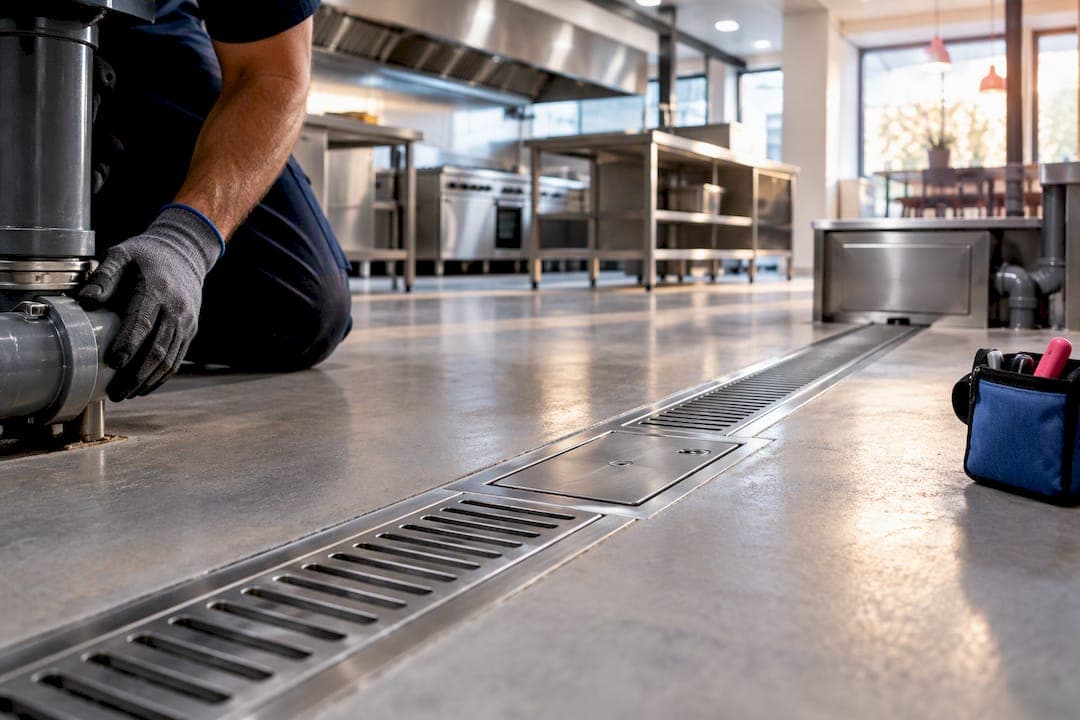
Certain restaurant plumbing works in Victoria legally require a compliance certificate, and the licensed plumber who does the job must lodge it with the Victorian Building Authority through VBA360 within five days of finishing. If you are planning a fit-out or repair, confirm this with your plumber up front and check your council and water authority obligations at the same time.
TL;DR:
- Only licensed plumbers can issue compliance certificates for specified restaurant plumbing works, and they must inspect and personally oversee the work before signing off.
- Certificates must be lodged with the Victorian Building Authority within five days of work completion, and owners should verify lodgement via VBA360 to avoid compliance gaps.
- Food premises require specific trade waste permits, properly sized grease traps, and ongoing pump-out schedules to prevent fines and disconnection risks.
- Non-compliance issues, such as undersized grease traps or missed lodgement deadlines, often stem from insufficient early planning and oversight, increasing costs and operational risks.
- Restaurant owners are responsible for ongoing compliance tasks like permit renewals and recordkeeping, which must be actively managed beyond the initial plumbing certification process.
Table of Contents
- 1. Which restaurant plumbing jobs need a compliance certificate
- 2. Who can actually issue a certificate and what supervision means
- 3. The five day lodgement rule and what your certificate must show
- 4. Trade waste, grease traps and water authority permits for restaurants
- 5. How council food premises registration connects to your plumbing checks
- 6. What happens if your plumbing work gets audited
- 7. Actionable compliance checklist for restaurant fit-outs
- 8. How Dual Flow Services supports restaurant compliance work
- 9. Specific Victorian plumbing standards that apply to restaurants
- 10. Getting approvals and inspections right during a fit-out
- 11. Common compliance issues and how to avoid them
- 12. Where owner responsibility ends and plumber responsibility begins
- 13. What non-compliance actually costs a restaurant
- Why compliance gets treated as an afterthought
- Book a compliance inspection with Dual Flow Services
- Sources
- FAQ
1. Which restaurant plumbing jobs need a compliance certificate
Not every repair triggers a certificate, but a wide range of common restaurant jobs does, regardless of the price of the work. If your plumber touches any of the following, a certificate is mandatory under Part 12A of the Building Act 1993:
- Consumer gas piping installed or altered for kitchen equipment.
- Type A gas appliances, including most commercial cooktops and ovens.
- Gas conversions between fuel types.
- Below-ground sanitary drains, gullies and associated fittings.
- Cooling towers connected to your building's water systems.
- Major alterations to existing drainage lines.
Complex gas work and Type B appliances fall outside standard certification and sit with Energy Safe Victoria instead. Ask your plumber which category applies before work starts, since the certificate obligation exists whether the job costs a few hundred dollars or tens of thousands.
2. Who can actually issue a certificate and what supervision means
Only a licensed plumber can issue a compliance certificate. A registered plumber can carry out certain classes of work but is generally restricted or must work under a licensed plumber's supervision, depending on the job type.
Supervision is not a paperwork formality. It means the licensed plumber has:
- Inspected and tested the completed work personally.
- Either carried out the job themselves or overseen its completion directly.
- Signed a declaration that the work meets the applicable standards.
Getting this wrong carries real consequences. Issuing a certificate for work you did not properly supervise is an offence, and it can also void your insurance if something later fails and the paperwork does not hold up to scrutiny. If a contractor offers to "sort the certificate" without inspecting the finished job, that is a warning sign worth acting on.
3. The five day lodgement rule and what your certificate must show
Once specified plumbing work is finished, the licensed plumber has five days to issue the compliance certificate to you and lodge it with the VBA through VBA360, a timeframe set out under Part 12A of the Building Act 1993. The VBA requires certificates to be lodged within five days of completion or contract termination, which is a fixed obligation on the plumber rather than something you need to chase, though checking it happened protects you.
A valid certificate should include:
- The consent number or as-laid plan reference, where the work required one.
- Full details of the appliances, fixtures and pipework involved.
- Notes on any incomplete work still outstanding.
- The plumber's licence number and signature.
You can confirm lodgement yourself by searching the VBA360 compliance certificate register using the property address or the plumber's details. Our guide to the five day lodgement rule for gas certificates covers the gas-specific version of this process in more depth.
4. Trade waste, grease traps and water authority permits for restaurants
Restaurant kitchens produce fats, oils and grease at concentrations far higher than a household, which is why water authorities regulate restaurant trade waste separately from ordinary sewer connections. According to Water Corporation, a trade waste permit commonly requires a properly sized grease arrestor, scheduled pump-outs and ongoing compliance with the permit's specific conditions.
Key points to get right:
- Grease traps must be sized for your kitchen's output and are usually required to sit externally, per manufacturer and water authority specifications.
- Pump-outs must be carried out by a licensed liquid waste contractor, not general cleaning staff.
- Keep every pump-out manifest alongside your trade waste permit and compliance certificates as audit evidence.
- If you are buying an existing restaurant site, confirm the trade waste permit is transferred or reissued in your business name, since an old permit in a previous owner's name will not protect you.
Non-compliance is expensive. Water Corporation notes that breaches of trade waste permit conditions can attract fines and daily charges, with penalties reported as high as $10,000 plus ongoing daily amounts, and repeated or serious breaches risk disconnection.
Pro Tip: Ask your water authority for the exact pump-out frequency written into your permit rather than guessing based on how busy your kitchen feels, since under-servicing a grease trap is one of the most common trade waste breaches.
5. How council food premises registration connects to your plumbing checks
Every food business in Victoria must register with its local council before trading, and the council assigns a class based on food safety risk. According to the Health.vic guide to starting a food business, most restaurants fall into Class 1 or Class 2, both of which typically require a food safety program and closer scrutiny during fit-out.
This classification is not just an administrative label. It shapes what your council's environmental health officer checks when you fit out or renovate:
- Handwash basins in the right locations with hot and cold running water.
- Graded floor wastes that drain properly in food preparation areas.
- Condensate tundishes for cooling and refrigeration equipment.
- Correct sewer connections for kitchen fixtures and equipment.
Request a plan assessment from your council before construction begins rather than after, since retrofitting a floor waste or basin once tiling and services are in tends to cost far more than designing it correctly from the start. Speaking with your local EHO early in the fit-out process, alongside your licensed plumber, is one of the simpler ways to avoid delays at final inspection.
6. What happens if your plumbing work gets audited
The VBA and Building and Plumbing Commission run a risk-based audit program that selects compliance certificates for on-site review rather than auditing every job. An auditor works through a checklist appropriate to the class of plumbing work and checks it against what was actually installed.
If your work fails an audit, expect:
- A rectification notice detailing exactly what needs to be fixed.
- A 14 day window to complete the rectification.
- A possible re-audit to confirm the fix, with escalation for repeat or serious non-compliance.
Good recordkeeping makes this process far less stressful. Keep your compliance certificates, grease trap pump-out manifests and plumber invoices together in one place, since an auditor or council officer asking for evidence of maintenance history is far easier to satisfy when the paperwork is already organised rather than scattered across old emails.
7. Actionable compliance checklist for restaurant fit-outs
Working through fit-out or renovation plumbing in a logical order saves time and avoids expensive rework.
Pre-work:
- Confirm your planning and building permits cover the proposed plumbing changes.
- Check your council's food premises classification and any related fit-out conditions.
- Contact your water authority about trade waste requirements before ordering equipment.
- Engage a licensed plumber, not just a registered one, for anything requiring certification.
During work:
- Confirm supervision arrangements are in place if a registered plumber is doing hands-on work.
- Request as-laid plans and certificate details as the job progresses, not just at the end.
- Schedule grease trap access early so pump-outs can start as soon as the kitchen opens.
Post-work:
- Verify the compliance certificate was lodged on VBA360.
- Store certificates, permits and manifests together for future reference.
- Set a recurring maintenance and pump-out schedule rather than waiting for a problem.
Pro Tip: Build your pump-out and maintenance schedule into your calendar the same week you open, since it's far easier to maintain a habit from day one than to introduce one after a permit breach.
8. How Dual Flow Services supports restaurant compliance work
A qualified trades service provider can offer licensed plumbing, electrical and heating and cooling trades covering certified work restaurants need for fit-outs, repairs and grease trap installation. They may coordinate with water authorities on trade waste requirements and assist with compliance certificate lodgement.
If your kitchen also needs hot water system checks, our hot water temperature checklist for restaurants covers the fixture-level detail councils look for during inspection. We've applied the same compliance discipline in aged care plumbing projects across Victoria, where certificate accuracy and audit readiness matter just as much.
9. Specific Victorian plumbing standards that apply to restaurants
Restaurant plumbing in Victoria sits under Part 12A of the Building Act 1993 for compliance certification, and under the AS/NZS 3500 series for design and installation standards. The VBA confirms that AS/NZS 3500:2025 Part 2, covering sanitary plumbing and drainage, applies to any plumbing work commenced on or after 20 October 2025.
This matters for restaurants specifically because commercial kitchens generate discharge types the older standard did not address in the same detail, including new clauses on miscellaneous discharges and materials suited to commercial food environments. If your fit-out or major renovation started after that date, your sanitary drainage design needs to be checked against the 2025 edition rather than an older copy your plumber may have used previously.
Beyond the national standard, Victorian-specific requirements layer on top: the compliance certificate regime under Part 12A, council food premises design guidance covering fixtures like graded floor wastes and condensate tundishes, and water authority trade waste conditions specific to your site and kitchen size. None of these operate in isolation. A restaurant fit-out that meets AS/NZS 3500:2025 but ignores your council's food premises guidelines, or that installs a grease arrestor without checking your water authority's sizing rules, will still hit compliance problems at inspection. Treating the standard, the certificate rules and the local permit conditions as three separate boxes to tick, rather than one connected process, is where most avoidable delays come from.

10. Getting approvals and inspections right during a fit-out
A restaurant fit-out in Victoria typically needs sign-off from three separate bodies working in parallel: your local council for planning, building permits and food premises registration, your water authority for trade waste permits, and the VBA for plumbing compliance certification on specified work.
The practical sequence that avoids the most delays starts with a plan assessment submitted to your council before any construction begins, since this is when an environmental health officer flags issues with handwash basin placement, floor waste grading or fixture layout while changes are still cheap to make. In parallel, your licensed plumber should be talking to your water authority about trade waste permit conditions, particularly grease arrestor sizing, since ordering kitchen equipment before this conversation happens can mean expensive changes later.

Once physical work starts, inspections happen at multiple points: council building inspectors check general compliance with your approved plans, while your licensed plumber inspects and tests plumbing work themselves before issuing the compliance certificate. The certificate then gets lodged with the VBA via VBA360 within five days of completion. If you are sourcing kitchen fixtures such as commercial sinks or under-bench chillers, suppliers like Superior Kitchen Equipment can advise on plumbing connection points early, which helps your plumber plan drainage and water supply runs before the space is fitted out.
11. Common compliance issues and how to avoid them
Most compliance problems in Victorian restaurants trace back to a handful of recurring mistakes rather than anything exotic.
Undersized or poorly located grease traps cause a large share of trade waste breaches, usually because the trap was chosen based on the previous tenant's kitchen rather than the new menu and equipment. Registered plumbers doing certifiable work without proper licensed supervision is another frequent issue, one that can invalidate the certificate entirely and leave you needing the job redone. Missed lodgement deadlines happen too, often because a business assumes the plumber handled the paperwork without confirming it on the VBA360 register.
On the food safety side, floor wastes installed without adequate grading, or handwash basins placed where staff cannot access them mid-task, are common findings at council inspection, and both are far cheaper to fix on a plan than after tiling is down. Buying an existing restaurant site without checking whether the trade waste permit and grease arrestor sizing were ever brought up to current standards is another trap, since compliance history does not automatically transfer with the lease.
The fix for most of these is the same: engage a licensed plumber early, confirm certificate lodgement yourself rather than assuming it happened, and get your council EHO involved in fit-out plans before construction starts rather than at final inspection.
12. Where owner responsibility ends and plumber responsibility begins
Your licensed plumber carries the technical compliance burden: testing and inspecting the work, correctly completing and lodging the compliance certificate within five days, and ensuring any supervised work meets the required standard. That professional responsibility does not transfer to you, and you cannot lodge a certificate on their behalf.
Your responsibility as the restaurant owner sits one level up. You need to confirm the certificate actually exists and was lodged, since the legal obligation not to use non-compliant plumbing sits with the business operating the premises. You are also responsible for the ongoing side of compliance that has nothing to do with the original installation: trade waste permit conditions, grease trap pump-out schedules, keeping records organised, and holding the permit in your business name if you bought an existing site.
In practice, this means treating your plumber as the technical expert on the installation itself, while you own the administrative and operational follow-through, checking the VBA360 register, storing certificates and manifests, and renewing permits when your business changes hands or your kitchen equipment changes. Neither party can fully cover for the other, and gaps tend to appear exactly at that handover point between finishing the work and maintaining it.
13. What non-compliance actually costs a restaurant
Non-compliant plumbing rarely announces itself immediately, which is part of what makes it costly. A failed audit under the VBA's plumbing audit program triggers a rectification notice with a 14 day window to fix the problem, and further non-compliance can lead to escalation and re-audit, all of which disrupts kitchen operations during the fix.
Trade waste breaches carry their own financial exposure. Water Corporation notes that non-compliance with permit conditions can attract fines and daily charges reported as high as $10,000 plus ongoing daily amounts, with repeated breaches risking disconnection, an outcome that would shut a commercial kitchen down entirely until resolved.
Insurance is the less visible risk. If a plumbing failure, grease trap overflow or gas incident occurs and your compliance certificate is missing, incomplete or was issued without proper supervision, insurers can use that gap to dispute or reduce a claim. A restaurant that has been trading for years on an unlodged certificate or an expired trade waste permit may not discover the problem until it needs to make a claim, at which point the paperwork gap becomes far more expensive than the original job would have cost to certify properly.
Why compliance gets treated as an afterthought
Most restaurant owners treat plumbing compliance as paperwork that follows the real work, something the plumber sorts out while you focus on the fit-out, the menu and opening day. That ordering is backwards. The certificate and the permit conditions are not an administrative layer on top of the plumbing: they are the record that the plumbing was actually done to standard, and without them you have no way to prove it later.
The conventional advice to "hire a licensed plumber and trust the process" is not wrong, but it stops short. A licensed plumber's obligation ends once the certificate is lodged. Yours does not. Grease trap pump-out schedules, permit renewals and recordkeeping are ongoing operational tasks, not one-off box ticks, and they are exactly the things that lapse quietly over a busy trading year.
If you take one thing from this guide, make it this: check the VBA360 register yourself after every certifiable job, rather than assuming lodgement happened. It takes minutes and it is the single gap most likely to surface at the worst possible time, during an audit, an insurance claim or a sale.
— Mike
Book a compliance inspection with Dual Flow Services
If you need certified plumbing work, trade waste advice or a grease trap maintenance schedule sorted for your restaurant, Dual Flow Services can help across the Mornington Peninsula and surrounding Melbourne suburbs. Our licensed trades handle the technical work and the certificate lodgement side, so you are not left checking VBA360 on your own.
- Book a plumbing compliance inspection or fit-out assessment.
- Ask about trade waste permit requirements before you order kitchen equipment.
- Ask about trade waste permit requirements before you order kitchen equipment.
- Set up a recurring grease trap pump-out and maintenance schedule.
Get in touch through the Dual Flow Services website to arrange a visit, and see our commercial plumbing maintenance guide for what ongoing upkeep should look like between visits.
Sources
- Issuing compliance certificates | Victorian Building Authority
- Food handling and preparation | Water Corporation
- So you want to start a food business (Health.vic guide)
FAQ
What are the plumbing regulations in Victoria?
Victorian plumbing work is governed by Part 12A of the Building Act 1993, which sets out compliance certificate requirements, alongside the AS/NZS 3500 series of technical standards. Restaurants also need to meet council food premises guidelines and water authority trade waste conditions on top of these core plumbing rules.
How long does a plumbing compliance certificate last in Victoria?
A compliance certificate is not something that expires like a licence: it is a permanent record that specific work met the required standard at the time it was completed. It stays relevant for as long as that plumbing installation remains in place and should be kept on file indefinitely for insurance and audit purposes.
Who regulates the plumbing industry in Victoria?
The Victorian Building Authority, working alongside the Building and Plumbing Commission, regulates licensed and registered plumbers and runs the compliance certificate and audit systems. Local councils and water authorities add further requirements specific to food premises and trade waste that sit alongside, not instead of, VBA regulation.
What are the plumbing regulations in Australia?
Plumbing regulation in Australia is set at the state and territory level rather than nationally, so Victoria's Part 12A compliance certificate system and VBA oversight do not apply outside Victoria. The AS/NZS 3500 technical standards are shared across Australia and New Zealand, but licensing, certification and audit processes differ by jurisdiction.
Does buying an existing restaurant transfer its plumbing compliance?
No, compliance history does not automatically transfer with a lease or sale. You need to confirm the trade waste permit is reissued in your business name and check that the grease arrestor still meets current sizing requirements before you start trading.