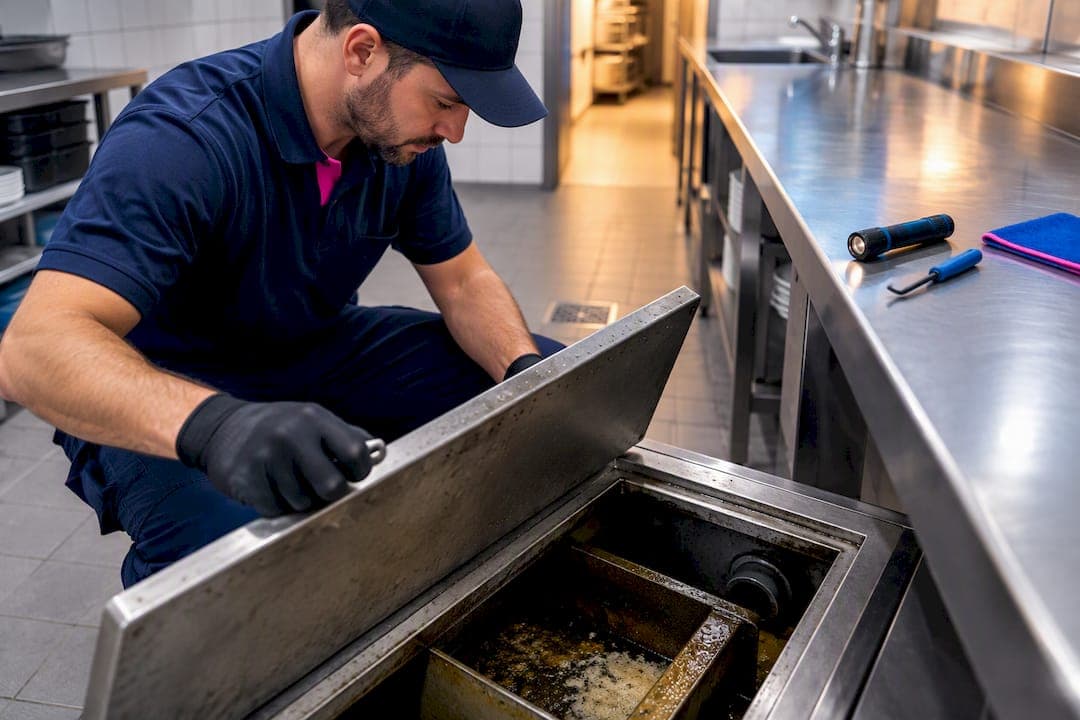
If you run a commercial kitchen in Victoria, you must hold a Trade Waste Agreement with your local water corporation and keep a properly sized grease interceptor in service. Pump-outs need to be carried out by an EPA-licensed waste transporter, typically every few months depending on your agreement. Installation, repairs and disconnection must go through a licensed plumber with water authority approval.
TL;DR:
- Most food businesses discharging fats, oils, or solids into the sewer must hold a Trade Waste Agreement and install a properly sized grease interceptor based on their kitchen size and flow.
- Pump-outs are typically required every three to four months and must be performed by an EPA-licensed waste transporter, with all maintenance carried out by licensed plumbers under approved standards.
- Failure to maintain the correct size or missed pump-outs can result in fines, enforcement notices, or disconnection of trade waste access, emphasizing the importance of proactive record keeping.
- Installing and servicing grease traps must follow water authority approval and standards, with regular visual checks and immediate action if warning signs like odours or slow drains occur.
- A professional plumbing service can support compliance through accurate installation, scheduled maintenance, and organizing documentation for audits.
Table of Contents
- Who needs a grease trap and the Trade Waste Agreement requirement
- Sizing and installation requirements: what compliance expects
- Maintenance and pump-out rules: frequency, operator and warning signs
- Record keeping, inspections and what water authorities will check
- Penalties, non-compliance risks and the enforcement process
- Practical compliance checklist for commercial kitchens
- Why grease trap upkeep pays off, and where operators go wrong
- How Dualflow Services supports grease trap compliance
- Sources
- FAQ
Who needs a grease trap and the Trade Waste Agreement requirement
Any business that discharges fats, oils or food solids into the sewer, cafes, restaurants, takeaway shops, caterers and commercial bakeries among them, falls under what water authorities call "trade waste." If your kitchen produces greasy wastewater, you almost certainly need a grease interceptor and a signed Trade Waste Agreement before you connect to the sewer. Water corporations state plainly that food businesses discharging greasy waste must hold this agreement and maintain a working interceptor, as set out in trade waste manuals such as East Gippsland Water's.
Agreements generally come in two tiers, a minor consent for low-volume kitchens and a major agreement for higher-risk or higher-volume operations, and you apply through your local water corporation before you open or renovate.
- Businesses preparing food on-site (cafes, restaurants, takeaway outlets, caterers) typically require a grease interceptor.
- Minor trade waste agreements suit smaller kitchens with modest discharge volumes.
- Major agreements apply to higher-volume or higher-risk operations and often carry stricter monitoring.
- You must notify your water authority when operations change significantly or when the premises changes ownership.
Selling the business or changing your menu enough to alter waste volumes both trigger a notification obligation, and delaying it can leave the wrong party liable for charges.
Sizing and installation requirements: what compliance expects
Water authorities size grease interceptors against your kitchen's appliance load and expected flow, not a flat rule of thumb. Trade waste manuals include sizing tables that map common business types (a small cafe, a full-service restaurant, a high-volume takeaway) to interceptor capacities, with some manuals citing examples from around 250 litres up to 2,000 litres depending on the kitchen's scale and function. Getting this wrong in either direction causes problems: an undersized unit fills too fast and fails, an oversized one wastes space and money.
Installation itself is not a job you can hand to just anyone.
- All installation, repair or disconnection work must be carried out by a licensed plumber under the AS/NZS 3500 series for sanitary plumbing and drainage.
- Placement must follow your water authority's approved drawings and location requirements, not just whatever fits under the sink.
- An undersized or failing unit usually triggers a compliance notice with a set timeframe to upgrade, arranged with your Trade Waste Officer.
If an inspection flags your device as undersized for current volumes, treat that notice as a deadline, not a suggestion.
Maintenance and pump-out rules: frequency, operator and warning signs

Pump-out frequency is not a Victoria-wide number, it is set in your individual Trade Waste Agreement based on kitchen size and risk. South East Water, as one example, typically requires food and oil interceptor pump-outs every four months, and many other authorities apply a similar three to four month baseline, with higher-volume kitchens serviced more often.
Whatever the interval, the job has to be done by someone licensed to do it.
- Confirm your pump-out frequency in your Trade Waste Agreement rather than assuming a standard interval applies.
- Book only EPA-licensed liquid waste transporters, since EPA Victoria classifies and regulates how grease interceptor waste must be handled and disposed of.
- Never attempt to empty or dispose of trap contents yourself, this waste is regulated and self-disposal is not a legal option.
- Watch for early warning signs, rising float layer thickness, persistent odour near the trap, or drains running slower than usual, and bring your pump-out forward if you see them.
Pro Tip: Keep a simple fortnightly visual check of the float layer, if it's approaching a third of the trap's depth, call your transporter before your scheduled date rather than waiting for a blockage.
Record keeping, inspections and what water authorities will check
Water authorities expect proof, not promises, that pump-outs happened on schedule. Keep the transporter's docket, the invoice and, where your authority uses a registration system such as Wastelog, the digital receipt for every single pump-out, since South East Water's Wastelog system is designed to centralise exactly this evidence for audits.
- Retain pump-out dockets and invoices, many authorities expect at least two years of records on hand.
- Store records where they can be produced quickly, an authorised officer can request them with little notice.
- During an inspection, expect checks on the free floating grease layer, the device size against your agreement, and whether transporter dockets match your claimed pump-out schedule.
- If you discover a gap in your records, contact your Trade Waste Officer proactively rather than waiting for an audit to surface it.
Penalties, non-compliance risks and the enforcement process
Missed pump-outs, an undersized device or an unauthorised discharge are the most common triggers for enforcement, and the consequences escalate from there. Water corporations can issue fines, apply additional trade waste charges, or suspend and ultimately disconnect your trade waste consent under Victorian trade waste licensing rules. If you receive a non-compliance notice, contact your Trade Waste Officer immediately, arrange the remedial work they specify, and be ready to hand over pump-out records as evidence you are acting on it.
Practical compliance checklist for commercial kitchens
Staying compliant comes down to routine, not paperwork panic before an inspection.
- Run a quick visual check of the grease trap before or after each shift, and a more thorough weekly check of the float layer and any odour.
- Book pump-outs against your Trade Waste Agreement schedule, and log each one in Wastelog or your transporter's receipt system as it happens.
- Call a licensed plumber for any installation, repair or resizing work, and an EPA-licensed waste transporter for every pump-out.
- Ask your transporter for their EPA licence number and a copy of the docket at the time of collection, not weeks later.
- Keep a compliance folder, digital or physical, with your Trade Waste Agreement, sizing documentation and every pump-out record on-site for inspections.
Pro Tip: Ask your transporter to email the docket the same day, a scanned copy filed immediately is far easier to produce during a surprise inspection than a paper slip hunted down later.
Why grease trap upkeep pays off, and where operators go wrong
The two mistakes I see most are assuming the water authority handles pump-outs, and installing a unit sized for the business's first year rather than its busiest one. Scheduling pump-outs around quiet trading hours keeps disruption low, and having one provider handle plumbing, compliance and maintenance together cuts the back and forth that usually causes missed deadlines.
— Mike
How Dualflow Services supports grease trap compliance
Getting a grease interceptor installed correctly and kept compliant shouldn't mean juggling separate calls to a plumber, a waste transporter and your water authority. A professional plumbing service can handle licensed installation, sizing checks and scheduled maintenance visits, and help facility managers organise documentation expected by Trade Waste Officers.
- Plumbing installation, repair and resizing work carried out to applicable standards.
- Scheduled maintenance visits to identify early warning signs before they escalate to compliance issues.
- Assistance liaising with trade waste officers and organising records needed for audits.
If your grease trap is overdue for a check or you're setting up a new kitchen, get in touch with Dualflow Services to arrange a site visit.
Sources
- Updated plumbing and drainage standards (AS/NZS 3500 series) – Victorian Building Authority
- Grease interceptor trap waste — classification for reuse – EPA Victoria
- Food and oil interceptor – South East Water
FAQ
What are the regulations for grease traps in Victoria?
Victorian food businesses that discharge greasy wastewater must hold a Trade Waste Agreement with their local water corporation and keep a compliant grease interceptor installed and maintained. Installation and repairs must be done by a licensed plumber under the AS/NZS 3500 series, and pump-outs must go through an EPA-licensed waste transporter.
How often should grease traps be serviced?
Pump-out frequency is set in your Trade Waste Agreement rather than a single statewide rule, though a common baseline is every three to four months. South East Water, for example, typically requires food and oil interceptor pump-outs every four months, with busier kitchens often serviced more frequently.
What inspections are required when installing a grease trap?
Installation must follow your water authority's approved drawings and sizing requirements, with the work carried out by a licensed plumber under AS/NZS 3500 standards. Water authorities may inspect the finished installation to confirm the device matches the size and location listed in your Trade Waste Agreement.
How often should a grease trap be emptied?
Emptying schedules depend on your Trade Waste Agreement and kitchen volume, commonly every three to four months as a starting point. Only an EPA-licensed liquid waste transporter can legally carry out the pump-out, since EPA Victoria regulates how this waste is classified and handled.
What records do I need to keep for grease trap compliance?
Keep every pump-out docket, invoice and, where available, digital receipt from systems such as Wastelog, since water authorities commonly expect at least two years of records available for audit. Store these alongside your Trade Waste Agreement and device sizing paperwork so they can be produced quickly if a Trade Waste Officer requests them.