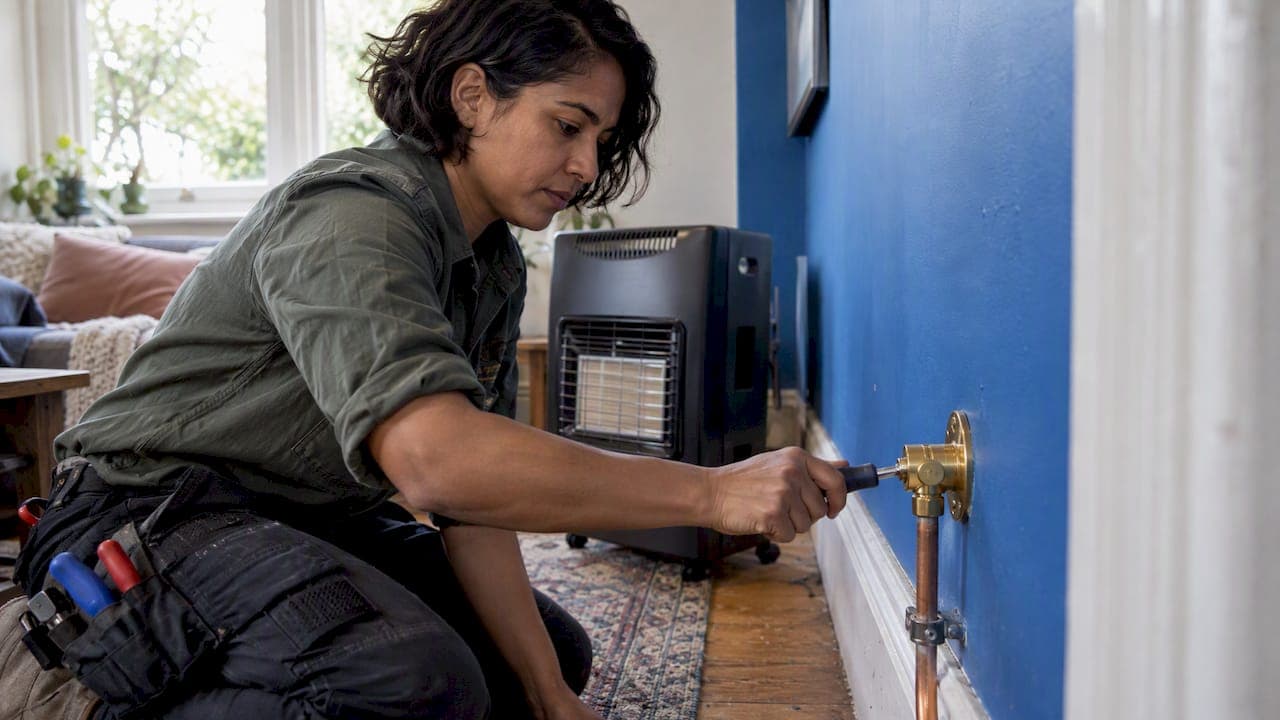
A gas bayonet point is a fixed wall or floor socket that lets you plug in a portable gas heater, BBQ or freestanding gas fire. In Victoria, installing one is gasfitting work, so it has to be done by a licensed gasfitter who then issues a compliance certificate. This guide covers what the job involves, where the point can safely go, what the paperwork looks like and what to check before you book. It is written for Mornington Peninsula homeowners, business owners and managers of aged care, retirement village and disability care sites.
TL;DR
- A bayonet point is the socket half of a quick-connect device. It joins a gas appliance to your gas supply without tools, and it shuts off when the hose is unplugged.
- In Victoria, Energy Safe Victoria says to use a licensed gasfitter for any gas installation. Never do gas work yourself.
- New consumer gas piping needs a compliance certificate, and only a licensed plumber can issue it.
- Location matters: away from doorways, never in bedrooms or bathrooms, and with a restraint for the hose where required.
- Natural gas and LPG are not interchangeable. The appliance, regulator and fittings must match your gas.
Table of Contents
- What a gas bayonet point is and what it does
- Who can install a gas bayonet in Victoria
- The rules that apply to your installation
- Where a bayonet point can and cannot go
- What happens during a bayonet installation
- Natural gas, LPG and the wrong-appliance trap
- Commercial kitchens, aged care and shared facilities
- Our perspective on bayonet installations
- What a bayonet installation costs
- Book a licensed gasfitter on the Mornington Peninsula
- Looking after the point and the appliance afterwards
- FAQ
- Sources
What a gas bayonet point is and what it does
The bayonet is a two-part plug-and-socket. The fixed female socket sits on the wall or floor and is connected to your gas pipework. A hose with a male bayonet connector attaches to the appliance. You push the connector in and twist to lock, as Elgas describes in its guide to bayonet fittings and hoses.
In Australia this arrangement is a Type 1 quick-connect device under AS/NZS 5601.1, the gas installations standard. It is meant for detachable appliances: portable heaters, BBQs and freestanding gas fires. The connection is designed to shut off the gas when the appliance is unplugged.
That shut-off is the reason bayonets are popular. You can move a heater between rooms, unplug it in summer and not leave a live gas line sitting exposed. It is also the reason the socket has to be right: it is a permanent gas outlet in your home or building.
Where bayonets are commonly used
- Living rooms and lounges with a portable gas heater.
- Patios, alfrescos and outdoor entertaining areas for BBQs or patio heaters.
- Common lounges and activity rooms in retirement villages and care homes.
- Commercial kitchens or café areas where mobile equipment needs a flexible connection (this has its own rules, covered below).
Who can install a gas bayonet in Victoria
Only a licensed gasfitter. The Victorian Building Authority defines gasfitting as the construction, installation, replacement, repair, alteration, maintenance, testing or commissioning of gas pipes, appliances, flues, fittings and controls downstream of the gas supply point. A bayonet socket is a fitting on your gas pipework, so fitting, replacing or relocating one falls squarely inside that definition.
The practical reasons go beyond the legal ones. Energy Safe Victoria notes that licensed gasfitters have training and competency, carry insurance and must remedy problems caused by a faulty installation. An unlicensed job offers you none of that, and a leak at a socket can mean fire, explosion or carbon monoxide exposure.
If you already smell gas, stop reading and follow our steps in what to do in the first five minutes if you smell gas.
How to check a gasfitter before they start
Energy Safe Victoria advises customers to inspect the gasfitter's photo ID card and confirm the listed licence class and relevant expertise before work begins. In practice:
- Ask to see the licence card and check that the class covers the work.
- Ask whether they will lodge and give you a compliance certificate for the job.
- Ask about insurance and what happens if a fault appears after the visit.
- Ask them to confirm which gas you have (natural gas or LPG) and how they will match the fittings to it.
If you want a wider view of what separates a properly licensed plumber from a risky shortcut, this overview of licensed plumbing works covers the verification mindset, though the rules that bind your job are Victorian.
The rules that apply to your installation
Three layers sit behind a bayonet installation in Victoria.
The standards. Gasfitting work must comply with the prescribed standards AS/NZS 5601.1 and AS/NZS 5601.2, and certain gas installations require Energy Safe Victoria's acceptance before commissioning. Energy Safe also says amendments to the standards become legally enforceable once published, so your gasfitter works to the current version.
The regulations. The Gas Safety (Gas Installation) Regulations 2018 set out the prescribed standards, consumer piping clearances, installation safety duties and gasfitter responsibilities. Beyond those, the VBA lists the Building Act 1993, the Plumbing Regulations 2018, WorkSafe requirements and the National Construction Code Volume 3 among the instruments practitioners must apply.
The certificate. The VBA says a compliance certificate is required for installation, modification or relocation of consumer gas piping, regardless of job value, except work done for a gas company. Only a licensed plumber can issue it. It must go to you within five days of completion and be lodged with the VBA within the same five days.

Keep that certificate. It is your proof the work was done and checked to standard, and it matters when you sell, when an insurer asks questions, and when an auditor visits a care facility. Our post on the five day lodgement rule for gas certificates explains how the timing works in practice.
Where a bayonet point can and cannot go
Location is where many poor installations go wrong. A hose that is trodden on, tripped over or dragged across a doorway is a hazard, and a socket in the wrong room is a breach of the standard.
Building Commission NSW summarises the AS/NZS 5601.1 requirements in an advisory note, and the same standard applies in Victoria. According to the NSW guidance on connection point location:
- Locate the point so people will not walk across the hose.
- Keep it at least 1 metre from a building doorway.
- Do not locate it in a bedroom, bathroom, sauna, toilet, hallway or residential garage.
- Outdoors, the socket must be at least 300 mm above the ground or floor and have a means of securing a safety chain or wire within 50 mm.
Your gasfitter makes the final call on site, because the exact conditions depend on the building, the appliance and the gas type. Treat these points as a way to brief your gasfitter on what you want, not as a design you can follow yourself.
Planning the position with the appliance in mind
Bring the appliance, or its model details, to the quote. Heater clearances, hose length and where the unit will actually sit all affect the best socket position. A heater that lives in a lounge corner is better served by a floor or low wall socket near that corner than by a socket on the far wall and a hose stretched across the room.
What happens during a bayonet installation
Every site differs, but a licensed gasfitter will typically work through these steps.
- Assess the supply. They confirm whether you are on natural gas or LPG, check the existing pipework and its capacity, and decide whether the new outlet can be supplied safely.
- Agree the location. They check it against the standard and your intended appliance.
- Isolate and fit. The gas is isolated, pipework is extended or modified, and the socket is fixed through the wall or floor.
- Provide accessible isolation. Energy Safe Victoria's guidance on connecting equipment says isolation valves and regulators must be accessible without hazard or undue difficulty, and a connection needs a means of disconnection downstream of isolation.
- Test and purge. The new work is tested for leaks and air is purged from the line. Energy Safe's purging guidance calls for planning, an accurate pipework plan, no other work during purging, suitable purge points and a gas detector.
- Commission and certify. The appliance is connected, checked, and the compliance certificate is issued and lodged.
A straightforward replacement of an existing socket is quicker than a new outlet that needs pipework extended through walls or under a slab. Ask for the scope in writing so you know which one you are paying for.
Natural gas, LPG and the wrong-appliance trap
Bayonet sockets look alike on both gas types, but the appliances and pressures are not the same. Energy Safe Victoria says not to connect LPG cylinders to appliances designed for natural gas. The same page warns that outdoor LPG appliances must never be used indoors, because poor ventilation can cause carbon monoxide poisoning.
That has two consequences. First, buying a portable heater and plugging it into whatever socket is nearest is not a safe plan. Check the appliance data plate for its gas type and approval. Second, a heater designed for outdoor use belongs outdoors, whatever the socket location.
Carbon monoxide cannot be seen or smelled, which is why the checks around the appliance matter as much as the socket. Our guide on questions to ask before a Victorian carbon monoxide test is worth reading if you run heaters in shared or occupied spaces.
Commercial kitchens, aged care and shared facilities
For business owners and facility managers, a bayonet is a connection method with extra conditions.
For commercial catering equipment on castors, rollers or wheels, or designed to slide out, Energy Safe Victoria requires a hose assembly, isolation and disconnection capability, and a wall restraint shorter than the hose assembly and strong enough not to break when the appliance is moved. The detail is in GIS 18 on connecting commercial catering equipment. If your kitchen has a mobile cooktop or fryer, this is the sheet your gasfitter should be working to. Our post on Victorian restaurant plumbing compliance covers the wider obligations.
In residential care, gas is one of several utilities you must plan around. Victoria's guidance for residential aged care services says providers must maintain safe systems, assess fire and other hazards, keep emergency plans current, train staff, test emergency equipment and plan for disruption of essential utilities, including gas. In that setting, a bayonet in a common lounge is not just a convenience. It needs a documented position, a certificate on file, and a plan for what staff do if the supply is lost. Our Victoria guide to plumbing compliance in aged care pulls those threads together.
Our perspective on bayonet installations
Most of the bayonet calls we see do not start as a bayonet job. They start with a resident or owner who has bought a portable heater, found it will not connect to anything, and wants it working before the next cold snap. The pressure to "just get it going" is where mistakes happen: a socket placed where the hose crosses a walkway, a heater matched to the wrong gas, or no certificate left behind.
We treat the socket as part of the whole space rather than a stand-alone fitting. Because we cover plumbing, electrical and heating and cooling under one roof, we can look at the heater, the room, the ventilation and any electrical needs of the appliance in a single visit, instead of leaving you to coordinate three trades. For care sites and villages that is the real saving: one point of contact, one set of records.
Our advice is simple. Decide where the heater will actually live, tell your gasfitter the gas type and the appliance model, insist on the certificate, and book a service for the appliance on a regular cycle. Do not let a heater sit unchecked for years because the socket was installed neatly.
— Mike
What a bayonet installation costs
We do not publish a fixed price for bayonet work, and we would be wary of any page that quotes one number for every job. Three factors move the price far more than the socket itself:
- Pipework. Adding a socket next to existing gas pipe is a small job. Running a new line through walls, ceilings or a slab is not.
- Access and building type. Brick, double-storey and older buildings take longer than a simple wall in an open room.
- Gas type and supply. LPG and natural gas installations differ in regulators and checks, and some sites need pressure or capacity to be verified first.
The cleanest way to compare quotes is to ask each gasfitter the same things: where the socket goes, what pipework is included, whether testing and the compliance certificate are in the price, and whether a call-out fee applies. A quote that leaves out the certificate is not comparing like with like.
A retail bayonet kit from a hardware or gas supplier is only the fitting. It does not include the licensed labour, testing or certificate that make the installation lawful.
Book a licensed gasfitter on the Mornington Peninsula
If you want a bayonet point installed, moved or replaced, we can assess the site, match the fittings to your gas and issue the paperwork. We service homes, businesses, aged care facilities, retirement villages and disability care homes across the Mornington Peninsula and surrounding Melbourne suburbs, and we offer emergency call-out around the clock if a fitting is leaking. See our heating and cooling services or plumbing services, or start from our main page to request a booking.
Looking after the point and the appliance afterwards
A bayonet installation is not the end of the safety job. Energy Safe Victoria's 2026 heating advice is that Victorians should have gas heaters serviced by a licensed gasfitter at least every two years, because carbon monoxide is invisible and odourless.
Between services, a few habits help:
- Check the hose for cracks, kinks or wear each season, and replace it if it is damaged.
- Unplug and store the hose when the heater is not in use for months.
- Keep the area around the socket clear of furniture, curtains and clutter.
- Never use a heater designed for outdoors inside the home.
- If a socket feels loose, hisses or smells of gas, stop using it and call a licensed gasfitter.
For a plain-language walkthrough of what a service includes, see how gas appliance servicing works for homeowners, and why gas heater safety inspections matter for the reasoning behind the two-year rule.
FAQ
Can I install a gas bayonet myself in Victoria?
No. Fitting a socket is gasfitting work, and Energy Safe Victoria says to use a licensed gasfitter and never undertake gas work yourself. A licensed gasfitter also issues the compliance certificate that proves the work meets the standard.
What standard applies to gas bayonet installations?
Victoria prescribes AS/NZS 5601.1 and AS/NZS 5601.2 for gas installations. Your gasfitter applies the current version, along with the Gas Safety (Gas Installation) Regulations 2018 and the location rules for hose connection points.
Can I connect a heater to an existing bayonet point?
Plugging a hose into a correctly installed socket is how the device is designed to work, but the appliance must suit your gas type and be approved for indoor use if it is going inside. If the socket is old, damaged or in a doubtful location, have a licensed gasfitter check it first.
Does a bayonet installation need a compliance certificate?
Yes, where consumer gas piping is installed, modified or relocated. The VBA says the certificate is required regardless of job value, must be given to you within five days of completion and lodged with the VBA within the same period.
Can I buy a bayonet kit and have someone fit it?
You can buy the parts, but the fitting still has to be done by a licensed gasfitter, who will usually prefer to supply fittings that match the job. Ask before you buy, so the parts suit the location, gas type and appliance.
Sources
- Gas installations, AS/NZS 5601.1 preview
- Elgas, gas bayonet fitting and hose
- Energy Safe Victoria, gasfitters
- Victorian Building Authority, gasfitting
- Energy Safe Victoria, AS/NZS 5601 changes
- Gas Safety (Gas Installation) Regulations 2018
- VBA, issuing compliance certificates
- NSW Government, location of connection point for gas hose assembly
- Energy Safe Victoria, GIS 18 connecting commercial catering equipment
- Energy Safe Victoria, GIS 14a purging natural gas
- Energy Safe Victoria, gas and LPG safety outdoors
- Victorian Department of Health, residential aged care natural hazards guidance
- Energy Safe Victoria, home heating safety check
- Plumbing works overview