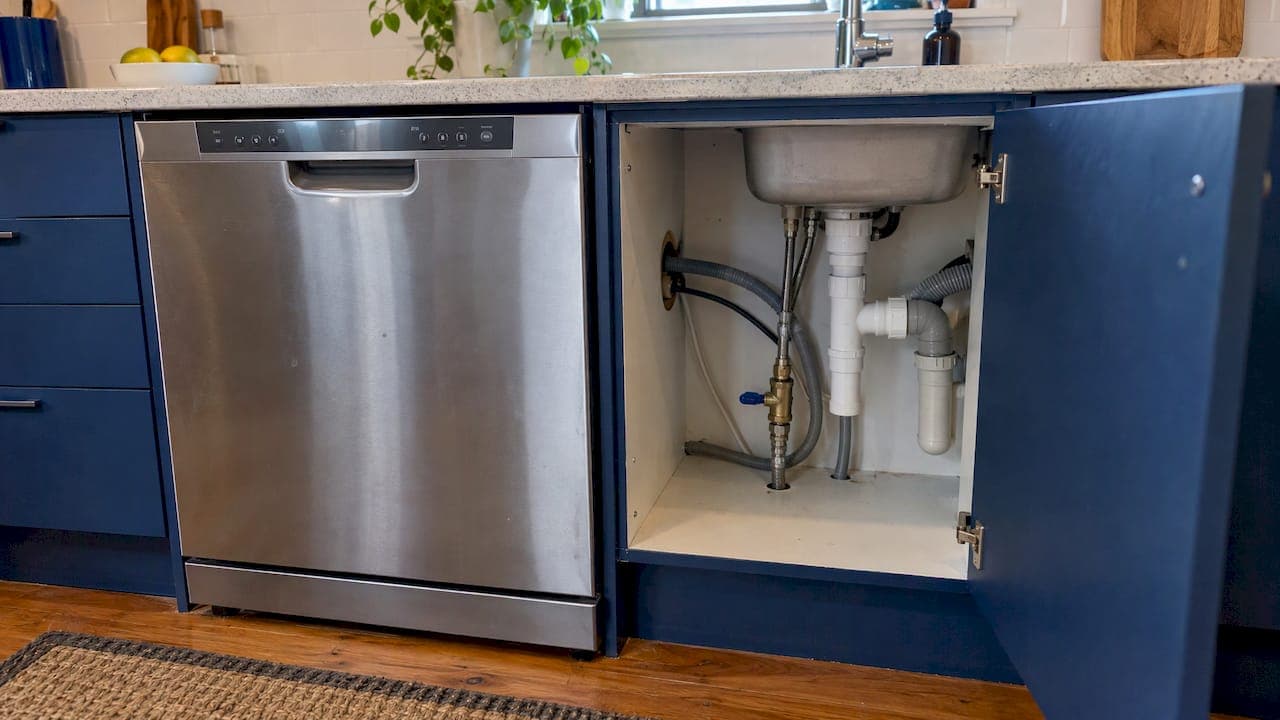
A dishwasher needs four things: a water supply, a drain, a power point and the right cabinet space. If your kitchen already has a tap and drain connection ready behind the cabinet, a replacement is a simple swap. If it does not, you need new plumbing and likely a new power point, and in Victoria that work belongs to a licensed plumber and a licensed electrician. Here is what each connection involves, what a trade will check, and how to avoid the leaks that cause most call-outs.
TL;DR
- A dishwasher needs a water inlet (a dedicated tap or dual-outlet valve), a drain connection (a sink waste or standpipe connection), a power point and a cabinet void that meets the Building Code.
- Replacing a dishwasher with existing connections is straightforward. A first-time installation needs new fittings, and where supply or drain fittings do not exist, CHOICE says a licensed plumber is required.
- The drain hose should be looped high and clamped to prevent siphoning, and the manufacturer's instructions set the exact height.
- Power point and water pipes should sit in the adjacent cabinet, not in the dishwasher's own void.
- Commercial dishwashers in aged care, disability care and hospitality kitchens face extra requirements, including backflow protection and compliant drainage.
Table of Contents
- What plumbing does a dishwasher actually need?
- The water supply connection
- The drain connection and why hose height matters
- Cabinet space and the Building Code
- Who is allowed to do the work in Victoria?
- What a plumber checks before and after connecting
- Slow drains, smells and venting
- Commercial dishwashers in care facilities and kitchens
- Perspective: one booking, three trades
- Getting it installed on the Mornington Peninsula
- A short planning checklist
- FAQ
- Sources
What plumbing does a dishwasher actually need?
Every dishwasher needs power, water, drainage and suitable cabinet space. What that means in practice depends on whether you are replacing an old unit or fitting one for the first time.
Replacement. The new machine connects to the existing inlet tap and drain, using the supplied inlet and outlet hoses, and plugs into the existing power point. If the old connections are in good condition, the job is mostly about hose routing, levelling and testing.
First-time installation. CHOICE describes the work as a new tap connection and a new drain connection with a dishwasher-hose attachment, plus a power point if there is none. These are the parts that change the plumbing in your home, and they are the reason a dishwasher can be a plumbing job, not just an appliance delivery.
The components you will see on a typical job are:
| Component | What it does | Where it sits |
|---|---|---|
| Water inlet tap or dual-outlet valve | Supplies cold or hot water to the machine through the inlet hose | Under the sink or in the adjacent cabinet |
| Inlet hose | Carries water from the valve to the dishwasher | Passes through the cabinet opening |
| Drain hose | Carries wastewater out of the machine | Looped high, then connected to the sink waste or outlet |
| Hose clamp | Holds the drain hose at the connection | At the waste pipe fitting |
| Power point | Powers the machine | Adjacent cabinet, not in the dishwasher void |
The water supply connection
The supply hose connects to a dedicated supply, or to a dual-outlet valve, according to Beko's Australian installation guidance. Before you touch anything, turn off both the water and the electrical supply.
A dual-outlet valve matters most in older homes. Many older kitchens have a single isolation tap feeding the sink mixer and nothing spare. Rather than leave the dishwasher without a feed, a plumber can fit a dual-outlet valve so the same supply serves the sink tap and the dishwasher, each with its own shut-off. That keeps the dishwasher isolatable for servicing without cutting water to the kitchen tap.
A few practical points a plumber will check at this stage:
- Isolation. You should be able to shut the dishwasher's water off without shutting off the whole house.
- Hose condition and routing. Hoses should run without kinks or sharp bends. Kinks restrict flow and wear the hose.
- Fittings and materials. From 1 May 2026, the Plumbing Code requires copper alloy products that contact drinking water to have no more than 0.25% weighted average lead content. A licensed plumber works to that standard when fitting new valves and fittings.
- Leak-free joints. Tighten by hand and then a firm part-turn with a spanner. Over-tightening damages washers and threads.
The drain connection and why hose height matters
The drain hose connects to an outlet or sink waste pipe. Beko's guidance is to keep the hose 50 to 100 cm off the ground. CHOICE adds that the hose should be kept as high as possible in the drain pipe and clamped, because a low hose can create a siphon effect that may damage the appliance.

Siphoning is the quiet problem here. If the drain hose sits low, dirty water can be drawn back toward or through the machine, or the machine can drain when it should be filling. A high loop with a clamp breaks that effect.
The exact height and maximum hose length are set by the manufacturer, and they differ between brands and between markets. Some overseas manuals quote figures in inches or feet that do not match Australian products, so always follow the instructions that came with your machine and your plumber's advice.
Older homes without a drain connection
Many pre-dishwasher kitchens have a sink with a plain U-bend and nothing to connect to. Beko notes that if needed, a tailpiece can be added to the sink's U-bend to take the drain hose. This is a small piece of plumbing, but it is still a change to the waste system and should be done by a licensed plumber.
Proximity helps. Bunnings advises positioning the dishwasher near the sink, with the siphon connection less than one metre away. Extra-long hoses exist for awkward layouts, but a short, direct run is easier to keep tidy and less likely to kink.
If your kitchen layout means the dishwasher would be far from existing pipes, the plumber may need to extend supply and waste lines. That is a bigger job than a hose swap, so it is worth getting a quote before you buy the appliance. If you are planning a refresh, a guide to kitchen upgrades without moving plumbing is a good way to see how much can be improved while leaving the pipework where it is.
Cabinet space and the Building Code
This is the requirement people most often miss. CHOICE reports that under the Building Code of Australia, the dishwasher's power point and water pipes must not sit in the same cabinet void as the appliance. Instead, power, water and drainage are placed in the adjacent cabinet, and the hoses and cable pass through an opening of roughly 100 × 150 mm.
The reasoning is simple. Putting a power point and pressurised water connections in the same tight void as a machine that can vibrate and leak is a hazard. Keeping them next door means you can reach them, isolate them and service them without pulling the dishwasher out.
When you plan a kitchen, think about:
- Which cabinet is next to the dishwasher. It needs room for the valve, the drain connection and the power point.
- The opening between cabinets. It must be big enough for two hoses and the cable to pass without being pinched.
- Access. If the adjacent cabinet will be full of pots, you still need to reach the isolation valve quickly.
- Clearance for the machine. Check the appliance dimensions against the void, including the door swing and the feet adjustment.
If you are renovating, tell the plumber and electrician where the dishwasher is going before cabinets are built. Moving a pipe once a benchtop is down costs far more than placing it correctly at the start.
Who is allowed to do the work in Victoria?
In Victoria, the Building and Plumbing Commission describes sanitary work as including installing or altering above-ground sanitary plumbing that connects fixtures and appliances to tanks, wastewater systems or below-ground sanitary drainage. A dishwasher's drain connection falls squarely in that picture when it involves new or altered waste pipework.
CHOICE puts the practical rule plainly: where the water-supply or drain fittings do not already exist, a licensed Australian plumber is required, and a licensed electrician is required for a new power point. Bunnings makes the same point from the retail side: mains-power work and virtually all plumbing jobs should be done by licensed tradespeople.
A simple way to sort it:
| Situation | Who you need |
|---|---|
| Swapping like for like, with existing tap, drain and power point in good order | Often a straightforward connection by the installer or a plumber |
| New water supply or valve | Licensed plumber |
| New drain connection or altered waste pipe | Licensed plumber |
| New power point | Licensed electrician |
| Drainage below ground | Licensed plumber, with inspection |
Drainage is where the regulator is most active. Victorian drainage work must be performed by a licensed plumber, and underground drainage requires inspection and approval by the BPC before it is backfilled. In a 2025 inspection blitz, 146 of 440 below-ground sanitary drainage inspections failed standards or were not ready, and faulty drainage can cause flooding and structural damage. A dishwasher on its own rarely involves underground work, but if a kitchen move or extension does, that inspection step applies.
There is a practical benefit beyond compliance. Appliance warranties typically expect a correct installation, and a licensed plumber provides the paperwork and accountability if something goes wrong later.
What a plumber checks before and after connecting
Before
- Water and power are off at the source.
- The supply valve works, does not weep and is accessible.
- The drain connection is clear, with no old build-up in the trap or waste pipe.
- The cabinet opening is large enough, and the hoses can run without being crushed by the machine.
- The power point is in the adjacent cabinet and is not shared with an extension lead.
After
Beko recommends running a short test programme and checking for leaks, kinks, excessive vibration or unusual sounds, and confirming the appliance is level. A machine that is out of level can vibrate, drain poorly and wear its door seal unevenly.
Beko also says to plug the dishwasher directly into a mains outlet on the home's circuit breaker system, with no extension cable or multi-plug. Water and power sit close together in a kitchen, and a dedicated outlet removes one common risk.
Watch the first few cycles. Look at the valve, the hose joints and the cabinet floor for moisture. A slow drip at a joint often shows up only once the machine has pressurised and heated through a full cycle. If you see water, our guide to a dishwasher leaking under the sink lists the usual causes.
Slow drains, smells and venting
A dishwasher that drains slowly or leaves a smell is often telling you something about the waste pipe, not the machine. A blocked or partly blocked sink trap, food build-up at the connection, or an unvented waste can all cause gurgling and poor drainage. The national drainage provisions require adequate disposal for sanitary appliances and ventilation to prevent foul air and gases accumulating and to avoid hydraulic load imbalance. If the sink and dishwasher gurgle together, the cause may be venting. Our explainer on how plumbing venting systems work shows what to look for.
If water ever pours from under the sink and you cannot stop it, shut off the supply at the isolation valve or the mains and use our emergency plumbing checklist for Victorian homeowners.
Commercial dishwashers in care facilities and kitchens
The domestic rules above are a starting point. In an aged care home, retirement village, disability residence or commercial kitchen, dishwashers are larger, run more cycles and discharge more water, so the plumbing side carries more weight.
The National Construction Code's plumbing volume covers plumbing and drainage systems in new and existing buildings, and it applies to those systems in all classes of buildings whenever plumbing work is carried out. A commercial dishwasher installation is plumbing work, so it comes under that umbrella.
For commercial catering equipment, the ABCB's technical specification WMTS-101-2025 requires watertight water-service and sanitary-plumbing connections, backflow protection and compliant appliance hoses. Product data should identify the drainage size and position and the permitted water temperature, pressure and flow. The same specification says the equipment must have backflow prevention meeting the stated appliance standards, or be supplied with a backflow-prevention device of the type the Plumbing Code requires. Where an integral waste trap is fitted, it must meet the specified standards.
For facility managers, that translates into questions to ask before purchase and installation:
- Does the product data confirm drainage size and position, and the water temperature, pressure and flow it needs?
- Is backflow protection built in, or does a device need to be fitted on the supply?
- Do the hoses comply?
- Does the kitchen's drainage, including any grease or trade waste arrangements, suit the extra load?
We cover the wider picture in our guides to plumbing compliance in aged care facilities, plumbing upgrades for disability homes, restaurant plumbing and trade waste and commercial kitchen grease trap compliance.
Perspective: one booking, three trades
A dishwasher looks like a one-trade job, and it rarely is. The water and waste are plumbing. The power point is electrical. In a care facility, the hot water supply and the building's compliance obligations come into it as well.
That is why we run plumbing, electrical and heating, cooling and hot water under one roof. When a facility manager books us, they are not coordinating three businesses to get one machine running. One team plans the connections, checks the supply and drainage, and coordinates the power, so the job is finished once and finished properly.
We work with homes, businesses, aged care, retirement villages and disability care homes across the Mornington Peninsula and surrounding Melbourne suburbs, and we offer 24/7/365 emergency availability. Where a dishwasher leak or blocked waste cannot wait, you can call us at any hour.
Our advice is simple. Plan the connections before the cabinets go in, use licensed trades for every new connection, and put scheduled maintenance on your calendar so small drips are found before they become floor damage.
Mike
Getting it installed on the Mornington Peninsula
If you are fitting a dishwasher for the first time, replacing one in an older kitchen, or managing machines across a care facility, we can connect the water supply, drainage and power in a single visit and test the result before we leave. Our team handles plumbing, electrical work and heating and cooling, and we also offer scheduled maintenance, compliance checks and emergency call-outs.
To book an install, a compliance check or a call-out, visit DualFlow Services and tell us about your kitchen or facility.
A short planning checklist
Use this list when you are buying a dishwasher or briefing a trade:
- Measure the void, and note which cabinet is adjacent.
- Identify the existing supply tap or valve, and whether it is a dual outlet.
- Locate the sink waste and check for a tailpiece or standpipe connection.
- Confirm there is a power point in the adjacent cabinet, or book an electrician for a new one.
- Check the manufacturer's drain hose height and length limits.
- Plan access so you can reach the isolation valve without removing the machine.
- Book the licensed plumber before delivery, and run a test cycle on the day.
FAQ
Do I need a plumber to install a dishwasher in Victoria?
If the water supply or drain fittings are not already there, yes: CHOICE says a licensed plumber is required, and a licensed electrician for a new power point. Victorian sanitary work includes installing or altering plumbing that connects appliances to drainage. Even with existing connections, a plumber makes sure the hoses, height and test are right.
Where should the dishwasher drain hose connect?
It connects to an outlet or a sink waste pipe, kept 50 to 100 cm off the ground per Beko's guidance. CHOICE says to keep it as high as possible and clamped to prevent siphoning. If your sink has no connection point, a tailpiece can be added to the U-bend by a plumber.
Can the power point be inside the dishwasher cabinet?
No. CHOICE reports that the Building Code of Australia keeps the power point and water pipes out of the dishwasher's own void. They go in the adjacent cabinet, with hoses and cable passing through an opening of about 100 × 150 mm.
What should I check after installation?
Run a short programme and watch for leaks, kinks, heavy vibration and odd noises, and confirm the machine is level. Check the cabinet floor for moisture after the first few cycles. Plug directly into the wall outlet, not an extension lead or multi-plug.
Are commercial dishwashers regulated differently?
The National Construction Code plumbing volume applies to all building classes whenever plumbing work is carried out. ABCB's commercial catering specification adds requirements such as backflow protection and compliant hoses. Ask your plumber to check the product data against your site before installation.
Sources
- CHOICE: How to install a dishwasher safely
- Beko: How to install your Beko dishwasher
- Bunnings: Retrofit a dishwasher to modernise your kitchen
- Building and Plumbing Commission: Sanitary work
- Building and Plumbing Commission: One in three drains fail BPC inspection blitz
- Building and Plumbing Commission: Victoria leads the way on lead free plumbing under NCC 2025
- ABCB: NCC 2025 Volume Three, Plumbing Code of Australia
- ABCB: Part C2 Sanitary drainage systems
- ABCB: WMTS-101-2025
- Kitchen upgrades without moving plumbing