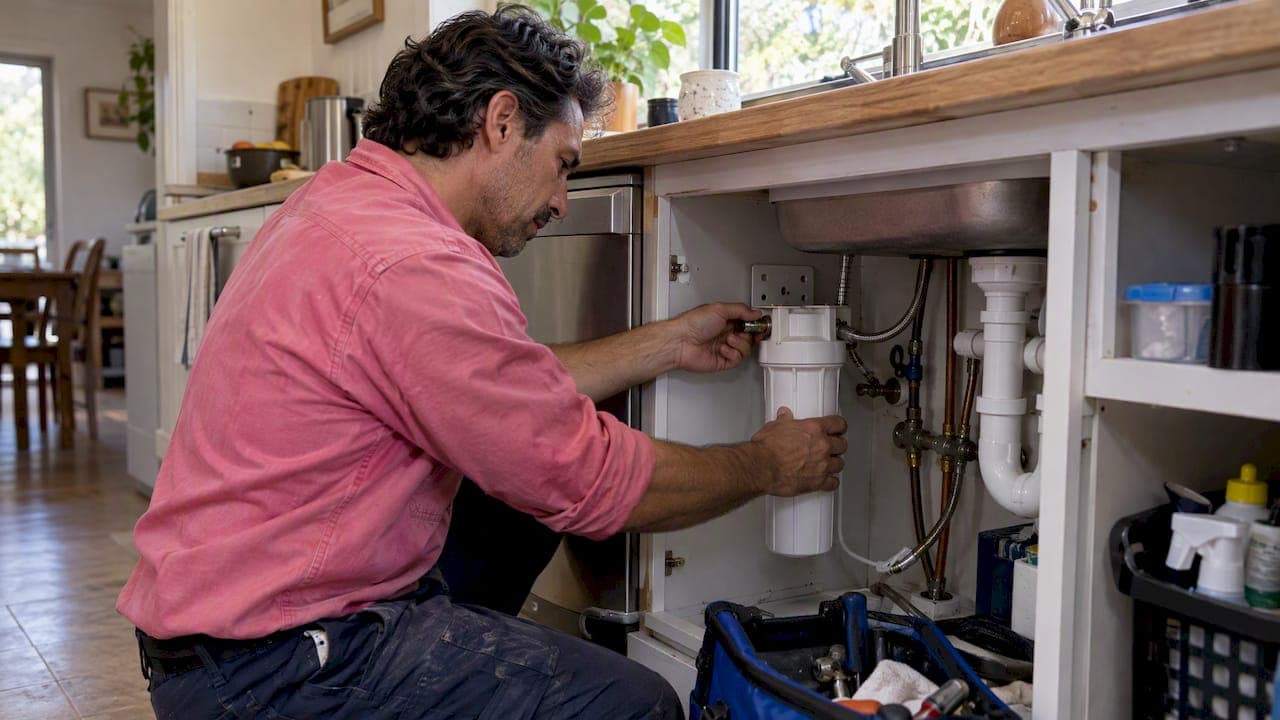
A water filter installation is a small job with a few expensive ways to get it wrong. In Victoria, a filter that connects to your drinking-water supply is plumbing work, so the safest path is a licensed plumber who fits a certified product, tests it and signs it off. This guide covers where under-sink and whole-house systems go, what to check before booking, what upkeep to expect, and the extra points for aged care, retirement villages and disability homes. It also covers evaporative cooler maintenance, because the same site visit often covers both.
TL;DR
- Filters that connect to the mains are plumbing work. Only a licensed plumber can issue a compliance certificate, so use one for anything beyond a plug-in jug or tap-top unit.
- Choose the filter for your water and your problem, then check it carries a WaterMark or Plumbing Safety Type Test mark and is certified to AS/NZS 4348.
- Whole-house systems go near where the main enters the property, and backflow requirements may apply.
- Cartridges need replacing on a schedule. A neglected filter can be worse than none.
- Facilities with vulnerable residents should treat filters, hot water and cooling as one maintenance program.
Table of Contents
- Do you need a licensed plumber to install a water filter?
- Choose the right filter before you book anyone
- Installing an under-sink filter
- Where a whole-house filter should go
- What affects the cost
- Maintenance: how often to change cartridges
- Evaporative cooler maintenance: the other seasonal job
- Aged care, retirement villages and disability homes
- Our perspective: treat the filter as part of the water system
- Book your installation with DualFlow Services
- FAQ
- Sources
Do you need a licensed plumber to install a water filter?
For most fixed filters, yes. The Victorian Building Authority explains that only a licensed plumber can issue a compliance certificate, which certifies that the work meets plumbing regulations, codes and standards. The Building and Plumbing Commission adds that a licensed plumber must issue the certificate to the customer within five days of finishing work that requires one.
The VBA describes water-supply work as covering installation, replacement, alteration, maintenance, testing and commissioning of parts of drinking-water services. Practitioners must apply Victorian plumbing requirements, the WaterMark scheme and the relevant Australian standards.
In practice:
- Jug filters and tap-top units that you screw on yourself do not touch the pipework. No plumber needed.
- Under-sink filters, reverse osmosis units, fridge-line filters with new fittings and whole-house systems are cut into or connected to your water supply. Treat these as licensed work.
A do-it-yourself install can also leave you exposed. A leak behind a cupboard can run for weeks before anyone notices, and an uncertified connection can complicate an insurance claim or a product warranty. If you are unsure about a particular job, ask the plumber whether it needs a compliance certificate before they start.
Choose the right filter before you book anyone
The best installation in the world will not fix the wrong product. Start with the problem you are trying to solve: chlorine taste, sediment, hardness, or a specific concern raised by a water test.
Western Australia's health department advises choosing a filter based on the volume of water and the problem you want to address, and looking for a WaterMark or Plumbing Safety Type Test mark. CHOICE says certification is the best assurance a filter does what it claims, and points to AS/NZS 4348 as the standard covering taste, odour, and microbiological and chemical impurities.
A quick comparison of the common types:
| System | Where it goes | Best for | Watch out for |
|---|---|---|---|
| Tap-top or jug | Tap or benchtop | Renters, low-cost taste improvement | Frequent cartridge changes, small volume |
| Under-sink (carbon block) | Cold line under the kitchen sink, often with its own tap | Drinking and cooking water | Cabinet space, a spare tap hole, cartridge access |
| Reverse osmosis | Under the sink with a storage tank and drain connection | Targeted contaminant reduction | Highest cost to buy, install and run, and wastewater |
| Whole-house | Near where the main enters the property | Every tap, shower and appliance | Pressure, space, backflow requirements |
The WA health guidance notes that reverse osmosis is the most expensive filter type to buy, install and operate. That does not make it wrong. If you have a specific contaminant to deal with, it can be the right tool. For taste and odour in a town-water supply, a certified carbon filter is usually enough.
Do you need a filter at all?
Melbourne-area and Peninsula households mostly receive treated, regulated mains water. Many people still want better taste, or have tank water, bore water or a particular concern. If you are not sure, decide on the problem first. A filter is a tool for a defined problem, not a default upgrade.
Installing an under-sink filter
An under-sink system is the most common job. A plumber will typically work through these steps:
- Check the cabinet. There must be room for the housing and space to drop the cartridge out for changes. Clear the cupboard before the visit.
- Check the tap position. Many systems add a dedicated drinking tap, which needs a spare hole in the sink or benchtop. Some connect to the existing mixer instead.
- Isolate the supply at the stop tap under the sink or at the main, and relieve the pressure.
- Connect to the cold line with approved fittings, then mount the housing and run the tubing.
- Flush and test. New cartridges are usually flushed before first use, and every joint is checked under pressure for weeping.
- Document it. Where a compliance certificate applies, the plumber issues it. Keep it with the filter's manual and the receipt.
Have the filter model and its full kit on hand on the day. Missing brackets or the wrong fitting is the most common reason a job takes a second visit.
What to confirm when you book
- Is the plumber licensed, and will you receive a compliance certificate if the job needs one?
- Does the quote include the fittings, tap and disposal of packaging, or only labour?
- Is the filter certified to the relevant standard and carrying the WaterMark?
- Who do you call if it leaks, and what does the warranty cover?
Where a whole-house filter should go
A whole-house system treats all water entering the property, so it belongs close to the point where the main enters the building, after the meter and before the branches to taps, hot water and appliances. That placement protects everything downstream. It also needs enough space, a stable mounting and room to change the housings.
Before fitting, your plumber should check:
- Pressure and flow. A filter adds resistance. A system sized too small will starve showers and dishwashers.
- Isolation valves and bypass. You want to be able to shut the filter off for servicing without cutting the whole property.
- Hot water compatibility. Check manufacturer limits for connecting upstream of your hot water unit.
- Backflow protection. Some installations need a device that stops water flowing backwards into the supply. The VBA notes that only a licensed plumber with the specialist backflow class can independently test a testable device, with initial testing at commissioning and ongoing testing under AS/NZS 2845.3. That matters most for commercial sites and facilities.
- Future access. A filter wedged behind a water heater will not get serviced.
If an electrical supply is needed, for instance for a UV stage or a pump, that is a separate licensed trade. A business that holds plumbing and electrical under one roof avoids the back-and-forth.
What affects the cost
We do not publish fixed prices, because the job decides the price. Online guides give wide ranges for whole-house work, and we would not rely on a national figure for your property. These are the factors that move a quote:
- Type of system. A simple under-sink unit is a short job. A reverse osmosis unit with a drain connection or a whole-house system takes longer.
- Access. Tight cabinets, slab homes, and long runs to the main all add time.
- Extra work. Relocating a main, adding a pressure-limiting valve, extra isolation valves or a backflow device all add parts and labour.
- The filter itself. Brand, capacity and cartridge cost vary, and so do running costs.
- Call-out timing. A scheduled booking is generally simpler to price than an after-hours emergency.
The cartridge cost over several years often matters more than the install fee. Ask for the replacement cartridge price and interval before you commit.
Maintenance: how often to change cartridges
This is where most home filters fail. The cartridge is a consumable. Left too long, it clogs, slows the flow and can stop doing its job.

WA Health warns that filters can remove disinfectant and allow bacterial regrowth on poorly maintained media, and lists slower flow when filters clog among the downsides. The same page flags the cost of purchase, installation, operation and replacement as the main disadvantages.
Intervals depend on the model and your water. One Australian manufacturer's whole-house manual says cartridges may last up to 12 months in clean metropolitan supplies on the east and southeast coasts, or need changing about every 6 months in harsher rural supplies. It also says prefilters may need replacing about every 6 months, while carbon filters can last up to several years. Always follow your own model's manual.
A simple routine:
- Note the install date on the housing or in your phone calendar.
- Replace cartridges on the manufacturer's schedule, or sooner if flow drops or taste changes.
- If the filter has sat unused, for example in a holiday house, flush it before drinking.
- Do not store filtered water for long periods in open containers.
Evaporative cooler maintenance: the other seasonal job
People researching filters often also ask about evaporative cooling, because both involve water, pumps and seasonal servicing. Evaporative coolers are common on the Peninsula and across regional Victoria, and they should be serviced before the hot months, not during a heatwave.
Seeley International's owner's manual says coolers with a bleed system need seasonal maintenance before and after summer. The checks include:
- the water-distribution channels
- the pump and the pump filter
- the drain valve
- the float valve
- the fan motor
- cleaning the tank
The same manual warns that maintenance on roof-mounted units can be hazardous and suggests using an authorised dealer or service agent. We agree. Working on a roof with live electrical components and water is not a weekend DIY task. Our heating and cooling team handles heating and cooling servicing alongside plumbing and electrical work, so one visit can cover the cooler's water supply, pump and electrical connections.
If your cooler is an older model that has been left unserviced, ask the technician to check the water quality in the tank and the condition of the pads. Stale water is both a smell and a health issue.
Aged care, retirement villages and disability homes
For facilities, a filter is part of a bigger risk picture. Residents may be more vulnerable to waterborne infection and to heat, so water systems and cooling need documented, regular maintenance.
- Filters and infection risk. Filters that are not maintained can support bacterial regrowth, as noted above. Facility managers should build cartridge changes into their scheduled maintenance register, not leave them to memory.
- Legionella. In Victoria, owners of land with cooling tower systems must develop a risk management plan to control Legionella, and approved auditors can audit it. Anyone planning plumbing or cooling changes on a site with such a system should align the work with that plan.
- Heat. The Department of Health's heatwave resource advises residential aged care services to plan for heatwaves by servicing air conditioning and monitoring temperatures, with contingency plans for extreme heat and utility failures.
- Hot water safety. Our guide to TMV testing requirements in Melbourne covers temperature control where scalding is a risk.
For wider obligations, see our plumbing compliance guide for aged care facilities and our article on plumbing upgrades for disability homes. The common thread is one maintenance calendar covering water, hot water, cooling and electrical safety, with records you can show an auditor.
Our perspective: treat the filter as part of the water system
We see the same pattern on the Mornington Peninsula again and again. Someone buys a filter online, a handyman or a relative fits it, and nobody records when the cartridge was last changed. Two years later there is a slow drip, a flat tap or an odd taste, and the filter is the last thing anyone suspects.

We think a filter job should be treated like any other piece of plumbing: right product, right position, proper connections, a record, and a date for the next service. For homes, that means a short conversation about what the filter is for. For facilities, it means the filter joins the same planned schedule as hot water checks, backflow testing, cooler servicing and electrical safety tests.
The reason we offer plumbing, electrical and heating and cooling together is that these jobs overlap. A reverse osmosis unit needs a drain and sometimes a power point. A cooler needs water, a pump and a circuit. Facility managers should not have to coordinate three businesses to keep one building safe, and we are on call around the clock if something fails.
— Mike
Book your installation with DualFlow Services
We install and service plumbing, electrical, heating, cooling and hot water systems for homes, businesses, aged care facilities, retirement villages and disability care homes across the Mornington Peninsula and surrounding Melbourne suburbs. Tell us what you want filtered and where, and we will advise on the right system, fit it, and set up a maintenance plan.
Start with our plumbing services, add electrical work if the system needs power, or get in touch through our main site to arrange scheduled maintenance. For burst pipes and other urgent failures, use our emergency plumbing checklist while you wait for us.
FAQ
Can I install a water filter myself in Victoria?
You can fit a jug or a tap-top filter yourself because they do not alter your pipework. Under-sink, reverse osmosis and whole-house systems connect to the water supply, and only a licensed plumber can issue a compliance certificate for plumbing work. Using one also helps protect your warranty.
How long does a water filter installation take?
A straightforward under-sink unit is usually a short job, often around an hour in a clear cabinet. Whole-house systems take longer, and the time grows if pipework has to be moved or a backflow device added. Clear access to the sink or the main before the visit saves time.
How often should I replace filter cartridges?
Follow your model's manual, because it varies. One Australian whole-house manual suggests up to 12 months in clean metropolitan supplies and about 6 months in harsher rural supplies. Change them sooner if flow slows or the taste changes.
Are there downsides to using a water filter?
Yes. You pay for the unit, installation and replacement cartridges, flow can slow as filters clog, and an unmaintained filter can allow bacteria to grow. Choosing a certified product and keeping to the service schedule manages most of these risks.
How do I know a filter is any good?
Look for a WaterMark or Plumbing Safety Type Test mark, and for certification to AS/NZS 4348 for the claims you care about. CHOICE describes certification as the best available assurance that a filter performs as stated.
Sources
- Engaging a plumber, Victorian Building Authority
- Plumbing compliance certificates, Building and Plumbing Commission
- Water supply, Victorian Building Authority
- Backflow prevention: testing and compliance requirements, Victorian Building Authority
- Water filters for your home, WA Health
- Do you need a tap water filter in Australia? CHOICE
- Whole house system instructions and warranty, High Performance Filtration
- Owner's manual, Seeley International
- Legionella risk management, Victorian Department of Health
- Residential aged care services heatwave ready resource, Victorian Department of Health