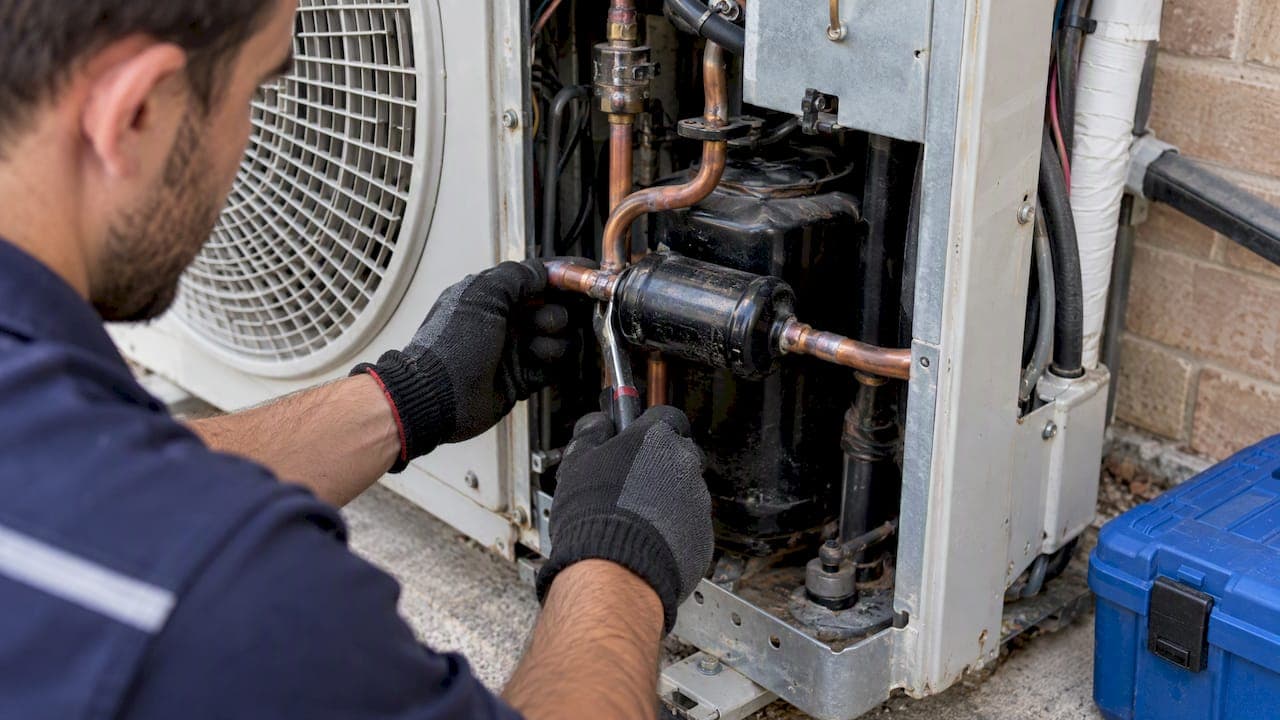
A filter drier should be replaced whenever the refrigerant circuit is opened for a major repair, and sooner if it has clogged or the system has taken on moisture. In Australia the job must be done by someone holding a refrigerant handling licence, and a typical residential job often lands between $300 and $700. Below we explain what the part does, the signs it is failing, how a proper replacement is done and what to ask before you book.
TL;DR
- A filter drier traps moisture, acid and debris in the refrigerant line so they never reach the expansion device or compressor. It is a cheap part that protects expensive ones.
- Replace it every time the sealed system is opened (compressor, condenser or coil work), after a burn-out, or when a pressure drop across it shows it is restricted.
- In Australia, anyone working on a refrigerant circuit needs a Refrigerant Handling Licence from the Australian Refrigeration Council. This is not a DIY job.
- Budget roughly $300 to $700 for a residential unit, because the cost is mostly labour, vacuum and refrigerant handling rather than the part.
- For care facilities and businesses, scheduled checks catch a restricted drier before it becomes an emergency breakdown.
Table of Contents
- What a filter drier does
- When to replace a filter drier
- How a proper filter drier replacement is done
- Who is allowed to do the work in Victoria
- What filter drier replacement costs in Australia
- Our perspective on filter drier replacement
- Planning around it: care facilities and commercial sites
- Need a filter drier checked or replaced?
- FAQ
- Sources
What a filter drier does
A filter drier sits in the liquid line of a refrigeration or air conditioning circuit. Danfoss describes it as having a dual function: it traps coarse particles such as copper shavings, and it captures moisture present in the system.
That matters because moisture and refrigerant oil do not get along. Water in a circuit can form acid, freeze at the metering device and corrode internal parts. Debris can block or score the expansion valve. The drier is the last line of defence ahead of those components.

Technicians put the filtering role first. As the HVAC School podcast on drier basics explains, filter driers mainly stop debris reaching the expansion valves, which is why the best position is close to the expansion valve.
In car air conditioning the equivalent part is usually called a receiver drier. The principle is the same, though the part and the work differ. This article is about home, commercial and care facility systems.
Filter drier, receiver drier and suction line drier
The names get mixed up, so here is the short version.
| Type | Where it sits | Typical use |
|---|---|---|
| Liquid line filter drier | Liquid line, near the expansion device | Permanent protection against moisture and debris |
| Suction line drier | Suction line, before the compressor | Temporary clean-up after a compressor burn-out |
| Receiver drier | Common on vehicle systems | Moisture and debris protection with a refrigerant reservoir |
The distinction is not cosmetic. Actrol's technical guidance notes that liquid line driers protect expansion devices, while suction line driers are a temporary clean-up tool used after a burn-out. Fitting the wrong type, or leaving a suction line drier in place after the clean-up, can hurt system performance.
When to replace a filter drier
There is no fixed calendar interval that suits every system. The reliable triggers are events and measurements.
Replace it whenever the system is opened
The desiccant inside the drier absorbs moisture the moment the circuit is exposed to air. A drier that has been open to the atmosphere, or has already done its job, should not be reused. Repco's guidance for automotive systems says a receiver drier should always be replaced when the system is opened for major repairs such as a compressor or condenser job, and the same logic holds for home and commercial equipment.
In practice, replace the drier when:
- a compressor is changed
- a condenser, evaporator or other major component is replaced
- a leak is repaired and the circuit is opened
- there has been a compressor burn-out and acid contamination is likely
- the old drier is visibly damaged, dented or corroded
Replace it when it is restricted
A new drier should show very little pressure drop across it. HVAC School's field comparison makes this point about pressure drop on a brand-new drier, which is the baseline a technician compares against. As the core loads up with debris and moisture, the drop rises.
A technician can spot this in a few ways:
- A temperature difference between the inlet and outlet of the drier. A cold or frosted outlet suggests a restriction.
- A pressure or temperature reading showing a drop across the drier that should not be there.
- A moisture indicator in a sight glass changing colour, where one is fitted.
- Poor cooling, long run times or icing at the evaporator with no other obvious cause.
A restricted drier starves the evaporator, and the compressor works harder for less cooling. Left alone, that can lead to overheating and expansion valve damage.
Signs you might notice at home or on site
You cannot diagnose a drier by feel, but you can report symptoms. Call a licensed technician if you see:
- weak cooling or heating from a reverse cycle unit that used to perform well
- frost or ice on refrigerant lines
- a unit that runs constantly or short cycles
- a refrigeration room or cool room that struggles to hold temperature
- unusual compressor noise or a trip on overload
These symptoms have many possible causes, including low refrigerant, dirty coils and failed fans. A drier is only one suspect. That is exactly why a measured diagnosis beats guessing.
How a proper filter drier replacement is done
The part is small. The procedure is what protects your system, and it is where cheap or rushed jobs fall down.
1. Recover the refrigerant
The refrigerant has to be recovered into a cylinder, not vented. Releasing fluorocarbon refrigerants is illegal in Australia, which is the reason a licence is required for the work.
2. Cut the old drier out, do not torch it
Trade guidance in ACHR News is clear that you should cut the old drier out with tube cutters rather than unsoldering it with a torch. Heating a used drier can drive trapped moisture back into the system.
3. Fit the right replacement
The new drier must match the system: line size, refrigerant, flow direction and capacity. Flow direction is marked on the shell, and fitting it backwards defeats the purpose.
4. Braze with protection
The same ACHR News guidance recommends a heat shield or wet rag to protect the desiccant core while brazing, and leaving one end open so pressure can vent and the joint does not develop pinholes. Nitrogen flow through the pipe during brazing is standard practice too, to prevent scale forming inside the copper.
5. Pressure test and pull a deep vacuum
This step is the one most worth asking about. Technicians stress that a drier is a safeguard, not the main way to dry a system. The HVAC School podcast notes that good protection relies on a deep vacuum, typically 500 microns or less, before the drier starts its working life. Expecting the drier to dry out a poorly evacuated system is a common mistake and leads to early failure.
6. Recharge and verify
The system is recharged with the correct refrigerant type and weight, then run and checked: pressures, temperatures, superheat and subcooling, and a final leak check.
Cartridge-style driers on larger systems
On larger commercial installations, facility managers may have cartridge-style driers. Danfoss notes that with designs like its DCR, you can replace just the filter core without breaking or soldering the refrigerant piping, which cuts time and cost on bigger plant. It is worth asking about if you are specifying or upgrading a system.
Who is allowed to do the work in Victoria
Replacing a filter drier means breaking into the refrigerant circuit, so it counts as work on refrigeration and air conditioning equipment. The Australian Business Licence and Information Service says you need a Refrigerant Handling Licence to do anything with a fluorocarbon refrigerant as part of that work.
Victoria adds its own layer. Energy Safe Victoria's fact sheet on air conditioning systems says practitioners must hold a refrigerant handling licence, and that installing or replacing systems involves Victorian Building Authority registration and electrical licensing arrangements. The exact requirements depend on the job, so ask the technician what they hold.
Before you let anyone open your system, ask:
- Can I see your Refrigerant Handling Licence?
- Will the refrigerant be recovered, not vented?
- Will you pull a vacuum and what reading will you reach?
- Will you cut out the old drier and shield the new one while brazing?
- Is the work covered by a written warranty?
Any competent tradesperson will answer these without fuss.
What filter drier replacement costs in Australia
There is no single price, because the part is a small share of the bill. One Australian cost guide puts standard maintenance visits at $180 to $450, and a filter drier replacement often in the $300 to $700 range once labour, vacuum evacuation and refrigerant handling are counted. The same source gives commercial hourly rates of $100 to $140 plus GST. Treat those as guides, not quotes.
What moves the price:
- System type. A split system, a ducted unit and a cool room are different jobs.
- Refrigerant. Type and quantity affect recovery and recharge cost.
- Access. Roof, ceiling or plant room access adds time.
- What else is wrong. If the drier clogged because of a leak or contamination, the real repair costs more than the drier.
- Urgency. After-hours call-outs cost more than booked visits.
Be wary of a very low quote for the drier alone. If it skips the vacuum or reuses the old part, you are likely to pay again.
Our perspective on filter drier replacement
Most drier jobs we see are not really about the drier. They are about what the drier was telling someone for months. A restricted drier is a symptom: a leak, an unsealed system, a past burn-out that was never cleaned properly.
So we do not treat it as a swap-and-go. We look at why the drier loaded up, check the vacuum before we close the circuit and make sure the part going in is the right type for the system.

In aged care, retirement villages and disability homes, the stakes are higher than a warm room. Residents can be vulnerable to heat and cold, and a cooling failure in summer is a welfare issue as well as a maintenance one. That is why we favour scheduled maintenance that tracks pressure drop and temperature across the drier, so a restriction is found and fixed on a planned visit. Catching it early avoids the domino effect of compressor overheating and expansion valve damage that follows a total failure.
We run plumbing, electrical and heating and cooling under one roof, with emergency availability around the clock. For facility managers, that means one team to call when a cooling fault also involves a switchboard or a hot water problem.
— Mike
Planning around it: care facilities and commercial sites
If you manage a facility, fold the drier into your routine rather than waiting for it to fail.
- Record pressure and temperature readings at each service so you can see trends, not just one-off numbers.
- Keep a log of every time the refrigerant circuit is opened, and replace the drier each time.
- Ask your contractor to note drier type and size in your asset register so the right spare is available.
- Schedule major service work outside peak summer and winter demand.
Our related guides go deeper on the surrounding work: how commercial air conditioning servicing works, maintaining cooling systems in aged care and HVAC filter maintenance for care homes. If you look after a village, the retirement village maintenance checklist helps you slot cooling checks into the year. Heading into summer, the air conditioning maintenance checklist is a sensible place to start.
Need a filter drier checked or replaced?
We service homes and businesses across the Mornington Peninsula and surrounding Melbourne suburbs, as well as aged care, retirement village and disability care sites. If your system is struggling, or a repair is about to open the refrigerant circuit, our team can diagnose the fault, replace the drier correctly and set up a maintenance schedule that catches the next problem early. See our heating and cooling services or get in touch through our main site to book a visit or arrange an emergency call-out. We do not publish set prices, so we quote after assessing your system.
FAQ
Does a filter drier need to be replaced?
Yes, whenever the refrigerant circuit is opened for a major repair, and whenever it is restricted or contaminated. The desiccant absorbs moisture from the air once exposed, so reusing an old drier undermines the repair. A system that has not been opened can run for years on the original drier, provided it is checked for pressure drop.
What are the symptoms of a bad filter drier?
The common signs are weak cooling, frost on the refrigerant lines, long run times and a noticeable temperature difference across the drier. Several other faults cause the same symptoms, so a licensed technician needs to measure before replacing anything. Compressor overheating is a sign to stop using the unit and call for service.
Can I replace a filter drier myself?
No. Work on a refrigerant circuit requires a Refrigerant Handling Licence in Australia, and the job needs recovery equipment, brazing and a vacuum pump. Doing it wrongly can damage the compressor and release refrigerant illegally.
How much does it cost to replace a filter drier?
For a residential unit, one Australian guide suggests $300 to $700, mostly labour and refrigerant handling. Commercial and care sites vary with system size and access. A written quote after inspection is the only reliable figure.
Sources
- Refrigerant Handling Licence, Australian Business Licence and Information Service
- How much does air conditioning repair cost, ServiceTasker
- Refrigeration filter drier comparison, Actrol
- Filter Drier Basics, HVAC School
- Filter-Driers: HH vs. EK technical and field comparison, HVAC School
- Troubleshooting Filter Driers, Part 2, ACHR News
- Filter driers and sight glasses, Danfoss
- Air-conditioning systems installation and replacements, Energy Safe Victoria