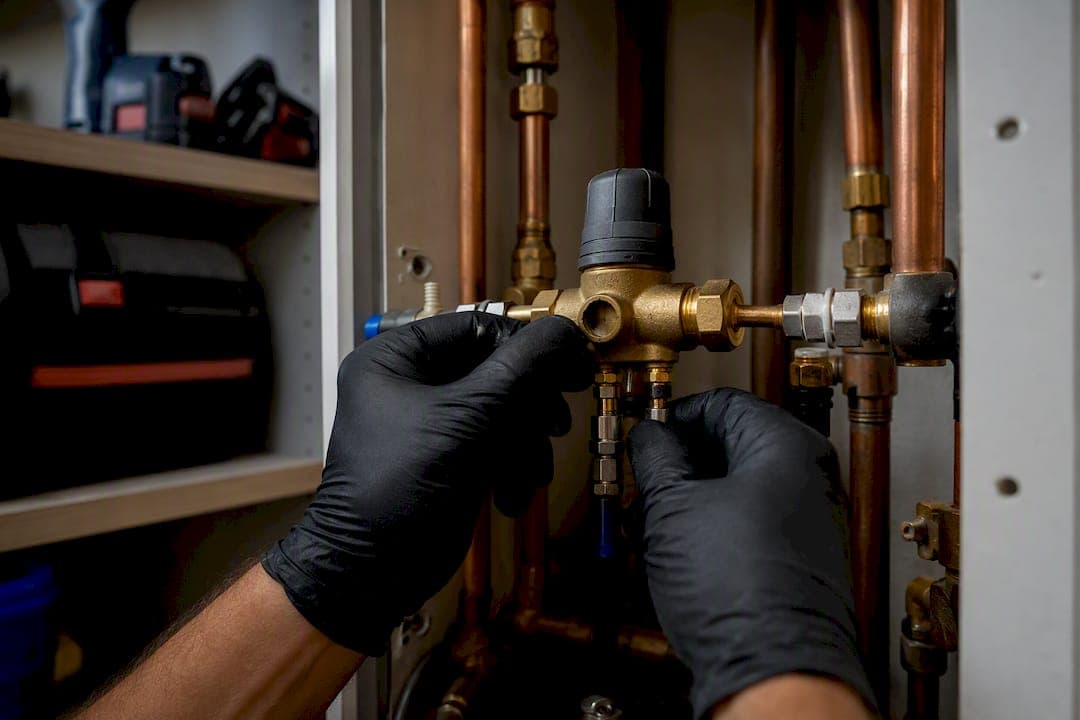
Thermostatic mixing valve testing in Victoria is regulated under the Plumbing Regulations 2018 and must be carried out by a plumber registered or licenced to perform TMV work by the Victorian Building Authority. That's the whole legal position in one sentence. Before you book anyone, ask for their VBA registration number, proof they've completed the CPCPWT4023A/CPCPWT4023 competency unit, and confirmation they've passed the BPC exam where it applies.
Pro Tip: Check the plumber's VBA registration online before you book, not after. Ask for a written test report or certificate the moment the job wraps up, not "sometime this week."
Key Takeaways
Compliant TMV testing in Melbourne requires a VBA-registered plumber with CPCPWT4023 competency and a written test certificate on file for every device.
| Point | Details |
|---|---|
| Confirm registration first | Check the plumber's VBA registration for the TMV class before booking, not after the job starts. |
| Testing counts as regulated work | Part 5 of the Plumbing Regulations 2018 includes testing, maintenance and commissioning, not just installation. |
| Match device to risk level | High-risk sites like aged care and childcare typically run TMVs; standard homes usually use tempering valves. |
| Follow sector testing cycles | Annual testing and five-year overhauls are common practice in healthcare and aged care, but check your facility's own rules. |
| Get it in writing | DualFlow Services provides tester registration details and a written test report after every compliant TMV test. |
Table of Contents
- What counts as TMV work in Victoria, and when testing gets triggered
- DualFlow Services' perspective for Melbourne property managers
- How DualFlow Services handles compliant TMV testing and paperwork
- Frequently asked questions
- Sources
What counts as TMV work in Victoria, and when testing gets triggered
Part 5 of the Plumbing Regulations 2018 casts a wide net. TMV work isn't just swapping out a faulty valve. It covers:
- Construction and installation of new TMVs and tempering valves
- Replacement, repair and alteration of existing units
- Ongoing maintenance
- Testing and commissioning
That last point trips people up. A lot of property managers assume "just a test" sits outside the regulated class. It doesn't. Under the Business and Plumbing Commission's framework, anyone testing a TMV needs the same registration as someone installing one.
There's a practical distinction worth knowing between the two device types. TMVs hold water temperature to a tight tolerance, ensuring precise control, and shut off flow if the cold supply fails, which is why Australian Standard AS 4032.1 governs them and demands that fail-safe behaviour. Tempering valves, covered by AS 4032.2, are the simpler, more common choice in standard residential bathrooms. Hospitals, aged care homes, childcare centres and schools almost always run TMVs because the scalding risk is higher and the margin for error is smaller.
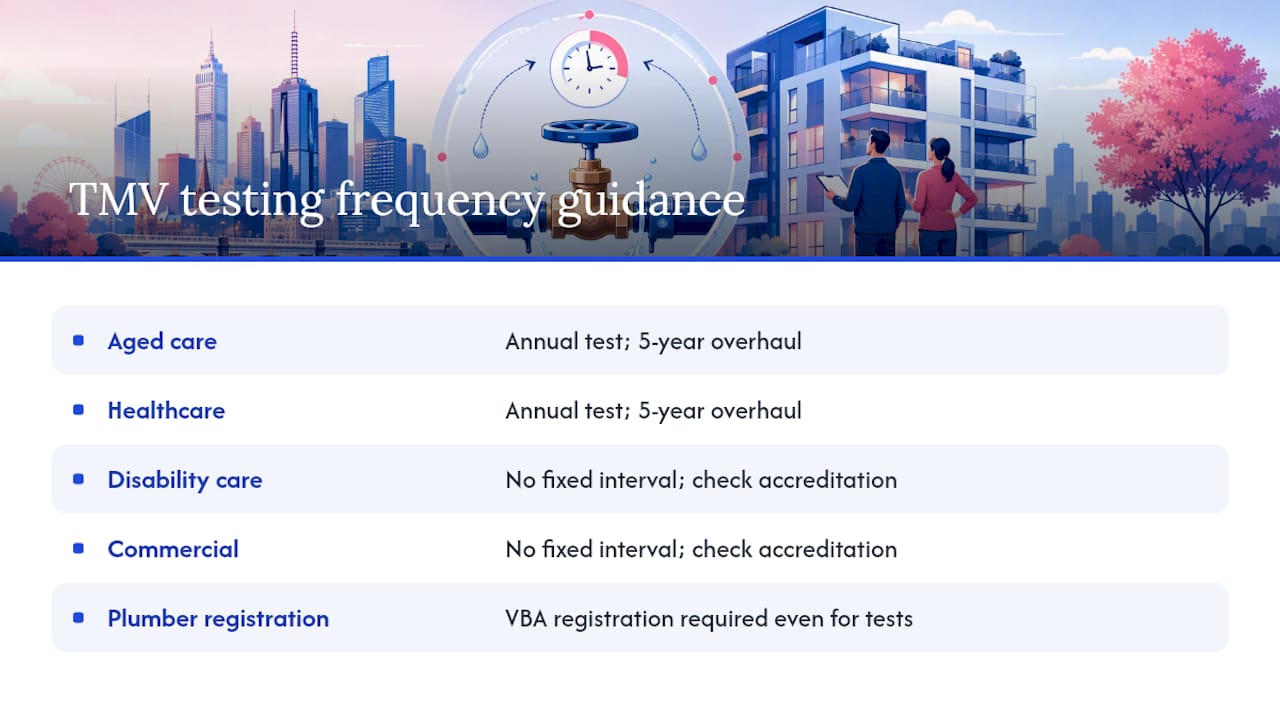
Testing gets triggered at commissioning, straight after any repair or valve replacement, on a scheduled maintenance cycle, and during facility accreditation checks. Sector guidance commonly points to annual testing in healthcare and aged care settings, with a full overhaul at regular multi-year intervals. That's standard industry practice rather than a fixed number written into the regulations, so always check what your specific facility's accreditation body requires on top of it.
Testing, maintenance and commissioning are named activities inside the regulated TMV class under Part 5 of the Plumbing Regulations 2018. There's no informal shortcut where testing sits outside licensing requirements.
DualFlow Services' perspective for Melbourne property managers
Working across aged care, disability and commercial sites on the Mornington Peninsula and into Melbourne's suburbs, we see the same three gaps repeatedly: no proof of tester registration on file, no written certificate after the job, and no scheduled overhaul plan sitting behind the annual test. Always ask for VBA registration details and a certificate showing post-test temperatures plus any corrective action taken.
How DualFlow Services handles compliant TMV testing and paperwork
Chasing down a registered tester, then chasing the paperwork afterwards, eats up time you don't have when you're managing a facility. DualFlow Services runs booked TMV testing, emergency call-outs for valve failures, and scheduled maintenance programs across plumbing, hot water, electrical and heating systems, all under one provider.
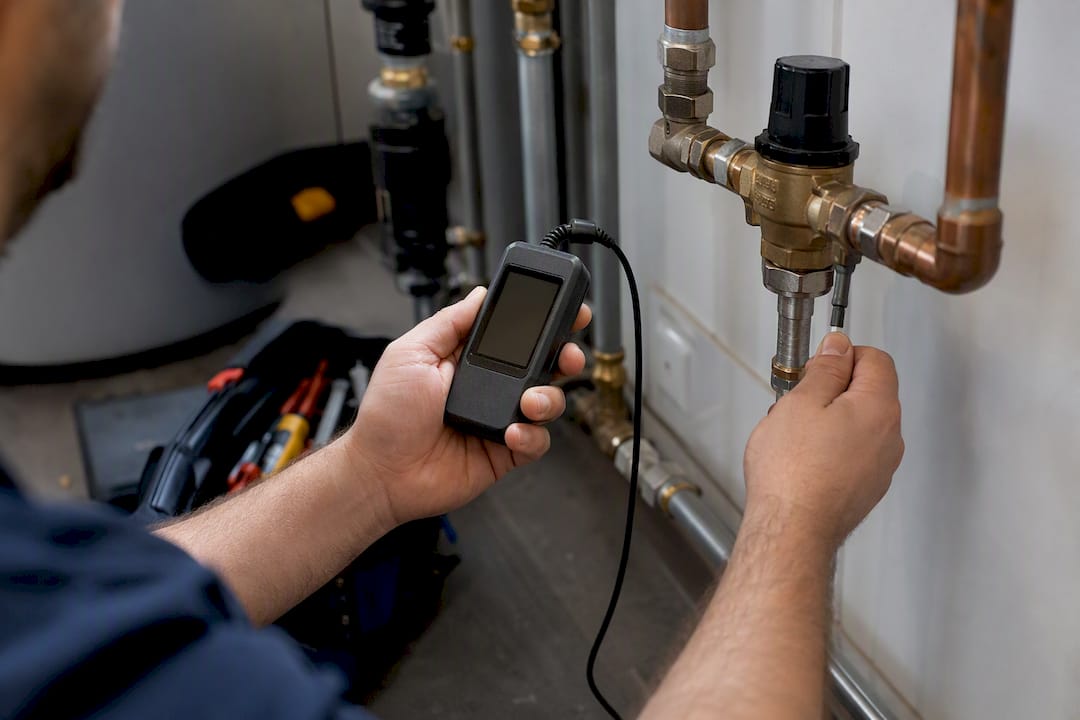
Every compliant test we complete comes with the tester's VBA registration details, evidence of the CPCPWT4023 competency, and a written test report covering post-test temperatures and any corrective work needed. If your site runs TMVs in resident bathrooms or shared facilities, that report becomes the document you hand over at the next accreditation review, no scrambling required. For aged care and disability sites specifically, our guide to plumbing compliance in aged care facilities walks through the broader regulatory picture alongside TMV-specific obligations.
If your last TMV test is more than 12 months old, or you can't put your hands on a written certificate for the last one, book a compliant TMV test with DualFlow Services and get the paperwork sorted before your next audit lands on your desk.
Frequently asked questions
Do I need a licensed plumber just to test a TMV, or only to install one? Testing is included in the regulated TMV class under Part 5 of the Plumbing Regulations 2018. The plumber needs VBA registration for TMV work even if they're only running a test, not doing any repair.
How often does TMV testing need to happen in Melbourne facilities? There's no single number fixed in the regulations for every property type. Sector guidance commonly points to annual testing in aged care and healthcare settings, with five-year overhauls, but your facility's accreditation requirements may set a different schedule.
What should a TMV test certificate actually include? Look for the tester's VBA registration number, evidence of CPCPWT4023 competency, the post-test temperature readings, and any corrective action recommended or completed.
What happens if a facility uses an unregistered tester? The test itself may not satisfy Victoria's TMV work requirements, leaving the facility without valid compliance evidence for accreditation or insurance purposes, and exposing the site to the safety risk the testing was meant to catch.
Sources
- Thermostatic mixing valve (TMV) work — Business and Plumbing Commission (BPC)
- Thermostatic mixing valve — Victorian Building Authority (VBA)