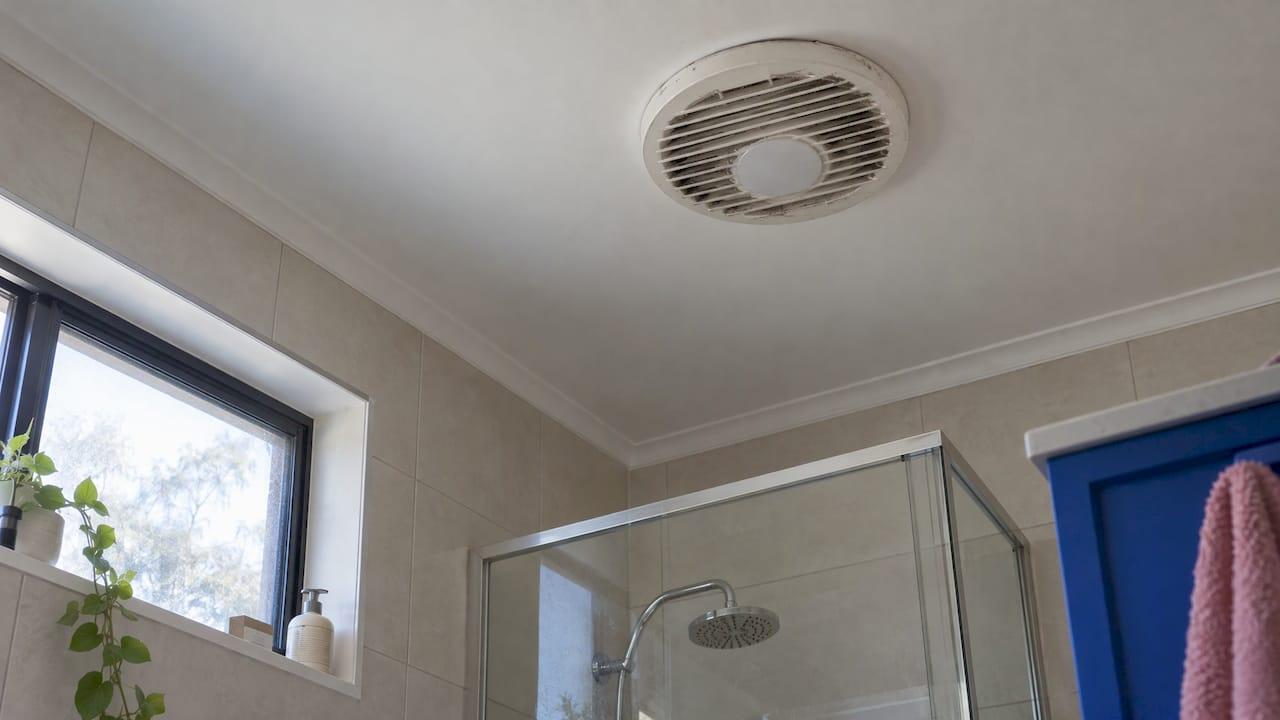
A noisy bathroom extractor fan is usually telling you one of three things: dust or a loose part is making it rattle, the bearings are wearing out, or the ducting behind it is restricting airflow. Cleaning the cover safely fixes the first. The other two need the fan or its ducting assessed. In Victoria, any work on the fan's wiring or a hardwired replacement must be done by a licensed electrician. At DualFlow Services we do plumbing, electrical and heating and cooling on the Mornington Peninsula, so one call covers the fan, the wiring and the duct.
TL;DR
- The type of noise points to the cause: rattling means something is loose or dirty, grinding or squealing means worn bearings or a failing motor, and whistling or rushing points to restricted ducting.
- You can switch off at the breaker and gently clean the grille and visible blades. Do not open wiring or motor connections.
- A grinding or squealing fan is wearing out and is normally replaced rather than repaired.
- In Victoria, electrical installation work must be done by a registered electrical contractor, who sends a licensed electrician.
- Properties with many bathrooms, such as aged care, retirement villages and disability homes, are best served by a scheduled check rather than waiting for each fan to fail.
Table of Contents
- What your fan's noise is telling you
- Why fans get louder with age
- What you can safely do yourself
- When it is time for an electrician
- How long should a fan last?
- For landlords, aged care and disability homes
- Our view: fix the cause, not the sound
- Getting it fixed on the Mornington Peninsula
- FAQ
- Sources
What your fan's noise is telling you
Before you touch anything, listen. The character of the sound is the quickest diagnostic, and it decides whether a ten-minute clean is enough or whether the fan needs replacing.
| Sound | Most likely cause | What to do |
|---|---|---|
| Rattling or buzzing from the grille | Loose cover, grille clips or screws, or dust unbalancing the blades | Switch off at the breaker, clean and re-seat the grille |
| Scraping or ticking | Blades touching the housing, or debris inside | Switch off, inspect the blades, remove debris you can reach without tools |
| Grinding, squealing or a rough hum from inside the housing | Worn bearings or a failing motor | Book an electrician to assess and replace |
| Whistling or rushing air | Restricted duct, tight bend, crushed flexible duct or blocked outside vent | Have the duct run and outlet checked |
| Low drone felt through the ceiling or wall | Vibration passing into the structure | Check fixings; a tradesperson can re-mount the unit |
| Loud hum with blades not turning | Motor powered but jammed | Switch off at the breaker immediately and call an electrician |
This grouping follows a 2026 guide that treats the type of noise as the key diagnostic: a rough hum, grinding or squeal from inside the housing indicates a motor or bearing issue, scraping or ticking suggests the impeller (the spinning wheel that moves the air) is touching the housing or debris has got in, and a whistle or rushing sound points to a duct restriction. Timing helps too. Note whether the noise happens only while the fan runs, after switch-off, in windy weather or only on a boost setting. That pattern often separates a fan fault from a duct fault.
One point of reassurance. A steady, low motor hum while the blades are turning is normal. What matters is a change: a fan that was quiet last year and is loud now has a reason.
Why fans get louder with age
Australian building inspectors describe the usual path: bearings wear, dust builds up on the blades, and the unit begins to rattle, hum or grind. A noisy fan still moves air, but it is wearing out and can eventually seize. The same inspectors note that most noisy-fan findings are rated minor and monitored, which is fair. The risk is not a sudden hazard. It is that a fan that stops moving air leaves steam in a small room, which is what mould and peeling paint feed on.
Bathrooms are hard on fans. Steam carries fine dust and lint into the motor housing, and the dust sets into a film on the blades. Because the film is rarely even, the wheel goes slightly out of balance and starts to vibrate. Vibration wears the bearings faster, and worn bearings make more noise. That loop explains why a fan that is only a little noisy tends to become very noisy.
Ducting can be the real culprit
Sometimes the fan is fine and the duct is the problem. Restrictive ducting is the most common installation fault behind loud fans: long runs, tight bends, crushed flexible duct, undersized diameter and blocked outside terminals all add resistance. A reducer or tight bend can create high local air speed and turbulence, which sounds like whistling or rushing even though less air is actually moving.

This matters if you are tempted to replace a noisy fan with a bigger one. A stronger fan pushing through the same restricted duct is usually louder, not quieter. Finding the source first stops the same noise returning with a new unit.
The duct also has a destination. Under the National Construction Code, windowless wet areas need 25 L/s of extraction, and the duct must discharge outside rather than into the roof cavity. A duct that ends in the ceiling space pushes warm, wet air onto the roof timbers and insulation. If you want to understand why a roof space needs to breathe as well, this overview of roof ventilation options explains the principle.
What you can safely do yourself
Cleaning is the one job that sits comfortably with a homeowner or a maintenance officer, provided you stay on the right side of the electrical line. The Home Ventilating Institute's maintenance guide sets out a sensible routine, and says to clean the fan at least once a year. Here is how it works in practice.
- Turn off the power at the circuit breaker, not only the wall switch. Confirm that neither the fan nor the light comes on. If your switchboard is unlabelled, that is a good moment to label it.
- Release the grille gently. Most pull down on spring clips or sit on a couple of screws. Do not force it. A cracked clip is a new rattle.
- Wash the grille in mild detergent and water, then dry it fully before it goes back.
- Vacuum the fan body and blades with a brush attachment. Wipe with a damp cloth. Avoid solvents and harsh chemicals, and never let water reach the motor, lamp holder or electrical connections.
- Look at the blades. Dust, a crack or a bent blade explains many rattles. If you can see melted or scorched parts, or smell burning, leave the breaker off and stop.
- Refit the grille and check the clips or screws. If a new rattle appears after cleaning, the grille is almost always not seated properly.
- Restore power and listen. A tissue held near the grille gives a rough idea of suction before and after the clean.
A few cautions from experience of what goes wrong. Compressed air looks like a shortcut but tends to scatter dust or drive it deeper into the motor, so a vacuum with a soft brush is the better tool. Do not remove the motor, touch wiring or unscrew terminal covers. That is electrical work, and in Victoria it is illegal to do your own electrical work and you must engage a registered electrical contractor. In a bathroom, where water and electricity share a small space, that rule is there for a reason.
What about WD-40 or oil?
Please skip the can of WD-40. It is a solvent and penetrant rather than a long-term lubricant, it can attract dust, and it is not recommended on fan motors. Many fan motors are also sealed for life and have no oil port at all. Spraying a sealed motor does nothing for the bearing and can leave a sticky film that collects dust. A squealing bearing is a sign the motor is near the end of its life, so lubricating is a short reprieve at best, and opening the motor to reach it is a job for a licensed electrician.
When it is time for an electrician
Call a licensed electrician when:
- The noise is grinding, squealing or a rough hum that cleaning did not remove.
- The fan hums but the blades are stationary. The motor is energised and cannot turn, so it can overheat. Cut power at the breaker and leave it off.
- You smell burning or see scorching.
- The fan trips the circuit breaker or safety switch.
- The mirror stays fogged and the walls streak with moisture long after a shower, even though the fan is running.
- The fan is old, and the noise has returned after a clean.
Australian inspectors' practical advice is to have an electrician assess the fan and replace it if the noise continues, since work on the fan itself is an electrician's job. Replacing the whole unit is normally more sensible than rebuilding a worn motor, because a new unit comes with new bearings, a new motor and a fresh connection.
What a proper replacement involves
A hardwired fan has to be installed by a licensed electrician to AS/NZS 3000:2018, the Australian wiring standard. Fans in bathroom zones 1 and 2 need at least an IP44 rating, and the circuit needs RCD (safety switch) protection. The IP rating tells you how well the fan resists water. The safety switch cuts power quickly if something goes wrong. In Victoria, installation work is also done by a registered electrical contractor, as Energy Safe Victoria's guidance above explains.
When you choose a replacement, compare three figures: airflow in litres per second, noise in sones or dBA (lower is quieter), and the IP rating for where it sits. For quiet running, look for 1.0 sones or less, and be wary of ignoring the noise rating altogether, which is a common installation mistake. Also check that the existing duct is the right diameter and in good condition, and that the outside vent is not blocked. A quiet fan on a crushed duct will still whistle.
How long should a fan last?
With regular cleaning, a bathroom fan is built to last five, seven or even 10 years. The same tradesman's advice is to clean every six to 12 months, or sooner when dust builds up, and to leave the fan running for 15 to 20 minutes after a shower, or up to 30 minutes if the room has poor ventilation. A fan that gets shut off at the instant the shower stops never clears the room, so it works harder, and the damp keeps depositing dust on the blades.
For a household, this is a small job. For a facility with dozens of ensuites, it is a maintenance schedule.
For landlords, aged care and disability homes
If you manage rentals, retirement villages, aged care or disability accommodation, a noisy fan is more than an annoyance. Residents may sleep lightly, may be in the room for long periods, and may be less able to report a problem. Steam that does not clear is also a hygiene and mould concern. Our guide to ventilation in disability care facilities covers the wider picture.
For rental providers, Victoria's rules also matter. From November 2025, rental properties must meet minimum standards from the moment they are advertised, and rental providers must have a qualified electrician check all wiring, fittings and switchboards at least every two years. A fan that is on its last legs is a sensible thing to deal with while that electrician is on site, rather than as a separate emergency call.

The practical approach in a multi-room building is to treat fans as part of a scheduled round: clean, listen, note any that have changed, and replace them in a batch before they seize. If a bathroom upgrade is planned, the fan is worth deciding on at the same time, and our overview of bathroom plumbing upgrades shows what else tends to be done in the same visit.
Our view: fix the cause, not the sound
Most fan calls we would expect to field fall into two groups. In the first, the fan is fine and has simply collected dust, so a clean fixes it. In the second, the fan is worn, and the sensible response is a replacement fitted properly rather than another round of sprays and tightening.
What we think matters is looking at the whole run from the switch to the outside vent. A fan is wiring, a unit, a duct and an outlet, and a noise can come from any of them. That is why we like one team that covers the electrical side and the ducting and ventilation side, so nobody has to guess which trade owns the problem.
For facility managers, the same thinking applies at scale. DualFlow Services covers plumbing, electrical and heating and cooling under one roof, with 24/7/365 emergency availability and experience in care sector environments. A scheduled maintenance visit that includes the bathroom fans means one booking and one point of contact, instead of a separate call for each trade.
Mike
Getting it fixed on the Mornington Peninsula
If your fan is grinding, squealing, humming without turning, or just louder than it was, we can assess it and replace it. Our electrical team handles the fan and its wiring, and our plumbing and ventilation work sits under the same roof. We work with homeowners, business owners, aged care, retirement villages and disability care homes across the Mornington Peninsula and surrounding Melbourne suburbs. For facilities, we also offer scheduled maintenance, so fans, wiring and compliance checks can be done in one visit.

You can book through our website for an assessment or, if a fan has stopped turning and is humming, call us for an emergency call-out.
FAQ
Why is my bathroom fan so loud all of a sudden?
The most common causes are dust on the blades, a loose grille or screw, or worn bearings. If cleaning the grille and blades with the power off at the breaker does not help, the bearings or motor are likely wearing out. At that point an electrician should assess the fan.
Can I spray WD-40 on a noisy bathroom fan?
No. WD-40 is a solvent and penetrant, not a lasting lubricant, and it can attract dust. Many fan motors are sealed and have no oil port. If the noise is a bearing squeal, the fan is nearing the end of its life and a replacement fitted by a licensed electrician is the lasting fix.
Can I replace a bathroom extractor fan myself?
Not if it is hardwired. In Victoria, electrical installation work must be done by a registered electrical contractor who sends a licensed electrician, and bathrooms add the water and safety switch requirements. You can safely clean the grille and visible blades with the power off at the breaker.
How long do bathroom extractor fans last?
A regularly cleaned fan is built to last five, seven or even 10 years. Cleaning every six to 12 months, and running the fan for 15 to 20 minutes after a shower, helps it reach the upper end of that range.
Sources
- Noisy Worn Exhaust Fans in Bathrooms and Ensuites, Sure Building Inspections
- Why Is Bathroom Fan Noisy? Causes and Practical Fixes, Haven Point
- Care and Maintenance of Your Bathroom Exhaust Fan, Home Ventilating Institute
- Electrical workers, Energy Safe Victoria
- Bathroom Exhaust Fan: How to Choose and Install, Myhomeware
- How to Fix a Noisy Bathroom Fan, About Darwin
- How to Properly Install a Bathroom Exhaust Fan, ReBath
- Exhaust fans: how long to run bathroom fans, Nine
- Minimum rental standards in Victoria, RACV