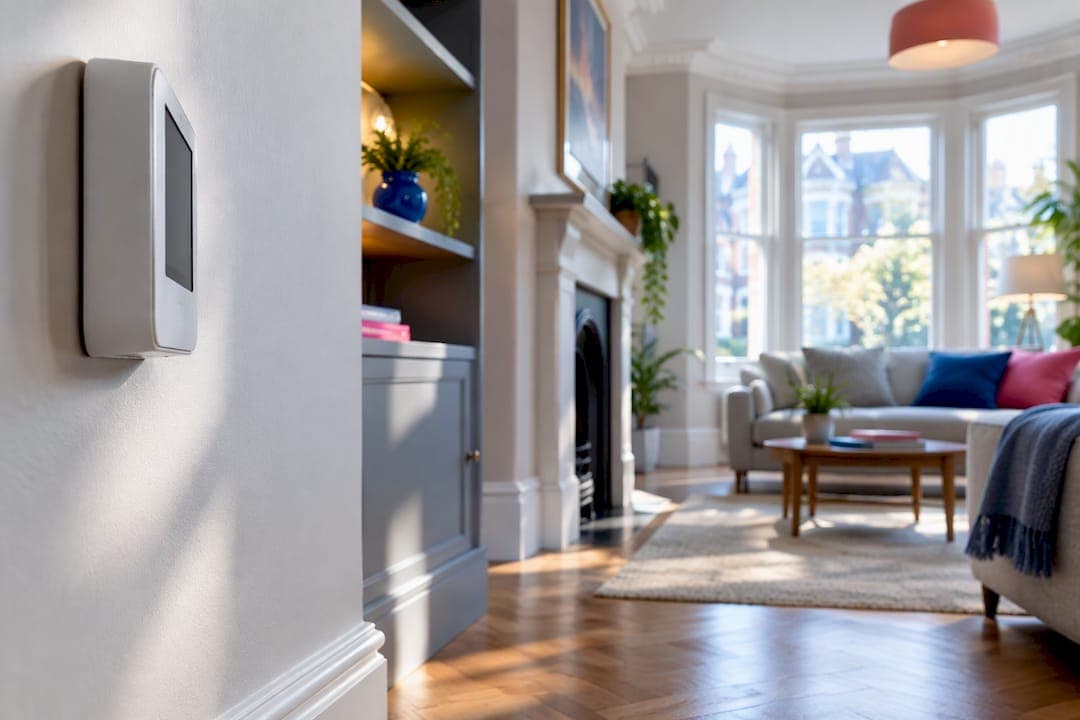
The best thermostat placement is an interior wall in a central, frequently used living space, mounted at around 1.5 metres, well clear of direct sunlight, air vents, and doors. This spot gives the sensor a true read of your home's average temperature. Get it wrong and the system runs longer than it needs to, chasing a reading that doesn't match how the rest of the house actually feels.
TL;DR:
- Placing the thermostat on an interior wall at about 1.5 meters height in a central, well-trafficked room ensures accurate temperature readings for efficient heating and cooling.
- Avoid installing the thermostat on exterior walls, near windows in direct sunlight, above heat sources like stoves or fireplaces, and close to vents or drafty areas to prevent skewed readings.
- Multi-zone homes and heat pump systems require remote sensors or zoning to prevent false triggers and inefficient operation caused by uneven temperature distribution.
- Testing new placement by comparing thermostat readings with a separate thermometer over 24-48 hours helps confirm its accuracy before finalizing location adjustments.
- Consult a professional for wiring, zoning, or complex relocations, especially when handling hardwired systems or multi-stage setups, to ensure safety and compliance.
Table of Contents
- Where to install a thermostat: the best spots and why they work
- Where not to place a thermostat: the mistakes that skew your comfort
- Mounting height and clearance: getting the physical details right
- Multi-zone homes, heat pumps, and split systems need a different approach
- A practical checklist for auditing your thermostat, and when to call a tradie
- Why placement affects smart thermostat accuracy so much
- Digital versus mechanical thermostats: does placement advice change?
- Testing whether your new thermostat location actually works
- What technicians see on the job
- Get your thermostat placement sorted properly
- Sources
- FAQ
Where to install a thermostat: the best spots and why they work
The right wall makes the difference between a system that runs efficiently and one that's guessing. A central living room or main hallway usually gives the most honest picture of how your home actually feels day to day, because it reflects the conditions you and your family spend the most time in.
For single-zone homes, aim for an interior wall on the main level, ideally in the living area rather than a bedroom or study that's used for a few hours a day. Interior walls avoid the temperature swings that exterior walls pick up from outside weather. Steer clear of dead-end hallways, spare rooms, or spaces near the front door that rarely get used, since these locations don't reflect how the rest of the house feels.
Good candidate spots typically share these traits:
- An interior wall, not one backing onto the outdoors
- A central, well-trafficked living space
- Easy access for adjusting settings or replacing batteries
- Away from direct airflow from vents, windows, or doors
Pro Tip: If you're not sure a spot works, stand there for a few minutes at different times of day. If it feels noticeably hotter or colder than the rest of the house, that's your answer.
Where not to place a thermostat: the mistakes that skew your comfort
A handful of common placement errors cause most of the heating and cooling complaints tradespeople see. Each one tricks the sensor into reading a temperature that has nothing to do with how the rest of the house feels.
- Exterior walls absorb outdoor heat and cold, feeding the sensor a false reading that doesn't match indoor conditions.
- Direct sunlight through a window can push a thermostat's reading up several degrees, tricking it into thinking the house is warmer than it is. Homes and Gardens notes that thermostats perform best away from direct sunlight and exterior walls.
- Near supply vents or return grilles, where blasts of conditioned air give an artificially fast, inaccurate reading.
- Above stoves or ovens, where cooking heat can trigger unnecessary cooling.
- Near fireplaces, which throw off heat readings even when not in use, thanks to residual warmth from the chimney breast.
- Bathrooms and kitchens, where humidity, steam, and appliance heat regularly distort temperature and humidity sensors.
Get any of these wrong and your heating or cooling ends up running when it doesn't need to, pushing bills up while parts of the house stay uncomfortable.
Mounting height and clearance: getting the physical details right
Height matters more than most homeowners realise. Warm air rises and cool air sinks, so a thermostat mounted too low reads colder than the room actually is, and one mounted too high reads warmer. Mounting at around 1.5 metres, roughly chest height, gives a representative average reading rather than one skewed by air stratification near the floor or ceiling.
Clearance matters just as much as height. Keep at least a metre from doors, windows, and vents, and never recess a thermostat into an alcove or behind furniture where airflow is restricted.
Practical mounting checks:
- Confirm at least a metre of clearance from any vent, door, or window
- Avoid alcoves, behind-door spots, or anywhere airflow is blocked
- Leave sensors unobstructed by furniture, curtains, or decor
- Keep access clear for battery changes or wiring checks
Pro Tip: A smart thermostat with wifi and app control is still only as good as its physical spot. Even the smartest sensor gets fooled by a sunny windowsill or a blocked vent.
Multi-zone homes, heat pumps, and split systems need a different approach
One thermostat can't represent a whole house once you're dealing with split-level floor plans, large open-plan living areas, or multi-zone heating and cooling. A single sensor picking up conditions in one room will always misrepresent the rest.
Remote sensors and zoning solve this without requiring a full rewire. Smart thermostats paired with remote sensors give you room-level sensing in spaces the main unit can't reach, which matters for split-level homes where upstairs and downstairs rarely sit at the same temperature.
Multi-stage heat pump systems carry a particular risk. Poor placement can trick the system into firing up secondary heating strips when the primary heat pump would have coped fine, driving running costs up for no comfort gain. Watch for these signs you need zoning or remote sensors rather than a single thermostat:
- Big open-plan areas with more than one distinct temperature zone
- Split-level or multi-storey homes with noticeable upstairs/downstairs differences
- Multi-stage heat pump systems that seem to run secondary heat too often
- Additions or extensions that weren't part of the original ducted design
Staging and offsets on these systems are best set up by a technician, not adjusted by trial and error.
A practical checklist for auditing your thermostat, and when to call a tradie
Before you touch any wiring, run a simple audit to work out whether the problem is placement or something bigger.
- Compare readings. Place a separate room thermometer near the thermostat for a day and compare the two. A gap of more than a degree or two points to a placement issue.
- Check the surroundings. Look for direct sun at any point in the day, nearby vents, drafty doors, or proximity to a kitchen or fireplace.
- Track comfort over 24 hours. Note which rooms feel too hot or too cold at different times, and whether that lines up with the thermostat's location.
- Assess the fix. A battery-powered unit on drywall is often a straightforward DIY relocation.
- Check the wiring type. Hardwired systems, multi-stage setups, or anything tied into zoning need a licensed electrician or HVAC technician, since moving a thermostat to a better spot often costs little but requires the right expertise for safe relocation.
Pro Tip: If your readings are inconsistent between rooms, check for common causes when heating isn't working properly before assuming the thermostat itself is faulty.
Call a professional once wiring, zoning, or persistent room-to-room mismatches are involved. Compliance and safety concerns around hardwired electrical work aren't a DIY job.
Why placement affects smart thermostat accuracy so much
A smart thermostat doesn't fix a bad location. It just gives you better data about how bad it is. Learning algorithms, geofencing, and remote scheduling all rely on the sensor reading an accurate baseline temperature, and if that baseline is wrong, every clever feature built on top of it inherits the same error.
Placement above a return vent, for instance, feeds a smart thermostat a stream of already-conditioned air. The system thinks it has hit target temperature fast, cycles off, and the rest of the house never actually catches up. Placement in a sunny corner does the opposite: the unit thinks the house is overheating on a mild day and cranks the air conditioning when nobody else in the house feels warm.
Multi-sensor smart thermostats help here, letting you average readings across two or three rooms rather than relying on one spot. That's a genuine advantage over older single-sensor units, but it doesn't remove the need for sound initial placement of the main unit. A poorly sited primary sensor still skews the average, even with remote sensors contributing data. Think of remote sensors as a correction tool, not a substitute for getting the main location right in the first place.
Digital versus mechanical thermostats: does placement advice change?
Older mechanical, dial-style thermostats use a bimetallic coil that expands and contracts with temperature. They're sensitive to draughts and vibration, and they tend to drift out of calibration over time, so the placement rules for them are stricter, not looser. An interior wall, chest height, away from direct airflow, matters even more with a mechanical unit because there's no software compensating for a slightly off reading.
Digital and smart thermostats use electronic sensors that respond faster and more precisely to temperature change, which is exactly why bad placement shows up more obviously. A digital unit reacts quickly to a blast of hot air from a nearby vent and adjusts the system almost immediately. That responsiveness is normally a feature, but in a poor location, it means the system overreacts to conditions that aren't representative of the whole house.
Wireless and battery-powered digital models add one extra placement consideration: signal strength to any base unit or hub. If your model relies on a wifi connection or communicates with a separate control panel, check signal reliability at the proposed spot before committing to it, particularly in older brick homes with thicker interior walls. Beyond that consideration, the fundamentals remain constant across the technology, whether you've got a decades-old dial unit or a current app-connected model: central, interior, unobstructed, and at a height that reflects the room's actual average temperature.

Testing whether your new thermostat location actually works
Relocating a thermostat is only half the job. Confirming it's actually reading accurately is what tells you the move paid off.
Start with a straightforward comparison test. Place a standalone room thermometer near the thermostat and check both readings at the same time over 24 to 48 hours, across different weather and times of day. If the two stay within a degree of each other consistently, the location is doing its job. Consistent gaps point to lingering sun exposure, draughts, or a vent that's closer than it looks.

Next, walk the house. Spend a few days paying attention to whether rooms far from the thermostat feel noticeably different from the room it's mounted in. A central first-floor location tends to track a whole house's average temperature more reliably than an upstairs spot, since heat naturally rises and upper floors run warmer regardless of what the thermostat says. If bedrooms upstairs still run hot despite a corrected downstairs reading, that's often a case for zoning or a remote sensor rather than another relocation.
Watch your system's run cycles too. A thermostat in the right spot should trigger heating or cooling in reasonably even bursts rather than short, frequent cycles or long, drawn-out ones. Erratic cycling after a relocation usually means something in the new spot, a draught, sun at a particular hour, is still throwing off the sensor. If problems persist after testing and adjusting, a scheduled HVAC check can rule out a system fault rather than a location fault.
What technicians see on the job
The call-outs are almost always the same three culprits: a thermostat tucked behind a door, mounted above a supply vent, or catching afternoon sun through an uncovered window. Most of the time, the fix costs nothing more than a fresh mounting spot and a bit of wall patching.
Homeowners often assume a "smarter" thermostat will fix a bad spot. It won't. Good placement is the foundation everything else sits on, and it's usually the cheapest problem you'll ever solve in a heating and cooling system.
— Mike
Get your thermostat placement sorted properly
Reading this checklist is one thing. Confirming your walls, wiring, and system type actually support the fix is another, and that's where a trades-based, one-stop shop like Dualflowservices earns its keep across plumbing, electrical, and heating and cooling work in the one visit.

If your thermostat sits behind a door, above a vent, or in a sunny corner, relocating a battery-powered unit is often simple. Hardwired systems, multi-stage heat pumps, and anything involving zoning are a different story, and that's where a licensed electrician or HVAC technician earns their fee, checking wiring safety, staging offsets, and compliance in the same visit. Dualflowservices covers installation, relocation, and full system checks for homes, aged care, and retirement living settings across the trades that actually touch your comfort: plumbing, electrical, and heating and cooling. Book an on-site assessment if you're unsure whether your setup needs a simple move or a proper reconfiguration, or if you're dealing with an emergency heating or cooling fault that can't wait.
Sources
For deeper reading on placement rules and mounting standards, Homes and Gardens and MRCOOL cover manufacturer-backed guidance, while Lennox addresses multi-storey homes specifically. Building insulation also affects run times, covered well by Tenen's insulation guide.
- Where should a thermostat be placed? HVAC experts explain | Homes and Gardens
- Guide To Proper Thermostat Placement | MRCOOL
- If your thermostat is in any of these 3 places, it's time to move it - CNET
- Finding the right thermostat location for efficiency | Lennox
FAQ
Where is the best place to install a thermostat?
The best spot is an interior wall in a central, frequently used living area, mounted at around 1.5 metres above the floor. This gives a representative average temperature reading rather than one skewed by a single room's quirks.
Where should you avoid placing a thermostat?
Avoid exterior walls, direct sunlight, spots near supply vents or return grilles, and rooms like kitchens and bathrooms where heat and humidity distort readings. Placement in any of these spots can trigger unnecessary heating or cooling cycles and drive bills up.
Which direction should a thermostat face for the best reading?
There's no single "correct" compass direction, but the wall it sits on should never face direct morning or afternoon sun through a window. An interior wall away from exterior-facing sun exposure gives the steadiest, most reliable reading.
What is a safe minimum indoor temperature for a house?
There's no universal legal minimum for Australian homes, but most heating advice treats a moderate indoor temperature as a reasonable baseline for general comfort and health in occupied living areas. Vulnerable occupants, including the elderly or those in aged care settings, often need warmer conditions, and a scheduled system check can confirm your setup reaches that reliably.
Can Dualflowservices relocate or rewire an existing thermostat?
Yes. Dualflowservices handles thermostat relocation, wiring, and multi-stage system checks as part of its plumbing, electrical, and heating and cooling services across homes, businesses, and care facilities. Pricing depends on the scope of work; current price details can be found on the service provider's website.