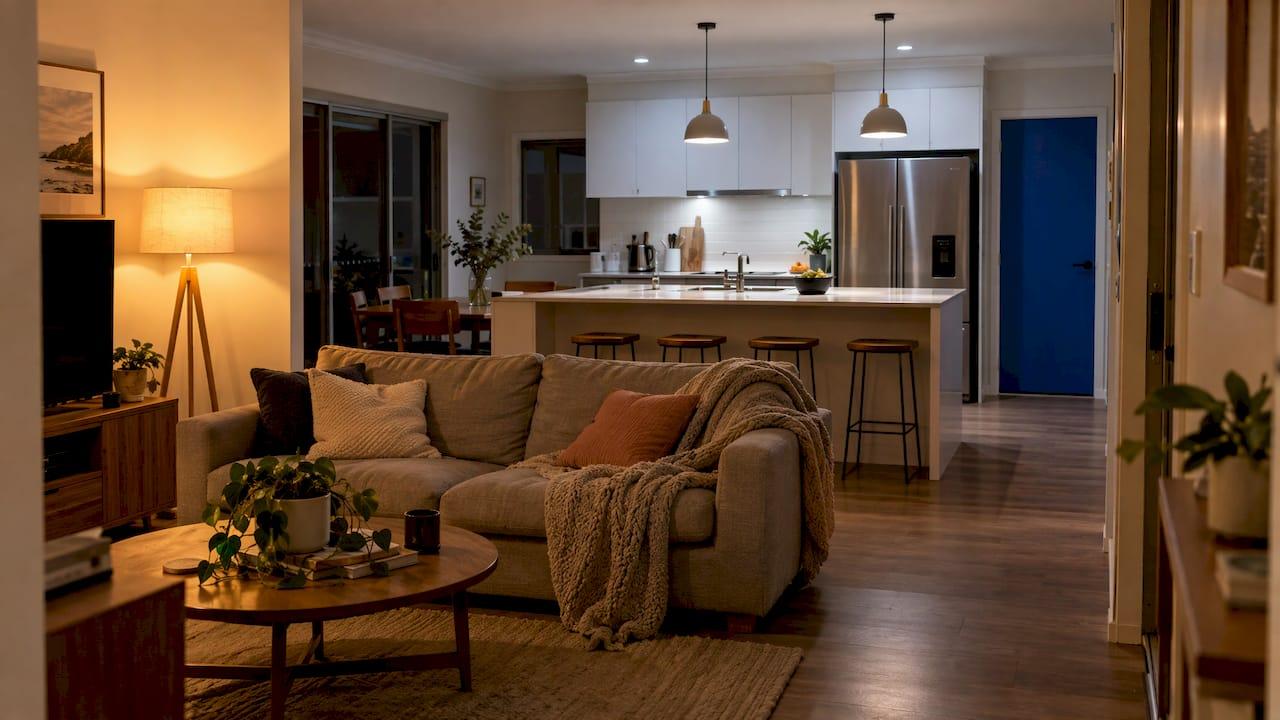
Warm white is a yellow-toned light of about 2700K that suits places where you relax, such as living rooms and bedrooms. Cool white is a crisper, bluer light of about 4000K that suits places where you work or need to see detail, such as kitchens, garages and studies. Neither is better overall. The right choice depends on what the room does, and the Kelvin number on the globe box tells you which one you are buying.
This guide explains what the numbers mean, where each colour works best at home and in the workplace, and how to avoid the common mistakes. It also covers sleep, eye comfort and colour accuracy, which matter more in aged care and disability care settings.
TL;DR
- Warm white (2700K to 3000K) is cosy and amber. Use it in living rooms, bedrooms, hallways and dining areas.
- Cool white (4000K) is crisp and neutral. Use it in kitchens, laundries, studies, garages and workshops.
- Kelvin measures the colour of the light, not its brightness or heat. Brightness is measured in lumens.
- Keep one colour temperature within each room, avoid blue-rich light in bedrooms and at night, and choose a high colour rendering index (CRI) where colours matter.
- If you are unsure about dimmers, circuits or a larger lighting upgrade, a licensed electrician can sort it out safely.
Table of Contents
- What is the difference between warm white and cool white?
- What the Kelvin numbers mean
- 2700K vs 4000K: how they compare in a real room
- Where to use warm white and cool white
- Is warm or cool white better for your eyes?
- The disadvantages of cool white light
- Colour temperature is only half the story: CRI
- Aged care, retirement villages and disability care homes
- Outdoor and wet-area lighting
- Practical tips before you buy
- Need help with lighting circuits, dimmers or upgrades?
- FAQ
- Sources
What is the difference between warm white and cool white?
The difference is the colour of the light. Warm white leans yellow, like an old incandescent globe or a sunset. Cool white leans blue-white, like an overcast sky. Australia's Energy Rating website describes warm white (2,700K) as a yellow-to-white light good for relaxing, and white light (4,000K) as a white-to-blue light better for concentrating or seeing detail.
It is a common misunderstanding that cool white is brighter or warm white is dimmer. Colour temperature and brightness are separate things. A 2700K globe and a 4000K globe can produce the same number of lumens. Cool white can look brighter to the eye because it contains more blue light, but the output is a different measurement. Colour temperature also has nothing to do with how hot the globe gets.
What the Kelvin numbers mean
Colour temperature (CCT) is measured in Kelvin (K). The Energy Rating guide explains that lower numbers give a warmer, amber or yellow tone, and higher numbers give a cooler, bluer tone. It lists warm white at 2,700K, cool white at 4,000K and daylight at 6,500K.

Different official and industry sources draw the lines slightly differently, which is why packaging can be confusing. The government's YourHome guide puts warm white at 2700K to 3200K, cool white at around 4100K and daylight at 5500K to 6500K. The Lighting Council of Australia's LED buyer's guide shows warm white as 2700K to 3000K and cool white as 4000K.
The practical rule is simple: ignore the marketing name and read the Kelvin figure.
| Colour temperature | Common name | Look and feel | Typical use |
|---|---|---|---|
| 2700K | Warm white | Amber, cosy, relaxed | Living rooms, bedrooms, dining |
| 3000K | Warm white | Slightly brighter, still warm | Hallways, rooms needing warmth and clarity |
| 4000K | Cool white (neutral) | Crisp, white, alert | Kitchens, laundries, studies, offices |
| 5000K to 6500K | Daylight | Cold, bluish, harsh | Garages, workshops, task areas |
2700K vs 4000K: how they compare in a real room
The 2700K versus 4000K question is the one most people face at the hardware aisle. Here is how the two behave in practice.
2700K is close to the traditional incandescent and halogen colour many of us grew up with. It flatters skin tones and timber, makes soft furnishings look inviting, and signals the day is winding down. It is the default for living spaces across Australia.
4000K gives a cleaner, more neutral white. Benchtops look sharper, text is easier to read, and a room feels awake. In a lounge room, though, it can feel clinical, like a shopfront.
3000K is the useful middle ground. It stays in warm territory but adds a touch more clarity, which suits rooms that need both warmth and legibility, such as a home kitchen that doubles as the family hangout.
The Lighting Council of Australia advises that personal preference, mood and the application of the space should be the main considerations when choosing, rather than treating any single temperature as universally correct. If you live in a place with a lot of natural light by day, you may find you want warmer globes in the evening than you expected.

Where to use warm white and cool white
The Lighting Council's guide says warm white is typically used in living rooms, bedrooms and hallways to create a relaxed ambience, while cool white is typically used in kitchens, studies, bathrooms, cupboards, offices and retail displays. The Energy Rating site similarly suits 4,000K to studies, kitchens, garages and workshops.
Here is a room-by-room starting point that sits within those recommendations:
| Space | Suggested colour temperature | Why |
|---|---|---|
| Living room | 2700K to 3000K | Relaxed evening atmosphere |
| Bedroom | 2700K | Avoids blue-rich light before sleep |
| Dining area | 2700K to 3000K | Warm and inviting for meals |
| Hallway | 2700K to 3000K | Soft, welcoming |
| Kitchen | 3000K to 4000K | Clear light for food prep, pick the warmer end if it is an open-plan living space |
| Laundry | 4000K | Clean, alert light for tasks |
| Bathroom | 3000K to 4000K | Clear light for grooming; avoid very cold daylight tones at night |
| Study or home office | 4000K | Supports concentration |
| Garage or workshop | 4000K or higher | Detail and safety |
The bathroom is a good example of why you should treat these figures as a starting point. YourHome suggests daylight tones for bathrooms and laundries, but it also warns that daylight colour temperatures should be avoided for night-time use. A bathroom you only use in the morning and a bathroom you walk into at 2am call for different choices. A dimmable or two-circuit setup can cover both.
Keep each room consistent
Avoid mixing 2700K and 4000K globes in the same room or open-plan space. Mismatched colours look patchy, and one set always seems wrong. If you want variety, change the temperature between rooms, or use dimmable lights that you can vary by brightness.
There is a counterpoint for larger rooms. Layered lighting, with warm ambient light and neutral task lighting over benches or desks, can add depth. The trick is to separate the layers clearly: general lighting in one colour, task lighting in a deliberate, different one, rather than a random mix of globes.
Is warm or cool white better for your eyes?
For general comfort, most people prefer warmer light at home, especially in the evening. The International Commission on Illumination's Australian arm notes in its position statement on blue light that cooler, higher colour temperature lamps contain a higher proportion of blue light, and that very high colour temperatures are perceived by most people as unpleasant and uncomfortable, particularly in homes.
On actual eye damage, the same statement is reassuring. It reports no evidence in humans of adverse health effects from occasional exposure at the exposure limits, and says the limits are not exceeded under reasonably foreseeable use for white light sources in general lighting, even blue-enriched ones. The Energy Rating site's health page likewise says studies found normal LED lights used in homes and offices are not a significant blue light risk.
What can cause eye strain is flicker. The same Energy Rating page notes that non-visible stroboscopic effects from some LED lights can distract, affect task performance, and contribute to migraines, eyestrain and fatigue. If a globe or dimmer makes you feel uncomfortable, flicker is a more likely cause than the colour temperature. Our guide to LED dimmer compatibility explains how globe and dimmer mismatches cause it.
The disadvantages of cool white light
Cool white is not a bad light. It is the wrong light in specific situations, and the main one is sleep.
- Bedrooms and evenings. The Energy Rating site says blue light should be avoided in bedrooms because it can suppress melatonin, the hormone the body produces to help you sleep. YourHome advises against daylight colour temperatures for night-time use, such as nightlights, because they may disrupt circadian rhythms.
- Night-time exposure in general. A 2018 submission to the Australian Parliament on sleep health says LED lighting is very blue-rich compared with traditional lighting, names cool white house lights and cool white outdoor lights as common sources, and recommends that artificial lights at night be rated no higher than 3000K.
- Atmosphere. At home, very cool light can feel stark, which is why most people choose it for utility spaces rather than lounges.
If you want the benefits of crisp light during the day without the late-night downside, use cool white in work areas and dimmable warm light wherever you wind down.
Colour temperature is only half the story: CRI
Two globes at the same Kelvin rating can make your kitchen look quite different. That is because of the colour rendering index (CRI), which YourHome describes as a 0 to 100 scale showing how accurately a light shows the colours of objects, with 100 representing true natural colour. YourHome also points out that, whatever colour temperature you pick, a low CRI means nothing will look good under it.
The Australian Energy Rating Lighting Manual groups lamp CRI as 1A (90 to 100, excellent), 1B (80 to 89, very good) and 2A (70 to 79, good). As a rule of thumb, choose a high CRI for kitchens, bathroom mirrors and anywhere you check the colour of food, fabrics or skin. Check the packaging, as CRI is usually printed next to the Kelvin figure.
Aged care, retirement villages and disability care homes
For facility managers, lighting is part of resident comfort and safety, not just style. A few points from official Victorian and Australian sources are worth keeping in mind.
- Colour accuracy. For dementia-friendly environments, the Victorian Department of Health says a bulb with a CRI of 80 or higher can give reasonably accurate colour rendering. It also advises testing colour samples under the proposed lighting to see how they will appear, which is a sensible step before a whole-building changeover. See its colour guidance for dementia-friendly environments.
- Night-time lighting. The parliamentary sleep health submission recommends that residential institutions such as nursing homes and hospitals use lighting that minimises the harmful effects of artificial light at night. In practice, that points towards warm, low-level lighting in resident bedrooms and corridors overnight, and brighter, cooler light in activity rooms, kitchens and staff areas during the day.
- Emergency lighting. Colour choices for general lighting sit alongside mandatory exit and emergency lights. Our guide to emergency lighting testing requirements for Victorian owners covers the testing side.
A mixed approach often works best: daytime-appropriate neutral light in shared spaces, warm light in private rooms, and dimmable circuits so staff can adjust to the time of day.
Our view on warm and cool white
After years of working in homes, businesses and care facilities across the Mornington Peninsula, we see the same pattern. People pick globes by price or by a name on a box, then live with a room that feels wrong. The fix is rarely complicated. Decide what each room is for, pick the Kelvin number to match, and make sure the circuit and dimmer can actually run the globes you chose.
For care environments the stakes are higher. Residents sleep better with warm, low light at night, and staff need clear light to work safely by day. That means thinking about circuits, switching zones and dimming when a building is wired or upgraded, not after. It is one reason we like to handle plumbing, electrical and heating and cooling together: one team who knows the building, one visit instead of three, and fewer surprises for facility managers.
If you are changing a few globes, go for it. If you are changing a whole floor, talk to a licensed electrician first.
Mike
Outdoor and wet-area lighting
Outdoors, the same logic applies with an extra layer: the light is visible to neighbours and affects night-time surroundings. Warm tones are generally the more welcoming choice around homes, and the sleep health submission specifically names cool white outdoor lighting as a common source of blue-rich light. If you are planning lighting around an entry, these driveway gate lighting ideas show how layered outdoor lighting can also save energy.
For spas, pools and other wet areas, fittings must be rated for the environment and installed correctly, so colour choice comes second to safe electrical work. Details on spa lighting and electrical services give a sense of what that work involves.
Practical tips before you buy
- Read the Kelvin figure. Ignore names like soft white or natural white, which vary by brand.
- Choose by room function. Relaxing rooms get 2700K to 3000K. Task rooms get 3000K to 4000K.
- Check CRI. Look for 80 or more for general use, and 90 or more where colour accuracy matters.
- Match globes in a room. Buy the same Kelvin rating for every fitting in one space.
- Check dimmer compatibility. An incompatible dimmer can cause flicker or buzzing. Read our dimmer compatibility guide first.
- Think about the night. Choose warm and dimmable in bedrooms, hallways and bathrooms you use after dark.
- Watch for symptoms. If lights flicker when the air conditioner starts, that points to an electrical fault rather than a colour problem. Our article on faults that make lights flicker when the aircon starts explains the common causes.
Need help with lighting circuits, dimmers or upgrades?
Choosing the colour is the easy part. Making sure the wiring, dimmers and switching suit the globes is where a licensed tradesperson helps. We provide electrical installation, servicing, scheduled maintenance and compliance work for homes, businesses, aged care facilities, retirement villages and disability care homes across the Mornington Peninsula and surrounding Melbourne suburbs, with 24/7 emergency call-out.

See our electrical services or get in touch through the DualFlow Services website to book a visit.
FAQ
What is better, cool white or warm white?
Neither is better in every case. Warm white (2700K to 3000K) suits living rooms, bedrooms and hallways, while cool white (about 4000K) suits kitchens, studies, laundries and workshops. Choose by what the room is used for and when you use it.
Is warm or cool white better for eyes?
For everyday comfort, most people find warmer light easier in the evening. Official sources say normal household LEDs are not a significant blue light risk, so the bigger factors are flicker, glare and having enough light for the task. If lighting causes headaches or eye strain, see an optometrist or your GP.
Is 2700K or 4000K better for a kitchen?
A kitchen used mainly for cooking suits 3000K to 4000K, which gives clear light on benchtops. If it is open to a living area, 3000K keeps it consistent with the rest of the space. Whichever you choose, look for a high CRI so food and finishes look natural.
Can I mix warm white and cool white globes?
It is best not to mix them within one room, because the colours clash and the space looks patchy. Use one temperature per room, or deliberately layer warm ambient light with a separate neutral task light over a bench or desk.
Which colour is best for a bedroom?
Warm white at around 2700K, ideally on a dimmer. Official guidance advises avoiding blue-rich light in bedrooms because it can suppress melatonin, and recommends that lights used at night be rated no higher than 3000K.
Sources
- Choosing the right lamp, Energy Rating
- Lighting, YourHome
- LED Buyer's Guide, Lighting Council of Australia
- Health issues, Energy Rating
- CIE Position Statement on the Blue Light Hazard
- Sleep Health Awareness submission, Parliament of Australia
- Colour, Victorian Department of Health
- Driveway gate lighting ideas
- Spa lighting and electrical services