
Emergency lighting in Australia must be tested at regular intervals with a full battery discharge test, plus an annual inspection, under AS/NZS 2293. In Victoria, results feed the Annual Essential Safety Measures Report, and the building owner carries legal responsibility even when a contractor does the testing. The National Construction Code and Victoria's Building Regulations 2018 both point back to this standard as the benchmark.
TL;DR:
- Six-monthly discharge tests must fully run emergency batteries for 90 minutes and cannot be replaced by monthly function checks.
- An annual physical inspection of fittings and signage is required, with higher-risk buildings often needing more frequent reviews.
- Building owners are legally responsible for compliance, and proper logbook documentation of each test with detailed information is mandatory for audits.
- Records must be kept for seven years and include specific test details such as date, location, tester, results, faults, and remedial actions.
- Incomplete or vague records are the most common cause of failed audits, with a focus on verifying precise luminaire testing rather than relying on blanket statements.
Table of Contents
- Emergency lighting testing requirements: how often and why
- Who's legally responsible, and what paperwork proves it
- How the tests are actually carried out
- What belongs in the emergency lighting logbook
- Common failure points and what non-compliance actually costs you
- A practical checklist for building managers
- Where audits actually go wrong in Victoria
- Where to check the rules yourself
- Get your emergency lighting compliance sorted properly
- Sources
Emergency lighting testing requirements: how often and why
The core obligation is simple to state and easy to get wrong in practice. Every emergency light and exit sign needs a six-monthly discharge test that runs the battery down over 90 minutes, confirming it can actually sustain evacuation lighting for that duration if mains power cuts out. This isn't a quick flick of a switch. It's a full-duration test that mirrors what would happen during a real blackout, and it's mandated at six-month intervals across Victoria under AS/NZS 2293.2.
Alongside that discharge test sits an annual inspection, which checks the physical condition of each fitting: lens clarity, mounting security, signage visibility, and general wear that a discharge test alone won't reveal. Some practitioners align this with the broader maintenance regime under AS 1851, which governs fire safety equipment servicing more generally, though AS/NZS 2293 remains the specific reference for emergency escape lighting itself.
Routine functional checks (monthly button-press tests) are useful for catching obvious faults, but they don't replace the six-monthly discharge, which is the only method that verifies genuine battery capacity under AS/NZS 2293.
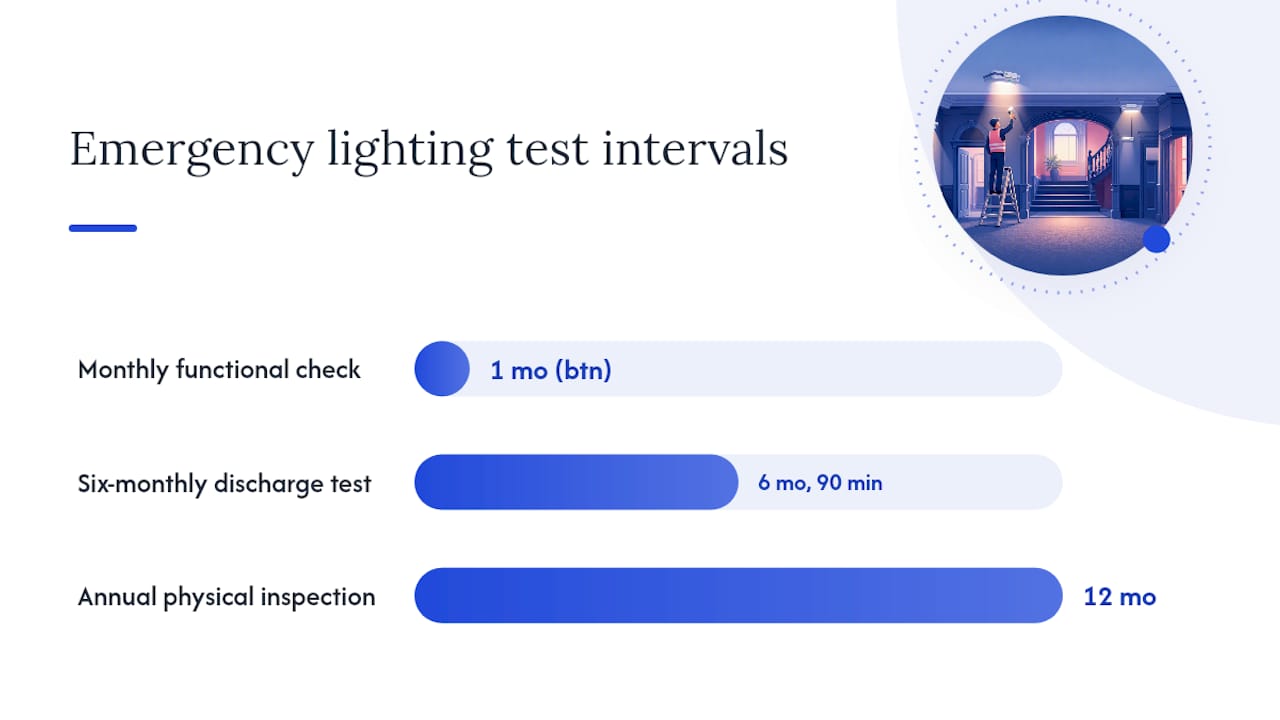
State-level detail matters here. Victoria's Building Regulations 2018 tie emergency lighting compliance directly to occupancy permits and the annual reporting cycle, which gives the state a more prescriptive paper trail than some other jurisdictions. Buildings with higher occupant risk, aged care facilities, hospitals, or venues with large crowds, often face tighter internal review even when the legal minimum stays the same.
What this means in practice for a typical commercial building:
- Periodic discharge test on every emergency luminaire and exit sign
- Annual physical inspection of fittings, mounting, and signage condition
- Monthly functional checks recommended (not a legal substitute for the discharge test)
- Higher-risk occupancies (aged care, disability care, large venues) often warrant more frequent internal reviews
Who's legally responsible, and what paperwork proves it
The building owner is legally responsible for emergency lighting compliance, full stop. Handing the job to a contractor or a facilities manager doesn't transfer that liability. If a fire safety audit turns up a lapsed test or a missing record, it's the owner's name attached to the breach, not the tradesperson who did (or didn't do) the work.
In Victoria, this responsibility plays out through three interconnected obligations:
- The logbook. A continuous, on-site service record documenting every test, inspection, and remedial action, kept in a format that a building surveyor or fire authority can inspect on request.
Owners remain liable even when contractors run the actual tests, which makes signed, dated, attributable entries essential. A logbook filled with vague notes offers no protection in an audit.
How the tests are actually carried out
A proper discharge test isolates the emergency circuit and lets each luminaire run on battery for the full required duration, then checks that light output stays above the required threshold for the entire duration, not just at switch-on. A lamp can glow brightly for the first 20 minutes on a failing battery and still fail the standard well before the 90-minute mark. That's precisely why a quick lamp-press check is not an acceptable substitute: it only proves the globe works, not that the battery can carry the load for the required time.
Measuring whether escape routes get enough light is its own discipline. WorkSafe Victoria's guidance calls for a calibrated light meter held at 1 metre height, with readings taken at 1 metre intervals along the escape path, then averaged to confirm the 20 lux minimum is met along the route, not just at a single bright spot near the fitting.
Three testing approaches are in common use:
- Manual discharge testing, where a technician physically switches each circuit and times the full 90 minutes.
- Self-testing luminaires, which run their own diagnostic cycle and report faults via an indicator light.
- Monitored systems, which centralise test data across a whole building and flag failures automatically.
Whichever method is used, the person conducting the test needs to be competent, meaning they understand the standard, can operate the test equipment correctly, and provide documentation detailed enough for a building surveyor to reconstruct exactly what was checked and when.
Pro Tip: Ask any contractor for a sample logbook entry before they start work. If it just says "all fittings tested, pass", that's a red flag. A proper entry names each luminaire individually.
What belongs in the emergency lighting logbook
Auditors don't accept blanket statements. Each entry needs to stand on its own as proof that a specific fitting, at a specific location, was tested on a specific date by a named, accountable person.
A logbook entry that will survive scrutiny includes:
- Date of test and tester's full name and signature
- Luminaire ID and precise location (floor, corridor, exit number)
- Test type performed and duration (90-minute discharge vs annual inspection)
- Measured illuminance or clear pass/fail result, with margin noted where possible
- Any faults identified during testing
- Remedial action taken and who carried it out
- Next due date for the following test
Recording the margin, not just a pass or fail, has real practical value. A battery that scrapes through at 92 minutes this cycle but drops to 91 next time is telling you something about the rate of battery degradation long before it actually fails. That trend line helps budget replacements before you're staring down an urgent, expensive fix.
Digital logbooks are widely accepted, provided they're backed up and genuinely accessible on site, not locked in a laptop that's gone home with a departed staff member. What matters to a fire authority or building surveyor is that the record exists, is complete, and can be produced without delay.
Common failure points and what non-compliance actually costs you
Most emergency lighting failures trace back to a handful of causes: batteries degrading past their rated capacity, faulty chargers that never fully top up the battery between tests, luminaires mounted in the wrong orientation, or fittings physically obstructed by shelving, signage, or renovation work that reduces the lux reaching the escape route.
When a fault is found, the response should be proportionate but prompt:
- Minor faults (dirty lens, loose mounting) get corrected on the spot and noted in the logbook.
- Battery or charger faults typically mean replacement, followed by a re-test to confirm the fix actually worked.
- Where a fitting can't be repaired immediately, temporary compensating measures (portable lighting, staff briefings) may be needed until it's back in service.
The consequences of skipping any of this aren't abstract. A failed AESMR can trigger a rectification order from the local council, and repeat or serious non-compliance carries fines. Insurance is the less obvious risk: if a fire or evacuation incident occurs and the emergency lighting records don't hold up, insurers can use gaps in documentation to dispute or reduce a claim.
A practical checklist for building managers
Getting this right doesn't require reinventing your maintenance calendar, just being deliberate about sequencing and documentation.
- Schedule the six-monthly discharge tests on a fixed calendar, not on an ad hoc "get to it eventually" basis.
- Pick low-occupancy windows for testing, so a fitting failing mid-discharge doesn't leave anyone genuinely exposed.
- Verify contractor competence before booking, and ask what documentation you'll receive at handover.
- Maintain and back up the logbook somewhere accessible on site, with a digital copy stored off-site too.
- Feed results directly into your AESMR cycle, so the annual report isn't a last-minute scramble to find records.
- Budget for replacements once margin trends start narrowing, rather than waiting for an outright failure.
Staging tests across a building, rather than discharging every circuit simultaneously, avoids a stretch where large sections have no working emergency lighting while batteries recharge. On large or high-occupancy sites, that staging becomes more important, not less.
Pro Tip: If your building has security doors or restricted egress points, check that lighting adequately covers those routes too. Door hardware and egress compliance under the NCC often get overlooked in emergency lighting audits, even though they sit on the same escape path.
Where audits actually go wrong in Victoria
The single biggest pattern we see in failed audits isn't missed tests. It's incomplete records for tests that probably did happen. An entry reading "all fittings tested, pass" tells an auditor nothing verifiable, and it's the fastest route to a rectification order regardless of whether the actual testing was sound.
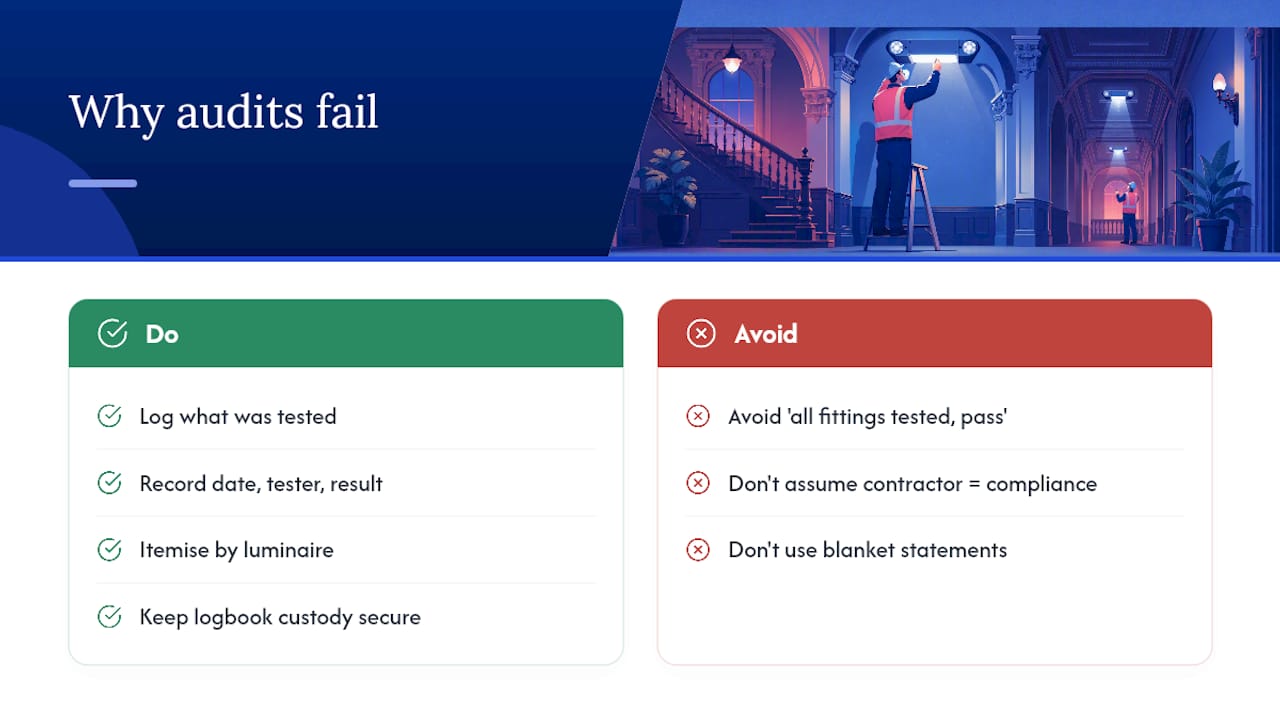
Owners often assume that because a contractor showed up and did the work, the compliance box is ticked. It isn't. The paperwork is the compliance, as far as a building surveyor or insurer is concerned. If the logbook can't reconstruct what was tested, when, by whom, and with what result, the six months of correctly functioning batteries behind it count for very little on paper.
Scheduled six-monthly discharge testing, full AESMR support, and secure logbook custody are available for owners and facility managers across the Mornington Peninsula, including aged care, retirement villages, and disability care homes where the compliance stakes are higher and the paperwork gets scrutinised harder. We record luminaire-level detail from the first visit, not blanket statements, because that's what actually holds up when someone asks for proof.
— Mike
Where to check the rules yourself
For the underlying standard, AS/NZS 2293 sits inside the National Construction Code framework and remains the primary reference for emergency escape lighting and exit sign design, installation, and maintenance across Australia. For Victoria-specific obligations, the Building Regulations 2018 set out logbook retention and AESMR timing, while WorkSafe Victoria publishes practical testing and illuminance measurement guidance. Use the NCC for national design and standard references, and the Victorian regulations plus WorkSafe for how those rules apply on the ground in this state.
Get your emergency lighting compliance sorted properly
Reading the requirements is one thing. Running six-monthly discharge tests, keeping a logbook that survives an audit, and feeding clean records into your AESMR every year, without it eating into your week, is another. Professional services are available to cover the gap for property owners and facility managers across the Mornington Peninsula: scheduled testing, discharge test execution, AESMR-ready documentation, and logbook custody that holds up when a building surveyor asks for it.
This matters most for the buildings where a lapsed record isn't just a fine risk: aged care facilities, retirement villages, and disability care homes, where plumbing, electrical, and essential safety compliance work support is important. If your last emergency lighting test is more than six months old, or your logbook wouldn't survive someone actually reading it, get in touch with Dualflowservices to book a compliance check and start your testing schedule on solid footing.
Sources
- Emergency Lighting Test & Tag Requirements in Victoria
- Emergency lighting on construction sites | WorkSafe Victoria
- National Construction Code (NCC) — ABCB