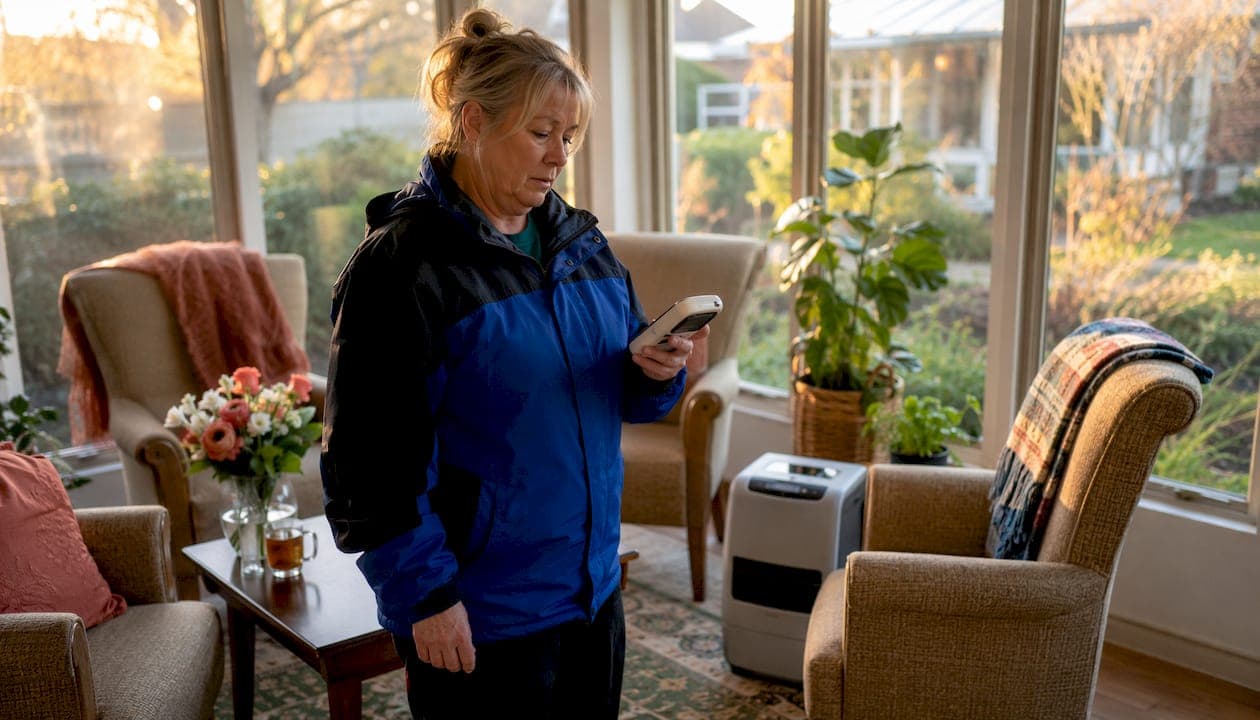
Heating system breakdowns put residents in aged care, disability and community housing at immediate risk of carbon monoxide poisoning, burns, fire, cold-related illness and structural damage. When a system fails, the first priority is people, not the equipment.
Three immediate actions when heating fails:
- Identify the hazard type (gas smell or CO alarm = evacuate; no heat only = protect and warm residents in place).
- Move or protect vulnerable residents, particularly those who are immobile, cognitively impaired or have respiratory conditions.
- Call emergency services if there is any suspicion of CO, fire or gas leak; call an authorised maintenance technician for all other failures and log the time, temperature and resident responses.
Who to contact and what to record: On-site, notify the facility manager and senior carer immediately. For emergency call-out, contact your qualified heating technician. Document indoor temperature readings every 30 minutes, which residents were affected, any symptoms observed and every action taken. This record supports both resident safety and regulatory reporting.
Table of Contents
- What hazards does a heating failure actually create for residents?
- Carbon monoxide: why a heating breakdown can be fatal
- Burns, scalds and entrapment risks from heaters
- Fire and electrical hazards when staff use unsafe temporary heating
- How cold temperatures harm resident health: what the evidence shows
- Common causes of heating system failures staff should know
- Warning signs staff should monitor and escalate every day
- What to do when heating fails: a step-by-step staff checklist
- Prevention through maintenance: what a qualified service does
- Emergency planning for aged, disability and community housing
- System lifespan, repair vs replacement and what it costs in Australia
- Regulatory and compliance pointers for Australian facilities
- Key takeaways
- The thing most facilities get wrong about heating safety
- Dualflowservices: emergency response and scheduled care for your facility
- Authoritative sources and further reading
What hazards does a heating failure actually create for residents?
A heating failure rarely produces just one hazard. It tends to cascade, and that cascade is what makes it genuinely dangerous for frail or vulnerable people.
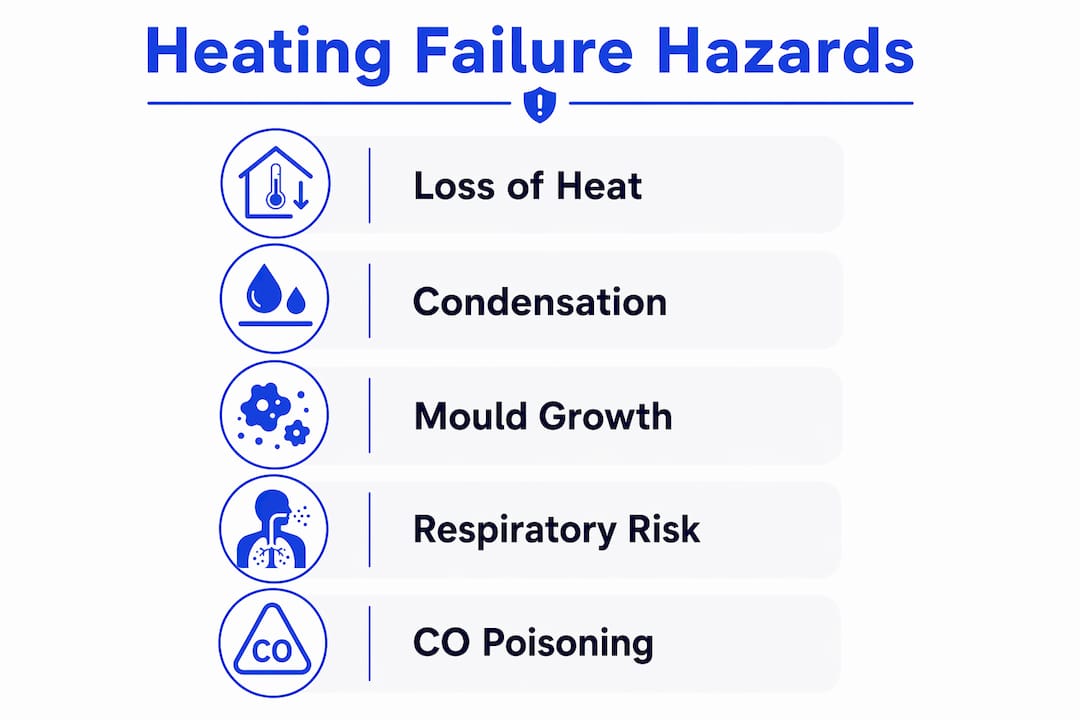
The principal hazards are:
- Carbon monoxide (CO): Colourless and odourless, produced by faulty combustion appliances. Undetectable without alarms or professional testing.
- Burns and scalds: From exposed hydronic radiator surfaces, portable heaters and hot-water systems, particularly for residents who cannot move away.
- Fire and electrical risk: When residents or staff improvise heating using kitchen stoves, overloaded power boards or uncertified portable heaters.
- Cold-related health effects: Hypothermia, cardiovascular stress and respiratory illness when indoor temperatures drop and stay low.
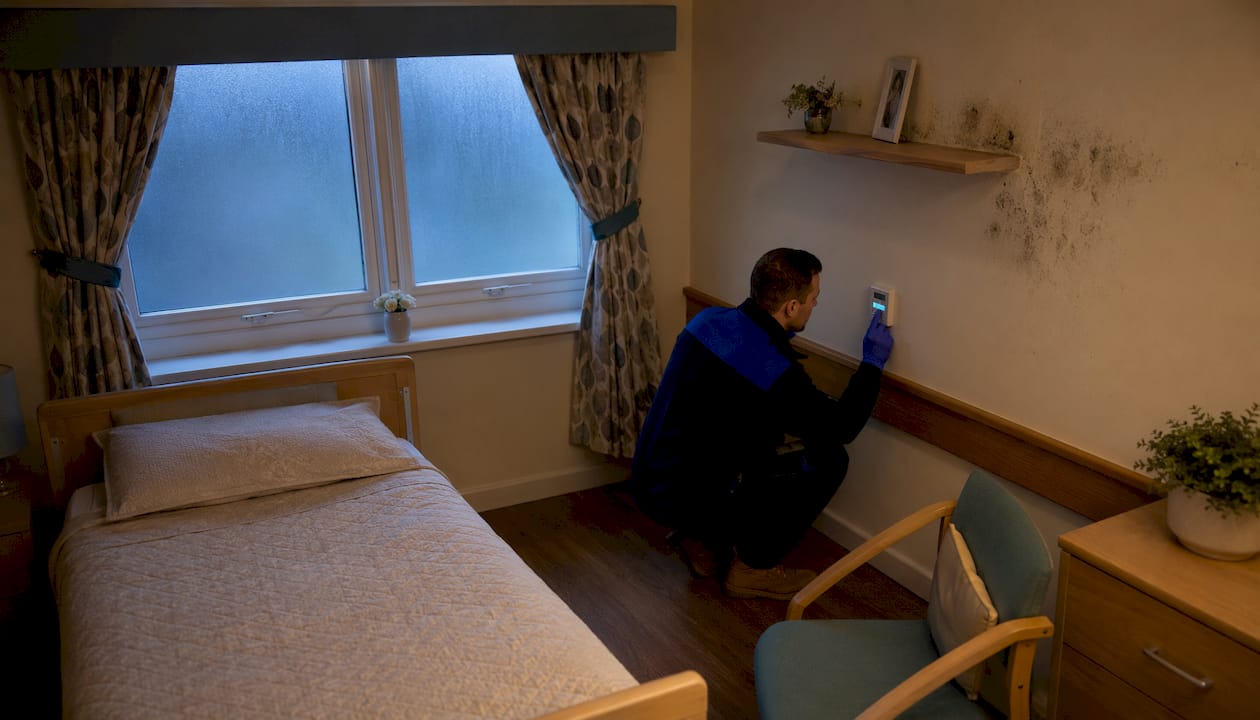
- Mould and structural damage: Loss of heat causes condensation on walls and windows, which feeds mould growth within days. Burst pipes follow if temperatures fall far enough.
The cascade matters. A loss of heat leads to condensation, which leads to mould, which worsens respiratory symptoms for residents with asthma or COPD. At the same time, staff may deploy unsafe temporary heaters to compensate, adding fire and electrical risk on top of the cold exposure. Australian state and national health and aged-care bodies, including the Aged Care Quality & Safety Commission, have issued specific safety alerts on heater burns and CO risks in care settings precisely because these hazards compound each other.
Carbon monoxide: why a heating breakdown can be fatal
CO poisoning is the heating hazard most likely to kill without warning. A system does not need to stop working entirely to produce it. Partial failures are often more dangerous than complete shutdowns because the appliance keeps running while combustion becomes unsafe.
The main causes are cracked heat exchangers, blocked or corroded flues, and improper gas supply pressure. When a heat exchanger cracks, combustion gases that should vent outside mix with the air circulating through the building. A blocked flue has the same effect. Malfunctioning combustion heaters and cracked heat exchangers are leading causes of CO leaks in residential settings, and annual servicing is the primary way to detect these faults before they become life-threatening.
Symptoms in residents include headache, nausea, dizziness and confusion. In older people or those with cognitive impairment, these signs are easily mistaken for fatigue, dehydration or a medication side effect. A resident who seems "off" during winter heating season deserves a CO check, not just a cup of tea.
Statistic callout: CO is colourless and odourless. Without a functioning alarm, there is no sensory warning before exposure reaches dangerous levels. Health.vic confirms that professional inspection is the only reliable way to detect combustion faults before they produce a leak.
Detection and prevention:
- Install CO alarms on every level of the facility, particularly near sleeping areas and combustion appliances.
- Test alarms monthly and replace units per the manufacturer's schedule (typically every 5–7 years).
- Schedule annual combustion appliance checks with a licensed technician, including flue integrity and heat exchanger inspection.
- If a CO alarm activates: evacuate immediately, call 000, do not re-enter until emergency services clear the building.
Pro Tip: Place CO alarms at breathing height (roughly 1–1.5 metres from the floor), not near the ceiling. CO disperses throughout a room rather than rising like smoke, so ceiling placement can delay detection.
For Victorian facilities, gas heater safety inspections are a specific regulatory priority under Energy Safe Victoria guidance.
Burns, scalds and entrapment risks from heaters
Burns are the most frequently reported heater injury in Australian aged care settings. The Aged Care Quality & Safety Commission's clinical alert on heaters and burns specifically flags the risk to residents who cannot move away from a heat source.
Hydronic radiators and panel heaters reach surface temperatures that cause contact burns within seconds on fragile skin. A resident seated in a wheelchair or confined to bed may be positioned close to a radiator for extended periods without the ability to reposition. Hot-water systems set above 50°C create scald risk at taps and shower outlets. Portable heaters placed too close to bedding or clothing are a direct fire and burn hazard.
Practical controls to put in place now:
- Fit radiator covers or guards on all exposed heating surfaces in resident rooms and common areas.
- Set hot-water system thermostats to 50°C at the outlet (or as specified by your state's plumbing code) and install tempering valves where required.
- Keep portable heaters at least one metre from any person, bedding, furniture or curtain.
- Conduct a daily visual check of heater placement in each resident's room, particularly for those with limited mobility.
- Document any skin redness or contact burn immediately and review heater placement as part of the incident response.
Fire and electrical hazards when staff use unsafe temporary heating
When central heating fails, the instinct to keep residents warm is right. The method matters enormously. Improvised heating is one of the leading secondary risks from a heating breakdown, and it has caused fatal fires in residential care settings internationally.
Unsafe practices that must be prohibited:
- Using kitchen stoves or ovens to heat rooms.
- Running multiple high-draw plug-in heaters from a single power board or extension lead.
- Using uncertified or damaged portable heaters.
- Placing any heater near curtains, bedding or upholstered furniture.
Older wiring in care facilities is particularly vulnerable. Overloaded circuits in buildings not designed for high plug-in electrical loads can cause wiring to overheat inside walls, where no one sees it until there is a fire. Research on structural fires and heating complaints confirms that unresolved heating failures directly increase the likelihood of residents resorting to dangerous practices that cause fires.
Safer approved alternatives to have on hand:
- Certified, thermostatically controlled panel heaters with tip-over and overheat protection (check for Australian Standards compliance marking).
- Additional blankets and thermal clothing for residents.
- Temporary relocation to a warm communal area while the primary system is repaired.
For facilities with older electrical infrastructure, an electrical safety upgrade assessment is worth scheduling before winter, not after a failure.
How cold temperatures harm resident health: what the evidence shows
Cold exposure is not just uncomfortable for older and disabled residents. It is a measurable health risk. Research links reduced heating use to higher winter mortality, particularly in high-poverty communities where heating affordability is already constrained. The mechanism is cardiovascular: cold causes blood vessels to constrict, raising blood pressure and increasing the workload on the heart.
For residents with pre-existing cardiac or respiratory conditions, even moderate cold exposure inside a building can trigger an acute event. People with cognitive impairment may not recognise or report that they are cold, making staff monitoring the only reliable safeguard. Utility outages disproportionately affect people with mental health conditions, who experienced heat outages at higher rates among those with such conditions in cross-sectional research.
Temperature thresholds to treat as emergencies: Practical HVAC guidance treats outdoor temperatures at or below 4°C as a frozen-pipe risk regardless of perceived indoor warmth. For vulnerable residents, indoor temperatures below 18°C are a health concern; below 16°C, the risk of respiratory illness rises sharply. Above 35°C in summer, the same logic applies in reverse.
Residents with asthma or COPD face a compounding risk. A heating failure that causes mould growth or forces staff to use dusty portable heaters degrades indoor air quality at exactly the moment the resident is already cold-stressed. Electrical outages are associated with increased respiratory hospitalisations, partly because many residents rely on electricity-dependent medical equipment. Facilities should identify these residents in advance and prioritise them in any heating contingency plan.
Common causes of heating system failures staff should know
Understanding why systems fail helps facility managers prioritise inspections and avoid being caught off-guard. Most breakdowns are not sudden. They follow a warning phase that a trained eye can catch.
- Cracked heat exchangers: Caused by thermal stress over years of cycling. Produces CO risk and is a replacement trigger, not a repair.
- Blocked or corroded flues: Prevent combustion gases from venting safely. Often caused by bird nests, debris or corrosion in older systems.
- Dirty or blocked filters: Restrict airflow, cause overheating and accelerate wear on blower motors. One of the most preventable failure modes.
- Failed blower motors or worn bearings: Produce noise before failure. Uneven heating across rooms is an early sign.
- Blocked condensate drains: Common in high-efficiency gas systems. A blocked drain causes the system to shut down on a safety lockout.
- Electrical faults: Failed ignition modules, faulty contactors or damaged wiring. Can cause intermittent operation or complete shutdown.
- Refrigerant leaks (reverse-cycle systems): Reduce heating capacity gradually before complete failure. Rising energy bills with declining output is the tell.
- Deferred maintenance compounding: Poorly maintained burners, blocked vents and missing safety interlocks create latent failure modes that are only discoverable by professional inspection.
Age accelerates all of these. A system running at high duty cycle in a care facility ages faster than one in a single-family home. A unit that has never missed a service can still reach end-of-life; one that has been neglected will reach it years early.
Pre-call checklist for staff before contacting a technician:
- Check the thermostat setting and battery.
- Check the circuit breaker for the heating unit.
- Check that the gas supply valve is open (if applicable).
- Check the filter and replace if visibly blocked.
- Note any unusual smells, sounds or error codes on the control panel.
Warning signs staff should monitor and escalate every day
Heating systems rarely fail without giving signals first. The problem is that those signals are easy to dismiss as minor annoyances until the system stops entirely. Failure commonly progresses through a warning phase of uneven airflow, odd noises or rising energy use. Catching these early avoids both the emergency and the premium call-out cost.
Observable signs to escalate immediately:
- Soot or black marks around vents, grilles or the appliance casing.
- Burning smell, sulphur (rotten egg) smell, or any smell of gas.
- Unusual banging, rattling, grinding or high-pitched squealing from the unit.
- Uneven heating: some rooms warm, others cold, with no change in thermostat setting.
- Frequent short cycling (the system turns on and off repeatedly in short bursts).
- Unexplained rise in energy bills without a change in usage pattern.
Escalation flow:
- Any gas smell or CO alarm: evacuate and call 000 immediately.
- Soot, burning smell or visible damage: isolate the system, do not restart, call a licensed technician.
- Uneven heating, noise or cycling: log the observation with time and date, notify the facility manager, book a technician within 48 hours.
For residents with communication or cognitive barriers, staff should conduct a daily comfort check, asking simple yes/no questions or observing for shivering, unusual stillness or skin colour changes. Do not rely on residents self-reporting.
What to do when heating fails: a step-by-step staff checklist
Speed and sequence matter. Work through these steps in order.
- Assess the hazard type. Gas smell, CO alarm or visible smoke: go straight to step 3. No heat only: proceed to step 2.
- Protect vulnerable residents in place. Add blankets, move residents away from cold external walls and windows, and close internal doors to retain warmth in occupied rooms.
- Evacuate if there is any CO, gas or fire risk. Call 000. Do not re-enter until emergency services clear the building.
- Isolate the fuel source if safe to do so. Turn off the gas supply at the meter if a gas leak is suspected and it is safe to reach the meter. Do not operate electrical switches in a gas-affected area.
- Ventilate for suspected CO. Open windows and doors to dilute any accumulated gas before emergency services arrive.
- Deploy approved temporary heating. Use only certified, thermostatically controlled units. Follow the safe-placement rules from the fire and electrical hazards section above.
- Log everything. Record indoor temperature readings (every 30 minutes), resident names and room numbers affected, symptoms observed, actions taken, times and contacts called.
- Call an authorised maintenance technician. For non-emergency failures, contact your scheduled service provider. Practical guidance treats outdoor temperatures at or below 4°C as a near-term frozen-pipe risk, which elevates any heating failure to urgent status.
- Notify the facility manager and document for regulatory reporting. Depending on the severity and duration, a heating failure in an aged care or disability facility may require reporting to the Aged Care Quality & Safety Commission or relevant state authority.
Prevention through maintenance: what a qualified service does
Scheduled maintenance is the single most cost-effective risk-reduction tool available to facility managers. Regular servicing materially reduces the likelihood of emergency breakdowns, and many forced-air failures are entirely preventable with periodic inspection.
A qualified service for aged care and multi-unit housing should include:
- Combustion analysis to confirm safe and efficient fuel burn.
- Flue integrity check and cleaning to prevent CO accumulation.
- Heat exchanger inspection for cracks or corrosion.
- CO alarm test and battery replacement.
- Electrical safety check of wiring, contacts and ignition components.
- Filter inspection and replacement.
- Condensate drain flush and blockage check.
- Blower motor and belt condition assessment.
| Service type | Recommended frequency | What it covers |
|---|---|---|
| Annual safety inspection | Once per year (pre-winter) | Full combustion, flue, CO alarm, electrical and heat exchanger check |
| Seasonal tune-up | Start of heating season | Filter, condensate, controls and thermostat calibration |
| Mid-season safety check | Midwinter | CO alarm test, visual inspection, resident comfort audit |
| Urgent response | As needed | Emergency fault diagnosis and repair |
Dualflowservices provides all four service types for aged care, retirement villages and disability care homes across the Mornington Peninsula and surrounding Melbourne suburbs. Bundling the annual inspection with a seasonal tune-up in a single visit reduces disruption to residents and typically lowers the overall service cost compared to booking each separately.
Pro Tip: Ask your technician to provide a written combustion analysis report after each annual inspection. This document is evidence of due diligence for regulatory purposes and gives you a baseline to compare against in future years. Any significant change in combustion efficiency year-on-year is an early warning sign worth investigating.
For a detailed maintenance cadence guide, the HVAC maintenance schedule overview and seasonal HVAC maintenance guidance both provide useful procedural frameworks, though the latter is US-focused and should be adapted to Australian conditions and licensing requirements.
Emergency planning for aged, disability and community housing
A written emergency plan for heating failure is not a compliance box-tick. It is the difference between a managed inconvenience and a crisis that harms residents. Facilities that have never tested their plan tend to discover its gaps at the worst possible moment.
Essential plan elements:
- Approved temporary heating inventory: List certified units on hand, their location, and the maximum number of residents they can safely serve.
- Evacuation thresholds: Define the indoor temperature at which residents are relocated (e.g. below 16°C for more than two hours), and identify the receiving location.
- Resident prioritisation: Rank residents by vulnerability (immobility, respiratory conditions, cognitive impairment, reliance on electrical medical equipment) so staff know who to attend to first.
- Communication templates: Pre-written messages for families, the facility manager and the regulator, so staff are not composing notifications under pressure.
- Staff roles: Name the person responsible for each step in the checklist above. Ambiguity about who calls the technician costs time.
- Training and table-top exercises: Run a 30-minute scenario exercise at least once per year. Walk staff through a simulated heating failure and test whether they can locate the temporary heaters, identify the evacuation threshold and complete the log template.
- Multi-unit considerations: In shared facilities, heating failures in one zone can affect common areas used by all residents. The plan should address communal spaces separately from individual rooms.
Utility outages are nearly three times more common in mid-rise and high-rise buildings than in low-rise buildings, so multi-storey community housing facilities face a statistically higher outage risk and need a correspondingly more detailed plan. The winterisation guide for care home heating covers facility-specific preparation steps worth incorporating into any emergency plan update.
System lifespan, repair vs replacement and what it costs in Australia
Knowing when to repair and when to replace is a budget decision that also carries a safety dimension. A system kept running past its safe service life is not just inefficient; it is a liability.
A well-maintained furnace typically lasts 15–20 years. In a care facility running at high duty cycle, expect the lower end of that range. Reverse-cycle systems and hydronic boilers have similar lifespans under normal residential use, but continuous operation in a care setting accelerates wear on heat exchangers, pumps and electrical components.
| System type | Typical lifespan | Common replacement triggers |
|---|---|---|
| Ducted gas heating | 15–20 years | Cracked heat exchanger, recurring ignition faults, CO test failure |
| Reverse-cycle split system | 10 years | Refrigerant leaks, compressor failure, declining efficiency |
| Hydronic boiler | — | Corroded heat exchanger, pump failure, persistent pressure loss |
| Portable/supplementary heaters | 5 years | Thermostat failure, damaged elements, safety switch faults |
Cost factors that influence the repair-vs-replace decision include parts availability for older units, the frequency of recent breakdowns, and whether the fault is safety-critical. A cracked heat exchanger is a replacement trigger, not a repair candidate, because the CO risk cannot be reliably eliminated by patching. Reduced heating use increases winter mortality, particularly for high-poverty communities, which means deferring replacement of a failing system in a care facility carries real human cost beyond the financial calculation.
If a system has required repairs in two consecutive seasons, or if the repair quote exceeds half the replacement cost, replacement is almost always the better decision for a care facility.
Regulatory and compliance pointers for Australian facilities
Australian facilities have specific obligations that go beyond general duty of care. The key bodies and documents to know:
Aged Care Quality & Safety Commission: Issues clinical alerts on heater burns and CO risks in aged care settings. Facilities must be able to demonstrate that heating systems are maintained, that CO alarms are installed and tested, and that incidents are reported. The Commission's heaters and burns alert is required reading for any facility manager updating their heating safety policy.
Energy Safe Victoria: Regulates gas and electrical safety in Victoria. Gas appliances must be serviced by a licensed gasfitter. Health.vic guidance on CO poisoning reinforces that annual servicing and CO alarm installation are the primary preventive measures for combustion appliance safety.
Housing.Vic: Provides home heating safety guidance for public housing residents, including specific advice on safe heater use, CO risks and what to do when heating fails. Community housing providers should align their policies with this guidance.
Documentation and reporting: Maintain a service log for every heating appliance, including the date, technician licence number, work performed and any faults found. A heating failure that results in a resident injury or a CO alarm activation is a reportable incident under aged care and disability service regulations. Report promptly and keep the log as evidence of prior maintenance.
This article provides general safety information, not professional legal or regulatory advice. Confirm current obligations with the Aged Care Quality & Safety Commission, Energy Safe Victoria, or a qualified compliance professional for your specific facility.
Key takeaways
Heating system breakdowns in aged care, disability and community housing create immediate, compounding risks that require a prepared response, not improvisation.
| Point | Details |
|---|---|
| CO risk is the top priority | A cracked heat exchanger or blocked flue can produce CO with no visible warning; annual combustion inspections are the primary safeguard. |
| Cold exposure harms health fast | Indoor temperatures below 16°C raise respiratory illness risk for vulnerable residents; treat sustained cold as a medical emergency, not a comfort issue. |
| Improvised heating causes fires | Overloaded power boards and uncertified heaters are a direct fire risk; facilities must keep certified temporary units on hand before a failure occurs. |
| Maintenance prevents most crises | Scheduled servicing catches dirty filters, blocked drains and failing components before they cause an emergency breakdown. |
| Dualflowservices covers emergency and scheduled needs | Dualflowservices provides emergency call-out, annual safety inspections and compliance checks for aged care, retirement villages and disability care homes across the Mornington Peninsula. |
The thing most facilities get wrong about heating safety
Most facilities treat heating maintenance as a facilities budget line, not a clinical risk. That framing is the root of most of the crises I see.
A system that is producing heat can still be dangerously compromised. A cracked heat exchanger does not announce itself. A partially blocked flue does not set off an alarm. The system runs, the rooms are warm, and the CO is accumulating. By the time a resident presents with a headache or confusion, the exposure has already happened. The only way to know the system is safe is to have someone open it up and look.
What facility managers consistently underestimate is the cascade effect. A heating failure in winter is not one problem. It is three or four simultaneous problems: the cold exposure risk, the improvised-heating fire risk, the mould risk if the failure lasts more than 48 hours, and the regulatory reporting obligation if a resident is harmed. Each of those has its own timeline and its own cost. The combined cost of an emergency call-out, a mould remediation, a regulatory investigation and a potential liability claim dwarfs the cost of an annual service contract many times over.
The facilities that handle heating failures well are the ones that have already done two things: they have a written plan that staff have actually practised, and they have a maintenance relationship with a technician who knows their systems. Not a technician they call when something breaks. One who has been in the building, knows the age of the equipment and has a record of what was found last time.
That is not a high bar. It is just a decision to treat heating safety the same way you treat medication management: as something too important to leave to chance.
Dualflowservices: emergency response and scheduled care for your facility
When a heating system fails in a care facility, the margin for delay is narrow. Dualflowservices provides emergency call-out, scheduled maintenance and compliance inspections specifically for aged care, retirement villages and disability care homes across the Mornington Peninsula and surrounding Melbourne suburbs. The team handles gas, electrical and hydronic heating systems, so one call covers the full scope of a heating emergency rather than waiting for multiple trades.
For scheduled work, Dualflowservices offers annual safety inspections that include combustion analysis, flue integrity checks, CO alarm testing and written reports suitable for regulatory documentation. Bundling the annual inspection with a seasonal tune-up reduces disruption to residents and gives facility managers a single service record covering all compliance requirements.
To book an emergency call-out or schedule a pre-winter inspection, visit Dualflowservices or contact the team directly. Have your system type, approximate age and any fault symptoms ready when you call. That information lets the technician arrive prepared rather than diagnosing from scratch on site.
Authoritative sources and further reading
The sources below are the primary references for the guidance in this article. Keep them accessible when updating facility procedures or preparing for a regulatory audit.
- Aged Care Quality & Safety Commission: Heaters and burns clinical alert
- Health.vic: Carbon monoxide poisoning in the home
- Housing.Vic: Home heating safety for public housing residents
- PMC: The mortality effects of winter heating prices
- LWW Environmental Epidemiology: Utility service outages and health correlates in NYC
- Munich Re / HSB: Avoid heating and cooling system failures
- Carrier: How long does a furnace last?
- Healthdirect: Winter health hazards at home