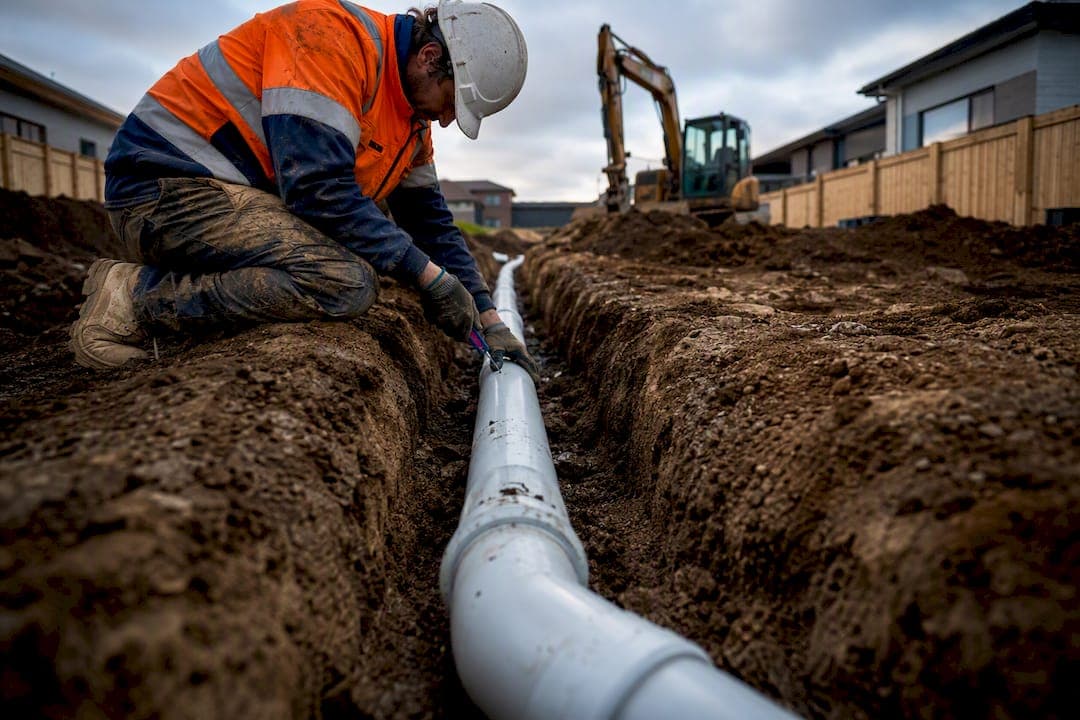
Victorian law requires you to connect stormwater to a legal point of discharge nominated by your council before you build, extend, or landscape anything that changes runoff. The design must satisfy Building Regulations 2018 reg 133 and comply with AS/NZS 3500.3 as referenced in the National Construction Code. Your first move: apply to council for a legal point of discharge (LPoD) and brief a licensed plumber or engineer before you lodge a building permit application.
TL;DR:
- Securing a legal point of discharge from council is crucial and typically takes up to 10 working days once a complete application is lodged with specified fees.
- The stormwater drainage design must comply with Building Regulation 133, NCC parts E4 and F, and AS/NZS 3500.3, with the latter providing technical standards for pipe sizing and system separation.
- Property owners are responsible for all infrastructure up to the nominated discharge point, while local councils, Melbourne Water, or the Department of Transport own assets downstream.
- Development projects such as multi-dwelling or commercial sites likely require a Water Sensitive Urban Design report to demonstrate proper stormwater management practices.
- Ensure all documentation, including engineered drawings, certified design statements, CCTV footage, and compliance certificates, are submitted at building permit stage to avoid compliance failures.
Table of Contents
- The legal framework: Building Regulations, the NCC and AS/NZS 3500.3
- What is a legal point of discharge, and how do you get one?
- Who's responsible: property owner vs council and other asset owners
- When do you need planning permits and WSUD reports?
- Design and construction standards, including minimum fall
- Council permits, road reserves and Department of Transport consent
- Common compliance pitfalls and how to avoid them
- What to submit at building permit stage
- Maintenance and inspection: your ongoing responsibilities
- A tradesman's view: sequencing and site tips that save time
- Getting your drainage compliant without the runaround
- Sources
- FAQ
The legal framework: Building Regulations, the NCC and AS/NZS 3500.3
Stormwater drainage compliance in Victoria rests on three layers, and missing any one of them stalls a building permit. The base layer is Regulation 133 of the Building Regulations 2018, which requires every stormwater drainage system design to be approved by the relevant building surveyor and to be built to a council-nominated point of discharge.
On top of that sits the National Construction Code. NCC Victoria parts E4 and F set the performance requirements for stormwater drainage, and both defer to AS/NZS 3500.3 for the technical detail: pipe sizing, fall, pit placement, and how surface water gets managed on site.
Three parties carry distinct roles in this process:
- Your building surveyor checks the drainage design against the NCC and issues the building permit.
- Your council issues the report identifying the legal point of discharge, under Regulation 133(2).
- The Victorian Building Authority (VBA) oversees practitioner registration and building surveyor conduct, and handles complaints when a surveyor approves work that doesn't stack up.
Skip the council report and your surveyor has no basis to sign off. It's the one document that ties the whole permit process together.
What is a legal point of discharge, and how do you get one?
A legal point of discharge is the exact spot council nominates where your private stormwater system is allowed to connect to the public network. It might be a council pit, a section of kerb and channel, a stormwater easement, or occasionally a table drain, and Maroondah City Council confirms this is where your legal responsibility for drainage ends and council's begins.
Getting one follows a fairly predictable sequence:
- Get your site plan and survey together. You need existing levels, boundaries, and the location of any known drainage infrastructure.
- Prepare drainage drawings and calculations. Your plumber or engineer sizes pipes and pits based on catchment area and expected flow.
- Lodge the LPoD application with council. Either you or your agent (usually the plumber, builder, or engineer) can submit it.
- Pay the application fee. Fees vary by council and are generally non-refundable regardless of the outcome.
- Wait for the report. Council issues a written LPoD report confirming the nominated discharge point.
- Feed the result into your building permit application. Your building surveyor needs this report before approving the drainage design.
Council LPoD applications typically take up to 10 working days once a complete application is lodged, and fee examples published by councils illustrate the range: City of Monash charges $238.19, while City of Boroondara charges $167.50 for the same type of report.
That 10-day clock only starts once your application is complete. Monash Council notes that incomplete lodgements get bounced back, which resets the timeline. If you're on a tight construction schedule, lodge early and lodge properly the first time.
Who's responsible: property owner vs council and other asset owners
Your responsibility as a property owner runs from your building to the nominated legal point of discharge. Everything downstream, the pipes, pits, and drains that carry stormwater away from that point, belongs to whichever authority owns that asset.
Different bodies own different parts of the network:
- Local councils typically own and maintain kerb and channel, street pits, and local underground pipes within road reserves.
- Melbourne Water manages larger regional drains, waterways, and floodplains across metropolitan Melbourne, including sections that pass through private land under easement.
- The Department of Transport and Planning controls drainage infrastructure tied to declared arterial roads.
Disputes usually arise when a blockage or flood event sits near the boundary between private and public responsibility. Photograph the issue, note the date and location relative to your LPoD, and contact council's drainage engineers first. Councils generally investigate whether the fault lies upstream or downstream of the nominated point before assigning responsibility, so having your original LPoD report on hand speeds that assessment considerably.
When do you need planning permits and WSUD reports?
Not every project needs a Water Sensitive Urban Design (WSUD) report, but a fair few do, and missing this at the planning stage causes real delays.
Development types that commonly trigger WSUD requirements include:
- Multi-dwelling developments, such as townhouses or unit blocks
- Land subdivisions creating new lots
- Commercial and mixed-use developments
- Any development in a growth area subject to a precinct structure plan
A WSUD report has to demonstrate how the development manages both stormwater quality and quantity, not just where the water goes. The Victorian Government's stormwater management guidance sets out best-practice performance targets that applicants measure their design against, often using standard modelling tools recognised by councils and water authorities.
WSUD sits at the planning permit stage, separate from your building permit. That means you can satisfy your LPoD and building permit drainage requirements while still failing to get planning approval if the WSUD report doesn't stack up. Sequence matters: settle the planning-level stormwater strategy before you lock in detailed drainage drawings for the building permit, or you risk redesigning both.
Design and construction standards, including minimum fall
AS/NZS 3500.3 is the technical backbone for stormwater drainage compliance in Victoria, covering everything from pipe sizing to pit construction to how you keep stormwater and sewage systems separate.
A few principles show up in almost every compliant design:
- Pipes need adequate fall to keep water moving by gravity. There's no single number here; the minimum fall depends on pipe diameter, expected flow volume, and the standard's own tables, so this has to come from your plumber's or engineer's calculations rather than a rule of thumb.
- Pits and access points need to be positioned so maintenance crews can actually reach them, not buried under a new deck or retaining wall.
- Design has to prevent stormwater from entering sewer infrastructure, and vice versa, a cross-connection that inspectors flag immediately.
- Discharge to the nominated point generally has to happen by gravity. City of Melbourne's guidance makes clear that pumped discharge is treated differently and needs separate sign-off.
Pro Tip: Don't let a landscaper or pool installer bury a drainage pit under new paving. It happens constantly on renovation sites, and it turns a five-minute maintenance job into an expensive dig-up later.
If your design deviates from a standard AS/NZS 3500.3 solution, get that variation documented and certified by your engineer before construction starts, not after your surveyor asks questions.
Council permits, road reserves and Department of Transport consent
Plenty of drainage work touches council-owned land, and that means a second layer of permits on top of your building permit.
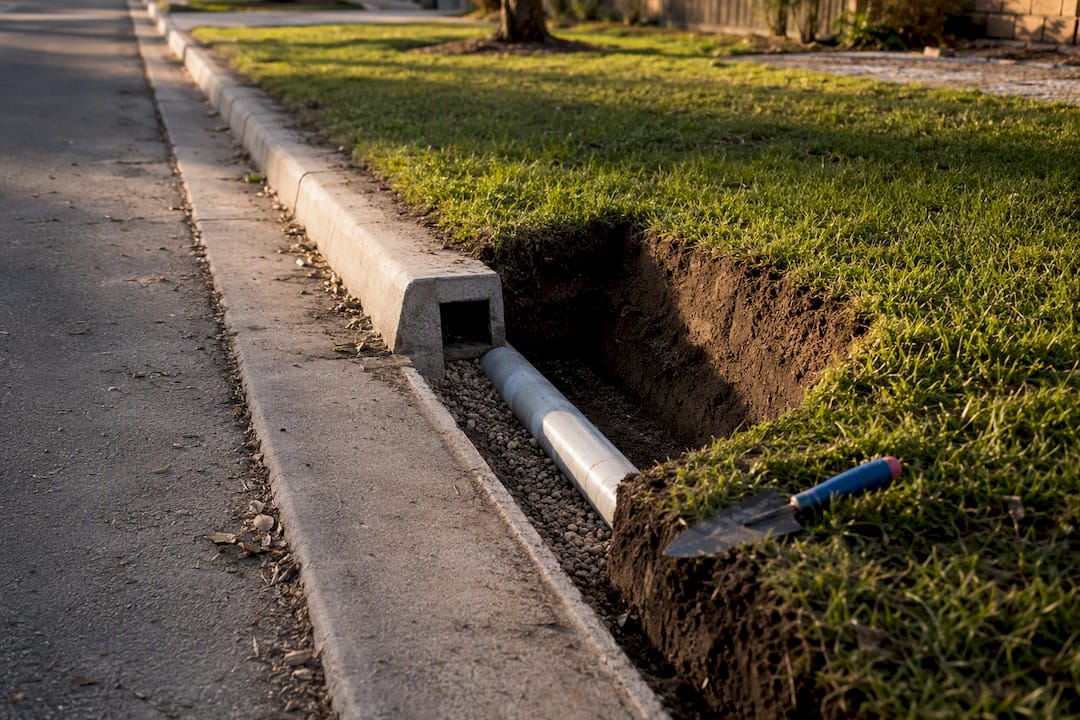
Expect to need a road reserve or works permit when your drainage connection crosses a footpath, nature strip, or kerb, and councils generally expect the surface to be reinstated to their specification, not just patched over. If your nominated legal point of discharge sits on a declared arterial road, Department of Transport and Planning consent is often required in addition to council approval, and that extra step can add real time to your program if you don't flag it early.
Councils typically want notice before they book an inspection, and common on-site conditions include:
- Open trenches left accessible for inspection before backfilling
- Traffic management plans for any work affecting a road or footpath
- Reinstatement to council's paving and compaction standard
Build this into your schedule from day one rather than discovering it mid-construction.
Common compliance pitfalls and how to avoid them
Most stormwater compliance failures in Victoria trace back to the same handful of mistakes.
- Assuming an existing connection still works after changes. Extending a house, adding a shed, or paving over a garden all increase runoff, and an existing connection sized for the old layout may no longer satisfy AS/NZS 3500.3. Any change that increases runoff volume or rate usually needs reassessment, and potentially a revised LPoD.
- Lodging an incomplete LPoD application. Missing site plans or drainage calculations get applications returned, burning through the processing window.
- Guessing the discharge point instead of checking the council report. Owners regularly assume stormwater just runs to the nearest kerb. Sometimes it does; sometimes council has nominated a different point entirely, and building to the wrong spot means redoing the work.
Pro Tip: If you're renovating an older property, request a copy of the original LPoD report from council before you finalise any drainage design. It often reveals a discharge point nobody on site expected.
What to submit at building permit stage
Your building surveyor needs a specific document set before approving stormwater drainage as part of a building permit application.
- Engineering drawings and calculations showing pipe sizes, falls, and pit locations against AS/NZS 3500.3
- A certified design statement from the engineer confirming the system meets NCC Victoria parts E4/F
- CCTV inspection footage, generally required where new drains are constructed or where existing drains are being handed over to council, as City of Melbourne notes for handover works
- Compliance certificates from the licensed plumber confirming the work matches the approved design
These documents form the paper trail your surveyor relies on, and they're the same documents council or the VBA will ask for if a dispute or complaint arises later.
Maintenance and inspection: your ongoing responsibilities
Compliance doesn't end when the building permit closes out. You're responsible for maintaining the drainage system on your property right up to the legal point of discharge, and that duty doesn't expire.
- Book a CCTV inspection every few years, or sooner if you notice slow drainage, pooling, or odours near pits.
- Keep records of any repairs, including photos and contractor invoices, in case a dispute with council or a neighbour arises later.
- Check drainage after any landscaping, deck, or driveway work, since compaction and new paving change how water moves across your block.
- Call a licensed contractor immediately for blockages or overflow that risk property damage rather than waiting for a scheduled service. A guide to routine checks that prevent blocked stormwater drains covers the warning signs worth watching for.
Pro Tip: Keep your original LPoD report and any CCTV footage in one folder. When something goes wrong five years down the track, that paperwork is what settles a dispute in an afternoon instead of a month.
A tradesman's view: sequencing and site tips that save time
Get your LPoD application in before you finalise tender documents, not after. I've seen builders lock in a construction schedule assuming drainage approval, then lose two or three weeks waiting on a council report because it wasn't in scope from day one.
Include drainage explicitly in your tender documents. Vague scope around "stormwater connection" invites subcontractors to quote for whatever's easiest, not what's actually compliant with AS/NZS 3500.3. Using a licensed plumber and a qualified engineer from the outset cuts down the back-and-forth with council enormously, because their documentation tends to match what surveyors expect the first time.
On site, mark your drainage offsets clearly before other trades start work, and pre-book your CCTV inspection window well ahead of your target completion date. Councils get busy, and last-minute bookings are how projects slip.
— Mike
Getting your drainage compliant without the runaround
Chasing council reports, coordinating a licensed plumber, and lining up a CCTV inspection is a lot to juggle on top of everything else a build or renovation demands. A single service provider handling plumbing, electrical, and heating and cooling, with emergency availability, can help reduce the complexity of coordinating multiple contractors to get a stormwater connection signed off.
Some service teams liaise directly with council on LPoD applications, carry out compliant installation work, and provide CCTV inspection for both new connections and pre-purchase checks on older properties. Before hiring a contractor for drainage work, it's important to inquire about their plumbing licence, experience with local council LPoD processes, and whether they perform CCTV inspections in-house or subcontract them.
If you need someone to walk your site, review your existing drainage, and tell you exactly what's needed for compliance, book a compliance check with Dualflowservices and get a clear answer before your next council submission.
Sources
Keep these on hand when you start a stormwater application in Victoria:
- Building Regulations 2018 (Reg 133) - AustLII
- NCC 2025 Volume Three (BPC guidance)
- Legal point of discharge (City of Monash)
- Stormwater management for urban development (Victorian Government)
FAQ
What are the Australian standards for stormwater drainage?
Stormwater drainage design and construction in Victoria must comply with AS/NZS 3500.3, the plumbing standard referenced by the National Construction Code for surface and subsurface drainage. NCC Victoria parts E4 and F set the performance requirements that AS/NZS 3500.3 details technically.
Who is responsible for stormwater drains in Victoria?
Property owners are responsible for drainage on their own land up to the legal point of discharge nominated by council. Beyond that point, councils, Melbourne Water, or the Department of Transport and Planning own and maintain the downstream network, depending on the asset.
What is the minimum fall required for stormwater pipes in Australia?
There's no single fixed figure for minimum fall. It's calculated per project under AS/NZS 3500.3 based on pipe diameter and expected flow, which is why a licensed plumber or engineer needs to run the calculation for your specific design rather than applying a generic rule.
Who pays for sewer and stormwater drain issues in Victoria?
You pay for any fault on your property up to the legal point of discharge, while the asset owner, typically council or Melbourne Water, pays for faults in the downstream public network. If a blockage sits near that boundary, council's drainage engineers generally investigate before responsibility is confirmed, so keep your LPoD report handy. Some service providers handle both diagnosis and repair work for drainage issues on the private property side, including emergency call-outs.