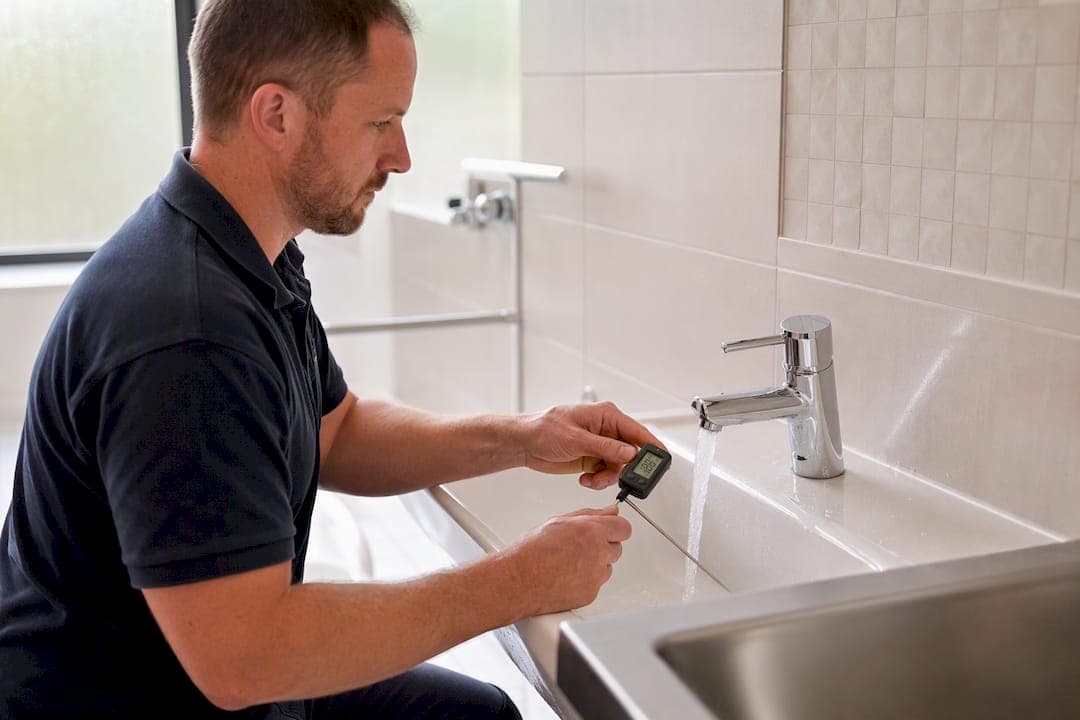
Store hot water at ≥60°C, deliver it at no more than 50°C at general personal-hygiene fixtures, and drop that ceiling to 45°C wherever vulnerable people bathe or shower. Getting the balance between those two numbers right is the entire game when you set safe water temperatures for a facility, whether that's a hospital wing, an aged care home, or a public change room.
You hold the storage temperature high enough to kill Legionella, then use a device at the outlet to bring the water down before it reaches skin. The number that actually matters for compliance isn't what the thermostat says. It's what a thermometer reads at the tap, within one minute of opening it, recorded on paper or in a digital log.
- Storage: ≥60°C at the water heater or cylinder
- General delivery: ≤50°C at hand basins, showers, baths for the general population
- Vulnerable population delivery: ≤45°C in aged care, disability care, paediatric and similar settings
- Verification point: outlet temperature, measured within 60 seconds of running the tap
Key Takeaways
Facilities stay compliant when storage holds at 60°C or above and every outlet delivers no more than 50°C generally, or 45°C for vulnerable populations, verified within one minute.
| Point | Details |
|---|---|
| Set the two temperatures | Store at ≥60°C; deliver at ≤50°C generally or ≤45°C for vulnerable populations. |
| Test at the outlet, not the heater | Verify sentinel taps within one minute; heater readings alone miss distribution failures. |
| Match the device to the fixture | Use Type 3 TMVs for vulnerable-population bathing fixtures, tempering valves elsewhere. |
| Keep a written Water Safety Plan | Log test results, valve serial numbers, service dates and corrective actions. |
| Get a compliance-focused partner | Dualflow Services runs sentinel testing, TMV servicing and WSP support on-site. |
Table of Contents
- Proper water temperature guidelines and where they come from
- Why you keep the system hot but temper at the tap
- Which devices control delivery temperature, and where they go
- Building a testing and monitoring routine that holds up
- Maintenance tasks and the records an auditor will ask for
- What actually goes wrong on site
- Where the standard advice falls short
- Frequently asked questions
- Sources
Proper water temperature guidelines and where they come from
These numbers aren't arbitrary. They come from AS/NZS 3500.4:2025, the plumbing standard governing heated water services, which sets the maximum delivery temperature for personal-hygiene fixtures at 50°C, tightening to 45°C in facilities housing vulnerable populations. Public health guidance sets the other half of the equation.
The critical figure most managers miss: storage and distribution temperature has to reach 60°C or higher, with outlets delivering 50 to 55°C within one minute of running the tap to keep Legionella bacteria from establishing in the system.
Three terms get used loosely, and mixing them up causes real compliance gaps:
- Storage temperature — what's sitting in the tank or cylinder, always ≥60°C
- Distribution temperature — what's moving through the pipework, ideally staying close to storage temperature until it nears the outlet
- Delivery temperature — what actually comes out of the tap, governed by the 45°C or 50°C ceiling depending on who uses that fixture
Why you keep the system hot but temper at the tap
Legionella bacteria thrive in the 20 to 45°C range and start dying off above 60°C. Drop your storage set point to "save energy" or "avoid scalds," and you've just built the bacteria a comfortable home. That's the trap a lot of well-meaning facility managers fall into: they hear about scald injuries, panic, and turn the whole system down at the heater instead of fixing the problem at the outlet.
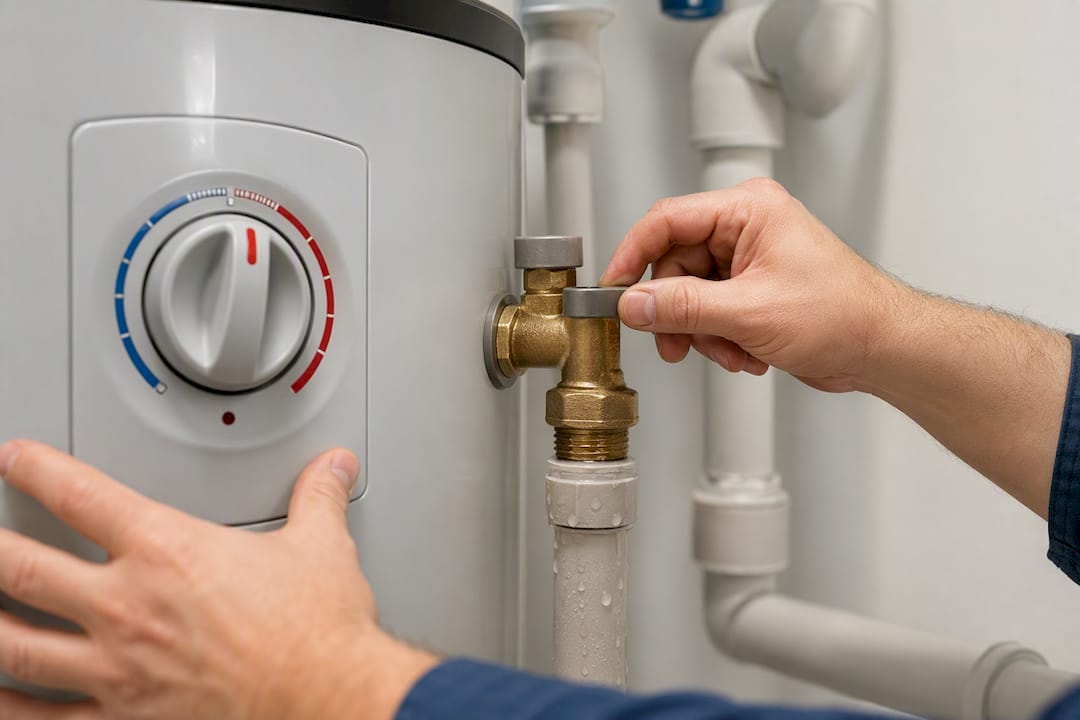
The correct move is to leave the heater alone and control temperature downstream with a valve. Lowering the heater set point doesn't just risk Legionella. It also slows recovery time for hot water demand across a busy ward or communal bathroom block.
Pro Tip: If a facility has long pipe runs or sections that don't see regular use, storage heat alone won't protect the far end of the system. You'll need scheduled flushing, and in more complex or ageing networks, dead-leg removal or supplementary disinfection to back up the temperature control.
Which devices control delivery temperature, and where they go
Getting delivery temperature right comes down to selecting the correct valve for each fixture, not guessing at a single facility-wide fix.
- Type 3 thermostatic mixing valves (TMVs) are the recommended device for vulnerable-population fixtures. Public guidance recommends Type 3 TMVs for high-risk settings because they fail safe, shutting off flow if the cold-water supply drops out, rather than letting scalding water through unchecked.
- Tempering valves suit general personal-hygiene fixtures where the 50°C ceiling applies. They're simpler and cheaper than TMVs but don't offer the same fail-safe response, so they're not the right pick for bathing fixtures used by people with reduced mobility or sensation.
- Thermostatic Low-Water-Heaters (TLWHs) work as an integrated alternative at some fixtures, delivering tempered water without a separate downstream valve in appropriate installations.
Whichever device you choose, install it as close to the point of use as practical, fit an isolation valve for servicing, label it clearly with its rated delivery temperature, and get a commissioning test done before the fixture goes into use. A tempering valve that's never been commissioned is a guess wearing a compliance badge.
Building a testing and monitoring routine that holds up
Verification has to happen at "sentinel" points, not just at the heater. Test the nearest outlet to the storage system and the furthest outlet from it, because those two extremes tell you whether the whole distribution network is behaving.
- Storage check: confirm the tank or cylinder is holding ≥60°C
- Sentinel outlet check: measure temperature at the nearest and furthest taps within one minute of opening
- Vulnerable-population fixture check: confirm delivery is at or below 45°C at every relevant bathing or shower point
| Check type | Suggested frequency |
|---|---|
| Sentinel outlet temperature | Monthly |
| Full-system audit (all fixtures) | Quarterly |
| Re-check after any repair or fault | Immediately |
If a reading fails, don't just note it and move on. Early detection and repair is crucial — learn more about leak detection and plumbing leak repairs to avoid compromising your water system. Rebalance the system, purge the affected branch, service or recommission the TMV, and if the fault persists, escalate to a licensed plumber before that fixture is used again. This mirrors the sentinel testing approach outlined in NHS HTM 04-01, which several Australian facility operators use as a practical testing template alongside AS/NZS 3500.4. A restaurant-style verification checklist built for hospitality settings follows the same logic and adapts easily to a facilities context.
Maintenance tasks and the records an auditor will ask for
A test result means nothing without a paper trail behind it. Auditors expect to see TMV service certificates, calibration dates, and a clear maintenance schedule, not just a verbal assurance that "someone checks it."
- Service and recalibrate TMVs on the manufacturer's schedule, and keep the signed test certificate on file
- Check circulation pumps and system balancing regularly, since a pump fault can quietly drop distribution temperature across an entire wing
- Log every sentinel test result, corrective action taken, valve serial number, and service date in a written Water Safety Plan (WSP)
- Have a documented process for temporary outages: how the system gets flagged, isolated, and re-verified before fixtures go back into service
- Know your notification obligations if a Legionella incident is suspected, and don't wait for a confirmed case before acting
Regular system flushing belongs on this schedule too, particularly for any branch of the network that sees irregular use.
What actually goes wrong on site
Most compliance failures Dualflow Services finds aren't thermostat problems. They're distribution problems: a long pipe run that cools below target before it reaches the tap, a mixing valve that's been bypassed during a repair and never reconnected, or a thermostat that was reset months ago and nobody logged it.
That's why a proper compliance visit checks more than the number on the heater. Our technicians confirm the TMV service tag is current, test delivery temperature at the actual outlet rather than trusting the dial, and check that flow balancing hasn't drifted since the last service. Facility managers who rely solely on heater readings miss the failures that happen downstream, in the pipework nobody's looking at.
For deeper background on Legionella-specific controls in aged care settings, see our guide to Legionella prevention systems.
Where the standard advice falls short
The compliance documents tell you the numbers. They don't tell you that the number on your heater display is close to irrelevant if nobody's tested the outlet at the far end of the east wing in six months.
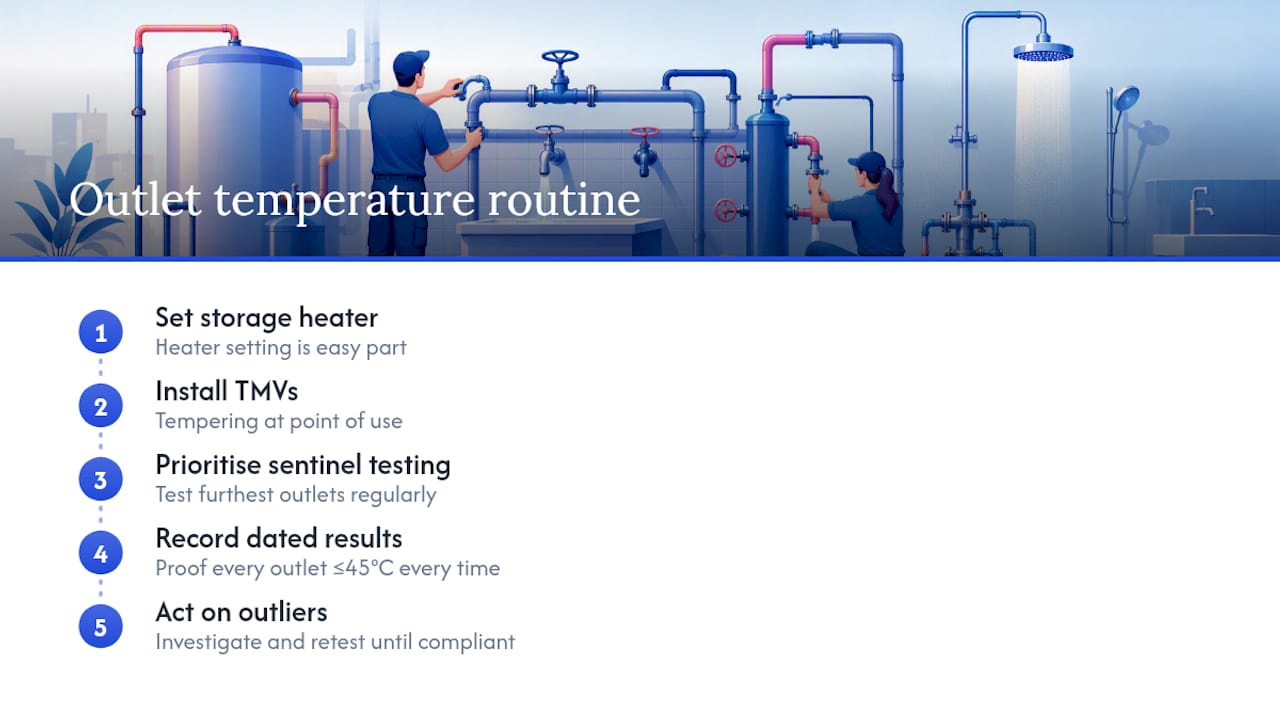
Most facility managers treat temperature compliance as a set-and-forget task: dial in the heater, install a TMV, tick the box. That's backwards. The heater setting is the easy part. The hard part is proving, with dated records, that every outlet a vulnerable resident touches is actually delivering 45°C or less, every time, not just on the day the auditor visited.
I'd also push back on the instinct to treat Legionella risk and scald risk as competing priorities you have to trade off against each other. They're not in tension if the system's designed properly. Storage stays hot, tempering happens at the point of use, and the only real risk is a facility that hasn't tested its furthest outlets recently enough to know whether that theory holds up in practice. Prioritise the sentinel testing routine before anything else. Everything else in a Water Safety Plan builds on having that data.
How Dualflow Services keeps your facility compliant, without the guesswork
Dualflow Services runs the exact sentinel checks this article describes, on-site, with dated test certificates you can hand straight to an auditor. Where a lot of facilities lose time chasing a compliance issue after the fact, we build the testing and TMV servicing into a scheduled visit so the paperwork exists before anyone asks for it.
We handle Type 3 TMV installation and commissioning, tempering valve servicing, and full outlet verification across aged care, retirement villages, disability care homes, and public buildings throughout the Mornington Peninsula and surrounding Melbourne suburbs. If your facility hasn't had its outlets tested in the last quarter, or you need a Water Safety Plan built from scratch, book an on-site compliance visit and we'll get your sentinel testing and documentation sorted before it becomes an audit finding.
Frequently asked questions
What's the difference between a tempering valve and a TMV? A tempering valve mixes hot and cold water to a set target but doesn't fail safe if the cold supply drops out. A TMV shuts off flow in that scenario, which is why Type 3 TMVs are the standard choice for aged care and disability bathing fixtures.
Can I just turn the hot water heater down to prevent scalds? No. Dropping storage temperature below 60°C to prevent scalds creates conditions where Legionella can multiply. Control delivery temperature at the outlet with a valve instead, and leave the heater set point alone.
How often should sentinel outlets be tested in a healthcare or aged care facility? Monthly sentinel checks at the nearest and furthest outlets, with a full system audit quarterly, is a workable baseline. Any fault or repair should trigger an immediate re-test before the fixture returns to use.
What records should a Water Safety Plan include? Sentinel test results, corrective actions taken, TMV serial numbers, service and calibration dates, and notes on any temporary outages. Auditors expect a simple, dated log they can cross-check against maintenance records.
Sources
- Hot water safety — BPC / AS/NZS 3500.4:2025
- Legionella prevention — Health QLD guidance
- Hot water safety — South Australia government