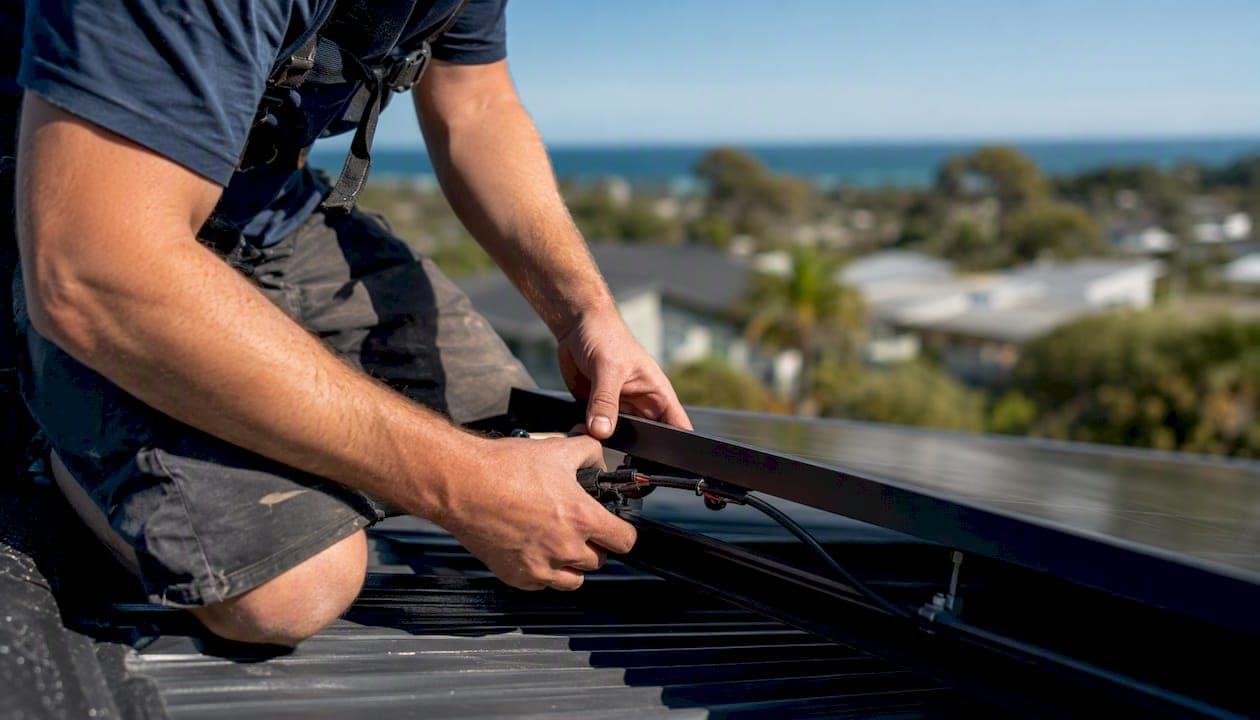
A home solar electrical system turns sunlight into usable household power by converting photons into DC electricity inside PV cells, converting that DC to AC with an inverter, and routing the result to your switchboard, battery, or the grid. The Clean Energy Regulator and the Clean Energy Council are the two Australian authorities that set the rules for how this happens safely on your roof. Dualflowservices works with homeowners and property managers across the Mornington Peninsula to install, inspect, and maintain these systems every day, so the perspective here is grounded in what actually happens on site.
This guide covers every component in the chain, how they connect, what affects real-world output, what maintenance looks like, and what Victorian compliance paperwork you should hold at handover. It applies equally to grid-tied, off-grid, and hybrid systems.
Table of Contents
- What are the main components in a home solar system?
- How do PV cells actually convert sunlight into electricity?
- What does an inverter do, and which type suits your home?
- Should you add a battery, and how does storage work?
- How does a solar system connect to your home and the grid?
- Grid-tied, off-grid or hybrid: which system suits you?
- What actually affects how much power your system produces?
- Key takeaways
- A tradesperson's honest take on what goes wrong in the field
- Useful sources and further reading
What are the main components in a home solar system?
According to the U.S. Department of Energy, a complete residential PV system consists of modules, an inverter, wiring, a meter, and safety equipment. Batteries and a charge controller are optional additions for storage or off-grid use.
Here is what each part does in the energy chain:
- PV modules (solar panels): — The panels themselves. Each module contains dozens of PV cells wired together to produce DC voltage. They sit at the start of the chain.
Installers will list BOS items on your quote. If you see line items for DC isolators, conduit, combiner boxes, or monitoring hardware, those are all BOS components. They are not optional extras — they are required for a safe, compliant installation.
How do PV cells actually convert sunlight into electricity?
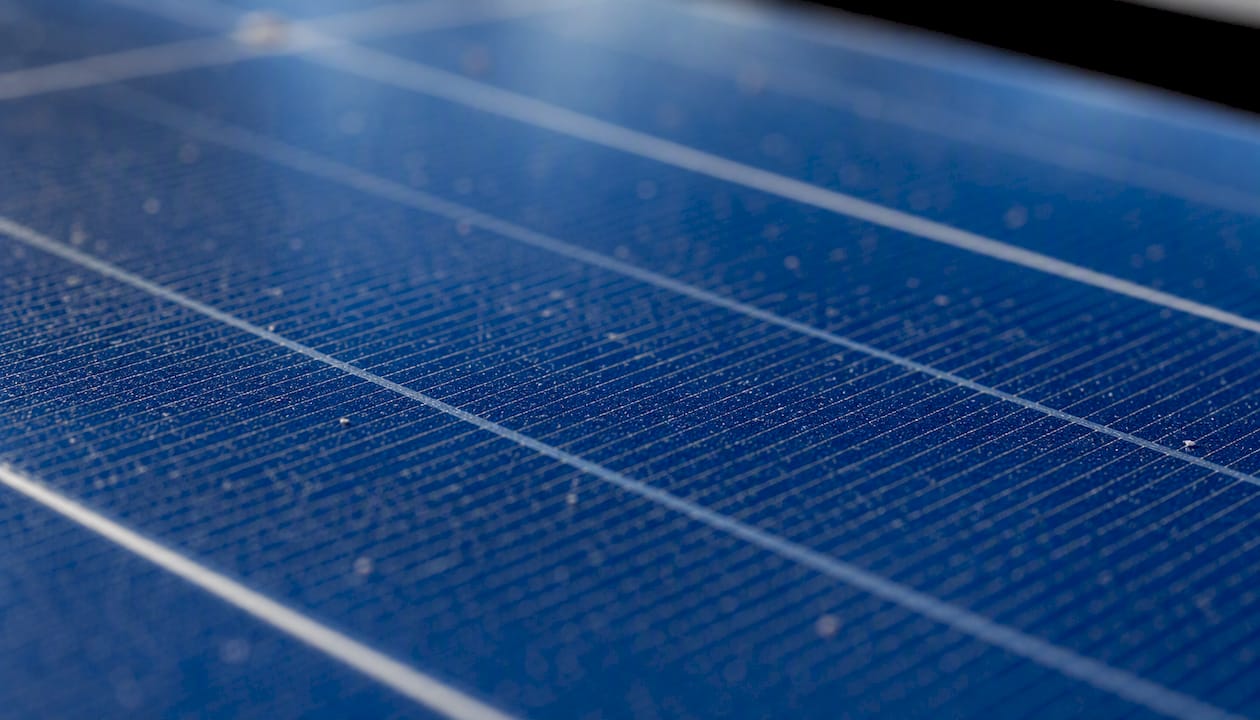
PV cells convert sunlight directly into electricity by absorbing photons that free electrons in a semiconductor material, producing a flow of direct current. That is the photovoltaic effect in one sentence.
The semiconductor at the heart of most panels is silicon. When silicon absorbs light, it transfers energy to electrons, enabling them to move and create current. A single cell produces a small voltage — typically around 0.5–0.6 volts. Cells are wired in series inside a module to raise that voltage to a usable level, and modules are wired together into an array to reach the system's total capacity.
Common PV module types
| Technology | Typical efficiency | Best use case | Durability |
|---|---|---|---|
| Monocrystalline silicon | 20% | Space-limited roofs, high-output priority | Excellent; 25+ year output warranties common |
| Polycrystalline silicon | 15% | Budget installs, larger roof areas | Good; slightly lower heat tolerance |
| Thin-film (e.g. CdTe, CIGS) | 10% | Commercial flat roofs, low-light environments | Varies; lighter but lower efficiency per m² |
Efficiency figures are measured under Standard Test Conditions (STC): 1,000 W/m² irradiance, 25°C cell temperature, and a specific air mass. Real-world output is almost always lower.
Monocrystalline panels dominate the Australian residential market because roof space is finite and the efficiency premium is worth it on a typical suburban home. Thin-film is rarely seen on residential roofs here.
On orientation: a fixed north-facing array at a tilt angle roughly equal to your latitude gives the highest annual yield in Australia. East-west split arrays are increasingly popular because they spread generation across more of the day, which can reduce grid imports during morning and evening peaks even if total daily output is slightly lower.
What does an inverter do, and which type suits your home?
The inverter is the DC-to-AC bridge. It converts the DC electricity produced by your panels into 230V AC at the correct frequency to power your appliances and synchronise with the grid. Without it, your panels produce power that nothing in your house can use.
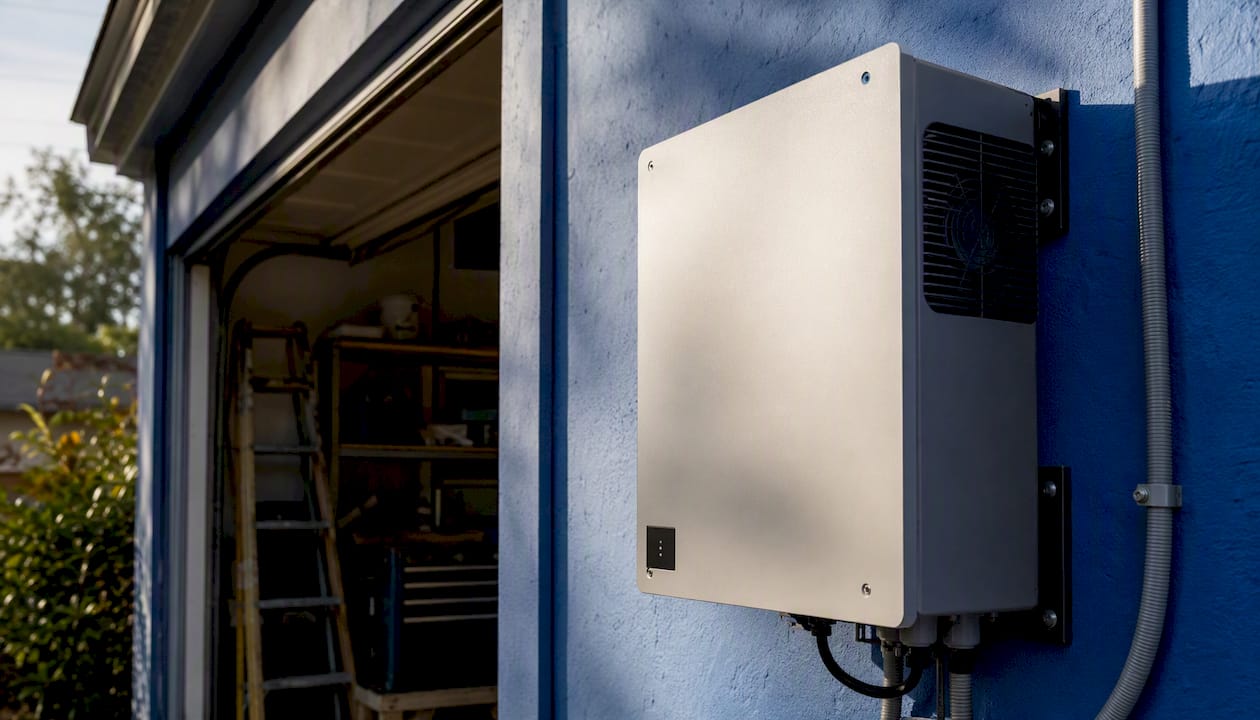
Modern inverters include MPPT (maximum power point tracking) algorithms, which continuously adjust the electrical load to extract the maximum available power from the panels as conditions change throughout the day. One MPPT tracker per string is standard; premium inverters carry two or more for split arrays.
Inverter types compared
| Type | Shading tolerance | Monitoring | Relative cost | Best for |
|---|---|---|---|---|
| String inverter | Low — one shaded panel affects the whole string | System-level | Lowest | Unshaded roofs, simple layouts |
| String inverter + power optimisers | High — per-panel MPPT | Panel-level | Moderate | Partially shaded or multi-orientation roofs |
| Microinverters | Highest — fully independent per panel | Panel-level | Higher upfront | Complex roofs, long-term monitoring priority |
| Hybrid / battery-ready inverter | Moderate to high | System + battery | Highest | Homes adding or planning battery storage |
Microinverters and power optimisers give better per-panel performance under shading or mixed orientations, though they typically increase upfront costs. For a clean, unshaded north-facing roof, a quality string inverter is hard to beat on value.
Pro Tip: Mount your inverter in a cool, shaded, well-ventilated location — a garage wall is ideal. Inverters generate heat during operation, and high ambient temperatures shorten their working life. Most inverter warranties run several years, which is shorter than panel warranties. Budget for a replacement during the system's 25-year life.
Should you add a battery, and how does storage work?
Batteries store excess DC generation (or AC via a hybrid inverter) for use after dark, during peak tariff periods, or as backup when the grid goes down. A complete residential system can include batteries and a charge controller for storage or off-grid use.
The charge controller sits between the panels and the battery bank, preventing overcharge and deep discharge — both of which shorten battery life significantly. In a hybrid inverter system, this function is built into the inverter itself.
Battery chemistry: lithium-ion vs lead-acid
Lithium-ion (LFP chemistry in most residential products) is now the default for new Australian installations. It offers higher round-trip efficiency, a smaller footprint, and no maintenance requirements beyond monitoring. Lead-acid is cheaper upfront but heavier, less efficient, and requires periodic electrolyte checks if it is a flooded type.
Batteries typically last multiple years depending on chemistry and usage patterns., and round-trip efficiency is always less than 100% — meaning some energy is lost in every charge-discharge cycle.
When does adding a battery make sense?
- You experience frequent grid outages and need backup power for essentials.
- Your retailer's feed-in tariff is low relative to your import rate, so self-consuming stored power saves more than exporting.
- You are on a time-of-use tariff with high peak rates in the evening.
- You want to move toward energy independence or are planning an off-grid system.
Net metering effectively turns the grid into virtual storage in many Australian jurisdictions. If your feed-in tariff is reasonable, the grid can do the job a battery would do — at no capital cost. Export credit policies materially change the payback case for batteries, so check your retailer's current rates before committing.
How does a solar system connect to your home and the grid?
The physical connection path runs: panels → DC isolator → inverter → AC isolator → switchboard → bi-directional meter → grid. Every step in that chain has a safety device, and every safety device must be accessible and labelled.
The inverter conditions the power to match home and grid voltage and frequency. When your panels produce more than your home is consuming, the surplus flows out through the meter to the grid and earns a feed-in credit. When generation falls short — at night or on overcast days — the grid supplies the difference automatically.
Anti-islanding is a critical safety feature. If the grid goes down, your inverter must detect the loss and shut down within milliseconds. This prevents your system from energising lines that network workers believe are de-energised. All grid-connected inverters sold in Australia must comply with AS/NZS 4777.2, which mandates anti-islanding protection.
What site works look like at installation
Your installer will mount panels and run DC cables in conduit from the roof to the inverter location. From the inverter, AC cables run to a new AC isolator and then to the switchboard, where a dedicated circuit breaker is added. The existing meter is usually swapped for a bi-directional smart meter by your network distributor — this is arranged by your installer but carried out by the distributor's metering provider.
Pro Tip: At handover, walk the full installation path with your installer. Confirm the location of the DC isolator on the roof, the AC isolator near the inverter, and the new meter. Check that rapid-shutdown signage is posted at the switchboard and that the inverter's status display shows normal operation.
Grid-tied, off-grid or hybrid: which system suits you?
A residential solar system can be configured as grid-tied, battery-backed, off-grid, or hybrid. Each has a different cost shape, resilience profile, and regulatory requirement.
| System type | Battery required | Grid backup | Onsite backup | Regulatory complexity |
|---|---|---|---|---|
| Grid-tied | No | Yes | No | Low |
| Grid-tied + battery | Yes | Yes | Partial | Low–moderate |
| Hybrid | Yes | Yes | Yes (limited) | Moderate |
| Off-grid | Yes (large bank) | No | Full | Higher; no distributor approval needed |
Which scenario fits which system?
- Rental and multi-unit properties: — Embedded network rules and metering requirements add complexity. Check with your state distributor and the Australian Energy Regulator before proceeding.
What actually affects how much power your system produces?
Manufacturer watt ratings are measured under Standard Test Conditions, which your roof will rarely replicate. Real output depends on irradiance, orientation, tilt, shading, and temperature.
Key performance factors
| Factor | Effect on output | What you can do |
|---|---|---|
| Orientation | North-facing maximises annual yield in Australia | Choose north or east-west split at design stage |
| Tilt angle | Matches latitude for peak annual yield (~30° for most of Victoria) | Fixed at installation; adjustable mounts cost more |
| Shading | Partial shading of even one cell can reduce a string's output significantly | Use microinverters or optimisers; trim trees |
| Temperature | Panels lose efficiency as cell temperature rises above 25°C | Choose panels with a low temperature coefficient |
| Soiling | Dust, bird droppings, and pollen reduce transmission | Periodic cleaning, especially after dry spells |
| Inverter sizing | An undersized inverter clips peak output; oversized adds cost | Size inverter to 100% of array DC capacity |
Panels operate less efficiently at higher temperatures, and partial cloud cover reduces output but does not stop generation. On a hot summer day in Victoria, cell temperatures can rise well above the 25°C STC reference. A panel with a temperature coefficient of -0.35%/°C loses a significant portion of its rated output at elevated temperatures.
Pro Tip: During a site visit, stand on the roof or use a sun-path app (Solar Surveyor works well in Australia) to check for shadows at 10 AM, noon, and 3 PM on the day of your visit. A shadow that looks minor in winter can cover half a string at the summer solstice.
Warranty expectations
PV module warranties commonly guarantee a minimum percentage of nameplate output after 25 years; in practice, many panels produce serviceably for 30+ years with gradual degradation. Inverter warranties are typically 5–10 years — plan for at least one replacement over the system's life. Battery warranties vary by product but commonly cover 10 years or a specified number of charge cycles, whichever comes first.
Common failure modes include inverter capacitor degradation (usually shows as intermittent faults after 8–12 years), corroded DC connectors from poor initial crimping, and micro-cracks in panels from hail or foot traffic during installation.
Pro Tip: Never attempt to work on DC wiring, isolators, or the switchboard yourself. DC circuits from solar panels cannot be switched off simply by turning off the inverter — the panels continue to produce voltage in daylight. All isolator and switchboard work must be carried out by a licensed electrician who holds the appropriate electrical licence for Victoria.
Key takeaways
A solar electrical system converts photons to DC in PV cells, inverts that DC to 230V AC, and routes power to your home, battery, or grid via a switchboard and bi-directional meter.
| Point | Details |
|---|---|
| Energy flow is linear | Sunlight → PV cell (DC) → inverter (AC) → switchboard → home, battery, or grid. |
| Inverter type matters | String inverters suit unshaded roofs; microinverters or optimisers suit shaded or complex layouts. |
| Batteries are situational | Add storage for outage resilience or high time-of-use tariffs; net metering can substitute for many households. |
| Maintenance is light but not zero | Monthly monitoring checks and a visual inspection every 6 months protect output and warranty claims. |
| Compliance paperwork is mandatory | A Certificate of Electrical Safety and grid connection approval are legal requirements in Victoria, not optional extras. |
A tradesperson's honest take on what goes wrong in the field
The most common issue Dualflowservices sees on solar jobs is not a failed panel — it is an inverter installed in a hot, unventilated roof cavity because the installer wanted a tidy cable run. Inverters generate heat. Put one in a 60°C roof space and its working life drops sharply. The second most common problem is an undersized inverter: a 5 kW inverter on a 6.6 kW array is fine (clipping is minimal and the economics work), but a 3 kW inverter on the same array wastes a significant portion of peak generation.
AC isolator placement is another recurring issue. Regulations require the isolator to be accessible, but "accessible" gets interpreted loosely. If your isolator is behind a hot water unit, above a door frame, or inside a locked meter box, an emergency responder cannot reach it quickly. Ask your installer to show you the isolator location before they finalise the cable route.
At commissioning, request a live walkthrough: watch the inverter display show real-time generation, confirm the monitoring app is connected to your account (not the installer's), and check that the feed-in tariff is active on your retailer's portal within a few weeks of the meter swap. These three checks catch 80% of post-installation disputes before they become disputes.
For property managers overseeing multiple sites, a commercial electrical servicing mindset applies here too: schedule annual inspections, keep records, and don't wait for a fault code to investigate a generation drop.
If you want a licensed electrician to inspect an existing solar installation or commission a new one on the Mornington Peninsula, Dualflowservices handles solar electrical work alongside its full range of residential and commercial electrical services.
Useful sources and further reading
The table below lists the primary references used in this guide and the Australian authorities you should consult before installation.
| Resource | What it covers | Link |
|---|---|---|
| Clean Energy Regulator | STC registration, accredited installers, scheme rules | cer.gov.au |
| energy.gov.au | Australian homeowner solar guidance, technology overview | energy.gov.au |
| U.S. Department of Energy — Solar | PV cell basics, system flow, performance and efficiency | energy.gov |
| U.S. EIA — Photovoltaics | PV effect, module warranties, electricity generation | eia.gov |
| University of Maryland Extension | Residential system components, batteries, maintenance | extension.umd.edu |
| Dualflowservices | Licensed electrical installation and inspection, Mornington Peninsula | dualflowservices.com.au |
Your local network distributor (AusNet Services, United Energy, or Powercor for most Victorian properties) sets the specific interconnection requirements and maximum export limits for your area. Check their websites directly for current technical standards before your installer submits a connection application.

This article provides general information about solar electrical systems. It is not a substitute for advice from a licensed electrician or accredited solar installer. Confirm current regulations, incentives, and technical requirements with the Clean Energy Regulator, your state distributor, or a qualified professional before proceeding with an installation.