A generator changeover switch fitted in Australia typically lands between $700 and $2,000 installed, with most homeowners paying around $1,200 all up. Manual switches sit at the cheaper end and suit anyone running a portable generator on essential circuits, while automatic transfer switches (ATS) cost more but handle whole-house switching without you lifting a finger. Where your job lands in that range depends on amperage, whether your switchboard needs upgrading, how far the cable has to run, and local permit requirements.
TL;DR:
- Most Australian generator switch installations cost between $700 and $2,000, with a typical price around $1,200, depending on amperage and job complexity.
- Longer cable runs, older switchboards lacking upgrades, and extensive wiring or permit requirements can significantly increase total costs beyond the average estimate.
- Automatic transfer switches cost more upfront, usually between $500 and $2,000 for the unit, plus $300 to $1,500 in additional labour, making them suitable for critical systems and frequent outages.
- Site conditions such as cable length over 15-20 meters, circuit count, panel condition, and difficult access influence final quotes more than the switch type itself.
- An onsite assessment and detailed, itemized quote from a licensed electrician ensures accurate pricing and helps avoid unexpected expenses.
Table of Contents
- What does a generator changeover switch cost, itemised?
- What factors push your quote higher or lower?
- Manual changeover or automatic transfer switch: which one fits?
- How long does the installation actually take?
- What permits and compliance checks apply in Australia?
- How do you choose a licensed electrician for the job?
- What do Australian installers actually see on site?
- Do changeover switches come with a warranty?
- Will you need to budget for maintenance later?
- Does location change the price?
- Why most cost guides miss the point on this job
- Get an onsite quote from Dualflow Services
- Sources
- FAQ
What does a generator changeover switch cost, itemised?
Break the quote into parts and the number stops feeling arbitrary. The switch itself is only one line item. Labour, wiring, accessories, and paperwork make up the rest, and each one moves independently depending on your property.
Unit prices scale with amperage and switching type:
- 30–60A manual switches: cheapest bracket, often the unit alone runs $150–$500
- 100–200A automatic transfer switches: the most common whole-house choice, with installed totals commonly falling between $1,000 and $3,000
- 200–400A commercial-grade units: reserved for larger homes or small businesses with heavier loads, and pricing climbs well past $2,000 once labour and switchgear are factored in
Statistic callout: the national average for a generator transfer switch installation sits around $1,200, with a typical range of $700 to $2,000. Low-end jobs can come in near $400; premium service-entrance work can push past $3,500.
Labour is usually billed by the hour, and a straightforward sub-panel job costs less than one requiring service-entrance work, simply because there are fewer hours on the clock. Accessories add their own small but real costs: an exterior inlet box for a portable generator typically runs $50 to $150, with heavy-gauge wiring adding another $100 to $350. Permits and inspection fees vary by council but usually add a modest amount rather than blowing out the budget.
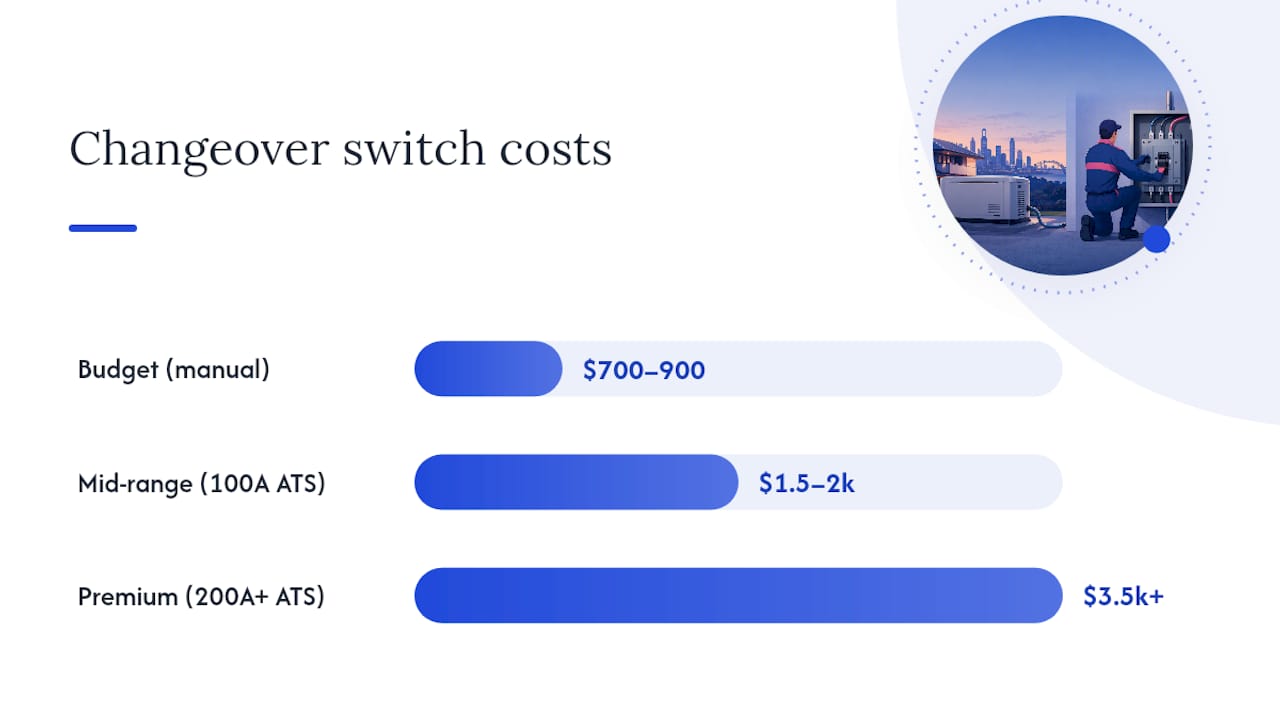
Put it together in three rough scenarios. A budget job (manual switch, short cable run, no panel issues) might land near $700–$900. A mid-range job (100A ATS, standard wiring, permit included) often sits around $1,500–$2,000. A premium job (200A+ ATS with a panel upgrade or long trenched cable run) can push toward $3,000 or beyond.
What factors push your quote higher or lower?
Before any electrician gives you a firm number, they'll want to see the site. A few things consistently separate a $900 quote from a $2,500 one.
- Cable run length: the further the generator sits from your switchboard, the more heavy-gauge copper is needed, and copper isn't cheap
- Sub-panel vs service-entrance work: sub-panel installs skip meter-side work entirely, while service-entrance jobs often need utility coordination and add real time to the job
- Circuit count: essentials-only setups (fridge, lights, a few power points) cost less than whole-house coverage
- Panel condition: an older board, missing RCDs, or corroded terminals often means extra remedial work before the switch can even go in
- Site access: switchboards buried in tight cupboards, or generators needing trenched cable and weatherproof external mounting, both add labour hours
Pro Tip: Walk your property before the electrician arrives and measure the rough distance from where your generator will sit to your switchboard. If it's more than 15 to 20 metres, mention it upfront. That single detail changes the quote more than almost anything else on the job.
Manual changeover or automatic transfer switch: which one fits?
The gap between a manual and an automatic switch isn't just convenience. It's usually $300 to $1,500 in extra labour on top of a pricier unit, since ATS units run $500–$2,000 compared with $150–$500 for manual gear. Whether that's worth paying depends entirely on how you'll use the generator.
- Choose automatic if you run essential medical equipment, live somewhere with frequent outages, or manage a property where nobody's guaranteed to be home when the power drops, including small businesses that can't afford downtime.
- Choose manual if you're running a portable generator, you're generally on site during outages, and you're happy to flick a switch yourself. It's also the most cost-efficient route when you limit coverage to 6 to 8 essential circuits rather than the whole house.
- Check compliance either way. Both switch types need correct interlocking so the generator can never backfeed into the grid, a safety requirement your installer should explain without you having to ask.
Standby generators built into a permanent installation almost always call for automatic switching. Portable units for occasional blackouts rarely need it.
How long does the installation actually take?
A typical job runs through a predictable sequence: site visit and quote, switch selection based on amperage and circuit count, isolating the existing supply, mounting the new switch, wiring it in, testing under load, then handover with paperwork.
- Sub-panel installs: usually 4 to 6 hours on site, often completed in a single visit
- Service-entrance upgrades: typically 8 to 12 hours, sometimes split across two visits if utility coordination is needed
- Permit waiting periods: can add days to weeks to the calendar, depending on your council's turnaround
- Testing and handover: your installer should test the switch under simulated outage conditions and hand you an electrical compliance certificate before they leave
Clear access to your switchboard and generator location on the day speeds things up considerably. If there's furniture, storage, or landscaping in the way, move it before the electrician arrives, as site clearance and trenching costs can significantly affect your installation price according to the guide on house demolition costs in Australia.
What permits and compliance checks apply in Australia?
Most Australian jurisdictions require an electrical permit and a follow-up inspection for this kind of work, and permits typically add a fee rather than a major cost blowout. Your licensed electrician normally lodges the permit on your behalf, not you.
- Meter or service-entrance work often needs coordination with your local network distributor, which can extend timelines
- You should receive a formal electrical compliance certificate on completion, not just a verbal "all done"
- Keep that certificate. It matters at resale time and can affect insurance claims if there's ever an electrical incident
- Rules vary by state, so check with your local council or state electrical regulator before assuming your job is straightforward
A pre-existing switchboard audit can flag compliance gaps before they turn into surprise costs mid-job.
How do you choose a licensed electrician for the job?
Not every quote is comparing the same thing, so check these before you sign anything.
- Verify the licence and insurance: ask for their electrical licence number, ABN, and confirmation of public liability cover.
- Ask about transfer switch experience specifically: general electrical experience doesn't guarantee they've done this job dozens of times.
- Request an itemised quote: labour, materials, model numbers, expected hours, and permit handling should all be listed separately, not bundled into one number.
- Confirm the compliance paperwork: always get written confirmation that a compliance certificate will be issued on completion.
- Get at least two quotes: compare them line by line rather than just looking at the bottom figure.
Red flags worth walking away from: a quote given without a site visit, vague pricing with no itemisation, no mention of permits, or a price that seems too low to cover the stated scope of work.
Pro Tip: If two quotes differ by more than a few hundred dollars for the same amperage and circuit count, ask both electricians to explain the gap in writing. Often it comes down to one quoting for a panel upgrade the other missed.
What do Australian installers actually see on site?
A straightforward sub-panel install on the Mornington Peninsula might wrap up in an afternoon. A full service-entrance upgrade on a larger home is a different job entirely, often stretching across two visits once utility coordination enters the picture.
The surprises that push costs up are rarely dramatic. Poor panel access, corroded lugs on old wiring, and missing RCDs are the recurring culprits Dualflow Services documents in site reports for switchboard work. What stays consistent regardless of scope: an onsite assessment before any number is given, an itemised quote, permit handling, and a compliance certificate at the end.
Do changeover switches come with a warranty?
Most transfer switches carry a manufacturer's warranty on the unit itself, commonly somewhere in the range of one to five years depending on the brand and switch type, separate from any labour guarantee. That unit warranty covers manufacturing defects but rarely covers wiring faults or installation errors, which is a distinction worth understanding before you assume you're fully covered.
Installation workmanship is a separate matter, and licensed electricians in Australia typically back their own labour with a workmanship guarantee, though the length and terms vary between businesses. Ask specifically what's covered: is it just the switch, or does it extend to the wiring, the inlet box, and the connection work? A reputable installer should be able to answer that question without hesitation.
It's worth getting warranty terms in writing at the time of quoting, not after the invoice is paid. Some installers bundle a service agreement alongside the warranty, offering an annual check of the switch's operation and connections for a fixed fee. That's a genuinely sensible add-on for properties running a standby generator through winter storm season, since the switch is exactly the kind of component nobody thinks about until the power goes out and it fails to engage.
If you're comparing quotes, treat warranty length and workmanship coverage as part of the price comparison, not a footnote. A slightly higher quote with a longer workmanship guarantee can work out cheaper than a discount job with no comeback if something fails in year two.
Will you need to budget for maintenance later?
A generator changeover switch is mechanically simple, which is exactly why ongoing costs stay low if the initial installation was done properly. There's no motor to service and no consumables to replace on a schedule, unlike the generator itself.
That said, a periodic function test is worth budgeting for, particularly for automatic transfer switches sitting idle between outages. A switch that hasn't engaged in eighteen months is one you don't want to discover is faulty during an actual blackout. Many electricians will fold a switch test into a broader annual electrical safety check, which keeps the incremental cost low rather than charging for a standalone callout.
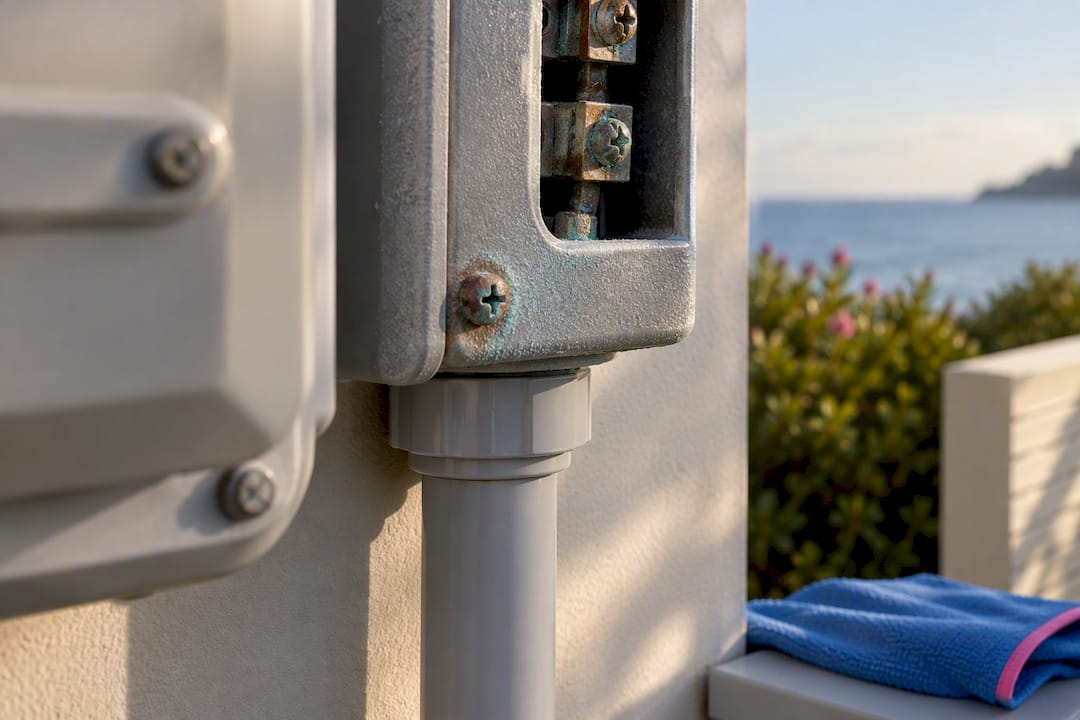
Corrosion and loose connections are the most common issues that surface over time, especially in coastal areas of the Mornington Peninsula where salt air accelerates wear on external inlet boxes and terminals. If your switch is mounted outdoors or in a garage without climate control, expect a slightly shorter service life on connectors than an indoor-mounted unit.
Budget-wise, an annual test and inspection typically costs far less than the original installation, often bundled into a standard electrical maintenance visit rather than priced separately. The bigger ongoing cost to plan for isn't the switch. It's periodic servicing of the generator itself, which is a separate expense entirely.
Does location change the price?
Where you live in Australia genuinely affects your quote, and not just because of state-based permit fees. Metropolitan areas generally have more electricians competing for the same jobs, which can keep pricing competitive, but travel time and access in dense inner-city properties sometimes add its own cost through tighter switchboard locations and stricter council requirements.
Rural and regional properties face a different set of pressures. Callout travel time adds to labour costs, and if your property sits a long way from the nearest township, that travel gets built into the quote whether you like it or not. Cable runs also tend to be longer on rural blocks, particularly if the generator sits some distance from the house or shed, which pushes wiring costs up independently of the switch itself.
Coastal properties, common across the Mornington Peninsula, sometimes need additional weatherproofing on external components, adding modestly to material costs compared with an equivalent inland install. None of these regional differences are dramatic on their own, but stacked together they can shift a quote by several hundred dollars from one postcode to the next. If a quote from a rural provider looks meaningfully higher than a metro one for a seemingly identical job, ask what's driving the gap before assuming you're being overcharged.
Why most cost guides miss the point on this job
Most online cost guides give you a number and stop there, and that number is usually roughly right. What they skip is that the real cost variable on almost every Australian job isn't the switch, it's what's hiding behind the switchboard cover. A property with a tidy, modern board and a short cable run will always land near the bottom of the range. One with a decades-old board, no RCDs, and a generator location 20 metres from the house will not, no matter how competitively an electrician prices their labour.
The conventional advice to "just get a quote" undersells how much a proper site visit matters. A quote given over the phone or from a photo is close to guesswork. The single best thing a homeowner can do before calling anyone is have a rough look at their own switchboard and measure the likely cable run themselves. It won't replace a professional assessment, but it means the first quote you get is closer to the last number you'll actually pay, rather than a figure that grows once someone opens the panel.
Prioritise the site inspection over the sales pitch. Any installer willing to quote firm numbers sight unseen is the one worth being cautious about.
— Mike
Get an onsite quote from Dualflow Services
You can choose a local service provider as an alternative to chasing multiple trades across the Mornington Peninsula for one job. Rather than juggling separate electricians, plumbers and HVAC technicians, some teams offer electrical installation, emergency call-out and compliance paperwork handled by one team familiar with the region's switchboards, council requirements and coastal wear patterns.
A typical quote for a generator changeover switch includes an onsite assessment of your existing panel and cable run, an itemised estimate broken down by labour and materials, permit lodgement where required, and an electrical compliance certificate once the job is completed. That's the full scope, laid out before any work starts, not discovered halfway through. If you're weighing up manual versus automatic, or just want a straight answer on what your specific property will cost, request an onsite quote through the Dualflow Services landing page and get a proper number rather than a guess.
Sources
- Generator Transfer Switch Cost Calculator (2026)
- Generator transfer switch installation cost guide 2026 – LatestCost
- Wholehousegeneratorcost
- How Much Does It Cost to Install a Changeover Switch? | CNC Electric
FAQ
How much does it cost to install a generator transfer switch in Australia?
Most installations cost between $700 and $2,000, with a national average around $1,200. The exact figure depends on whether you choose manual or automatic, the amperage required, and whether your switchboard needs any upgrade work first.
How much does it cost to install a changeover switch?
A manual changeover switch unit typically costs $150 to $500 before labour, while installed totals including wiring and labour generally land between $700 and $1,500 for straightforward jobs. Longer cable runs or panel issues push that figure higher.
How much should it cost to install a generator transfer switch?
For a standard 100–200A automatic transfer switch, expect an installed cost between $1,000 and $3,000. Jobs needing a service-entrance upgrade or extensive wiring can run higher, so an onsite quote from a licensed electrician gives you the most reliable number.
What is the price of a changeover switch?
The unit alone ranges from $150 to $500 for manual switches and $500 to $2,000 for automatic transfer switches. Installation labour, wiring and any permit fees are additional and typically make up more than half the total cost.